
EY-Parthenon Practice Cases: 8 Worked Due-Diligence Examples (2026)
8 EY-Parthenon practice cases with worked commercial due diligence math, buy or no-buy recommendations, and the written and group case variants EYP candidates are asked to run.
On this page
EY-Parthenon practice cases look different from generic consulting practice cases because the answer is an investment decision. The EY-Parthenon case interview guide covers the interview process, rounds, timeline and the written case; this page is where you rehearse. EY-Parthenon is EY's strategy arm, positioned around what the firm calls transformative strategy and transactions, with commercial due diligence, valuation and modelling sitting inside the same service line as corporate and commercial strategy. EY defines commercial due diligence as a detailed analysis of a target's market, customers and competitive positioning plus an assessment of growth potential and risks, and that definition is close to a case structure on its own. Published prep guides describe first-round interviews running roughly 30 to 60 minutes with a fit segment attached, two to three rounds spanning about 6 to 12 weeks, and a case mix weighted toward mergers, market entry and transaction topics.
The failure mode that separates candidates is not weak arithmetic. It is finishing a case with a diagnosis when the interviewer wanted a position. A strong EYP candidate says the market grows at 7%, the target needs 22% EBITDA growth to clear the fund's return bar, that gap is not credible organically, so no-buy at 11x and buy at 9x with a roll-up thesis attached. A weak candidate lists risks and stops.
This page gives you 8 EY-Parthenon-style practice cases with the worked math, the diligence structure that fits each one, and the drills to run when a specific step breaks. For the fit half of every interview, use the EY-Parthenon behavioral interview questions.
What should an EY-Parthenon practice case actually show?
Most published EYP examples stop at a prompt and a framework. That is not enough to practise with, because the part you get scored on is the arithmetic in the middle and the sentence at the end. A usable example carries five fields.
Work each case in that order and cover the answer until you have written your own. The structure step is the one candidates most often skip, because a diligence tree is not a profitability tree with the labels changed. If your opening branches are really cost, revenue and other, an interviewer will see it in the first 30 seconds.
Build a diligence-shaped structure and get it scored from the Road to Offer drill engine. Answer a real prompt and get AI-scored feedback. Free accounts include 5 drills per day for the first 3 days after signup.
EY-Parthenon vs MBB vs EY Consulting: what changes in the case
The three are often prepped as if they were interchangeable. They are not, and the differences are practical rather than reputational. EY-Parthenon operates as a distinct strategy brand inside EY, formed when EY acquired The Parthenon Group in 2014, and its case portfolio reflects the transaction work it sells.
Reported firm scale differs between sources, which is itself worth knowing before an interview: one guide puts EY-Parthenon at over 9,000 strategy professionals across 40 or more countries, another at roughly 10,000 across 45 or more offices in 25 countries with the global head office in London. Do not quote a precise headcount at a partner. Say the strategy arm is several thousand people globally and move to something you can defend.
What this means for your practice mix. If you have been running MBB-style profitability cases, your structure habits will mostly transfer and your endings will not. Shift roughly half your reps to prompts where a buyer is deciding something, and force yourself to name a price or a condition every single time. If you are coming from EY's broader consulting track, the gap is the opposite: your implementation instincts are strong and the multiple arithmetic is the part to build. The M&A case framework is the closest structural reference to what EY-Parthenon actually asks.
The four question types inside an EY-Parthenon due diligence case
Commercial due diligence is not one question. It is four, asked in sequence, and each one is scored on its own. EY's own description of the service names market attractiveness, competitive positioning, growth potential and risk, which maps cleanly onto how the case unfolds.
1. Is the market attractive? Size, growth rate, structure and margin pool. The interviewer is testing whether you can distinguish a big market from a good one. A $4B market growing at 7% with five consolidating players is a different investment from a $4B market growing at 7% with 400 fragmented operators, and the second is usually the one a private equity buyer wants because it supports a roll-up.
2. Can the target hold or gain its position? Share trajectory, customer stickiness, channel dependence, switching costs. This is where you ask for the customer cohort data rather than another market chart. A target growing at 30% because it is buying growth with paid acquisition is a different asset from one growing at 15% on retention.
3. Do the economics support the price? Entry multiple, the growth and margin path implied by that multiple, and the exit assumption. This is the block most candidates under-serve. If you never touch the asking price, you have written a market study, not a diligence.
4. What would change your answer? The two or three findings that would flip you. Naming them is what makes the recommendation credible rather than confident.
Run those four as your default branches. Then request evidence in that order, because the first block is the cheapest to test and the fastest to kill a deal. If the market is shrinking, you do not need the cohort analysis.
The transfer test is whether you can hold that spine while a live interviewer pushes back on it. Reading the structure is not the same as producing it under time pressure.
 Bain
BainM&A · medium
Run a live acquisition case out loud
Not an official EY-Parthenon case, but the same skill: justify the multiple, quantify the synergies, and commit to a buy or no-buy with a number attached.
The diligence math EY-Parthenon expects you to run in your head
Transaction math is the single highest-leverage thing to drill for EYP, and it is a small, closed set. Four families cover nearly everything you will be asked.
Three approximations are worth memorising because they save you 30 seconds each and let you keep talking while you compute. Doubling over five years is about 15% a year. Tripling over five years is about 25% a year. And a money multiple of 1.6x over five years is about 9% a year, which matters because 1.6x feels like a decent outcome and is well below what a private equity buyer underwrites.
The reverse direction gets asked more often than the forward one. Given an entry price, an exit multiple and a target return, what growth does the asset have to deliver? That is the question that turns a case from a description into a decision, and it is worth repping until the arithmetic is automatic.
Rep the multi-step math a diligence case runs on from the Road to Offer drill engine. Answer a real prompt and get AI-scored feedback. Free accounts include 5 drills per day for the first 3 days after signup.
If the arithmetic itself is the bottleneck rather than the setup, work through case interview math practice first and come back to the examples. If the numbers are fine but you lose the thread while speaking, that is a synthesis problem, not a math problem, and the fix is different.
The written case and the group case: two EY-Parthenon variants to rehearse
Neither exercise is universal. Both appear in candidate reports and published guides, concentrated in European offices and at the assessment centre stage, so treat them as formats to confirm on your invitation rather than defaults to assume.
The written case. You receive a document pack, you get a fixed window to work it, and you produce a small deck with a recommendation. The scoring is prioritisation, not coverage. With a pack of exhibits and a short clock, reading everything is a losing strategy. Decide first which two or three questions the recommendation depends on, then read only for those, then build the deck backwards from the answer slide.
A working sequence, timed on a two-hour pack:
- Ten minutes reading only the question and the contents page. Write the decision sentence you expect to make before you read a single exhibit.
- Twenty minutes triaging the pack into must-read, might-need and ignore. Most packs have three or four decisive exhibits and a long tail of context.
- Fifty minutes on analysis, keeping every number in a single running sheet so the deck build does not become a hunt.
- Thirty minutes building three to five slides, answer first, evidence second, risk last.
- Ten minutes rehearsing the two-minute verbal version, because that is what you deliver before the interviewer starts pushing.
Exhibit triage is trainable on its own. Work reading charts and exhibits and then rep it under a clock, because the skill only shows up when the clock is running.
The group case. Reported format is 3 to 5 candidates, roughly 60 minutes, a shared handout, and a 10 to 15 minute group presentation, with interviewers observing rather than participating. The scoring trap is obvious once named: candidates optimise for airtime, and airtime is not what is being scored. Contribution quality, whether you moved the group forward, and whether you made someone else's point better are what the observers are writing down. One guide suggests aiming for roughly a quarter to a third of the total contribution rather than dominating.
Three moves that consistently read well: take the timekeeping job early because nobody wants it and everyone benefits, restate the question out loud when the group drifts, and hand a piece of analysis to the quietest person with a specific ask rather than a general invitation.
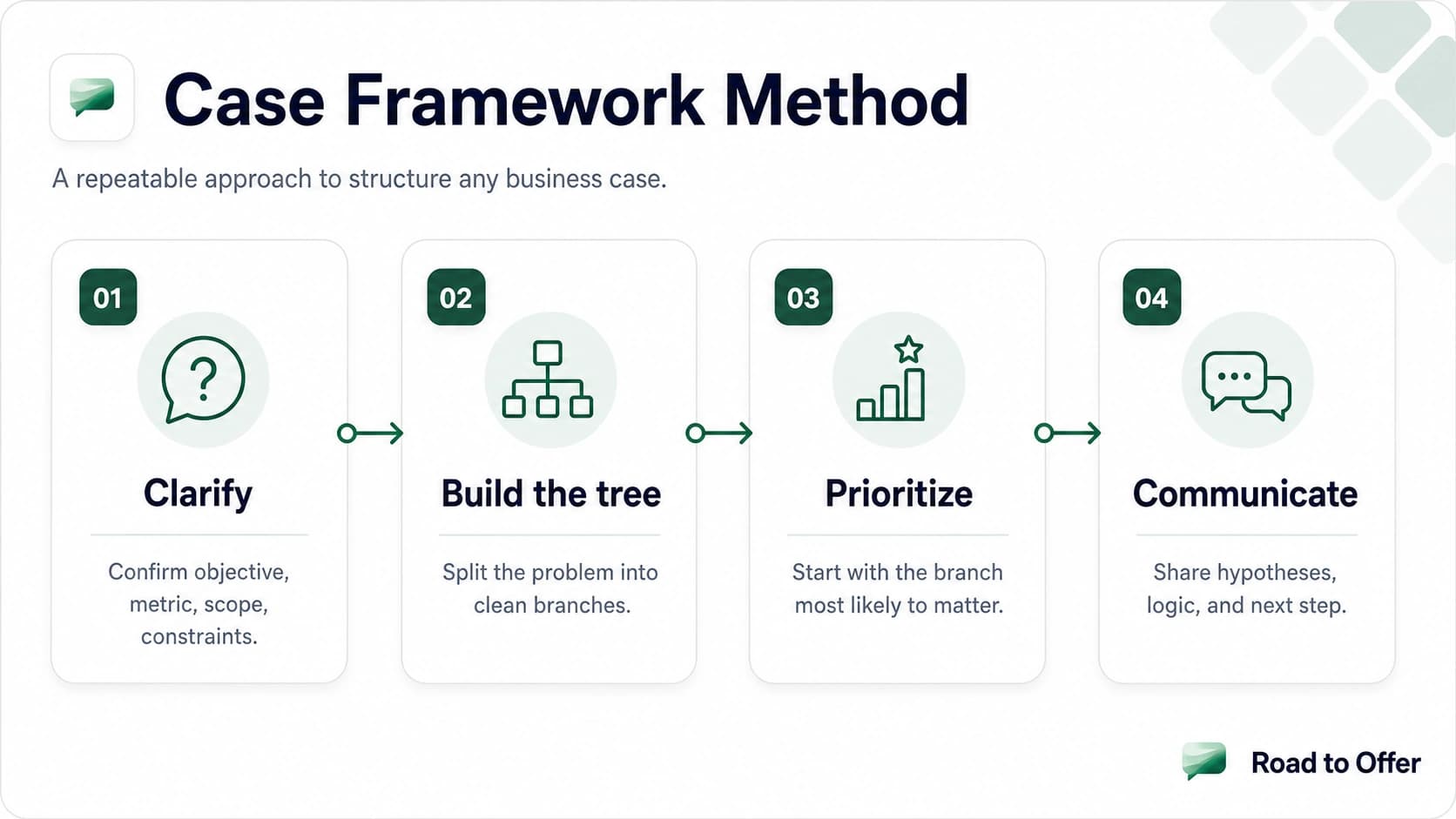
Learn the case method
One dense lesson, each step linked to the drill that trains it.
8 worked EY-Parthenon-style practice cases
These are original scenarios written to match the archetypes EY-Parthenon is known for. They are not official EY-Parthenon material. Cover the worked section, produce your own structure and numbers, then compare.
Case 1: Buy-side commercial due diligence, sports nutrition brand
Prompt. A mid-market private equity fund is considering acquiring a sports nutrition brand doing $180M in revenue at an 18% EBITDA margin. The seller wants 11 times EBITDA. The fund underwrites to a money multiple of at least 2.5x over five years. Should they buy?
The evidence you should ask for, in order. Market size and growth. The target's share and share trend. Channel mix, because a brand that is 70% one retailer is a different asset. Gross margin by channel. Then the exit comparables.
What the exhibits show. The US sports nutrition market is $4.2B growing at 7% a year, fragmented, with the top five players holding under 30%. The target holds 4.3% share, flat for three years. Direct-to-consumer is 22% of revenue at a 61% gross margin against 38% in retail.
Worked math.
- Entry. EBITDA is $180M multiplied by 18%, which is $32.4M. At 11 times, the ask is about $356M.
- Base case exit. Assume revenue compounds at 9%, above the market because of the direct-to-consumer mix shift. Over five years that is $180M times 1.54, or roughly $277M. Assume margin improves to 20%, giving $55M of EBITDA. Exit at 10 times gives $554M.
- Return. $554M divided by $356M is about 1.6 times over five years, which is roughly a 9% annual return. That is far below the 2.5x bar.
- Reverse the question. To reach 2.5x on a $356M entry, exit enterprise value has to be about $890M. At a 10 times exit that requires $89M of EBITDA, which from $32.4M is roughly 22% compound growth for five years, in a market growing at 7%.
The close. No-buy at 11 times. The price implies triple the market growth rate for five years with no evident share mechanism. The deal becomes interesting at around 8 to 9 times, or at 11 times only if diligence proves a specific roll-up pipeline that converts market growth into acquired growth. The finding that would flip the answer is a defensible direct-to-consumer subscription base with retention above 12 months, because that changes both the growth rate and the exit multiple.
This is the archetype to over-practise. If your version of this case ended with "the market is attractive but there are risks", the structure was fine and the ending was not. Rebuild the tree with the M&A case framework and force a price into your final sentence.
Case 2: Growth under a price cap, correctional communications
Prompt. A provider of phone and messaging services to correctional facilities serves 400 facilities and about 300,000 inmates, generating $220M in revenue. A regulator has cut the maximum call rate from $0.21 per minute to $0.06 per minute, effective in nine months. The private equity owner wants to know whether the asset can still grow.
Why this is an EYP-shaped case. It is a regulated, captive-demand market where the growth question is not "how do we sell more" but "what else can we sell to a customer base we already have exclusive access to". Market attractiveness and target position have to be assessed against a rule change rather than a competitor.
Worked math.
- Call revenue today is about $180M of the $220M. At $0.21 per minute that implies roughly 857 million minutes a year.
- At $0.06 per minute with flat volume, that $180M becomes $51M. Even if volume doubles to 1.7 billion minutes because calls become affordable, revenue is about $103M. The gap is roughly $77M.
- Replacing it from non-call products means new revenue per inmate per month of $77M divided by 300,000 inmates divided by 12, which is about $21 a month.
- Test whether $21 is reachable. Tablet rental at $2.50 a month gives $9M a year. Messaging and media at $6 a month gives $21.6M. Together that is under half the gap, so the answer depends on higher-value products such as education and telehealth, and on facility contracts that permit them.
The close. Conditional. The asset can grow only if contract terms are renegotiated to allow non-call services, and the diligence priority is the contract base, not the market model. Ask for the distribution of contract renewal dates and the share of contracts that already permit tablet revenue. If under half do, the growth case is a policy bet rather than an operating plan.
 Bain
BainM&A · medium
Run a live acquisition decision case
Same skill as Cases 1 and 2, framed on a different asset: size the opportunity, price the risk, and finish with a buy or no-buy you are willing to defend.
Case 3: Market sizing, robotic lawnmowers in Germany
Prompt. A European garden equipment manufacturer is evaluating whether to expand its robotic mower line. How large is the annual German market for robotic lawnmowers in units and value?
Why sizing shows up here. Market attractiveness is block one of a diligence, and interviewers frequently open with the sizing before the strategy question because your number sets up every answer that follows. A €225M market and a €900M market lead to different recommendations from identical qualitative analysis.
Worked approach, top down.
- German households: about 41.5 million.
- Households with a private lawn: detached and semi-detached housing is roughly 35% of stock, giving about 14.5 million.
- Lawns large and regular enough for a robot, say half of those: about 7.3 million addressable households.
- Current penetration of robotic mowers among that group: assume 10%, giving an installed base of about 730,000.
- Replacement demand: a seven-year life on 730,000 units is about 104,000 units a year.
- New adoption: penetration rising by two points a year on 7.3 million households adds about 146,000 units a year.
- Total annual units: about 250,000. At an average selling price of €900, the market is roughly €225M a year.
Sanity check. State your check out loud. 250,000 units against 14.5 million lawn households means roughly one household in 58 buys a robotic mower each year. That is plausible for a category at 10% penetration and would not be for one at 60%.
The connection back to the case. A €225M market growing through penetration rather than price is attractive for a manufacturer with existing distribution and unattractive for a new entrant that has to build it. Say which of the two you are advising before you give the number.
Size a market the way a diligence opener demands from the Road to Offer drill engine. Answer a real prompt and get AI-scored feedback. Free accounts include 5 drills per day for the first 3 days after signup.
For the driver-chain method behind that estimate, see market sizing step by step. If your assumptions keep getting challenged rather than your arithmetic, that is the page to work.
Case 4: Operations, bus rapid transit unit economics
Prompt. A city transit authority operates 320 buses across 18 routes at a cost of €5.40 per revenue kilometre. The authority has committed to €4.60 within three years without cutting service. Annual revenue kilometres are 28 million. Where does the €0.80 come from?
Structure. Decompose cost per revenue kilometre into its stack, then attack the largest line with the most controllable driver. Do not open with a generic cost reduction tree.
What the cost stack shows. Drivers 52%, energy 18%, maintenance 16%, overhead 14%. In per-kilometre terms that is €2.81, €0.97, €0.86 and €0.76.
Worked math.
- The total gap is €0.80 multiplied by 28 million kilometres, or €22.4M a year.
- Driver productivity. Paid hours include 22% non-revenue time from deadheading and layovers. Cutting that to 14% through route interlining and depot placement removes about 8% of driver cost, which is €0.22 per kilometre, or €6.3M.
- Maintenance. Unscheduled failures consume 38% of maintenance hours. Moving to condition-based maintenance to reach 25% saves roughly €0.11 per kilometre, or €3.1M.
- Energy. Electrification cuts energy cost per kilometre from €0.97 to about €0.55 on the routes it fits, worth up to €0.42 per kilometre, or €11.8M at full fleet conversion, against significant capital expenditure and depot upgrades.
- Those three add to about €21.2M, close to the €22.4M target, with the last stretch coming from overhead.
The close. The target is reachable but the composition matters more than the total: two thirds of the saving sits in electrification, which is a capital decision with a payback period, not an operating efficiency programme. Recommend phasing electrification on the six highest-kilometre routes first, where the energy saving per euro of capital is largest, and treating driver productivity as the near-term self-funding lever.
Case 5: Education sector, buy or build a tutoring platform
Prompt. An education group with $600M of revenue is deciding whether to acquire a digital tutoring platform or build one. The target does $48M in revenue at a 62% gross margin, is losing $4M at the EBITDA line, is growing 34% a year, and is asking 6 times revenue. Building internally is estimated at $55M over three years reaching $30M of revenue by year three.
Why this belongs on an EYP list. Education is one of the sectors where EY-Parthenon has a named practice, and buy-or-build framed against a specific price is a transaction question rather than a strategy question.
Worked math.
- The ask is 6 times $48M, or $288M.
- Build costs $55M and reaches $30M of revenue by year three. Buying costs $288M and delivers $48M today with 120,000 existing subscribers. The premium is therefore roughly $233M for about 24 months of time and an installed customer base.
- Test the growth quality, which is the real diligence question. Customer acquisition cost is $180. Average revenue per user is $58 a month with a nine-month average life, so lifetime revenue is $522 and lifetime gross profit is about $324. That is a ratio of 1.8 to 1 against acquisition cost.
- A ratio of 1.8 does not pay for the platform's fixed costs after acquisition spend, which is why the target is losing money while growing at 34%. The growth is bought, not compounding.
The close. Conditional. At 6 times revenue you are paying a compounding-asset multiple for a paid-acquisition business. Recommend 3.5 to 4 times revenue with an earn-out tied to twelve-month retention, and make retention cohort data a condition of proceeding. If retention above twelve months exceeds 40% in the most recent cohorts, the original multiple becomes defensible and the answer changes.
Case 6: Roll-up attractiveness, veterinary clinics
Prompt. A private equity fund owns a platform of 62 veterinary clinics and wants to reach 200 within four years. Is the roll-up still attractive?
Structure. For a roll-up, the three branches are market headroom, multiple arbitrage, and integration capacity. Headroom without arbitrage is a low-return business, and arbitrage without capacity is a plan.
Worked math.
- Headroom. The US veterinary services market is roughly $37B growing 6 to 7% a year, across about 28,000 practices, with corporate ownership at 25 to 30%. There are thousands of independent targets, so headroom is not the binding constraint.
- Arbitrage. Single clinics acquire at about 7 times EBITDA; platforms of this scale trade at about 13 times. Adding 138 clinics at an average of $850,000 of EBITDA each adds roughly $117M of EBITDA. A 6 turn spread on that is about $700M of value created by the arbitrage alone.
- Compression risk. If competition pushes acquisition multiples from 7 to 9.5 times, the spread falls to 3.5 turns and the arbitrage value drops to about $410M. That is the sensitivity to run before recommending.
- The kill test. Same-store revenue growth is 4% while price increases are 8%, which means visit volume is falling. A roll-up built on multiple arbitrage over a shrinking-volume base is a timing bet on the exit window.
The close. Attractive but time-boxed. Recommend accelerating the acquisition pace in the next 18 months while entry multiples are below 8 times, capping the price discipline at 8.5 times, and making same-store visit volume the tracked metric that triggers a pause. Name the labour constraint explicitly, because clinics that cannot staff a veterinarian shift do not deliver the modelled EBITDA regardless of price.
 BCG
BCGM&A · medium
Run a live healthcare acquisition case
Same skill as Case 6: screen the roll-up logic, work the deal math, and defend the thesis under pushback.
Case 7: Portfolio value creation, industrial coatings margin recovery
Prompt. A portfolio company making industrial coatings has $310M of revenue and has seen EBITDA margin fall from 15% to 11% over two years. Volume grew 6%, price rose 2%, and raw material costs rose 19%. The fund wants two of the four points back before exit.
Worked math, as a bridge.
- EBITDA fell from $46.5M to about $34.1M, a drop of roughly $12.4M.
- Raw materials were about 44% of revenue at the start, or about $136M. A 19% increase costs about $26M.
- Price recovered 2% on $310M, worth about $6M.
- Volume growth of 6% contributed roughly $8M of additional contribution.
- Those three net to about minus $12M, which reconciles with the observed EBITDA decline. State that reconciliation out loud, because a bridge that does not add up is worse than no bridge.
The mechanism. The problem is not that inputs rose, it is that contracts reprice annually while inputs move quarterly. The company is structurally absorbing three quarters of every input move.
The close. Recommend index-linked repricing clauses with quarterly triggers on the top 40 accounts, which represent about 68% of revenue. Recovering three of the four lost points is worth about $9.3M of EBITDA, which at a 10 times exit multiple is roughly $93M of enterprise value, against a commercial renegotiation cost that is a rounding error next to that. Flag the risk plainly: repricing clauses invite volume loss, so pilot on the accounts with the highest switching costs first.
If margin bridges are the part that slows you down, rebuild the mechanics with the profitability framework and rep the arithmetic before the next case.
Case 8: Sell-side diligence, preparing an equipment rental business for exit
Prompt. A fund is preparing to sell an equipment rental business with $140M of revenue and $38M of reported EBITDA. Buyers are indicating around 8 times. What should the seller do before going to market?
Why sell-side belongs in your prep. Commercial due diligence runs in both directions, and sell-side questions are a fast way for an interviewer to see whether you understand what a buyer will do to your numbers.
Worked math.
- Headline value is 8 times $38M, or $304M.
- A buyer will normalise EBITDA. Reported EBITDA includes $3.2M of gains on equipment disposals, which are not recurring operating profit. Adjusted EBITDA is therefore about $34.8M.
- A buyer will also price the deferred capital expenditure. Average fleet age is 6.2 years against an industry norm of about 4.5. On roughly 1,900 units with an estimated $19,000 of underspend each, that is about $36M of catch-up investment, which comes off enterprise value.
- At 8 times adjusted EBITDA the value is about $278M, and the capital expenditure adjustment reduces the seller's proceeds further. The gap between the headline number and the number a buyer will actually pay is significant.
The close. Recommend three actions before the process opens. Run the normalisation yourself and present a clean bridge, because a seller who surfaces the adjustment controls the narrative while a buyer who discovers it re-prices the whole deal. Invest ahead of the sale in the fleet categories with the shortest payback so the age profile improves on paper and in economics. And reduce customer concentration, because a top five representing 41% of revenue is the single largest discount a buyer will apply.
Self-diagnostic: are you casing like a diligence analyst?
Work through the eight cases, then answer these honestly. Each failure maps to a specific rep rather than to "do more cases".
- Did every case end with a price, a multiple or a condition? If any ended with a summary of findings, the gap is commitment, not analysis. Rehearse the closing sentence separately, out loud, before you touch the next case.
- Could you reverse the return question? Given a price, an exit multiple and a target return, could you state the growth the asset must deliver? If not, that is the single calculation to drill until it is automatic.
- Did your structure open on market, target and deal, or on revenue and cost? A profitability tree on a diligence prompt is the most common tell that a candidate has prepped generically.
- Did your bridges reconcile? If your price, volume and cost effects did not add back to the observed EBITDA change, you produced three plausible numbers and no argument.
- Did you name what would change your mind? Two specific findings, not a generic risk list.
The item that is hardest to self-grade is the last one, because a recommendation always sounds better in your own head than it does to a listener. Get one scored rather than guessing.
Deliver a recommendation and get it scored from the Road to Offer drill engine. Answer a real prompt and get AI-scored feedback. Free accounts include 5 drills per day for the first 3 days after signup.
EY-Parthenon's own resources and where they help
Official material is thin on interview cases and rich on the work itself, which is more useful than it sounds. Reading how the firm describes its own engagements tells you what a good answer sounds like.
- The EY-Parthenon strategy overview sets out the service line: corporate and growth strategy, commercial strategy, mergers and acquisitions advisory, divestment strategy, due diligence, and valuation and modelling. If your "why EY-Parthenon" answer does not reference the transaction half of that list, it is generic. Read it at ey.com/en_us/services/strategy/parthenon.
- The commercial due diligence service page is the closest thing to an official case structure. EY describes the work as analysis of a target's market, customers and competitive positioning plus growth potential and risks, drawing on proprietary primary research. That sentence is a defensible opening structure. It sits at ey.com/en_us/services/strategy-transactions/mergers-acquisitions-due-diligence.
- Published client stories give you concrete engagement language for the fit conversation, including a hospital cloud transformation and a supply chain optimisation programme, both published in 2025 on ey.com.
- The EY assessment stage sits ahead of the case for many applicants. Cover it with the EY assessment test guide before you spend a week on cases you may not reach.
- Your application materials decide whether any of this matters. Run your CV through the consulting resume grader and shape the motivation paragraph with the EY cover letter guide. If you are weighing the offer against alternatives, the EY consulting salary breakdown covers the compensation side.
Once you have read the firm's own language, the constraint stops being material and becomes reps. Browse the case library for acquisition, market entry and growth prompts and run them with the diligence spine rather than a generic framework.
How to use these EY-Parthenon practice cases
Do not run all eight in a weekend. Two well-worked cases with a real self-review beat six skimmed ones, and the review is where the learning is.
Execution checklist
Run each case prompt-first with the answer covered. Write your own structure, evidence request and number before reading the worked version, then diff the two
Force a price or a condition into every closing sentence. The commitment habit is what separates EYP-ready candidates; rehearse the close out loud with a free graded case
Drill the reverse return calculation until it is automatic. Given entry price, exit multiple and target return, name the required growth; build the speed with case interview math practice
Rebuild your opening tree as market, target and deal. A profitability tree on a diligence prompt is the fastest way to look generically prepped; work issue trees if the branches keep overlapping
Time-box one written case with a real document pack. Prioritisation is the scored skill, so decide which two questions the recommendation depends on before reading any exhibit, and build the deck backwards from the answer slide
Rehearse a group case with three other candidates. Take the timekeeper role and aim for a share of contribution rather than dominance; the observers score whether you moved the group forward
Prepare the fit half in the same week, not after. Every EYP interview carries a behavioral segment; build the stories with the EY-Parthenon behavioral questions guide
Then wire each weakness to one rep rather than to another full case:
- Structure came out as a template: run free structure drills until the tree is hypothesis-led.
- The sizing wobbled: work the market sizing method, then rep it on free sizing drills.
- The arithmetic slipped: use the math drill tool.
- Exhibits took too long: work reading charts and exhibits.
- The close rambled: tighten it with the synthesis guide.
- Entry strategy cases feel unfamiliar: the market entry framework covers the branch most diligence cases borrow.
For worked examples across other firm formats, see case interview examples. For the EY-Parthenon process itself, rounds, timing and what to confirm with your recruiter, the EY-Parthenon case interview guide is the companion page to this one.
If your application is not in yet, the EY-Parthenon resume guide covers what the screen reads before you ever see a case.
Sources and Further Reading (checked July 31, 2026)
- EY-Parthenon strategy and transactions service overview: ey.com/en_us/services/strategy/parthenon
- EY commercial and mergers and acquisitions due diligence service description: ey.com/en_us/services/strategy-transactions/mergers-acquisitions-due-diligence
- EY client story, Medtronic supply chain optimisation (June 2025): ey.com/en_us/insights/consulting/how-medtronic-optimized-supply-chain-gets-products-to-patients-in-need
- EY client story, St James's Hospital cloud transformation (June 2025): ey.com/en_us/alliances/how-st-james-hospital-journey-to-cloud-transformed-cancer-care
- CaseStar EY-Parthenon interview guide, round structure, group case format and reported difficulty: casestar.io/guides/ey-parthenon
- Case Prep EY-Parthenon guide, round timing, written case prevalence and case archetype mix: case-prep.com/firms/ey-parthenon
- CaseXcel EY-Parthenon prep, commercial due diligence block structure: casexcel.com/ey-parthenon-case-interview
Talk through an acquisition decision out loud
A live AI-graded case in the diligence mould: you open the structure, call for the evidence, run the multiple math, and get scored on whether your recommendation actually commits.
Frequently asked questions
Resources and related guides
- Run a real case interviewPractice
- Browse all free resourcesResource hub
- Accenture Case Interview Examples: 10 Practice Cases and the Official Workbook (2026)Firm Specific · Jul 31, 2026
- BCG Case Interview Examples: 10 Practice Cases (2026)Firm Specific · Mar 1, 2026
- Práctica de entrevistas de casos BCG: 10 ejemplos y qué esperarFirm Specific · Mar 1, 2026
- PwC and Strategy& Practice Cases: 8 Worked Examples (2026)Firm Specific · Jul 31, 2026