
Consulting Firms in Singapore 2026: MBB, Big 4, and the SEA Hub
Consulting firms in Singapore in 2026: MBB regional hubs, Big 4 strategy arms, and Tier 2 players, with an SGD salary guide and free case practice.
On this page
Consulting firms in Singapore in 2026 sit at the center of Southeast Asia's consulting market: the city is the regional headquarters for all three MBB firms, the Big 4, and most Tier 2 strategy players. McKinsey entered Singapore in 1998 and now runs more than 250 consultants from 21 national backgrounds out of One Raffles Quay, anchoring its regional teams across Southeast Asia (Source: Consultancy.asia, https://www.consultancy.asia/news/3215/the-top-consulting-firms-in-singapore-for-graduates). BCG has been in the market since 1995 and fields roughly 170 consultants from Raffles Place, while Bain, the first MBB firm on the island (1993), runs 300-plus consultants across the region. Singapore's own scale reinforces the pull: a 6.11 million population as of June 2025 (Source: Singstat) makes it a compact but high-income base for regional strategy work. This guide covers who is here, what they pay in SGD, and how to prepare.
If you are deciding between markets, compare this with the sister guides on consulting firms in India, consulting firms in the UK, and consulting firms in Dubai. For the global picture, see the top consulting firms ranking. Or run a real case the way these firms do.
Which consulting firms have offices in Singapore?
Singapore is the ASEAN hub for the global firms, not a satellite market. Because most regional leadership sits here, the office roster maps closely to the global firm tiers: MBB at the top, Big 4 strategy arms next, then sector-focused Tier 2 hubs.
Sources: Consultancy.asia, Roland Berger (https://www.rolandberger.com/en/SoutheastAsia/), Kearney (https://www.kearney.com/about/locations/southeast-asia), and firm office pages, accessed July 2026.
The practical takeaway: a Singapore-based consultant rarely works one national market. Engagements span Indonesia, Vietnam, Thailand, Malaysia, and the Philippines, so firms weight regional adaptability heavily in hiring. For the firm-by-firm strategy differences, see what is MBB consulting and the Big 4 consulting firms guide.
Which firms do Singapore graduates target most?
Prestige and headcount are not the same thing, and Singapore is the clearest example. In graduate-employer surveys the Big 4 rank highest on reach because they hire the largest classes, while MBB stays the hardest seat to win. Roughly 16,000 graduates emerge each year from Singapore's 30-plus universities, so the funnel is competitive at every firm.
Source: Consultancy.asia, top consulting firms in Singapore for graduates, https://www.consultancy.asia/news/3215/the-top-consulting-firms-in-singapore-for-graduates (accessed July 24, 2026).
The recruiting read: the Big 4 give you the widest set of shots and the largest intake, MBB gives you the steepest bar and the strongest exit options, and both screen every candidate through the same case-and-fit gate covered below. Undergraduate hiring concentrates on NUS, NTU, and SMU, while post-graduate classes pull from INSEAD's Asia campus and returning overseas graduates. If the gate itself is still fuzzy, learn how a case is actually run before you start filing applications.
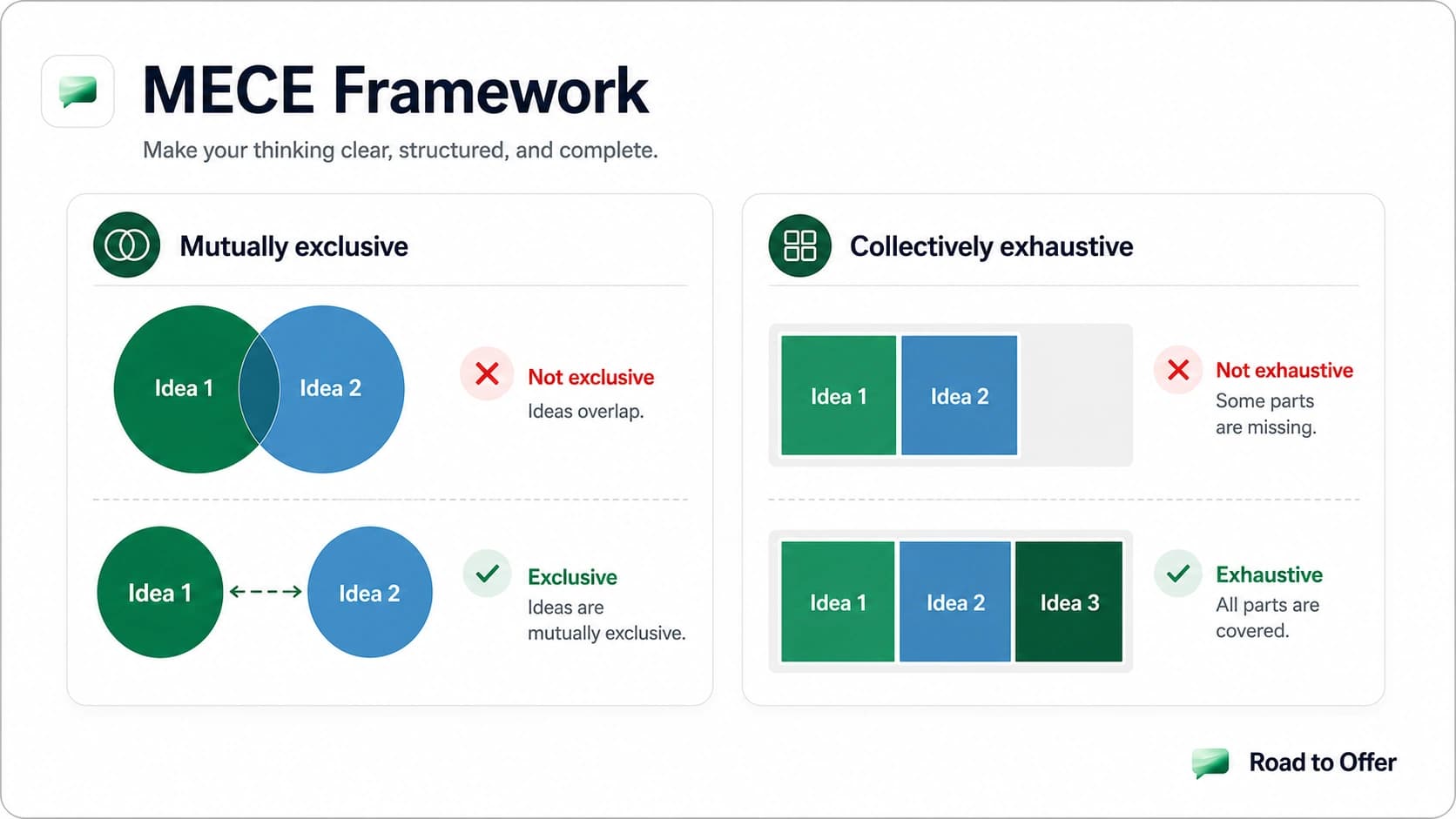
Learn frameworks properly
Pick and adapt structures instead of memorizing buckets.
What do consultants earn in Singapore?
Compensation in Singapore is quoted in SGD and varies widely by firm and level. Numbers below are hedged ranges from public reports, not offer letters. Glassdoor figures for Singapore are typically monthly, so annualized totals draw on Levels.fyi package data instead.
Public reports suggest these ranges. Sources: Levels.fyi McKinsey Singapore (https://www.levels.fyi/companies/mckinsey/salaries/management-consultant/locations/singapore) and BCG Singapore, plus Glassdoor Singapore, accessed July 2026. Treat as directional.
Two caveats. First, MBB compensation is a total package: base plus signing plus a performance bonus, so a single "salary" number understates it. Second, undergraduate and post-MBA tracks are different pay bands; a business analyst and a post-MBA associate are not the same level despite overlapping titles. For a broader benchmark, the McKinsey salary breakdown covers global bands by tenure and the consulting salary by city guide lines Singapore up against London, NYC, and Dubai.
Practice the profitability case that decides these offers
Every band in this table sits behind the same gate. Run a McKinsey, BCG, or Bain-style profitability case and get instant AI feedback on structure, math, and recommendation.
Can a foreign candidate actually get hired in Singapore?
This is the question the firm-listicles skip, and it decides whether an application is worth filing. Consulting roles for non-Singaporeans run on the Employment Pass, and since 2023 every new application is scored by COMPASS, the Ministry of Manpower's points framework. Two gates matter.
Source: Ministry of Manpower, Employment Pass eligibility (accessed July 24, 2026).
Read it the way a recruiter does. MBB and Big 4 salary bands clear the qualifying floor comfortably at consultant level, and the global firms score well on the qualifications and diversity criteria, so sponsorship is normal rather than exotic. The pressure sits at undergraduate entry, where local classes from NUS, NTU, and SMU are large and the local-employment component of COMPASS rewards hiring them. The two practical routes for a foreign candidate are therefore the post-graduate track (INSEAD's Asia campus is the obvious one) and an intra-company transfer from another office of the same firm, which is exempt from COMPASS scoring.
None of this lowers or raises the interview bar. It changes which door you should knock on, not what happens behind it.
What does the Singapore recruiting timeline look like?
Firms in Singapore recruit from local and regional talent pools with a predictable rhythm. Undergraduate hiring targets NUS, NTU, and SMU; post-graduate hiring pulls from INSEAD's Asia campus and returning overseas graduates. Off-cycle and experienced-hire tracks run year-round, so a target school is not a hard gate.
Singapore Consulting Recruiting Timeline
12 weeks out: Shortlist 4-6 firms across MBB, Big 4 strategy, and one Tier 2 sector specialist. Singapore firms share the same interview bar, so a wider net costs little extra prep and raises your odds
10 weeks out: Prepare online assessments (McKinsey Solve, BCG Casey) if you target MBB. Both firms screen with gamified digital tests before live rounds; these need dedicated practice
8 weeks out: Build a fit story bank with ASEAN-relevant motivation. Interviewers probe why Southeast Asia specifically, not just why consulting
6 weeks out: Drill case structure and market-sizing daily using local market examples. SEA cases frequently use regional market data, so local numbers make your estimates feel grounded
3 weeks out: Run full mock cases end to end, desktop and phone. Rounds are timed and candidate-led; stamina and clean transitions matter as much as the answer
1 week out: Close your single weakest dimension and rehearse your recommendation delivery. Targeted repair beats broad review this close to interview day
Wire each step to a real rep rather than passive review: screen-prep the assessments with the McKinsey Solve and BCG Casey guides (the Casey guide sits alongside a free simulator you can run right now), drill the quant with market sizing questions and case math, run the full loop as a graded case, rehearse your ASEAN-specific fit stories against a live behavioral simulator, and run your CV through the consulting resume grader before the portal closes. For a live partner, the founder-run Road to Offer case-practice Facebook group matches you with someone to mock rounds end to end.
You get hired in Singapore and staffed across ASEAN
The firm directories stop at the office address, which hides the single biggest difference between a Singapore seat and a London or New York one: the staffing pool is regional, not national. Bain describes a Southeast Asia system spanning five offices, Singapore (1993), Bangkok and Kuala Lumpur (2010), Jakarta (2013), and Manila (2021), with a staffing team that places consultants on projects across the region rather than in one country (Source: Bain Southeast Asia recruiting). McKinsey and BCG run the same model out of Singapore.
Two things follow. First, the "why Singapore" fit answer that lands is really a "why Southeast Asia" answer: interviewers want evidence you will be comfortable running a project in Jakarta or Manila two weeks after you start, so a story about ambiguity in an unfamiliar market beats a story about the city itself. Prepare that one properly, because the behavioral interview carries as much weight in ASEAN offices as the case does.
Second, the rolling experienced-hire window is the underused door. If you missed the campus cycle, an experienced-hire application does not wait for next February, and the case bar behind it is identical. That means readiness, not the calendar, decides when you apply.
Is the interview different in Singapore?
No, and this is the single most useful thing to internalize. MBB and Big 4 firms run a globally standardized case-and-fit interview. The format, the evaluation dimensions (structure, quantitative skill, business judgment, communication), and the pass bar are the same in Singapore as in London or New York. What changes is context, not process: a Singapore interviewer is more likely to hand you an ASEAN market example than a US one.
That means preparation transfers across borders. A candidate who can structure a profitability case and size a market cleanly is ready for Singapore, Dubai, or the UK. The only local adjustment is fluency with regional numbers, which is why the drills below use verified Singapore data.
Practice with real Singapore market numbers
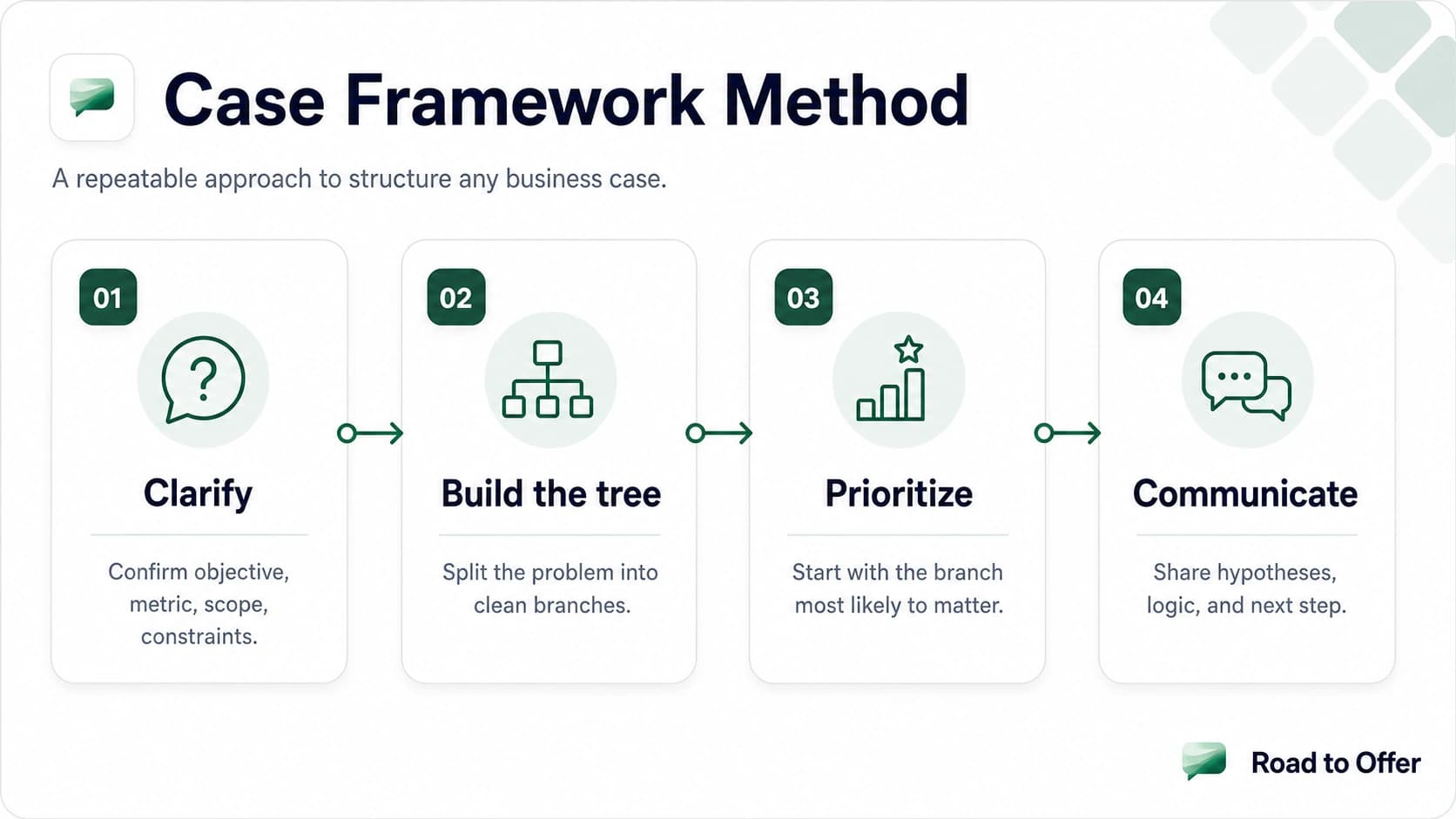
Learn the case method
One dense lesson, each step linked to the drill that trains it.
Singapore cases hand you clean anchors, so the grade is in the assumptions, not the arithmetic. Take the hawker-stall economy: there are roughly 13,430 NEA-licensed hawker stalls (Source: data.gov.sg, https://data.gov.sg/dataset/number-of-hawker-stalls-under-government-market-and-hawker-centres-annual). Size the meals they serve and the whole estimate rests on one credible per-stall throughput. If a stall serves about 120 meals a day across the lunch and dinner peaks, that is roughly 1.6 million meals a day, and an interviewer rewards you for tying the 120 to operating hours and covers rather than guessing. Now run a fresh prompt against the clock and get it graded the way the app does.
Want the full exercise? A graded case runs structure, math, and recommendation together, which is how firms actually score you. A pricing decision in an ASEAN market is close to what a Singapore-based team hands a first-year.

Pricing · hard
Practice a real case, step by step
Matched to this article: an automotive pricing case, guided step by step. Free.
How should you choose a firm in Singapore?
Start from fit, not prestige. MBB offers the broadest regional exposure and the strongest exit options, but the Big 4 strategy arms and Tier 2 specialists win on sector depth and often better hours. If you know your sector (financial services points to Oliver Wyman, industrials to Roland Berger, life sciences to L.E.K.), a focused Tier 2 hub can beat a generalist MBB seat. If you are still deciding, the MBB versus boutique versus Tier 2 guide walks through the tradeoff, and market sizing practice sharpens the one skill every Singapore round tests. Whichever firm you target, the case is the same gate, so build the skill once and apply it across your shortlist.
Practice an ASEAN market-entry case
Singapore loops lean on regional growth and market-entry scenarios. Run a strategy case with instant AI feedback on structure, math, and recommendation before interview day.
Sources
- Consultancy.asia: top consulting firms in Singapore for graduates (accessed July 24, 2026)
- Singstat: Population Trends 2025 (accessed July 23, 2026)
- Levels.fyi: McKinsey Management Consultant Salary in Singapore (accessed July 23, 2026)
- Roland Berger: Southeast Asia Offices (accessed July 23, 2026)
- Kearney: Southeast Asia Locations (accessed July 23, 2026)
- data.gov.sg: hawker stalls under government markets and hawker centres (accessed July 23, 2026)
- Bain & Company: Southeast Asia recruiting process and timeline (accessed July 24, 2026)
- Ministry of Manpower Singapore: Employment Pass eligibility (accessed July 24, 2026)
Is your firm on this list?
If a figure or detail about your firm is out of date, send us the correct one with a source and we'll update the page.
Send a correctionFrequently asked questions
Resources and related guides
- Practice a real case interviewPractice
- Browse all free resourcesResource hub
- Consulting Firms in Dubai 2026: The Complete GuideGetting Started · Jul 23, 2026
- Consulting Firms in the UK 2026: How to Choose and PrepareGetting Started · Jul 23, 2026
- Consulting Firms in Germany: Candidate Map by Specialty, Office, and Interview (2026)Getting Started · Aug 13, 2026
- Best MBA Programs for Consulting (2026): Placement Data From the Class of 2025 ReportsGetting Started · Jul 19, 2026