
Consulting Interview Prep Timeline: 4 Plans from 2 Weeks to 12 Weeks
Choose a 2, 4, 8, or 12-week consulting interview prep timeline using your deadline, baseline case, weekly availability, and skill checkpoints.
On this page
The right consulting-prep timeline is a deadline and readiness decision: choose 2, 4, 8, or 12 weeks after a baseline case, not from universal hours or case-count rules. Anchor the schedule to the actual interview date and use the baseline to decide which skill receives the first checkpoint.
For session design, see how to practice case interviews. This guide focuses on what your schedule should look like depending on how much time you have.
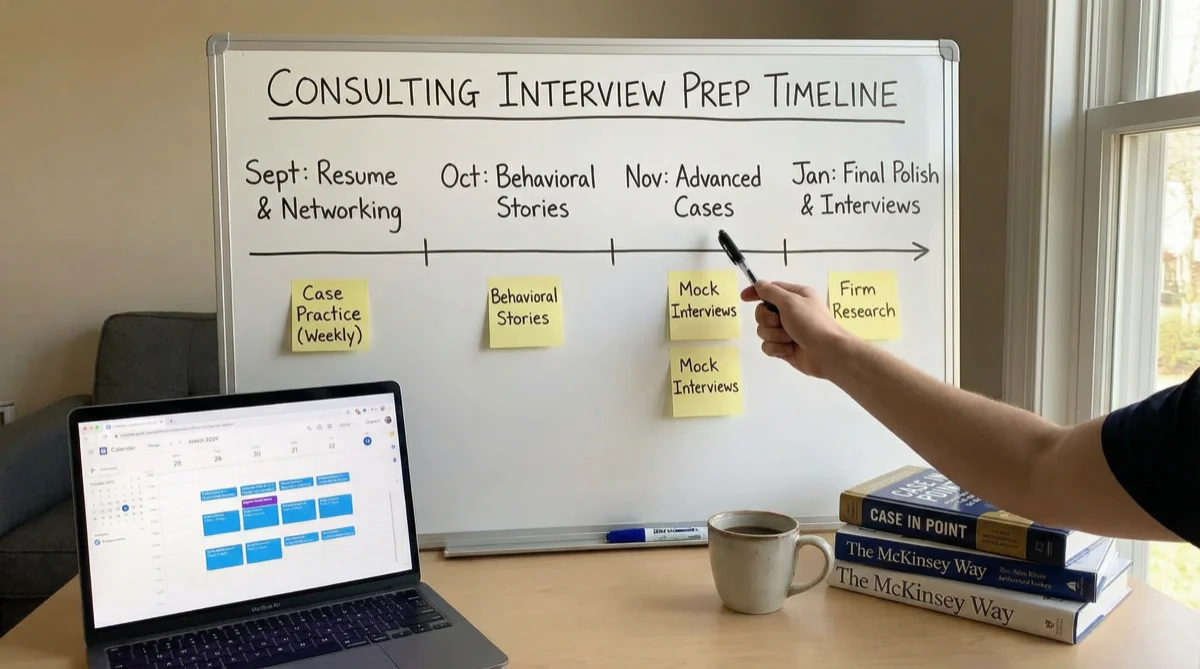
How to Choose Your Timeline
Before diving into the plans, be honest about two things: your starting point and your daily availability.
Use four inputs before choosing a row:
The total hours are roughly equivalent across plans. The difference is intensity: shorter timelines pack more into each day, while longer timelines let you absorb material at a steadier pace.
Set the timeline from an honest baseline
Run one scored case, record the weakest dimension, and choose the sample plan your calendar can sustain.
2-Week Emergency Plan
Who this is for: You already understand profitability, market entry, and other core frameworks. You have done at least 10 cases before. You just need reps, speed, and polish.
Daily commitment: 2.5 to 3 hours Total hours: ~38 to 42
What this plan is NOT: A place to learn frameworks from scratch. If you cannot build a case structure in under 2 minutes, use the 4-week plan instead, even if it means asking to reschedule.
Week 1: High-Volume Reps
Daily schedule (2.5 to 3 hours):
- 15 min: Math drills (mental math for case interviews)
- 60 min: Two full cases with feedback through a partner or Road to Offer Voice Mode
- 30 min: Review and log weaknesses from both cases
- 15 min: Fit story rehearsal (rotate through 4 stories)
- 15 min: Synthesis drills from completed cases
Weekly milestone: 12 to 14 full cases completed with logged feedback. You should be able to identify your top 2 weaknesses from the data.
"Done" looks like: You can complete a case in 25 to 30 minutes, deliver a clear synthesis, and articulate specifically what you need to fix.
Solo vs. partner: This entire week should be at least 70% partner or AI practice. You already have foundations. You need pressure and feedback.
Week 2: Simulation and Calibration
Daily schedule (2.5 to 3 hours):
- 15 min: Targeted Road to Offer drills on your top 2 weaknesses
- 75 min: Two full timed simulations (fit + case + synthesis, strict 35-min limit)
- 30 min: Deep review with scorecard
- 15 min: Fit story final polish
Days 12 to 14: Reduce to 1 case per day. Prioritize rest, review your practice log, and do light math maintenance.
Weekly milestone: 8 to 10 simulation-quality cases. Consistent performance across different case types.
"Done" looks like: You can walk into the interview with the confidence that you have seen enough case types, your math is sharp, and your synthesis is clean. No new material, just execution.
4-Week Standard Plan
Who this is for: You have some familiarity with case interviews (maybe a workshop, a class, or a few self-study sessions), but you need to build real skill from a moderate base.
Daily commitment: 2 to 2.5 hours Total hours: ~60 to 70
Week 1: Framework Foundation
Daily schedule (2 hours):
- 15 min: Math warm-up (percentages, growth rates, break-even)
- 45 min: Study one framework per day. Build your own version, not a memorized template
- 30 min: Practice structuring 3 to 4 case prompts (framework only, no full case)
- 30 min: Draft and rehearse 1 fit story (aim for 4 stories by end of week)
Key frameworks to cover this week:
- Profitability
- Market entry
- Growth strategy
- Pricing
- M&A
Weekly milestone: You can build a custom framework for any common case type in under 2 minutes. You have 4 drafted fit stories.
"Done" looks like: When you read a case prompt, you do not freeze. You might not execute perfectly, but you have a starting point for any standard case type.
Solo vs. partner: 100% solo this week. You are building internal fluency, not performance skills yet.
Week 2: First Full Cases
Daily schedule (2 to 2.5 hours):
- 15 min: Math drills
- 60 min: 1 to 2 full cases with partner feedback or a Road to Offer scorecard
- 30 min: Post-case review and logging
- 15 to 30 min: Drill your weakest skill from the day's cases
Weekly milestone: 8 to 12 full cases completed. You have a practice log with scores across structure, math, analysis, and synthesis.
"Done" looks like: You have completed cases in at least 3 different types (profitability, market entry, growth, etc.). Your practice log shows clear patterns, both strengths and weaknesses.
Solo vs. partner: Shift to 50% partner or AI practice. You need feedback on communication and pacing now.
Week 3: Targeted Improvement
Daily schedule (2 to 2.5 hours):
- 15 min: Math drills
- 30 min: Focused Road to Offer drill on your #1 weakness
- 60 min: 1 to 2 full cases, deliberately choosing types that expose your weak areas
- 30 min: Review and log
Weekly milestone: 8 to 10 more cases. Your weakest score should improve by at least 1 point (on a 5-point scale) compared to Week 2.
"Done" looks like: You no longer have a single skill below 3/5 on your scorecard. You are consistent, if not yet polished.
Solo vs. partner: 70% partner or AI. Increase pressure and realism.
Week 4: Simulation and Final Calibration
Daily schedule (2 hours):
- 15 min: Light math maintenance
- 60 min: 1 full timed simulation (fit + case + synthesis, strict timing)
- 30 min: Detailed review
- 15 min: Fit story rehearsal
Days 25 to 28: Reduce to 1 simulation every other day. Review your full practice log. Rest.
Weekly milestone: 5 to 7 simulation-quality reps. No new frameworks or case types introduced.
"Done" looks like: You feel ready, not perfect. You know your strengths, you know your tendencies, and you can execute under time pressure.
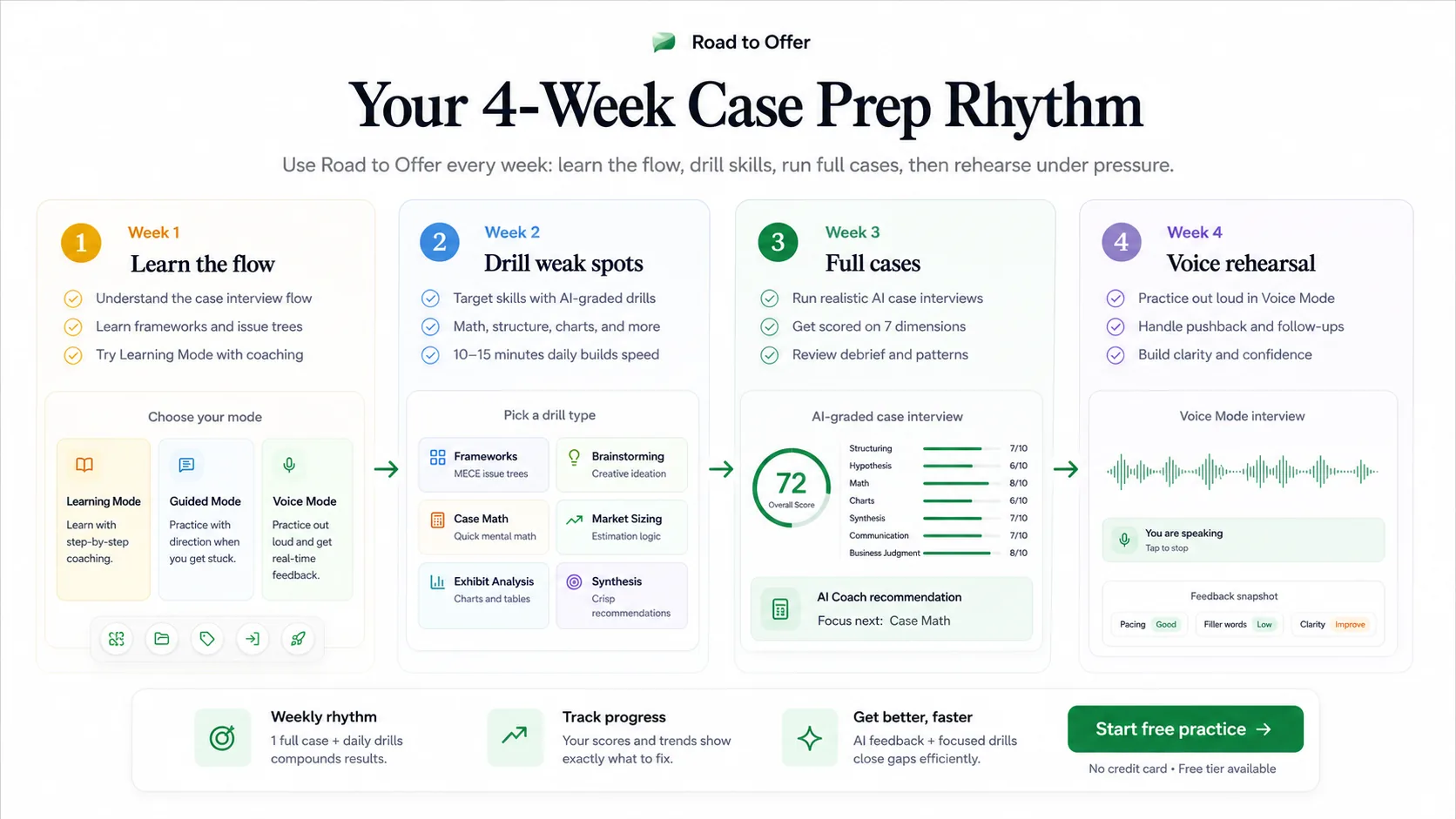
8-Week Plan
Who this is for: You are starting from scratch or nearly so. You have 8 weeks, which is the sweet spot for most candidates. Enough time to build real skill without burnout.
Daily commitment: 1.5 to 2 hours Total hours: ~90 to 110
According to BCG, their interview process evaluates problem-solving, analytical thinking, and leadership, all skills that take sustained practice to develop (BCG Careers, 2026). Eight weeks gives you enough runway to build them properly.
Weeks 1 to 2: Learn the Building Blocks
Daily schedule (1.5 hours):
- 15 min: Mental math practice
- 45 min: Framework study (1 framework per day, build your own version)
- 30 min: Structuring drills (open case prompts, write framework only, 2 min each)
Cover these frameworks:
- Profitability
- Market entry
- Growth strategy
- Pricing
- M&A
- MECE principle (applies across all frameworks)
Also this phase:
- Draft 4 fit stories using the STAR format
- For McKinsey candidates, begin reviewing the PEI guide
- Read through case interview examples to see what full cases look like
Weekly milestone (end of Week 2): Custom framework for any standard case type in under 2 minutes. 4 fit stories drafted. Math accuracy above 80% on timed drills.
"Done" looks like: You understand the core toolkit. You are not yet good at cases, but you know what each case type demands.
Solo vs. partner: 100% solo. Do not start partner practice until you can structure confidently.
Weeks 3 to 4: First Cases and Feedback Loops
Daily schedule (1.5 to 2 hours):
- 15 min: Math drills
- 45 to 60 min: 1 full case with feedback from a partner or Road to Offer
- 30 min: Post-case review, logging, and one targeted drill from the weakest score
Weekly milestone (end of Week 4): 12 to 16 full cases with logged feedback. Practice scorecard started with at least 3 data points per skill area.
"Done" looks like: You can get through a case without getting lost. Your structure is reasonable. Your math might be slow, and your synthesis might be rough, but you can complete the loop.
Solo vs. partner: Shift to 40 to 50% partner or AI practice by Week 4. Start getting feedback on how you communicate, not just what you say.
Weeks 5 to 6: Targeted Drilling
Daily schedule (2 hours):
- 15 min: Math drills
- 30 min: Focused Road to Offer drills on your bottom 2 skills (see your scorecard)
- 45 min: 1 full case, deliberately choosing types that test your weaknesses
- 30 min: Review and log
Weekly milestone (end of Week 6): 10 to 14 more cases. All scorecard areas at 3/5 or above. You can handle market sizing and quantitative cases without panicking.
"Done" looks like: You do not have a single skill area that is a liability. You might not be exceptional at everything, but nothing will cause you to bomb a case.
Solo vs. partner: 70% partner or AI. The shift toward realistic practice is important here.
Weeks 7 to 8: Simulation and Polish
Daily schedule (1.5 to 2 hours):
- 15 min: Light math maintenance
- 60 min: 1 full timed simulation in Voice Mode or with a partner (fit + case, strict 35-minute limit)
- 30 min: Detailed review and fit story rehearsal
Week 8 (final week): Drop to 1 case every other day. Review your full practice log. Rest. Keep math sharp with 10-minute daily drills.
Weekly milestone (end of Week 8): 8 to 12 simulation-quality reps. Firm-specific preparation complete (BCG guide, Bain guide, or McKinsey Solve prep; MBA candidates can start with McKinsey Solve for MBA candidates).
"Done" looks like: You can execute a full case under time pressure, pivot when the interviewer redirects, deliver a clear synthesis, and handle fit questions with specific stories. You are ready.
Solo vs. partner: 90% partner or AI in these final weeks.
- 01
Weeks 1-2: Foundation. Frameworks, math basics, fit story drafts. 100% solo.
- 02
Weeks 3-4: First Cases. 12-16 full cases with feedback. Transition to 50% partner practice.
- 03
Weeks 5-6: Targeted Drilling. Focus on weak areas. 70% partner practice. All scores 3/5+.
- 04
Weeks 7-8: Simulation. Timed mocks under pressure. 90% partner. Wind down final days.
12-Week Relaxed Plan
Who this is for: You found out about your interview well in advance, or you are applying to firms with rolling timelines (including early-career programs like the Deloitte Discovery internship). You want to build skill without burning out or sacrificing your job, classes, or social life. If you are an experienced hire fitting this around work, McKinsey Solve for experienced hires covers that route.
Daily commitment: 1 to 1.5 hours Total hours: ~85 to 105
The biggest risk with a 12-week plan is not running out of time. It is losing momentum. The antidote is clear weekly checkpoints.
Weeks 1 to 3: Foundation at a Comfortable Pace
Daily schedule (1 hour):
- 10 min: Mental math
- 30 min: Framework study (take 2 days per framework instead of 1)
- 20 min: Structuring drills or fit story drafting
Weekly milestone (end of Week 3): Same foundation as the 8-week plan, but built more slowly. 5 frameworks learned, 4 fit stories drafted.
"Done" looks like: You feel genuinely comfortable with the building blocks. No rush, no gaps.
Solo vs. partner: 100% solo.
Weeks 4 to 6: Early Cases
Daily schedule (1 to 1.5 hours):
- 10 min: Math drills
- 45 min: 1 full case with feedback (not every day, aim for 4 to 5 cases per week)
- 15 to 30 min: Review and logging
Weekly milestone (end of Week 6): 15 to 18 full cases completed. Scorecard started.
"Done" looks like: You have a real sense of what cases feel like. You know your strengths and weaknesses from data, not intuition.
Solo vs. partner: Shift to 40% partner or AI practice by Week 5.
Weeks 7 to 9: Skill Building
Daily schedule (1.5 hours):
- 10 min: Math drills
- 30 min: Targeted drills on weak areas from your Road to Offer or partner scorecard
- 30 min: 1 full case
- 20 min: Review
Weekly milestone (end of Week 9): 12 to 15 more cases. All scorecard areas at 3/5 or above. You have practiced across all major case types.
"Done" looks like: You are consistently solid. Not flashy, but reliable. You can handle surprises.
Solo vs. partner: 60 to 70% partner or AI.
Weeks 10 to 12: Simulation and Peak
Daily schedule (1 to 1.5 hours):
- 10 min: Math maintenance
- 50 to 60 min: 1 full timed simulation OR detailed review session (alternate)
- 15 min: Fit rehearsal
Week 12 (final week): Light maintenance only. 1 case on Monday, 1 on Wednesday, rest Thursday and Friday before interviews.
Weekly milestone (end of Week 12): 10 to 14 simulation-quality reps completed. Ready for any case type, any firm.
"Done" looks like: You feel calm. You have done the work. No last-minute panic.
Solo vs. partner: 80 to 90% partner or AI.
Cumulative Case Count Targets
Across all four plans, you should hit roughly similar total case counts. The difference is pacing.
McKinsey's own interviewing guidance emphasizes practicing "as many cases as you can," but our data suggests that quality-reviewed cases matter far more than raw volume (McKinsey Careers, 2026). A candidate with 30 well-reviewed cases will almost always outperform someone who rushed through 60.
When to Switch from Solo to Partner Practice
This is one of the most common timing questions, and getting it wrong costs weeks.
Switch too early: You stumble through cases because you do not have the framework vocabulary yet. Your partner gives you feedback on execution when you actually need to fix your foundations. You feel discouraged and behind.
Switch too late: You build confident but unchecked habits. Your structures sound good in your head but are unclear when spoken. Your math is correct on paper but slow under pressure.
The rule of thumb: Start partner or AI practice once you can build a custom framework for any standard case prompt in under 2 minutes, without looking at notes. For most candidates, that happens:
- 2-week plan: Day 1 (you should already be here)
- 4-week plan: End of Week 1
- 8-week plan: End of Week 2
- 12-week plan: End of Week 3
For guidance on how to structure each practice session once you start, see the how-to-practice guide linked above.
Prep Readiness Checklist
Use this checklist in your final week, regardless of which plan you followed. If you can check every item, you are ready.
Execution checklist
Completed 25+ full cases with logged feedback. This is the minimum threshold where most candidates feel genuinely prepared, not just hopeful.
All scorecard areas at 3/5 or above for last 5 cases. Consistent recent performance matters more than lifetime averages. Your last 5 cases predict your interview performance.
Can build a custom framework in under 2 minutes for any prompt. The opening structure sets the trajectory of the entire case. Hesitation here signals to the interviewer that you are not ready.
Delivered 5+ timed syntheses under 90 seconds. The synthesis is the highest-signal moment of the interview. Practicing it under time pressure ensures you do not ramble or freeze.
4 fit stories rehearsed and under 2 minutes each. Fit questions carry real weight, especially at McKinsey (PEI) and Bain. Unrehearsed stories meander and lose impact.
Completed at least 3 full timed simulations (fit + case). Simulations calibrate your endurance and pacing. Doing cases without time pressure creates a false sense of readiness.
Reviewed firm-specific format and expectations, including professional interview dress code. BCG, McKinsey, and Bain each have distinct interview formats. Knowing what to expect eliminates surprise and lets you focus on performance.
Taken at least one full rest day in the final 3 days. Fatigue degrades performance more than one extra practice case improves it. Rest is preparation.
Common Timeline Mistakes
The planning drills below also have this text version:
Interactive drill set. Write an answer before revealing the worked solution, then continue into Road to Offer for scored practice and AI feedback.
Adjusting Your Plan Mid-Stream
No plan survives contact with reality perfectly. Here is how to adapt without losing your structure.
If you are ahead of schedule: Do not accelerate into simulation too early. Instead, expand the variety of case types you practice. Add market sizing cases, customer segmentation problems, and less common prompts. Breadth now pays dividends during interviews when you get an unusual case.
If you are behind schedule: Compress the foundation phase, not the simulation phase. You can learn frameworks while doing cases (it is slower, but it works). You cannot simulate interview pressure without dedicated simulation time. Protect your final 25% of prep time for timed mocks. If a McKinsey Solve link deadline is the squeeze, see what McKinsey says about Solve deadline extensions.
If you hit a plateau: Take one full day off, then come back and shift 50% of your practice time to targeted drills on your weakest skill. Plateaus almost always mean you are doing too many full cases and not enough isolated skill work. The session-design guide above covers specific drill formats.
Leave with checkpoints you can actually follow before interview day. Revisit the four inputs whenever the date, availability, or weakest skill changes.
Sources and Further Reading (checked June 17, 2026)
- McKinsey interviewing resources: https://www.mckinsey.com/careers/interviewing
- BCG interview process and preparation: https://careers.bcg.com/global/en/interview-process
- Bain interview preparation: https://www.bain.com/careers/interview-preparation/
- Cepeda, N. J., Pashler, H., Vul, E., Wixted, J. T., & Rohrer, D. (2006). Distributed Practice in Verbal Recall Tasks. Review of General Psychology, 10(4), 354-380.
- Management Consulted case prep benchmarks: https://managementconsulted.com/case-interview/
About Road to Offer
Road to Offer is useful in this timeline because it turns each practice block into a measurable loop: run the case, read the seven-dimension debrief, drill the weakest skill, then retest under Voice Mode or partner pressure.
- Diagnostic case: set the starting point before choosing a 2, 4, 8, or 12-week plan
- Targeted drills: keep math, structure, charts, market sizing, brainstorming, and synthesis from drifting
- Voice Mode: rehearse the final simulation phase with spoken delivery and pushback
Related Guides
Frequently asked questions
Resources and related guides
- Practice a real case interviewPractice
- Browse all free resourcesResource hub
- Case Interview Questions by Stage (With Worked Solutions)Getting Started · Feb 6, 2026
- How Should You Practice Case Interviews? A Step-by-Step PlanGetting Started · Feb 4, 2026
- Last-Minute Case Interview Prep: A 48-Hour Plan That Actually Works (2026)Getting Started · Mar 20, 2026