
Road to Offer Seven-Dimension Case Interview Grading: How AI Scores Like a Real Interviewer (2026)
Road to Offer grades every case across seven dimensions: structuring, hypothesis, math, charts, synthesis, communication, business judgment.
On this page
Road to Offer grades every case across seven dimensions: structuring, hypothesis, math, charts, synthesis, communication, and business judgment. The rubric matches the dimensions MBB partners grade on, which is what makes the feedback usable instead of generic. Free tier at Road to Offer practice includes one full graded case with all seven dimensions explained by AI Coach.
What the Seven Dimensions Actually Are
Each dimension maps to a specific moment in the case arc:
1. Structuring. The opening issue tree. MECE depth, branch quality, prioritization. The single most-graded dimension across MBB first rounds because it sets up everything that follows.
2. Hypothesis. The hypothesis you commit to before the analysis phase. Was it grounded in the prompt? Did it specify what data would prove or refute it? Did you defend it under pushback?
3. Math. Calculation work during the case. Formula stated? Staged calculation without errors? Units carried through? Final number translated into a business statement?
4. Charts (and exhibits). When the AI provides a chart or P&L extract, did you read the implication correctly? Did you tie it back to the hypothesis?
5. Synthesis. The recommendation at the end. Hypothesis-first ordering, three supports, one risk acknowledgement, one actionable next step. The dimension partners weight most heavily for offer decisions.
6. Communication and pacing (Voice Mode only). Filler words, rambling, recovery from a hard pushback, synthesis cadence under spoken pressure. The dimension typed practice can't grade.
7. Business judgment. Did your hypothesis surface a real driver? Does the recommendation match a client situation a partner would actually approve? The qualitative dimension that distinguishes "MECE answer" from "interview-ready answer."
How the Rubric Compares to Generic AI Case Feedback
ChatGPT and other general AI tools tend to score cases as a single blended number with one improvement suggestion. The seven-dimension rubric is the structural fix:
The structural difference matters because the action you take depends on which dimension scored worst. A 6/10 blended score tells you nothing. A 4/10 on synthesis with the specific synthesis line you wrote tells you exactly which drill to run tomorrow.
How the Dimensions Map to Each Practice Mode
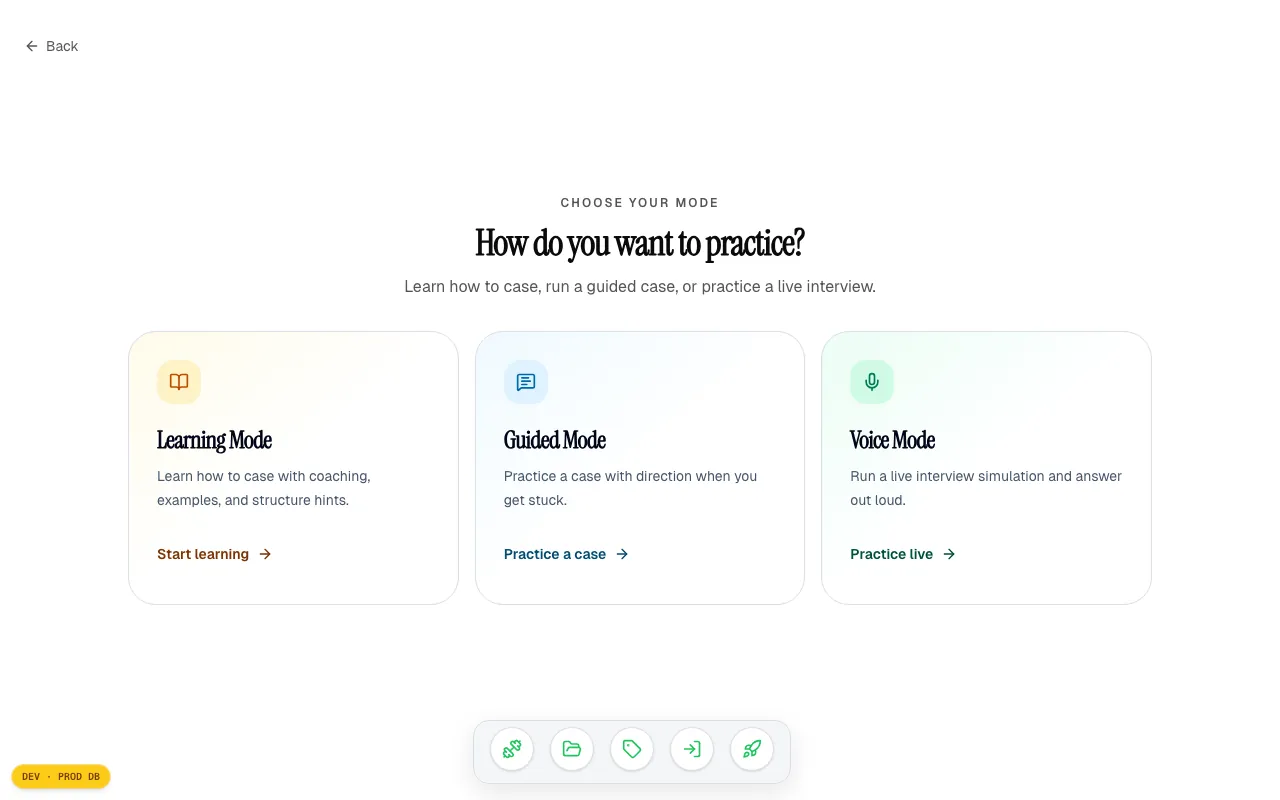
Guided and Voice Mode use the seven-dimension grading system. Learning Mode now teaches the same case skills without showing a score: the first five checkpoints use authored comparisons, and only the final synthesis receives personalized keep-and-improve coaching.
Voice Mode is the only mode that grades communication and pacing because typed input can't reveal filler words, rambling, or recovery quality. Most candidates need at least 3-5 Voice Mode cases before any partner round to surface delivery weak spots.
See Voice Mode, Learning Mode, the Drill Engine, and the Free Tools Hub for mode-by-mode detail.
How MBB Firms Actually Weight These Dimensions
McKinsey, BCG, and Bain all grade variations of the same seven moves. Public partner interviews and consulting-club prep materials suggest different weighting profiles, even if the universal dimensions are the same:
- McKinsey (interviewer-led format) tends to weight synthesis cadence and hypothesis discipline heavily, with partners often grading whether you commit to a hypothesis before the analysis, then defend it under pushback.
- BCG (candidate-led format) leans toward structuring and hypothesis-first ordering, since the structure you propose is the foundation the rest of the case hangs on.
- Bain (candidate-led, warmer tone) places more weight on communication and the "Monday-morning recommendation" framing under partner pushback.
These are tendencies, not codified rubrics. The seven dimensions stay universal; the weights shift firm by firm. Road to Offer's Guided and Voice grading targets MBB-level rigor across all seven. Learning Mode teaches the underlying moves without exposing scores. For firm-specific resource walkthroughs see the free McKinsey, BCG, and Bain prep guides.
See your seven-dimension scorecard on a free graded case
One full case in Guided or Voice Mode with all seven dimensions explained. AI Coach ties each score to a specific moment in your answer.
What to Do With Your Scorecard
Reading the scorecard is necessary but not sufficient. The actionable loop:
Post-case scorecard loop
- 01
Step 1: Identify the worst-scoring dimension. Not the lowest score on its own. Look for a dimension that scored 5/10 or lower; that's the leverage point.
- 02
Step 2: Read the specific reason for that dimension's score. AI Coach quotes the moment in your answer that cost points. The quote is the actionable artifact.
- 03
Step 3: Run the matching drill the same day. Case Math, Frameworks, Brainstorming, Synthesis, Exhibit Analysis, or Market Sizing. The drill engine targets each dimension independently.
- 04
Step 4: Run another full case 2-3 days later. The next case validates whether the targeted drill moved the dimension. AI Coach flags if the pattern persists.
- 05
Step 5: Repeat until the worst dimension stabilizes above 7/10. Once a dimension consistently scores 7+ across 3 cases, move to the next-weakest. Sequential focus beats trying to fix everything at once.
That loop, run for 4-6 weeks before interviews, brings most candidates from generic 5-6/10 across dimensions to specific 7-8+/10 on the dimensions that matter most for offer decisions.
What the Free Tier Includes
The free tier is built around the seven-dimension scorecard:
- 1 full graded case in Guided or Voice Mode with all seven dimensions explained
- Specific reason per score tied to the moment in your answer
- Drill recommendation routed to the dimension that scored weakest at structure drill
- AI Coach session memory activates from case 2 onward (paid plans for unlimited cases)
- Live PEI practice to prep the personal-experience interview that runs alongside cases
After the first case, paid plans unlock unlimited graded cases. The Starter Bundle is $20 for 5 case credits at $4 per case.
Verdict
The seven-dimension scorecard is the structural reason Road to Offer feedback is more useful than ChatGPT case feedback. Seven scores plus seven specific reasons give you exactly one thing to work on next. A blended 7/10 from ChatGPT gives you nothing.
If you've done 5+ ChatGPT-graded cases and still can't point to the single dimension holding you back, run a free graded case and read the seven-dimension debrief in full. The structure of the feedback is what makes it actionable.
Sources and Further Reading (checked June 17, 2026)
- Road to Offer practice modes
- Road to Offer drill engine
- Road to Offer pricing at /pricing
- Related: Best Free AI for Case Math Practice
See the seven-dimension scorecard on a free case
Free tier includes one full graded case with all seven dimensions explained. The scorecard structure ChatGPT can't deliver.
Related Guides
- Road to Offer Free PEI Fit Workbook
- Best AI Platform for Consulting Prep
- Best AI Drill Platform for MBB Prep
- How to Use ChatGPT for Case Interview Prep
Frequently asked questions
Resources and related guides
- Run a real case interviewPractice
- Browse all free resourcesResource hub
- Free Case Interview Drills, No SignupGetting Started · May 9, 2026
- Road to Offer AI Coach: Real-Time Case Interview Grading and Weak-Spot Tracking (2026)Getting Started · May 9, 2026
- Road to Offer Behavioral Practice: Live AI InterviewsGetting Started · Jul 19, 2026