
Road to Offer Voice Mode: Spoken Case Rehearsal Guide (2026)
Voice Mode helps candidates rehearse spoken case delivery, pacing, pushback, exhibits, synthesis, and debrief-driven follow-up drills.
On this page
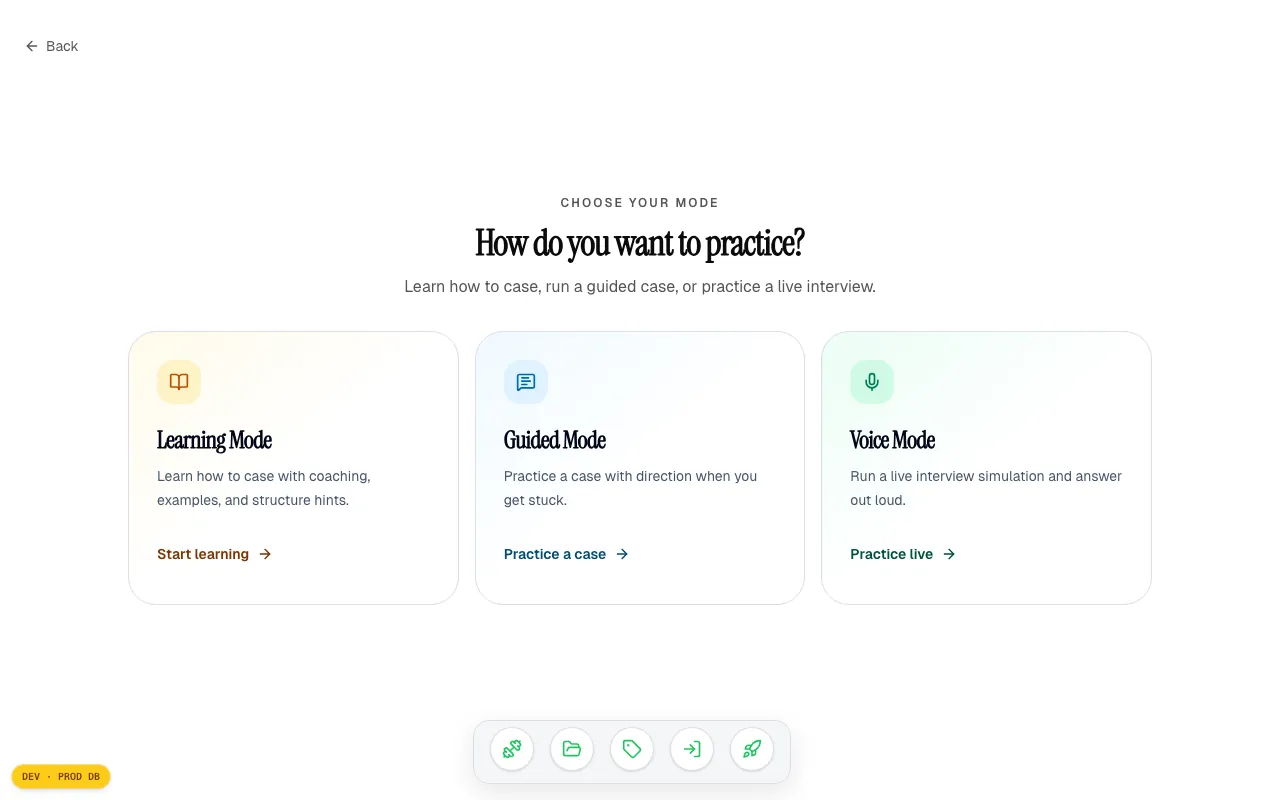
Voice Mode is the rehearsal layer of Road to Offer. Start at Road to Offer practice, choose Voice Mode, and use it when you can solve a case on paper but need to know whether the answer survives out loud. That matters because consulting interviews do not only test whether your structure is logical. Official firm pages describe case interviews as assessments of analytical thinking, problem solving, and communication, and BCG explicitly includes communication in its client-facing interview process.
Voice Mode should feel like rehearsal, not discovery. McKinsey's interview guidance describes the problem-solving interview as a business case used to evaluate analytical thinking and approach. BCG's interview process names problem-solving, analytical, and communication skills. That is the reason spoken practice has a place after typed practice: the content can be correct while the delivery still costs points.
Rehearse the case out loud
Use Voice Mode from /try once you can solve the case on paper and need to pressure-test delivery.
Who Should Use Voice Mode This Week
Voice Mode is for mid-to-late prep. It is not the best starting point if you are still learning basic case mechanics. It is the right next step when your typed answers are organized but your spoken case has friction: long pauses, filler, unclear transitions, late recommendations, or defensive recovery when the interviewer pushes back.
The highest-yield cadence is usually 1-2 Voice Mode cases per week, with targeted drills in between. More voice cases are not automatically better if the same weak behavior repeats.
What Voice Mode Rehearses That Typed Practice Misses
Typed practice can test logic. Spoken practice tests whether the logic is usable in a conversation. The National Association of Colleges and Employers defines communication as clearly exchanging information, ideas, facts, and perspectives, including verbal and non-verbal communication. That maps cleanly to case interviews: your interviewer needs to follow your reasoning as it develops.
Voice Mode is useful for four rehearsal behaviors:
- Signposting. Can the interviewer tell where you are in the case without reading your notes?
- Thinking aloud. Do you expose enough reasoning to be coachable without narrating every minor step?
- Recovery. When a hypothesis is challenged, do you update it calmly or defend the wrong answer?
- Synthesis cadence. Do you lead with the recommendation, then evidence, then risk?
The U.S. Office of Personnel Management's structured-interview guidance is a useful hiring-design parallel: interview questions are stronger when they map to job competencies and observable behavior. Voice Mode works for the same reason. It turns delivery into behavior you can observe and debrief.
The 35-Minute Voice Mode Rehearsal
A good spoken rep has a pre-brief, a live case, and a correction block. Do not treat the debrief as optional.
Voice Mode rehearsal block
- 01
1. Set the room (2 minutes). Use a quiet room and headset if possible. Open scratch paper. Put your phone away unless it is the device running the case.
- 02
2. Open with a clean case setup (5 minutes). Restate the objective, ask clarifying questions, and give yourself a short pause before the structure. Do not fill silence with filler words.
- 03
3. Run the analysis aloud (15-20 minutes). State formulas, units, chart implications, and hypothesis updates out loud. The goal is not speed alone. The goal is clear reasoning under pressure.
- 04
4. Deliver the recommendation first (2 minutes). Start with the answer. Then give two or three supports, one risk, and one next step. This is where synthesis quality becomes obvious.
- 05
5. Debrief and choose one drill (8-10 minutes). Read the scorecard, choose the weakest behavior, and route it to a targeted drill or fit resource before the next full case.
This block is deliberately shorter than a full evening study session. Voice work is cognitively expensive. One focused spoken case plus one targeted follow-up usually beats three rushed spoken cases with no correction loop.
How to Handle Silence, Filler, and Pushback
Spoken cases feel messy because you are managing reasoning and delivery at the same time. Do not try to sound constantly fluent. A clean pause is better than filler.
Road to Offer also protects the quality of the feedback loop. If a recording is very long but mostly empty, repeated filler, or too low-signal to evaluate, the transcript can be flagged as low quality. That is a feature, not a penalty. It keeps the debrief from over-interpreting audio that did not contain enough case reasoning.
What to Practice After Voice Mode
The debrief should decide the next public path.
This is where many candidates misuse Voice Mode. They run another spoken case because it feels realistic, but the debrief already told them the next skill is narrower. If the scorecard says math, drill math. If it says synthesis, drill synthesis. Full cases are for integration. Drills are for correction.
Fix the weak spoken-case skill
Use the targeted drills after a Voice Mode debrief so the next full case tests a real correction.
When Not to Use Voice Mode
Do not use Voice Mode as a shortcut around fundamentals. If you cannot build a basic structure, Learning Mode is more efficient. If your math error rate is high, public drills are more efficient. If your fit stories are weak, the live behavioral simulator is more efficient.
Use Voice Mode when the question is no longer "Do I know the case method?" but "Can I perform it aloud under interviewer pressure?" That is a narrower and more useful job.
Verdict
Voice Mode is the right practice mode once the case arc is familiar and delivery becomes the bottleneck. It helps you rehearse how the answer sounds: the pause before structure, the math narration, the exhibit implication, the recovery after pushback, and the recommendation-first close.
Start at Road to Offer practice, run one spoken case, read the debrief, then choose one follow-up: synthesis drills for a weak close, the live behavioral simulator for fit stories, or another full case when the correction is ready to test.
Sources and Further Reading (checked 2026-06-08)
- Road to Offer practice modes: Road to Offer practice
- Road to Offer targeted drills: synthesis drill
- Road to Offer PEI and fit workbook: /resources/pei-fit-workbook
- BCG, Consulting Interview Process
- McKinsey, Interviewing at McKinsey
- U.S. Office of Personnel Management, Structured Interviews
- NACE, Communication competency definition
- Hattie and Timperley, The Power of Feedback
Run one spoken case, then fix one thing
Use Voice Mode from /try for a live spoken rep, then route the debrief into drills or PEI work before the next case.
Related Guides
Frequently asked questions
Resources and related guides
- Run a real case interviewPractice
- Browse all free resourcesResource hub
- Case Interview Practice With AI: Free Tools and Method (2026)Getting Started · May 9, 2026
- Guided Case Practice on Road to Offer: Step-by-Step AI Feedback (2026)Getting Started · Jul 19, 2026
- Which Free AI Tools Are Best for Case Interview Prep in 2026?Getting Started · May 8, 2026