
Best Free AI for Case Interview Math Practice (2026)
The free AI tools that actually run case math drills with feedback: ChatGPT, Claude, Gemini, Perplexity, and Road to Offer's Math Drill, plus the prompts, worked examples, and mental-math shortcuts that make them work.
On this page
The five free AI tools cover different case-math jobs: high-volume prompts, long calculation chains, sourced assumptions, and a graded consulting-specific rep, so choose by the feedback you need, not by the model name.
What Does Case Math Practice Actually Look Like?
Case interview math is not a math test. Interviewers grade four things: the formula, the staged calculation, the units, and the business read. Not "the answer is 12 percent" but "revenue grew 12 percent year over year, which suggests pricing held up despite volume softness." A drill that only checks the final number misses roughly three quarters of what they are scoring.
That is why ChatGPT's default math drills feel off. It will verify "5,000 times 1.08 equals 5,400" without ever asking you to write the formula, sanity-check the units, or explain what the number means. The right free stack fills that gap.
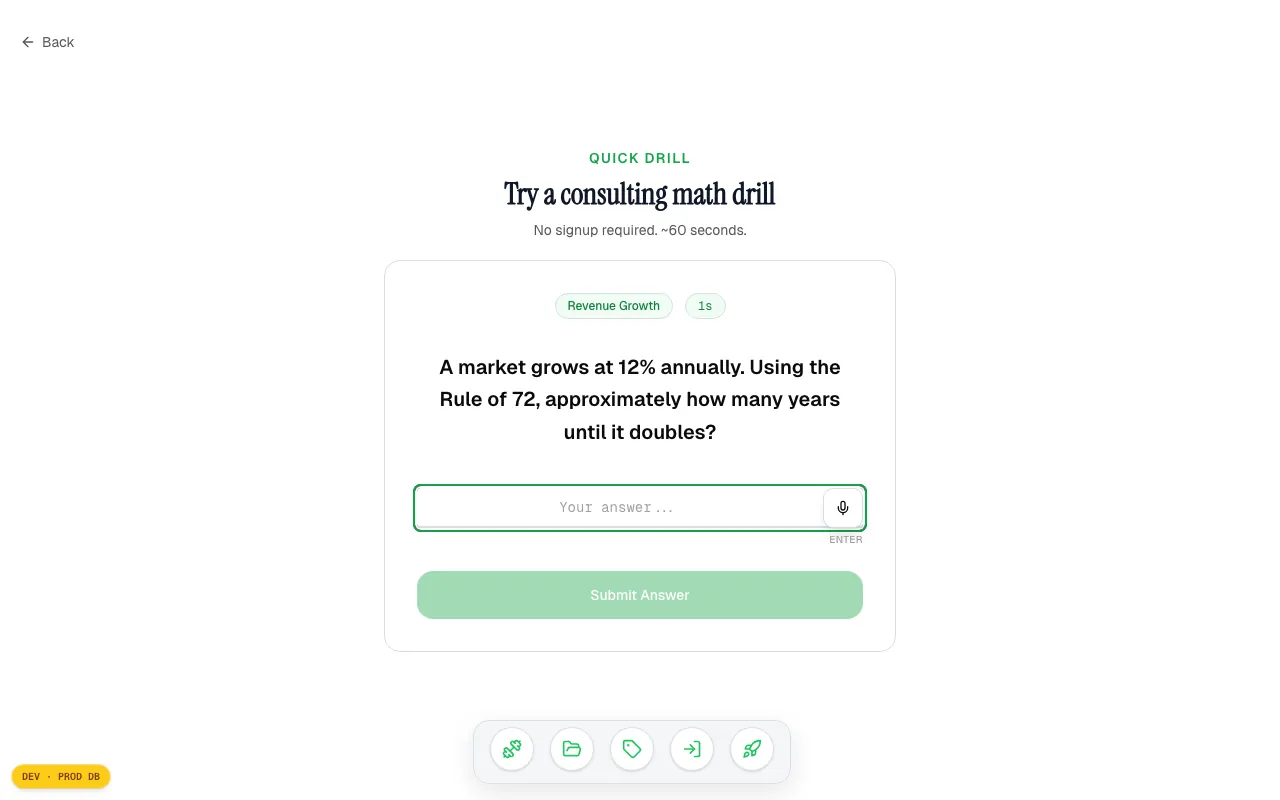
Run a live case math drill from the Road to Offer drill engine. Answer a real prompt and get AI-scored feedback. Free accounts include 5 drills per day for the first 3 days after signup.
The Five Best Free AI Tools for Case Math
ChatGPT (free tier)
What it does: ChatGPT generates custom math drills within its current usage limits if you prompt it correctly. Best when you give it a role ("act as an MBB interviewer"), constraints ("messy numbers, no calculator, 45 second target"), and grading rules ("check setup, units, and business interpretation, not just the final answer").
Price: Free, with usage limits on the top model and broader access to the lighter model in 2026.
Strengths: High-volume drill generation, voice mode when available, fast iteration on prompt tuning, broad business context.
Limitations: Sycophantic by default (it will praise weak setup if you sound confident), inconsistent grading without strong prompting, no spaced repetition or weak-spot tracking, can hallucinate numbers in long profitability chains.
Best for: High-volume daily drills once you have a strong prompt template. Pair with Road to Offer's Math Drill for the weekly graded rep.
Claude (free tier)
What it does: Claude offers the same drill function as ChatGPT, with a stronger long-context window and better reliability on multi-step calculation chains. You can paste an entire case prompt or a one-page exhibit and ask Claude to drill you on the math inside.
Price: Free, with daily message limits.
Strengths: Long context (handles full case prompts in one paste), more consistent on chained calculations, better at sensitivity and what-if math, less prone to inventing intermediate numbers.
Limitations: Free tier rate-limited, no voice mode, smaller community of shared prompts.
Best for: Chained calculations (sensitivity, multi-driver profitability, top-down market sizing), pasting full case prompts to drill the embedded math, and getting a second AI opinion on a hard problem.
Google Gemini (free tier)
What it does: Gemini pulls from Google Search, so it is the strongest free model for generating realistic industry numbers and market context. Use it to build a case prompt with plausible figures, or to sanity-check the inputs you are about to size a market with.
Price: Free, with limits on the top model.
Strengths: Live data grounding, good for realistic market-sizing inputs (population, household size, average spend), useful for building case prompts that feel current.
Limitations: Less consistent as a strict interviewer than ChatGPT or Claude, can still hallucinate, weaker at holding a long calculation chain together.
Best for: Generating realistic numbers before a market-sizing or industry case, then handing the drill itself to ChatGPT, Claude, or Road to Offer.
Perplexity
What it does: Perplexity returns sourced answers fast, which makes it ideal for a quick industry primer before a case. Before a healthcare or retail case you can ground your market-sizing assumptions in real, cited data in about five minutes.
Price: Free, with limits on advanced models.
Strengths: Sourced, fast research, good for the pre-case primer, useful for checking whether an assumption ("US households spend roughly X on groceries per month") is in the right range.
Limitations: Not built to run a mock case or grade your math. It researches, it does not interview.
Best for: The 5-minute sourced primer before a case so your assumptions are not pulled from thin air.
Road to Offer Math Drill (the only one that grades like an interviewer)
What it does: The Road to Offer Math Drill is a purpose-built case math drill that grades four dimensions, not one: the equation, the staged calculation, the units, and the business interpretation. You read the prompt, write the formula, compute, and explain what the number means. The AI tells you which dimension would lose points in a real interview.
Price: The free tier gives you 1 full AI-graded case, daily drill practice, one free resume review, plus the first two BCG Casey-style simulator questions with no account.
Strengths: Consulting-specific grading on the four moves real interviewers watch, Voice Mode for spoken practice, Learning Mode for the step-by-step loop before timed reps, weak-spot tracking across sessions, 30 to 45 second target.
Scope: The Math Drill is one surface in Road to Offer's full consulting-interview prep platform, alongside 71 active practice cases, a 600+ drill bank, two online assessment simulators including a BCG Casey-style simulator with 10 original cases and the first two questions free with no account plus a CCA-style simulator, behavioral and McKinsey PEI practice, Learning Mode, a free consulting resume grader, an application tracker, and a free case-book vault.
Best for: The weekly graded math rep that tells you whether your setup, pacing, and business translation would actually land. Stack on top of daily ChatGPT, Claude, or Gemini reps.
Comparison: How the Five Tools Stack Up
One rep to test the grader
Prompt: A product's price rises from $50 to $55. What is the maximum volume loss that keeps revenue flat?
Worked answer: Start with 100 units, so old revenue is 100 × $50 = $5,000. At the new price, flat revenue requires $5,000 ÷ $55 = 90.9 units. The business can therefore lose about 9.1% of volume before revenue falls. That is a revenue-neutral threshold, not proof that profit or customer lifetime value will improve.
See what the grader catches
Run the same four-part loop on a fresh prompt and get feedback on formula, calculation stages, units, and business meaning.
What Road to Offer is, exactly
Road to Offer is a full consulting interview prep platform powered by AI, not a single case grader. It carries 71 active practice cases run by voice or guided text and scored on a seven-dimension rubric, a 550+ drill bank across 6 skill types plus timed Quick Math, two online assessment simulators (a BCG Casey-style simulator with 10 original cases, first two questions free with no account, and a CCA-style simulator), behavioral and McKinsey PEI practice, step-by-step Learning Mode lessons, a free consulting resume grader, an application tracker, and a free case book vault.
The free tier includes 1 full AI-graded case, 1 teaching session that earns 1 case credit, daily drill practice across the 550+ bank, and a free resume review, with no card required. Signing up grants 1 case credit, so that first full case runs in Voice Mode for free. Paid entry starts at a $20 one-time Starter bundle (5 case credits); Pro is $49/month or $249/year. Road to Offer is AI-only: no human coaching, no hourly coaching rates, and no peer-matching marketplace. The trade is instant scored feedback on every rep instead of scheduling a partner.
Worked Examples: The Five Calculations Every Case Math Drill Reduces To
A tool only helps if you already know the move. Here are the five calculations that nearly every case math question collapses into, each worked end to end with the arithmetic shown. Drill these until the setup is automatic, then let the AI time and grade you.
1. Percentage change. Revenue went from $80M to $100M. Growth = (new minus old) / old = (100 minus 80) / 80 = 20 / 80 = 0.25 = 25 percent. Business read: a 25 percent jump is large enough to ask whether it came from price, volume, or a one-off.
Interactive drill set. Write an answer before revealing the worked solution, then continue into Road to Offer for scored practice and AI feedback.
2. Growth rate over time (CAGR). $10M growing at 5 percent for two years = 10 × (1.05)^2 = 10 × 1.1025 = $11.0M. The fast in-interview shortcut: for small rates over a few periods, add the rate each year (5 + 5 ≈ 10 percent, so roughly $11M) and note you rounded down slightly because compounding adds a little more. For doubling time, use the Rule of 72: at 8 percent growth, money doubles in 72 / 8 = 9 years.
Interactive drill set. Write an answer before revealing the worked solution, then continue into Road to Offer for scored practice and AI feedback.
3. Breakeven. A machine costs $1,000,000. Each unit sells for $500 and costs $300 to make, so unit margin = 500 minus 300 = $200. Breakeven units = fixed cost / unit margin = 1,000,000 / 200 = 5,000 units. Always state the unit: 5,000 units, not just "5,000." Interviewers dock points when you cannot say whether the number is units, customers, or dollars.
Interactive drill set. Write an answer before revealing the worked solution, then continue into Road to Offer for scored practice and AI feedback.
4. Profitability decomposition. Profit = revenue minus cost. A pharmacy fills 2.3M prescriptions at $87 net revenue each. Revenue = 2.3M × $87. Drop zeros and decompose: 2.3 × 87 = (2.3 × 90) minus (2.3 × 3) = 207 minus 6.9 = 200.1, then add the six zeros back = about $200M. If costs are $170M, profit = 200 minus 170 = $30M, a 15 percent margin (30 / 200). The decomposition step (split 87 into 90 minus 3) is the move that keeps you off the calculator.
Interactive drill set. Write an answer before revealing the worked solution, then continue into Road to Offer for scored practice and AI feedback.
5. Top-down market sizing. Size annual grocery spend in a city of 800,000 people. Penetration 70 percent = 560,000 shoppers. At 2.5 people per household, that is 560,000 / 2.5 = 224,000 households. At $400 monthly spend: 224,000 × 400 = $89.6M per month, times 12 = about $1.08B per year. State every assumption aloud and sanity-check the final number against something you know (roughly $1B for a mid-size city is plausible).
Interactive drill set. Write an answer before revealing the worked solution, then continue into Road to Offer for scored practice and AI feedback.
Now run three of those five calculation types against a timer and a grader, on numbers you have not seen.
Quick Math
- Revenue moved from $60M to $84M. What is the percentage change?
Percentage change = (New - Old) / Old x 100. State the formula before you compute, because a grader scores that.
- A machine costs $1,500,000. Each unit sells for $400 and costs $250 to make. How many whole units break even?
Unit margin = Price - Unit cost. Break-even units = Fixed cost / Unit margin, and say the unit out loud.
- At 6% annual growth, how many years does money take to double under the Rule of 72?
Years to double = 72 / growth rate, which replaces compounding arithmetic when only the doubling estimate is needed.
Mental Math Shortcuts That Make the Drills Faster
Speed is a motor skill. These are the shortcuts consultants actually use, and the ones to bake into your reps before you let any AI time you.
- The 10 percent and 1 percent anchors. 10 percent of any number is the number with one digit shifted. 10 percent of $160M = $16M, 5 percent is half that ($8M), 1 percent is $1.6M. Build any percentage from these anchors: 17 percent of 160 ≈ 16 + 6.4 + 1.6 ≈ $25.6M.
- Round, but never by more than about 10 percent. To multiply 398 × 21, do 400 × 20 = 8,000, then adjust. Rounding 17 percent to 20 percent for a quick pass is fine; rounding 17 percent to 10 percent distorts the answer too far.
- Decompose, do not grind. 24 × 18 = (24 × 10) + (24 × 8) = 240 + 192 = 432. 200 × 125 = (200 × 100) + (200 × 25) = 20,000 + 5,000 = 25,000.
- Drop zeros, track them with labels. 5 × 30M is 5 × 3 = 15 with seven zeros = 150M. Write the zeros back at the end so you do not lose them mid-calculation.
- Memorize fraction-to-percent conversions. 1/8 = 12.5 percent, 1/6 ≈ 16.7 percent, 1/3 ≈ 33 percent, 1/7 ≈ 14 percent. They turn ugly division into a lookup.
Interactive drill set. Write an answer before revealing the worked solution, then continue into Road to Offer for scored practice and AI feedback.
For a deeper drill set on these techniques, see the mental math for case interviews breakdown and the case interview math practice drill bank.
Copy-Paste Prompts That Make ChatGPT, Claude, and Gemini Useful
Generic prompts produce arithmetic, not case math. The five below force the AI to grade like a real interviewer. Copy them as written and swap the industry for one you are targeting.
Prompt 1: Profitability math drill
Act as an MBB interviewer. Give me a profitability case math problem set in the US specialty pharmacy industry with messy numbers (use figures like 2.3 million prescriptions filled, $87 average net revenue per prescription, 18 percent rebate compression). Time me at 60 seconds. After I answer, grade four things: did I write the formula, did I calculate in clean stages, did I carry units, did I explain what the number means for the client. Be strict. Do not say "great job" unless the answer would actually land in an interview.
Prompt 2: Growth rate (CAGR) drill
Generate ten compound annual growth rate problems with messy starting and ending values across five different industries. After each, ask me to estimate the CAGR before showing the exact answer. Penalize me if I do not state the formula and units before computing.
Prompt 3: Breakeven drill
Give me a breakeven analysis problem for a SaaS company with realistic fixed and variable costs. Walk me through the equation I should write before I compute. Then time me at 45 seconds for the calculation. Grade whether my breakeven number is interpreted as units, customers, or revenue.
Prompt 4: Sensitivity drill (Claude is stronger here)
Here is a profitability scenario: revenue $1.2B, cost base $940M, three cost drivers (labor 45 percent, materials 30 percent, overhead 25 percent). Drill me on what happens to operating margin if labor rises 7 percent, materials rise 12 percent, and overhead falls 4 percent. After each chained calculation, grade my arithmetic and my business statement.
Prompt 5: Market sizing drill (Gemini for the inputs)
Give me five top-down market sizing problems across consumer goods, B2B SaaS, healthcare, energy, and retail. Use current, realistic numbers. For each, ask me to state assumptions, do the staged calculation aloud, and translate the final number into a business statement. Penalize me if I forget units or skip the sanity check.
Use these prompts daily for high-volume practice. Then run one weekly Road to Offer Math Drill for the graded rep that tells you which dimension is actually weak.
Where Does Free AI Fall Short for Case Math?
Three failure modes show up when candidates rely only on the general models.
1. Sycophantic feedback. General AI is trained to be agreeable. It will praise a weak setup if you sound confident, even with strict prompts. Workaround: ask for specific failure modes ("tell me three things I did wrong") instead of "how did I do."
2. No weak-spot tracking. ChatGPT does not remember that you missed three breakeven problems last week. Road to Offer's drill engine tracks weak spots across math, structure, brainstorming, synthesis, charts, and market sizing, then routes your next rep to the dimension you keep missing.
3. Hallucinated intermediate numbers. On long sensitivity or profitability chains, the general models occasionally drop a digit, swap units, or invent a number that was not in the prompt. Claude is more reliable here, but none are perfect. Rebuild the chain yourself before trusting the answer.
The stack: free AI daily for volume, Road to Offer's Math Drill for the weekly graded rep, and a coach for two or three final-round calibration sessions. Road to Offer's free tier gives you 1 full AI-graded case, daily drill practice, one free resume review, plus the first two BCG Casey-style simulator questions with no account.
How Do You Build a Free Math Practice Routine?
A working free routine looks like this.
Free Daily Math Routine: Anchored on the Weekly Graded Rep
- 01
Step 1: Diagnose (weekly). Run one Road to Offer Math Drill from the math drill starter. Note which of the four dimensions (formula, calc, units, business meaning) lost the most points.
- 02
Step 2: Volume (daily, 10 min). ChatGPT or Claude with the five prompts above. Five reps. Voice mode if available. Gemini for the realistic numbers.
- 03
Step 3: Weak-spot reps (daily, 5 min). Five extra reps targeted at the dimension Step 1 flagged. Tell the AI 'only grade dimension X this round.'
- 04
Step 4: Re-diagnose (weekly). Run another graded RTO rep. The weak dimension should be improving. If not, rotate into structure or synthesis drills from the same picker.
Total time: about 15 minutes a day. Total cost: zero. Covers percentage change, growth, breakeven, sensitivity, and market sizing in a balanced rotation.
For broader prep beyond math, pair this with the AI case interview practice guide and the free AI tools for case interview prep hub. To turn the prompts above into a repeatable system, see how to use ChatGPT for case interview prep. For a curated platform comparison beyond math, see the best AI drill platform for MBB prep and best AI platform for consulting prep guides. Switching industries into consulting? Start with case interview prep for career changers.
Verdict
ChatGPT or Claude can generate repeated free prompts within their current limits. Gemini can help source assumptions and Perplexity can build a pre-case primer. Road to Offer is a full consulting-interview prep platform powered by AI, with 71 active practice cases, a 600+ drill bank across 6 skill types plus timed Quick Math, two online assessment simulators including a BCG Casey-style simulator with 10 original cases and the first two questions free with no account plus a CCA-style simulator, behavioral and McKinsey PEI practice, Learning Mode, a free consulting resume grader, an application tracker, and a free case-book vault. Its Math Drill adds consulting-specific grading. None replaces a real coach for final-round calibration.
If you only do one thing this week, use the graded-rep link in the sources below. It tells you which dimension is weak. That is the gap general-purpose AI alone may not surface.
Sources (checked July 18, 2026)
- Road to Offer Math Drill: start a free math drill
- ChatGPT: chatgpt.com
- Claude: claude.ai
- Google Gemini: gemini.google.com
- Perplexity: perplexity.ai
- IGotAnOffer, Case interview maths (formulas, practice problems, tips): igotanoffer.com
- RocketBlocks, Case interview math: rocketblocks.me/blog/case-interview-math.php
- CaseBasix, Case interview mental math guide: casebasix.com/pages/case-interview-mental-math
- Firmsconsulting, Case interview math (mental math) tools, formulas and tips: firmsconsulting.com/quarterly/case-interview-math
- Hacking the Case Interview, Best AI Tools for Case Interview Practice (2026): hackingthecaseinterview.com/pages/best-ai-tools-case-interview-practice
Related Guides
Frequently asked questions
Resources and related guides
- Use the math inside a full casePractice
- Browse all free resourcesResource hub
- Mental Math for Case Interviews: Speed Drills, Tricks, and MistakesMath And Quant · Feb 1, 2026
- Break-Even Analysis for Case Interviews: Formula, Worked Examples, and When to Use It (2026)Math And Quant · Mar 20, 2026
- Case Interview Math: Mental Shortcuts to Calculate FasterMath And Quant · Mar 1, 2026
- ROI, NPV & Payback Period for Case Interviews (2026)Math And Quant · Mar 20, 2026