
What Motivates You? Consulting Interview Answer
How to answer what motivates you in a consulting interview: fit logic, 3-reason story scaffold, firm tailoring, and strong vs weak examples.
Your first interview question
Get your full coached feedback now. Continue the interview free after sign-up.

On this page
The "what motivates you consulting interview" question is a fit screen, and in 2026 it carries more weight than most candidates give it. Interviewers are not collecting a list of nice-sounding values. According to Indeed's career guidance, firms ask "why consulting" and "what motivates you" to gauge your values, your fit, and whether you will actually stay. Consulting firms pour money into training and lose it when a new hire treats the job as a two-year resume line. MyConsultingOffer recommends structuring the answer around roughly three reasons told as a personal story using a STAR-style framework, not an abstract values dump. The winning move is specificity: pick two or three motivations you can prove, anchor each to a moment that actually happened, and tailor the whole thing to the firm in front of you. This guide gives you the logic, the scaffold, and annotated strong-versus-weak examples.
Why consulting interviewers actually ask "what motivates you"
Before you draft a word, understand the test. This is not curiosity. It is a retention and fit screen disguised as a soft question.
Consulting firms spend enormous sums hiring and training each analyst and associate, and the return on that spend only arrives if you stay long enough to become useful and then stay longer. A consultant who is genuinely energized by client impact and hard problems works through the brutal weeks. A consultant who is mainly here for the brand name on a resume or the private-equity exit tends to disengage the moment the work gets grinding. Indeed frames the question exactly this way: interviewers use "why consulting" and "what motivates you" to gauge values, fit, and whether a candidate will stay.
That is why the same answers that feel honest can quietly sink you. "I want exposure to senior executives" and "consulting opens doors to other careers" both describe what you extract from the firm, not what makes you good at and committed to the work. The interviewer hears a flight risk.
So your job is not to recite virtues. It is to give the interviewer evidence that the things that energize you are the things consulting actually delivers day to day.
How it connects to "why consulting?" and "why this firm?"
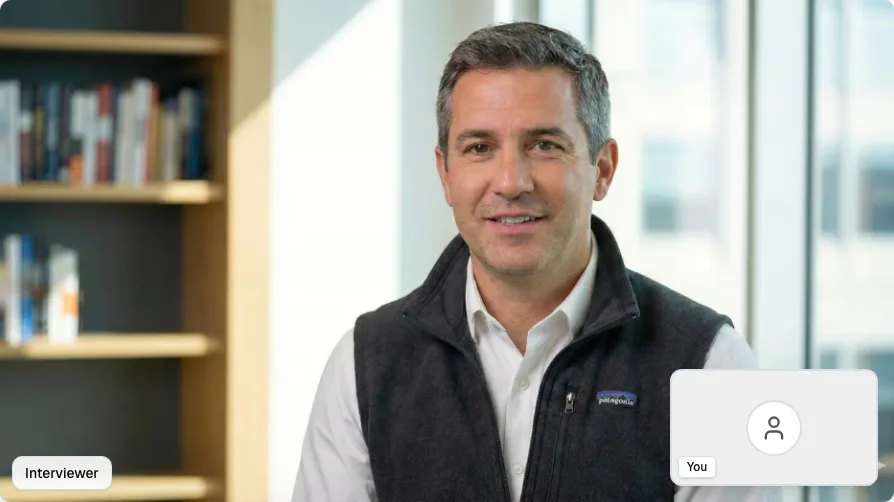
Candidates over-engineer this by preparing three unrelated speeches. They are not three questions. They are one motivation narrative seen from three angles, and your job is to keep them consistent.
- What motivates you is the broadest. It asks what energizes you as a person and worker, in or out of consulting.
- Why consulting narrows it. It asks why this profession is the place those motivations get satisfied better than the alternatives you could have chosen.
- Why this firm narrows it again. It asks why this specific firm, given its work, culture, and staffing model, fits you better than its direct competitors.
The mistake is answering them as if they have nothing to do with each other, then contradicting yourself. If "what motivates you" is solving messy quantitative problems, but "why consulting" suddenly becomes "I love mentoring people," the interviewer notices the seam.
For the full firm-fit version of this, the why consulting answer guide goes deeper on the "why consulting" layer specifically, and pairs directly with everything here.
The 3-reason structure: anchor each motivation to a real experience
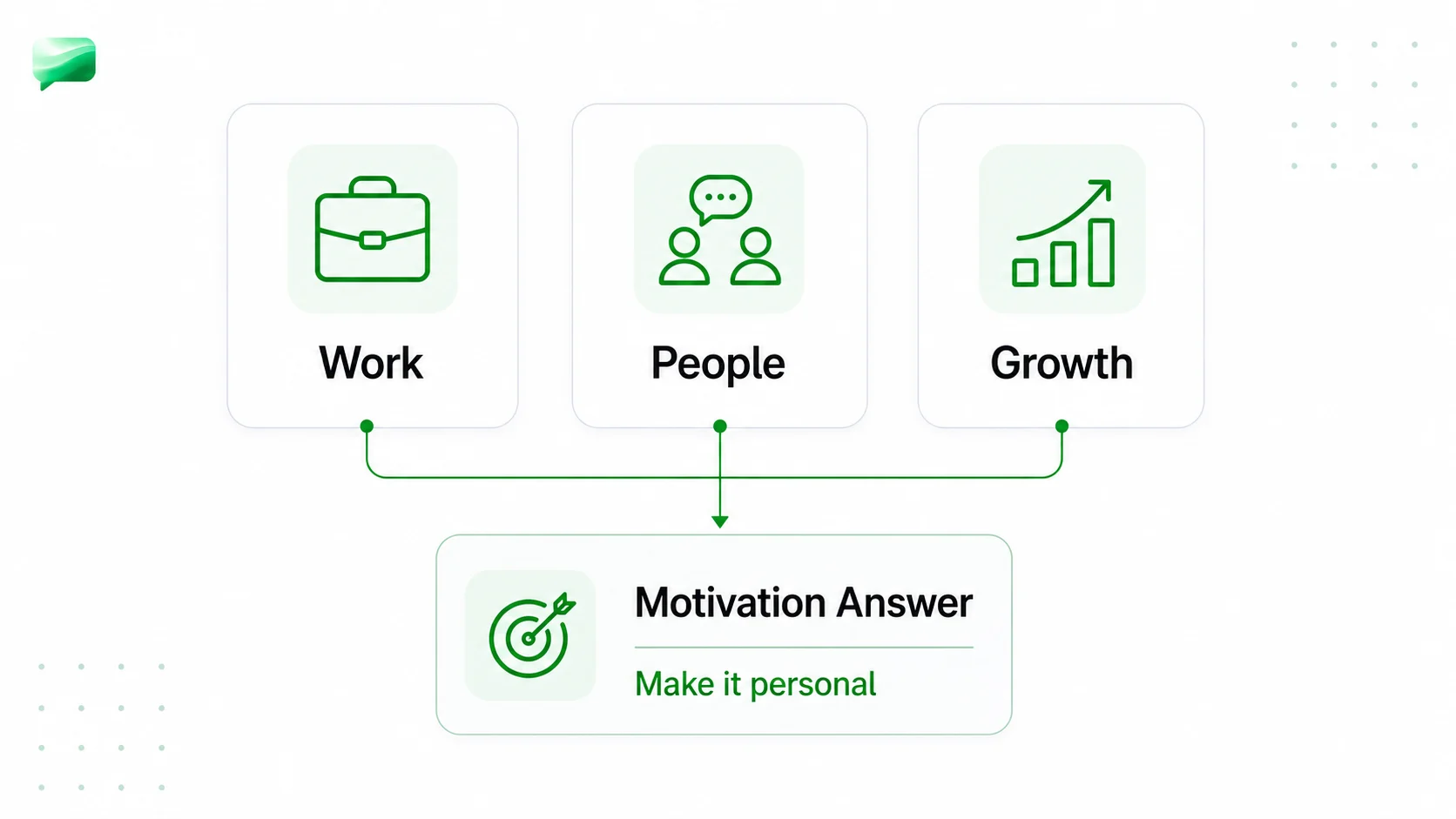
The structure most strong answers use is simple: two or three motivations, each one welded to a specific experience that proves it. The proof is the entire game. Anyone can say "I love problem solving." The candidate who says "I love problem solving, and here is the week I spent rebuilding a broken pricing model for a student client" is the one who is believed.
Here is the scaffold. Fill it in five minutes and you have a defensible answer.
CaseBasix recommends a comparable four-step build: reflect on your real motivation, connect it to your skills and experience, align it to your goals, and tailor it to the firm. The principle underneath both is the same. A motivation without a story is just a claim, and interviewers discount claims.
If you only remember one rule from this section: never give a motivation you cannot immediately back with a real moment. If you cannot think of the moment, it is not really your motivation, and the interviewer will sense it.
Motivations that actually land (and how to make each one yours)
Four motivations consistently read as genuine because consulting delivers them daily. The trap is naming them generically. Below is each one, plus how to make it specific to you.
- Meaningful client impact. Generic: "I want to make an impact." Specific: tie it to a moment you saw your analysis change a real decision. The student club project where your margin breakdown made the owner restructure the plan. The internship where your model killed a bad investment.
- Variety of problems and industries. Generic: "I like variety." Specific: name the moment you realized you get bored in one lane. The summer where you were staffed across retail, then healthcare, then logistics, and the whiplash was the best part.
- Fast skill-building and steep growth. Generic: "steep learning curve." Specific: describe a time you grew faster under pressure than you thought possible, and why you want to keep doing that on purpose rather than by accident.
- Working with sharp, driven teams. Generic: "smart colleagues." Specific: recall a team that pushed your thinking and the specific way they made your work better, so it reads as a working preference, not flattery.
The difference is not eloquence. It is evidence.
Cliches and red-flag answers to cut
Some answers are not just weak, they are actively harmful because they trigger the retention worry the interviewer is screening for. Cut these.
None of these are lies, which is why candidates use them. The problem is they answer a different question. "What motivates you" asks what makes you good and durable in the role. "Exit opportunities" and "prestige" answer "what do you get out of it," which is exactly the answer that makes a firm hesitate to invest in you.
Turn your answer into a 60 to 90 second story
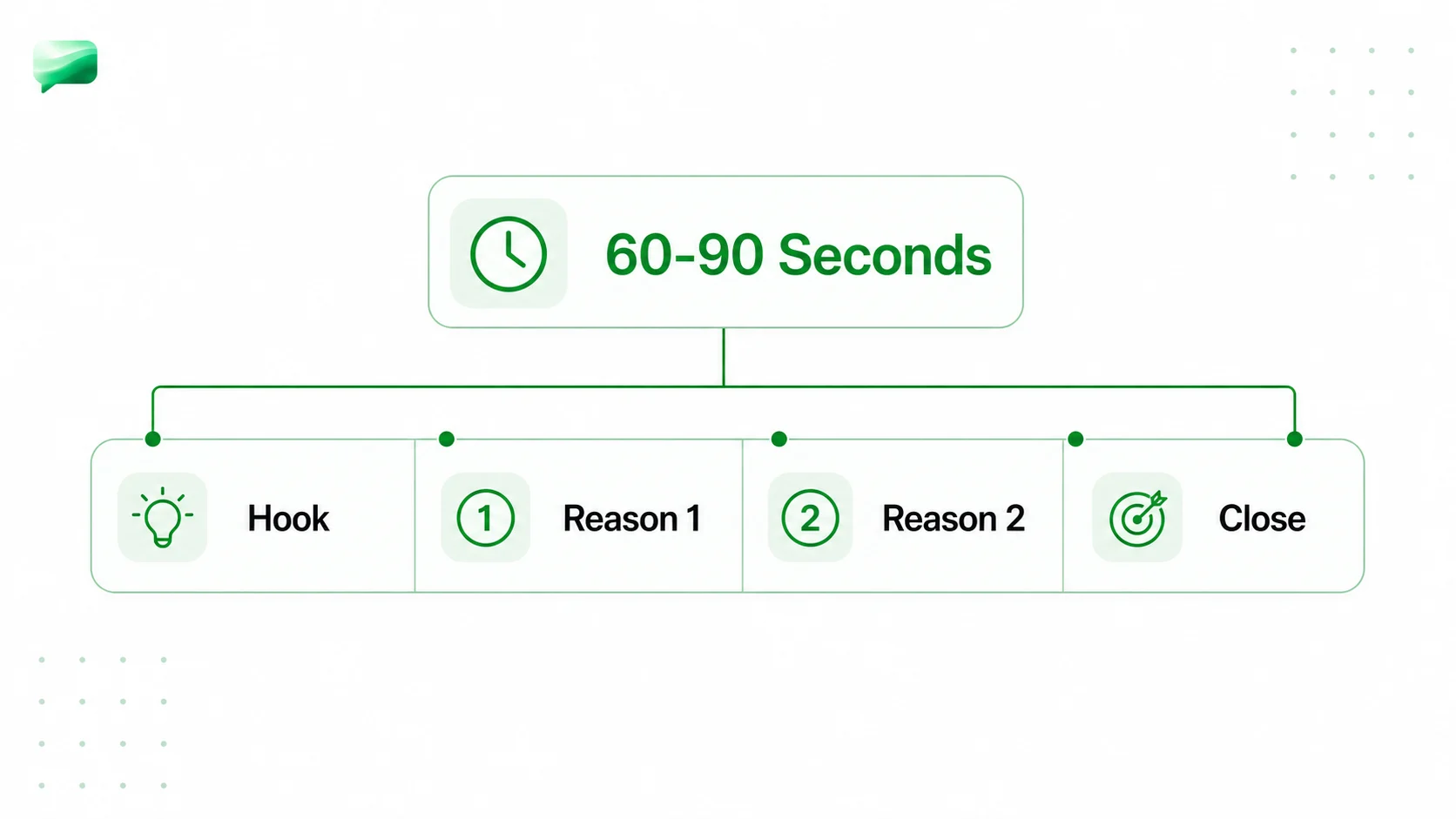
The single biggest upgrade is to stop listing values and start telling a short story. A list of three abstract motivations is forgettable. A 60 to 90 second story where you lived one of those motivations is memorable, and memorable wins.
MyConsultingOffer frames this as an A STAR(E) approach, a story-first version of the classic STAR structure. A practical mini-STAR for a motivation answer looks like this:
- Situation: one line of context so the interviewer knows where you were.
- Task: the problem or decision you faced.
- Action: what you did, where the real signal lives.
- Result: what changed because of you.
- (Emotion or reflection): the line that connects the experience to what now drives you. This is the part that turns a story into a motivation.
The reflection is where you say it out loud: "That is the moment I realized I want a job where analysis changes decisions, and that is consulting." Without it, you have told a competence story but not a motivation story.
PrepLounge makes an important counterpoint worth holding alongside this: do not force a rigid STAR template when the question does not call for it. Their guidance is to answer authentically, distinguish intrinsic from extrinsic motivation, and back the claim with a personal example. So use STAR as scaffolding for one anchored story, not as a cage that makes your answer sound robotic. One real story, lightly structured, beats a perfectly templated one that has no pulse.
Tailor your motivation to the specific firm
Generic motivation answers sound interchangeable across McKinsey, BCG, and Bain. The fix is referencing something real about how the firm actually works, so the answer could not survive being copied to a competitor.
One concrete lever is staffing model. MyConsultingOffer points to a real structural difference: McKinsey traditionally uses an on-site staffing model where teams deploy to the client, while Bain leans toward local staffing that keeps consultants closer to a home office. If part of what motivates you is immersion in the client's world and travel, that maps to McKinsey's model and you can say so. If part of what motivates you is sustained team continuity and a tighter local community, that maps better to Bain. Either way, you are now answering with a fact about the firm rather than a platitude.
The most credible firm tailoring comes from real contact: a consultant you spoke with, an event you attended, a report you actually read. That research is also what makes the difference between sounding interested and sounding informed.
Annotated sample answers: strong vs weak
Templates without reasoning are useless, so here are two answers to the same question with the logic exposed.
Weak answer.
"I'm really motivated by the steep learning curve in consulting. You get exposure to senior leaders, you work on a variety of projects, and the exit opportunities afterward are incredible. I think the prestige of working at a top firm would also push me to do my best work."
Why it fails: every phrase is a known cliche, there is zero proof, and two of the four reasons (exit opportunities, prestige) are exactly the extrinsic, take-not-give motivations that trigger the retention worry. The interviewer learns nothing about who you actually are, and quietly files you as a flight risk.
Strong answer.
"Two things really drive me. The first is seeing analysis change a decision. On my student consulting team, our client's margins were sliding and the team assumed it was pricing. I broke it into mix, shrink, and promotional timing and found the real driver was a shift toward lower-margin fresh goods. The owner restructured the plan and revenue per square foot rose the next quarter. That feeling of evidence actually moving a decision is what I want more of. The second is variety. I get restless in one domain, and consulting is the rare job where I would touch a new industry every few months. Your firm's on-site staffing model also fits how I work, because I do my best thinking embedded in the client's world rather than at a distance."
Why it works: two distinct intrinsic motivations, each anchored to a specific proof (one a full mini-story, one a clear preference), an explicit reflection line that names what drives him, and a firm-specific reference (staffing model) that survives the swap test. It is roughly 75 seconds spoken. The interviewer leaves with a clear, credible picture of a candidate who will last.
Delivery and practice: don't sound scripted
A perfect answer delivered like a recited script still reads as fake, and fit is partly a vibe check. The delivery rules are short.
- Keep it to 60 to 90 seconds, two minutes maximum. Stop once you have made your point. Rambling past the result dilutes it.
- Stay positive and authentic. Do not motivate yourself by trashing your current job or another industry. Pull toward consulting, do not push away from something else.
- Rehearse out loud, not in your head. The gap between a story that reads well and one that says well is large. Say it to a wall, a friend, or a recording until the beats feel natural.
- Memorize the structure, not the words. Lock in your two motivations and their proof. Let the exact phrasing vary so it sounds like thinking, not recitation.
The "tell me about yourself" opener and the motivation answer are close cousins, and rehearsing them together keeps your overall fit narrative consistent. The tell me about yourself guide covers that opener in full, and a clean handoff from it into your motivation story makes the first five minutes of any interview feel deliberate.
How this fits the broader fit and PEI arc
"What motivates you" rarely stands alone. It sits inside the fit or personal experience portion of the interview, alongside a predictable cluster of questions: tell me about yourself, why consulting, why this firm, a leadership story, a time you faced conflict, and a failure or weakness. They are all probing the same underlying thing from different directions: are you a genuine, durable fit.
McKinsey formalizes this more than most firms through its Personal Experience Interview, where structured behavioral stories about leadership, drive, and impact are scored as rigorously as the case. Your motivation answer should not contradict the stories you tell there. If your motivation is impact, your leadership and drive stories should show you chasing impact. The McKinsey PEI guide breaks down how those stories are evaluated and how to build a story bank that stays internally consistent with your motivation.
Treat the whole fit portion as one argument with one through-line. Your motivation answer states the thesis. Your behavioral stories are the evidence. When they reinforce each other, the interviewer trusts all of them more.
The fastest way to make any of this land is reps. You can pressure-test your motivation story and your full fit narrative with Road to Offer's behavioral simulator, then carry a tighter, more confident version into the room.
Sources
- MyConsultingOffer, Why Consulting and What Motivates You (checked June 26, 2026)
- CaseBasix, Why Consulting (checked June 26, 2026)
- Indeed, Why Consulting interview answers (checked June 26, 2026)
- PrepLounge, How to answer what motivates you (checked June 26, 2026)
Frequently asked questions
Resources and related guides
- Practice a real behavioral interviewPractice
- Browse all free resourcesResource hub
- Tell Me About a Time You Failed: Consulting AnswerGetting Started · Jun 30, 2026
- Why Bain? How to Answer the Fit Question (2026 Sample Script)Getting Started · Jun 27, 2026
- Why BCG? How to Answer the Fit Question (2026 Structure, Swap Test & Sample)Getting Started · Jun 27, 2026