
Tell Me About a Time You Failed: Consulting Answer
How to answer tell me about a time you failed in consulting interviews: what interviewers score, lesson-first STAR, and strong vs weak examples.
Your first interview question
Get your full coached feedback now. Continue the interview free after sign-up.

On this page
"Tell me about a time you failed" is one of the most-feared fit questions in consulting interviews in 2026, but the failure itself is almost never what gets you cut. PrepLounge's coaches frame it as a Personal Fit stress question that probes how you analyze a past experience, admit a mistake, show honesty, and draw conclusions for the future. Yet the interviewer is not scoring the size of your mistake. They are scoring four things: whether you own the decision, whether your judgment held up under imperfect conditions, what specific lesson you drew, and whether you actually changed your behavior afterward. The candidates who get dinged are the ones who pick a "safe" failure that was really someone else's fault, or who narrate the whole story and forget the lesson. This guide shows you what consulting interviewers reward, with a lesson-first structure and annotated good and red-flag answers.
Why consulting firms ask "tell me about a time you failed"
Picture a real candidate who walked into a final round, chose a tidy failure about a group project where "a teammate dropped the ball," and narrated it confidently for two minutes. The interviewer's notes did not say "weak failure." They said "no accountability." That is the trap. The question looks like it is about the failure, so candidates optimize to make the failure look small or someone else's fault. The interviewer is doing the opposite: using the failure as a controlled environment to watch how you handle being wrong.
Consulting firms run on people who can be junior, under-informed, and wrong in front of clients, then recover fast without ego. So the failure question tests self-awareness, accountability, resilience, and a growth mindset. PrepLounge's long-running thread frames it precisely as a Personal Fit stress question that probes how you analyze past experience, admit mistakes, show honesty, and draw conclusions for the future. None of those four things require an impressive failure. They require an honest one, owned cleanly, with a lesson that stuck.
What interviewers actually score in a failure answer
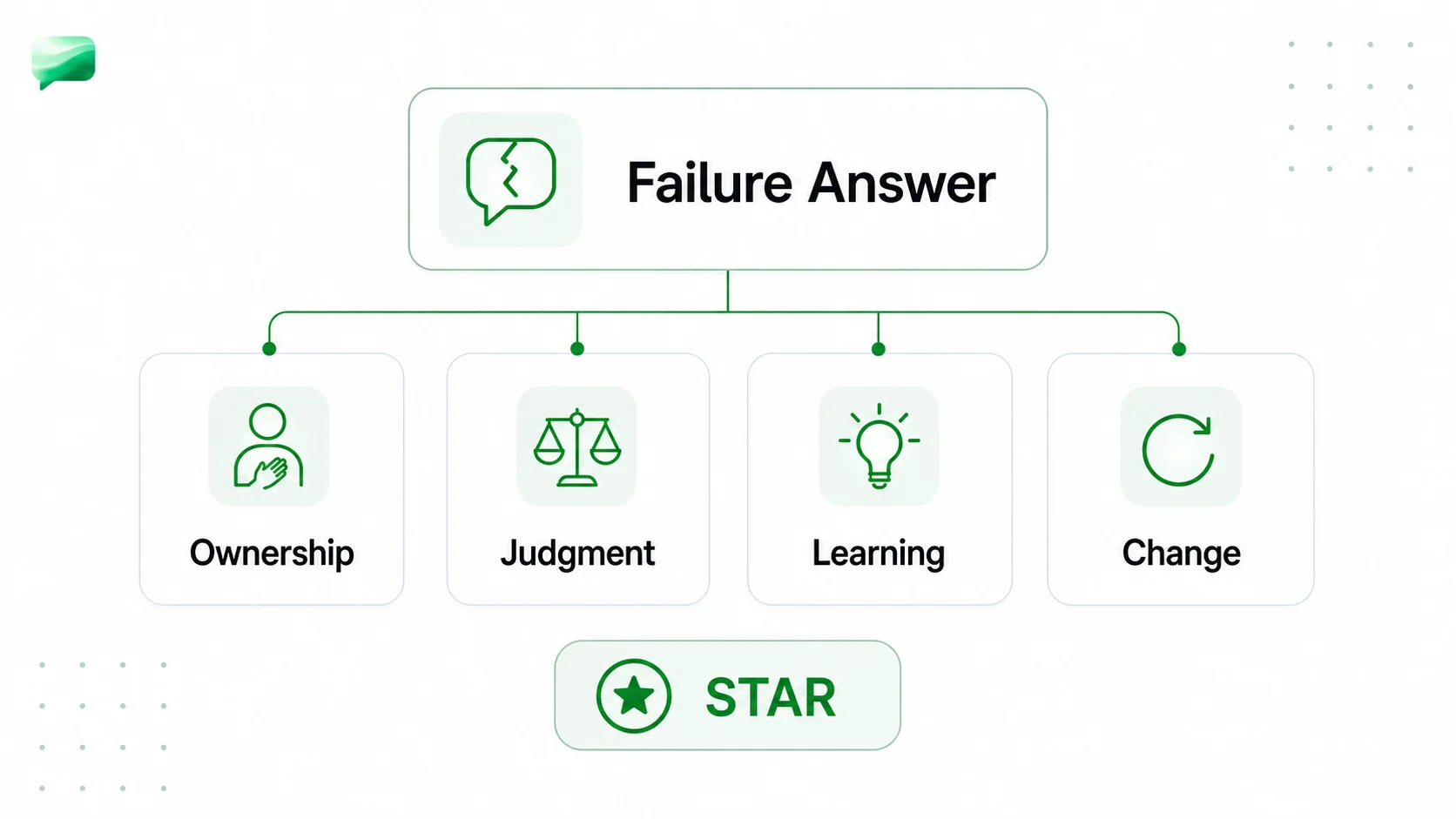
The interviewer is not running a generic empathy check. They are scoring four specific signals, in roughly this order of weight.
Ownership is the gate. If you fail it, nothing else gets scored, because the interviewer has already concluded you deflect. Judgment is the nuance most candidates miss: a good failure shows you made a defensible decision with the information available, and the world simply broke a different way. That is far stronger than a failure caused by carelessness, because it signals you can be trusted with ambiguity. The lesson must be specific enough that it could only have come from this experience. And the behavioral change is what converts a mistake into evidence of growth: name the new habit, and ideally name the later moment where the new habit paid off.
How the failure question maps to the McKinsey PEI
Here is the detail almost every competing article misses. At McKinsey, the Personal Experience Interview has no standalone "failure" prompt. The PEI evaluates four dimensions: Leadership (setting direction and mobilizing a team), Connection (influencing without authority, formerly Personal Impact), Drive (taking initiative and owning outcomes, formerly Entrepreneurial Drive), and Growth (driving change despite resistance and learning from failure, formerly Courageous Change). A cold "tell me about a time you failed" is not one of those four labels, but it lives most naturally inside Growth, which explicitly rewards learning from a setback, as candidates work through in the PrepLounge PEI discussion.
The practical consequence: do not prepare a free-floating failure story. Prepare a story that demonstrates one of the four PEI dimensions and contains a real failure inside it. A Drive story about a bold initiative that fell short on its first attempt is ideal, because it shows ambition, ownership, and recovery in one narrative, and a Growth story about learning from a genuine setback is the most direct fit of all. That single move converts the dreaded question into a dimension you were going to be scored on anyway. Our full McKinsey PEI guide breaks down how each dimension is scored, and the behavioral interview consulting guide covers how the same stories travel across BCG, Bain, and the rest.
A consulting-adapted STAR structure that front-loads the lesson
Standard STAR (Situation, Task, Action, Result) buries the lesson at the end and over-invests in context. For a consulting failure answer, invert it. Lead with the lesson, keep the setup minimal, and spend your airtime on the decision you owned and what changed.
Lesson-First Failure Story Structure
- 01
1. Headline the lesson. Open with one sentence naming what this taught you. It tells the interviewer where the story is going and signals self-awareness up front.
- 02
2. Minimal context. Two sentences maximum. Just enough for the stakes and your role to make sense. Resist the urge to justify.
- 03
3. The decision you owned. State the specific call you made, in the first person. This is the accountability moment the interviewer is waiting for.
- 04
4. The failure and root cause. What went wrong, and why. Name the real root cause, not a comfortable proxy. Honesty here is the whole test.
- 05
5. The behavioral change. The concrete habit or process you adopted afterward, ideally with proof it worked in a later situation.
The difference is stark in practice. A narrative-first answer makes the interviewer wait 90 seconds to learn whether you actually own anything. A lesson-first answer establishes accountability in the first sentence, then uses the rest of the time as evidence. You sound like someone who has already processed the failure, which is exactly the maturity the question is hunting for.
How to choose the right failure, and which to avoid
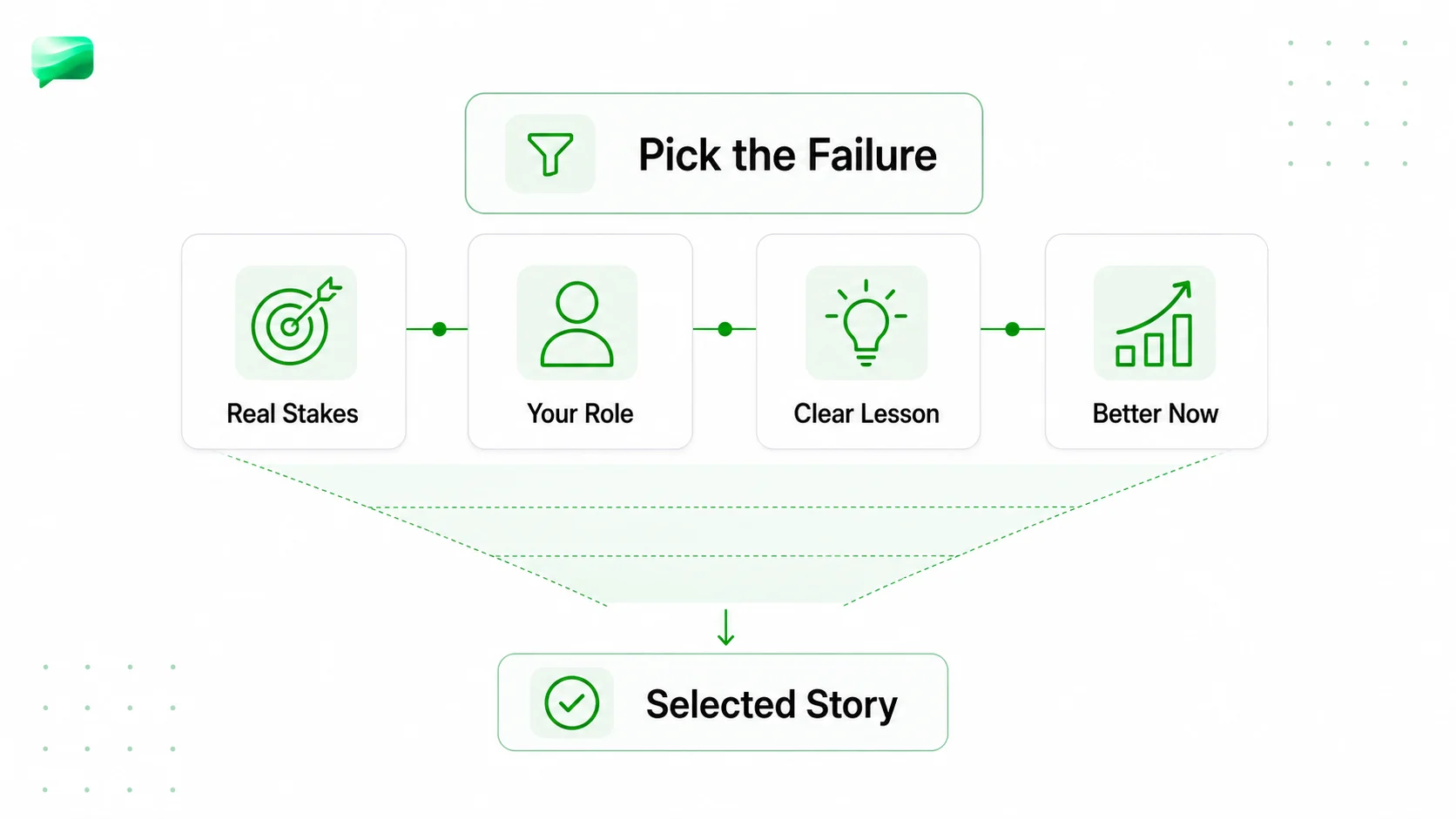
The story you pick determines most of your score before you say a word. A good consulting failure has three properties: real stakes (something or someone was actually affected), genuine personal ownership (you made the call that went wrong), and demonstrated recovery (you can point to what you changed). Miss any one and the answer collapses. Real stakes with no ownership is a complaint. Ownership with no recovery is a confession.
Just as important is what to avoid:
- A rejected consulting application or a failed prior interview. PrepLounge coaches warn against this explicitly. It tells the interviewer you only care about landing the job, not about judgment in real work, and it puts a rejection front of mind right when they are deciding about you.
- Trivial failures. "I once missed a typo in a report" signals you cannot recall a real one, which reads as either low self-awareness or low-stakes experience.
- Fake failures. "I work too hard and burned out" is a humble-brag, and every interviewer has heard it. It fails the honesty test instantly.
- Failures fully outside your control. A project killed by a budget freeze you never touched gives you nothing to own, so there is no signal to score.
The strongest pick is usually a moderate-stakes failure where you made a defensible decision that did not work out, then changed how you operate. For help mining your own history for these, the leadership story examples guide walks through turning real experiences into scored fit stories.
Two worked answers: strong version vs red-flag version
Same candidate, same underlying event, two ways to tell it. Watch what each one signals.
Why it scores: the lesson is in sentence one. The candidate says "I decided" and "my call," so ownership is unambiguous. The decision was defensible (saving time under pressure) rather than careless, which protects judgment. The lesson is specific to this event, and the behavioral change is concrete and proven by a later win.
Why it fails: the failure is pinned on teammates and "bad luck," so ownership never appears. There is no specific decision the candidate made, so there is nothing to score on judgment. "Teamwork can be hard" is not a lesson, and "a better team next time" puts the fix outside the candidate's control. This answer can describe the exact same project and still get a candidate cut, which is the entire point of the question.
Common mistakes that trigger red flags
Most failed answers fail for one of these reasons. Scan the list before your interview and check your story against it.
- Blaming others or circumstances. The fastest way to fail the question. Even one "but the client kept changing the brief" can flip the read from accountable to defensive.
- Picking a trivial or fake failure. A non-failure tells the interviewer you cannot or will not be honest about a real one.
- Skipping the lesson and the change. A story that ends at the failure is just a confession. The lesson and the behavioral change are where the points are.
- Humble-bragging. "I cared too much about quality" is transparent and erodes trust.
- Burying the answer in over-long context. If the interviewer is 90 seconds in and still waiting for the decision, you have lost the room. Cut the setup hard.
How to deliver the answer without raising red flags
Content gets you most of the way, but delivery decides whether the ownership reads as genuine. The tone that works is calm, factual accountability, the same register a consultant uses to brief a client on a project that went sideways. State what happened and what you decided in plain terms. Name your own role without hedging words like "kind of" or "I guess." Skip the emotional justification: the interviewer does not need to know how stressed you were, and dwelling on it reads as self-protection.
Keep the setup concise and let the decision and the change carry the weight. Do not over-apologize, and do not over-explain why the failure was not really your fault, because both undercut the accountability you are trying to demonstrate. A composed, matter-of-fact delivery signals that you have already metabolized the failure and moved on, which is precisely the resilience the question is built to detect.
Follow-up questions interviewers fire after a failure story
A strong failure answer invites follow-ups, and competitors almost never prepare candidates for them. Treat each as a deeper probe of the same four signals.
- "Why did you decide that at the time?" This tests judgment. Defend the decision on the information you had then, not on hindsight. "Given the deadline and what we knew, skipping the pilot looked like a reasonable trade" is a strong answer. "I don't know, I just did" is not.
- "What would you do differently?" This must match the lesson you already stated, not introduce a new one. Be specific and operational: the exact step you would add, not "I'd be more careful."
- "Did the change actually stick?" The highest-value follow-up. Have a second, later example ready where you applied the new habit and it paid off. This is the difference between claiming you grew and proving it.
- "How did the team or client react?" Tests accountability under social pressure. Show you owned it to the people affected, not just in your own head.
Prepare these answers in advance for each of your two or three failure stories. The follow-ups are where prepared candidates separate from rehearsed ones.
Your failure-story preparation checklist
Execution checklist
Build 2 to 3 ready failure stories. One backup matters because the interviewer may say 'give me a different one' or the first may overlap with a story you already used. Pull from work, internships, projects, or significant extracurriculars.
Tie each story to a target competency. Map each failure to a PEI dimension or fit theme (Leadership, Connection, Drive, or Growth) so the same story answers multiple questions.
Pressure-test each pick against the avoid list. Confirm real stakes, genuine ownership, and a concrete recovery. Cut any story that is trivial, fake, blames others, or uses a rejected application.
Write the lesson-first structure for each. Headline the lesson, keep context to two sentences, then decision, root cause, and behavioral change. Front-load accountability.
Prepare the four follow-ups per story. Why you decided that, what you'd do differently, whether the change stuck (with a second example), and how others reacted.
Rehearse out loud to 90 seconds to 2 minutes. Time it. Trim setup and hedging until the decision lands fast and the answer fits the window without rushing the lesson.
Get honest feedback before the interview. Have a peer, mentor, or an AI fit drill score you on ownership and the lesson specifically, not just polish. The blind spot is almost always weak accountability.
The failure question rewards preparation more than almost any other fit prompt, because the instinct under pressure is to deflect, and deflection is the one thing it is designed to catch. Build the stories, tie them to the dimensions, rehearse the delivery, and the question you dread becomes one you can win.
Sources
- PrepLounge: Tell me about a time you failed (Personal Fit thread) (checked June 26, 2026)
- PrepLounge: McKinsey PEI interview, tell me about a time you have failed (checked June 26, 2026)
Frequently asked questions
Resources and related guides
- Practice a real behavioral interviewPractice
- Browse all free resourcesResource hub
- What Motivates You? Consulting Interview AnswerGetting Started · Jun 30, 2026
- Why Bain? How to Answer the Fit Question (2026 Sample Script)Getting Started · Jun 27, 2026
- Why BCG? How to Answer the Fit Question (2026 Structure, Swap Test & Sample)Getting Started · Jun 27, 2026