
Why BCG? How to Answer the Fit Question (2026 Structure, Swap Test & Sample)
A fill-in-the-blank way to answer 'Why BCG?' in 2026: a 3-reason structure, the swap test that kills generic reasons, a current BCG fact sheet, and a 60 to 90 second sample answer.
Your first interview question
Get your full coached feedback now. Continue the interview free after sign-up.

On this page
A strong "Why BCG?" answer in 2026 is not a list of compliments about the firm. It is two or three BCG-specific reasons, each backed by your own evidence, delivered in roughly 60 to 90 seconds, the length CaseBasix recommends for this question. Interviewers ask it to screen for genuine motivation, the depth of your research, how clearly you communicate, whether you fit the culture, and whether you would actually accept an offer. The fastest way to fail is a reason that would still read fine if you pasted in "McKinsey" or "Bain," so every reason needs a detail only BCG could claim. BCG gives you plenty to work with: founded in 1963 by Bruce Henderson, the firm now reports 14.4 billion dollars in revenue and runs more than 100 offices across over 50 countries. This guide hands you a fill-in-the-blank structure, a one-line swap test, a sourced fact sheet, and a sample answer you can rehearse out loud against a timer.
Why interviewers ask "Why BCG?" and what they screen for
This question looks soft. It is not. In the time it takes you to answer, your interviewer is scoring five things at once.
- Genuine motivation. Do you want consulting, or do you want this firm? A reason that only works for BCG proves the second.
- Depth of research. Generic praise signals you read the homepage for ten minutes. A named program, report, or person signals real effort.
- Communication. Can you make a clear point in under two minutes without rambling? The fit question is a live sample of how you will sound in front of a client.
- Culture and fit. BCG wants people who match how it works. Leland notes that 97% of BCG employees said they felt personally responsible for maintaining the firm's values in 2022, which tells you culture is taken seriously internally.
- Offer acceptance. Firms protect their yield. A candidate with a specific, evidence-backed reason is far more likely to sign than someone who applied everywhere with one script.
The takeaway: treat "Why BCG?" as a screening question with a right structure, not a vibe check you improvise.
What actually makes BCG different from McKinsey and Bain
Before you can write a BCG-specific reason, you need raw material that is BCG-specific. Here is a current fact sheet to pull from. Use one detail, not all of them.
The hard facts behind the firm, all from Wikipedia's BCG entry: BCG was founded in 1963 by Bruce Henderson, reports 14.4 billion dollars in revenue (2025), employs roughly 33,500 people (2026), and operates more than 100 offices across over 50 countries.
The 3-reason structure: a fill-in-the-blank skeleton
Stop writing essays. Build the answer from a repeatable formula and fill the blanks:
[BCG-specific reason] + [my evidence] + [why it matters to my goals]
Run that formula two or three times, in priority order, and you have a complete answer in the 60 to 90 second window CaseBasix recommends (Leland frames the same target as about 1 to 2 minutes). One worked blank:
- BCG-specific reason: "BCG X lets me do strategy that ships, not strategy that sits in a deck."
- My evidence: "I spent two years building an analytics tool for my team and I do not want to leave the build behind."
- Why it matters: "I want a consulting career where I stay close to the product, and BCG X is the clearest version of that."
Notice the structure is the same one you use for the broader 'Why consulting?' answer, just aimed at the firm instead of the path. Keep those two answers separate so neither sounds recycled.
Run the swap test on every reason
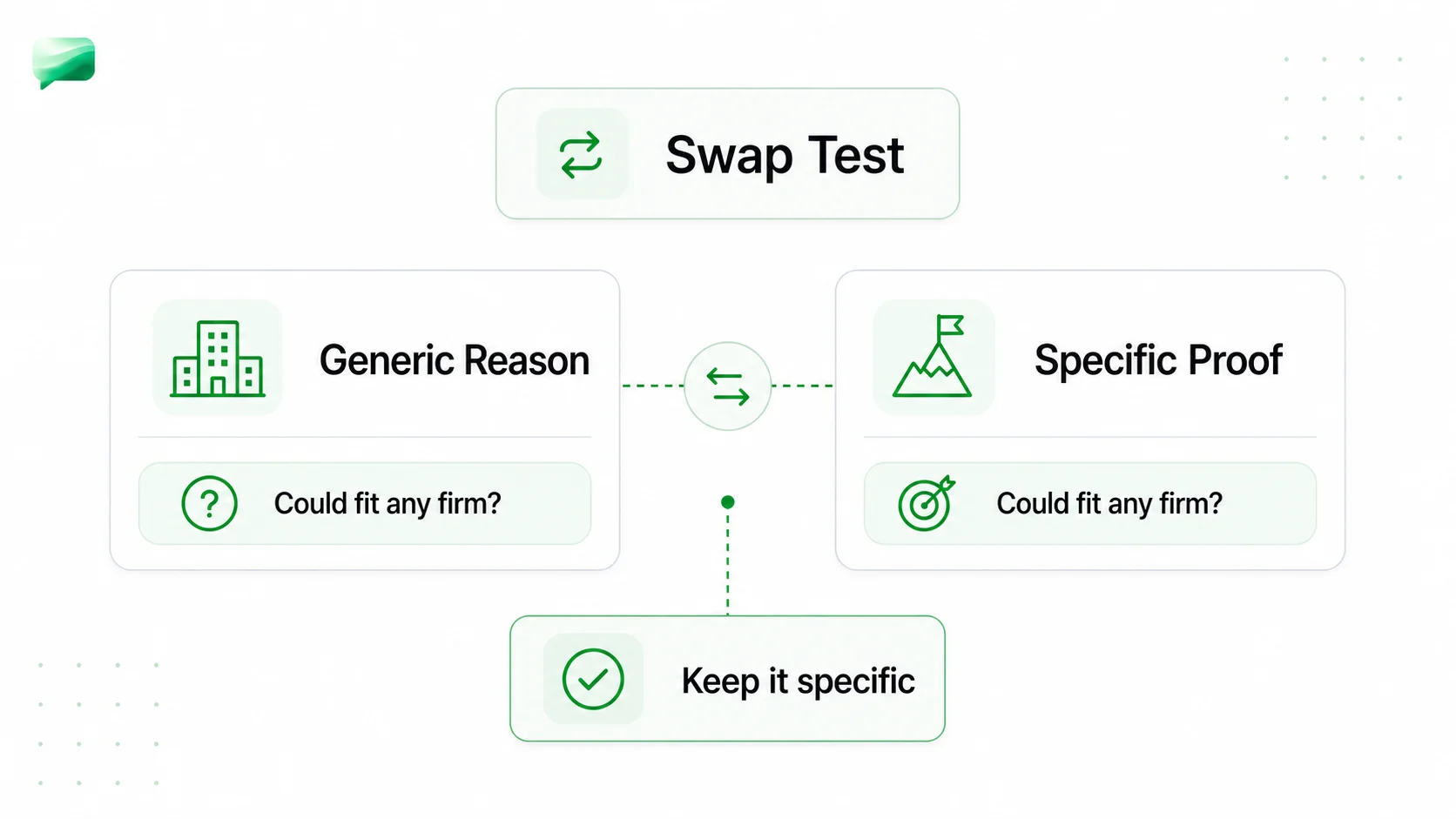
This is the single rule that fixes most weak answers, and almost no one operationalizes it. After you draft each reason, do this literally:
- Read the reason out loud.
- Replace "BCG" with "McKinsey," then with "Bain."
- If the sentence still sounds true, delete it. It is not a reason to join BCG, it is a reason to join consulting.
"I want to work with smart people on impactful projects" survives the swap, so it is dead weight. "BCG X pairs me with engineers to build the product" breaks the moment you swap in another firm, so it stays. At least one of your reasons must be so BCG-specific that the swap test breaks it instantly.
The people angle: name a real conversation
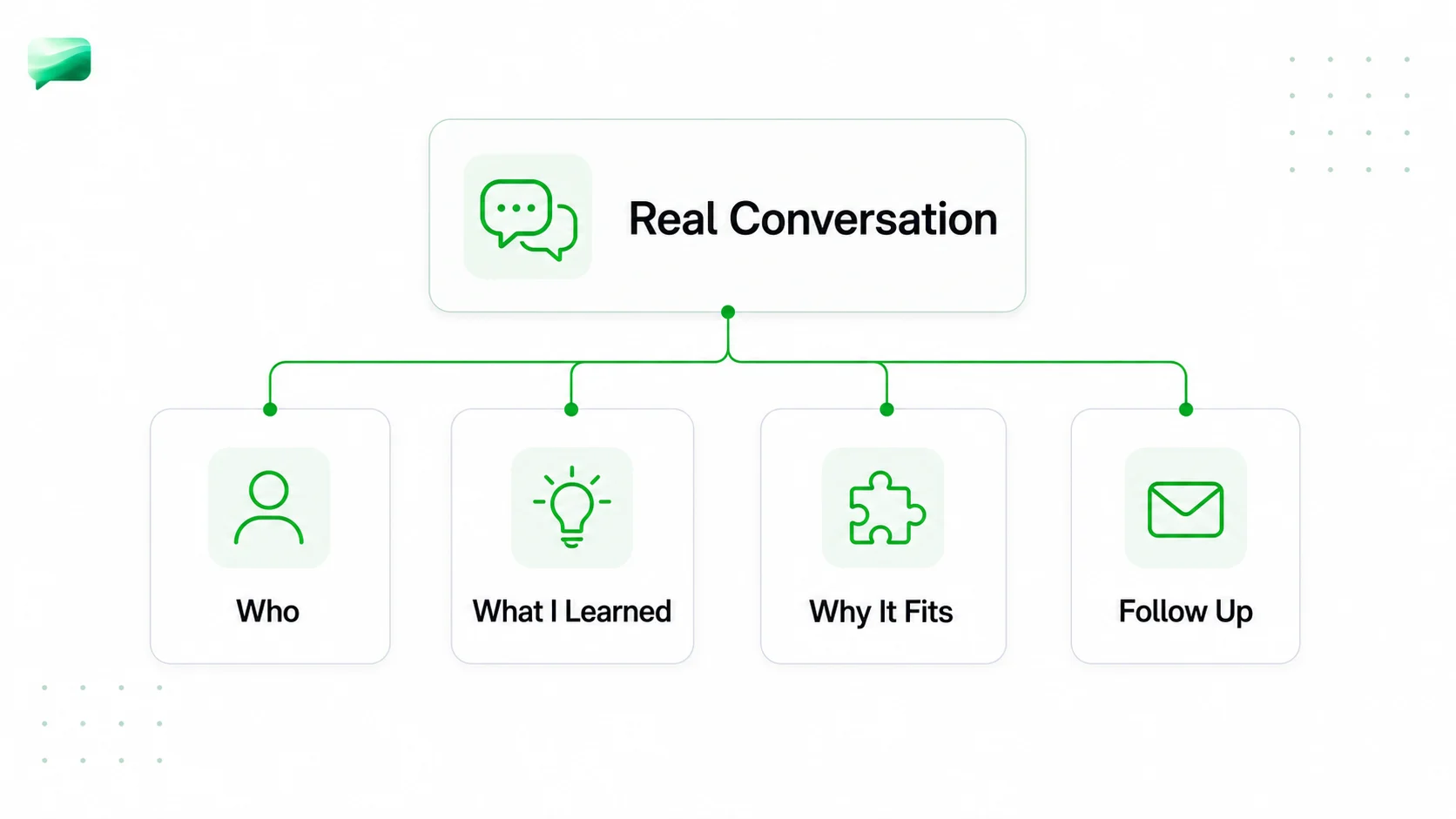
The strongest differentiator you can use is a person. A reason built on someone you actually spoke with cannot be copied from any website, and it proves research in a way no fact can.
- Attend a coffee chat, campus session, networking event, or virtual info session.
- Ask one consultant a real question about how they work day to day.
- In your answer, quote that conversation by name: "When I spoke with [name] in the [office] office, she described how the flexible staffing model let her move from a healthcare case to a climate case in one year."
That sentence does three jobs at once: it is BCG-specific, it is evidence, and it shows you did the legwork. If you only have time to prepare one standout reason, make it this one.
Cite BCG's published research by name
If you cannot land a personal conversation, the next best proof of intellectual engagement is naming BCG's own research. The BCG Henderson Institute is the firm's think tank, and Featured Insights is its public research library. Read one piece and reference it specifically.
Weak: "I love that BCG publishes thought leadership." That survives the swap test, so it is useless.
Strong: "I read the BCG Henderson Institute's work on [specific topic] last month, and the fact that the firm funds a research arm to question its own assumptions tells me the intellectual culture is real, not a recruiting slogan." Naming the report is the whole point. It is the difference between "I browsed the site" and "I engaged with the ideas."
Connect BCG's strengths to your own background
A reason is only persuasive when it ties a BCG strength to something true about you. The pillar you pick should map to your story:
- Technical or product background, choose BCG X.
- Research, academic, or analytical depth, choose the BCG Henderson Institute.
- A varied resume and a desire for range, choose the flexible staffing model.
- A mission or nonprofit thread, choose the social-impact track.
If you are recruiting at McKinsey in the same cycle, build that firm's motivation separately. The McKinsey PEI guide shows how McKinsey screens motivation through personal-experience interviews, which is a different bar than BCG's embedded fit questions. Do not let one answer bleed into the other.
A full sample answer, plus a weak-answer teardown
Here is a complete answer that fits the 60 to 90 second window and survives the swap test.
Now the version that loses the offer:
Common mistakes to avoid
- Generic prestige or "smart people" reasons. They survive the swap test, which means they are not about BCG at all.
- Citing compensation. Never lead with pay. It signals the wrong motivation and every firm pays well.
- Reciting facts with no personal link. "BCG has more than 100 offices in over 50 countries" is a fact, not a reason. A fact only counts when you attach evidence and a goal to it.
- Rambling past 90 seconds. Past the 60 to 90 second target, interviewers stop hearing content and start hearing nerves. Stop at three reasons.
- One answer for every firm. The reason it fails is the reason it is fast: you skipped the research the question is designed to detect.
Office-specific and practice-area research, and where to rehearse
Two quick research moves sharpen any answer. First, look up the specific office you are interviewing with and mention something true about it (a local practice strength, a recent expansion, a person you spoke to there). Second, identify the practice area you are drawn to (BCG X, social impact, a specific industry) and name it. Specificity at the office and practice level is what separates a researched answer from a templated one.
Then rehearse the answer the way you will deliver it: out loud, on a timer, not silently on a page. Pair your fit prep with case prep so the whole BCG loop is covered. The BCG case interview guide walks through the candidate-led case format you will face in the same rounds, and practicing both together keeps your delivery sharp under real time pressure.
Sources (checked June 26, 2026)
- Boston Consulting Group overview (founding, revenue, employees, offices): https://en.wikipedia.org/wiki/Boston_Consulting_Group
- CaseBasix, Why BCG answer length and structure
- Leland, How to answer the Why BCG behavioral question (length and values stat)
Frequently asked questions
Resources and related guides
- Practice real BCG casesPractice
- Browse all free resourcesResource hub
- Why Bain? How to Answer the Fit Question (2026 Sample Script)Getting Started · Jun 27, 2026
- Why McKinsey? How to Answer the Fit Question (Sourced Differentiators + Sample Answers) (2026)Getting Started · Jun 27, 2026
- Tell Me About a Time You Failed: Consulting AnswerGetting Started · Jun 30, 2026