How to Structure Your Case Interview Opening Statement
Mar 1, 2026
Frameworks · Case Interview, Opening Statement, Structure
Road to Offer Team
Road to Offer
We built Road to Offer to make deliberate case practice accessible to every candidate — not just those who can afford $200/hour coaching.
- -Strategy consulting background
- -200+ candidates coached
Published Mar 1, 2026
Summary
Master the first 2 minutes of a case interview. Covers clarifying questions, structuring the problem, and how to open your case in a way that signals top-tier candidate quality.A case interview opening statement is a structured 2-minute sequence — covering one or two clarifying questions, a restatement of the objective, and a presentation of your analytical framework — that immediately follows the interviewer's prompt. McKinsey's interviewing page describes the case opening as the moment candidates demonstrate how they "structure tough, ambiguous challenges" and "identify important issues." Management Consulted's case structure guide recommends 2 minutes for silent structuring and 2 minutes to present it, calling the opening sequence the first scored moment of the interview.
This guide provides the exact sequence — and the exact words — for the first three minutes of any case interview, from the moment the interviewer finishes the prompt to the moment you start your analysis.
Practice your opening under realistic pressure
Run through the first three minutes of a case with AI feedback on your clarifying questions, structure, and hypothesis.
Try a free case →The Opening Sequence: Four Steps in Three Minutes
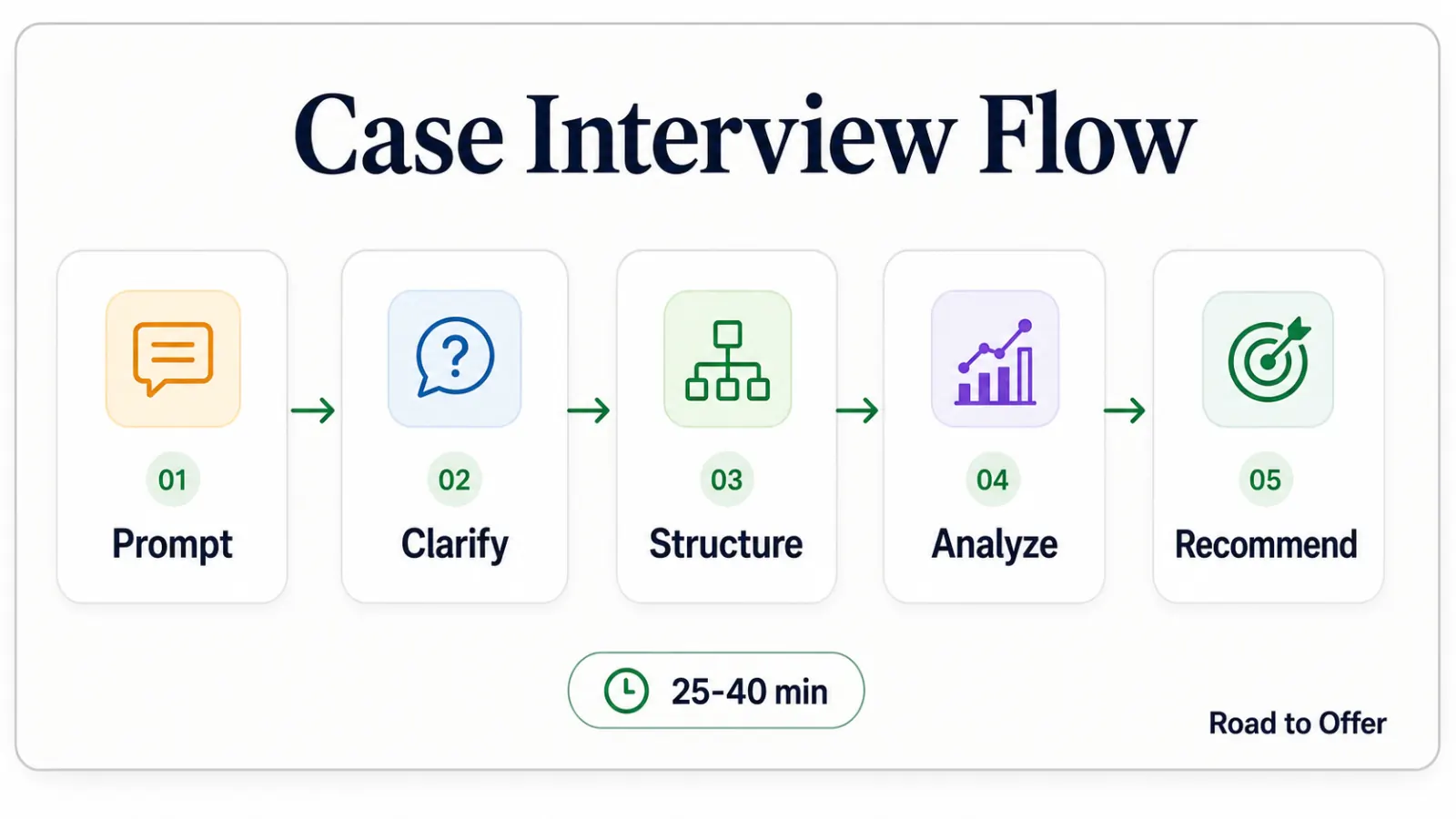
The case interview opening has four distinct steps. Skipping any of them creates risk. Here is the full sequence with approximate timing:
| Step | What You Do | Time |
|---|---|---|
| 1. Listen and take notes | Capture key facts while the prompt is delivered | 60-90 sec (interviewer-driven) |
| 2. Ask clarifying questions | 1-2 targeted questions that affect your structure | 30-45 sec |
| 3. Restate the objective | Confirm your understanding of what you are solving | 15 sec |
| 4. Structure time + presentation | Silent structuring, then walk through your framework | 2-3 min structure + 60-90 sec presentation |
Candidates who skip steps 2 or 3 — jumping straight to structure time — regularly misalign with the case's actual objective and spend 15 minutes solving the wrong problem. Management Consulted's case structure guide uses the BGOT framework — Business model, Geography, Objective, Timeline — as a checklist for clarifying questions, noting that "your questions should ensure you acquire the highest leverage information that would influence your case structure."
Step 1: Listen Actively and Take Structured Notes
While the interviewer delivers the case prompt, you have two simultaneous jobs: absorb the content and capture the most important details on paper.
What to write down:
- The client: company type, industry, market position if mentioned
- The situation: what is happening, for how long, what has changed
- The explicit objective: what the client wants to know or decide
- Quantitative anchors: revenue figures, growth rates, time horizons, market size
- Unusual details: anything that seems oddly specific — these are usually clues
Do not try to write everything verbatim. Use shorthand. You will have your notes throughout the case, so capturing the right numbers and the core framing matters more than capturing every word.
What to listen for: Pay attention to specificity in the prompt. If the interviewer mentions the decline started in Q3 of last year, that is not throwaway context — it is a signal. If they say the company is the market leader, that affects competitive framing. Every adjective and qualifier is potentially meaningful.
Word-for-word example of what to say when the prompt ends:
"Thank you. Let me make sure I captured the key details — I have a couple of clarifying questions before I structure my approach."
This single sentence accomplishes three things: it acknowledges the prompt, it signals that you took notes, and it previews your next step (clarifying questions). The interviewer knows exactly what is coming.
Step 2: Ask 1-2 Clarifying Questions That Shape Your Structure
Clarifying questions serve two purposes: they ensure you understand the case correctly, and they demonstrate to the interviewer that you are thinking critically about the problem from the very start.
The constraint: Ask 1-2 questions that genuinely affect how you would structure the problem. Asking 4-5 questions looks like stalling. Asking questions the prompt already answered signals you were not listening.
What Makes a Clarifying Question Good vs. Bad
A good clarifying question addresses something that, if the answer were different, would change your analytical approach. Use the BOTM framework to identify what to ask about:
- Business model: "Could you help me understand how the client generates revenue? Is this primarily subscription-based or transaction-based?" (Only ask if not clear from the prompt.)
- Objective: "When you say 'improve profitability,' is the client targeting a specific margin level, or is this more about understanding the root cause of the decline?"
- Timeline and scope: "Is the client looking at this as a short-term fix over the next 12 months, or is this a longer-term strategic question?"
- Metric of success: "What does the client consider a good outcome here — is this a go/no-go decision, or are they already committed and looking for the best approach?"
Examples of strong clarifying questions in context:
For a profitability case: "You mentioned the profitability decline has been ongoing. Is this a recent trend over the past 12 months, or has it developed over several years? That would affect whether I focus on cyclical factors or structural ones."
For a market entry case: "When you say 'expand into a new market,' is the client considering organic growth, acquisition, or both? That would change how I scope the analysis."
For a growth strategy case: "Is the client looking to grow within their current product lines, or are they open to adjacent products or services? That affects whether I focus on market share capture or portfolio expansion."
What makes a bad clarifying question:
- Asking what the company does when it is obvious from the prompt
- Asking questions whose answers you can assume without consequence
- Restating the prompt back as a question ("So they want to improve profitability?")
How to phrase it: Signal that your question has analytical purpose. "Before I structure this, I want to clarify one thing that would affect my approach..." is better than "Wait, can you repeat what the client does?"
Step 3: Restate the Objective in One Sentence
Before starting structure time, confirm your understanding of the core question you are being asked to solve. This step takes 15 seconds and protects you from the most costly error in a case interview: solving the wrong problem.
The script:
"So to confirm my understanding: [Client] is facing [situation], and the core question we need to answer is [explicit objective]. I'm going to take a couple of minutes to structure my approach — does that sound right?"
Three examples:
"So to confirm: the client is a mid-market SaaS company that has seen a 6-point margin decline over three years despite stable revenue growth. The core question is what is driving the margin compression and how to reverse it. I'd like to take a couple of minutes to structure my approach — does that align with what you're looking for?"
"To make sure I have this right: the client is a European consumer goods company evaluating entry into the US market. The question is whether the US market represents an attractive opportunity and, if so, what the right entry strategy would be. Let me take a few minutes to organize my thinking."
"So the situation is: the client is a regional hospital network whose patient volume has declined 15% in two years. We need to diagnose the root cause and recommend a recovery path. I'll take a couple of minutes to structure this — does that capture it?"
The "does that sound right?" at the end gives the interviewer a clean opportunity to correct you. Most of the time they will confirm. Occasionally they will add an important nuance. Either way, you are protected.
Step 4: Structure Time — What to Do in the Silent Two Minutes
You have asked clarifying questions and confirmed the objective. Now say: "Could I take a couple of minutes to structure my thinking?" The interviewer will say yes. Take 2-3 minutes of silent note organization.
What to do during structure time (in order):
First, identify the case type. Is this profitability, market entry, market sizing, growth strategy, M&A, pricing, or operations? The case type gives you a structural starting point — but only a starting point.
Second, identify the specific version of the question. Not "this is a profitability case" but "why has EBITDA margin declined 6 points in three years despite revenue growth." The specificity of the question should shape the specificity of your structure.
Third, design 2-4 buckets that collectively cover the key drivers. The best structures are:
- MECE: Mutually exclusive (no overlap) and collectively exhaustive (nothing important is missing)
- Hypothesis-informed: They reflect your initial hypothesis about where the answer likely lives
- Client-specific: They use language from the actual business, not generic consulting labels
Fourth, identify your starting point and why. After presenting your buckets, you need to say where you are going first and have a reason — grounded in your hypothesis about where the answer most likely lives.
A critical note on frameworks vs. structures: The profitability framework, market entry framework, or any standard template is scaffolding, not a finished structure. A profitability tree for a SaaS company should look different from one for a physical retailer — the revenue drivers and cost structures are fundamentally different. IGotAnOffer's case frameworks guide specifically warns that "memorizing pre-made frameworks will NOT impress your interviewers" — you need custom frameworks tailored to each case's specific details. If your structure labels are "Revenues / Costs / Market" for every profitability case, you are demonstrating memorization, not thinking. Customize.
Your structure labels reveal how deeply you understand the business. "Customer acquisition cost trends by channel" is more insightful than "costs." "Revenue per user by subscription tier" is more specific than "revenue." The specificity of your labels tells the interviewer whether you are applying a generic template or actually thinking about this client's business.
How to Present Your Structure: The Word-for-Word Transition
The transition from silent structuring to spoken presentation is where many candidates stumble. Here is the exact sequence to follow.
Step 1: Signal the transition.
"I've organized my thinking into [number] areas I'd want to explore."
Step 2: Walk through each bucket. For each one, provide:
- A specific label (not "revenue" — rather "pricing and volume dynamics by segment")
- 2-3 sub-elements you would investigate within that bucket
- One sentence on why this bucket matters for this specific case
Step 3: State your starting point with hypothesis logic.
"I'd like to start with [bucket], because given [specific detail from the prompt], I think the most likely driver is [hypothesis]. Starting there allows us to confirm or rule out the most probable explanation first."
Step 4: Invite the interviewer into the conversation.
"Does that make sense as a starting point?"
Full example of a strong structure presentation:
"I've organized my thinking into three areas. First, cost structure evolution — specifically whether fixed costs have expanded faster than revenue over the past three years, and whether unit variable costs have changed. Given that revenue has been stable while margin has compressed, cost-side changes seem like the most probable driver.
Second, revenue quality — I'd want to understand whether there has been a mix shift toward lower-margin products or customer segments, even if total revenue is stable. Sometimes stable top-line revenue masks a margin-destructive mix change.
Third, competitive and market context — understanding whether this margin compression is company-specific or an industry-wide dynamic, which would change the recommendation significantly.
I'd like to start with cost structure, because the pattern of stable revenue plus declining margin is most commonly driven by fixed cost expansion that hasn't been absorbed by volume. I'd want a cost breakdown by year. Does that make sense as a starting point?"
This presentation takes 60-90 seconds. It demonstrates structured thinking, business specificity, and a clear hypothesis. The final question invites the interviewer to redirect if needed.
What McKinsey's Candidate-Led Format Demands Differently
At McKinsey, the opening structure is more critical than at BCG or Bain because you are running a candidate-led case. The interviewer does not guide you through a sequence of questions — you drive the entire analysis. Your structure is the roadmap for the full 35-minute conversation. McKinsey's interviewing page describes the problem-solving interview as evaluating "how you structure tough, ambiguous challenges" — placing structuring ability at the center of what McKinsey assesses, which explains why a weak opening in the candidate-led format is so difficult to recover from.
This means:
- Your structure must be more comprehensive, because you are responsible for covering all relevant areas
- Your initial hypothesis must be clearer, because you will be directing your own analysis
- Your starting point must be deliberate, because there is no interviewer question to redirect you
The McKinsey Case Interview Guide covers the candidate-led format in depth, including how to manage your hypothesis throughout the case.
At BCG, the interviewer guides you through specific questions even after your structure, so your opening is more of a demonstration of structured thinking than a literal roadmap. The BCG Case Interview Guide has format-specific advice.
The Five Most Common Opening Mistakes
1. Skipping clarifying questions entirely. You may seem eager and decisive. You are actually taking on the risk of solving the wrong problem. Always ask 1-2 questions.
2. Asking too many clarifying questions. More than 3 sounds like stalling. Keep it to 1-2 focused questions with clear analytical purpose.
3. Using a verbatim pre-built framework. If your structure labels are identical to a textbook framework, the interviewer — who has seen hundreds of candidates — knows you are reciting, not thinking. Customize your labels to the client's business.
4. Forgetting to state your starting point. Presenting a three-bucket structure without saying where you will start leaves the interviewer uncertain about your direction. Always conclude your presentation with "I'd like to start with X because..."
5. Presenting before you are ready. Some candidates feel pressure to start talking quickly. If you need 3 minutes of structure time, take 3 minutes. An organized structure after 3 minutes is far better than a half-formed one after 90 seconds. The interviewer expects you to use the full time — they will tell you to take as long as you need.
Practice the Opening in Isolation
The opening is the one part of a case interview you can practice completely alone. Write out a case prompt, set a 3-minute timer, draft a structure, and then deliver the full sequence out loud: clarifying question, restatement, structure presentation with stated starting point.
Record yourself and listen back. Evaluate:
- Did you ask a clarifying question that genuinely shaped your approach?
- Did you restate the objective before structuring?
- Did your structure labels reflect the specific business, not a generic template?
- Did you state a clear starting point with hypothesis logic?
- Did you end with "Does that make sense?" to invite the interviewer in?
Our structure drills include opening exercises where you receive AI feedback on specificity, MECE quality, and hypothesis clarity. The opening structure is weighted heavily in the scoring rubric — a strong opening establishes your structure score within the first few minutes and creates momentum for the rest of the case.
Key Takeaways
- The opening sequence: listen and note-take, ask 1-2 clarifying questions, restate the objective, take structure time, present with a stated starting point.
- Clarifying questions should genuinely affect your structure — use the BOTM framework (Business model, Objective, Timeline, Metric of success) to identify what to ask.
- Always restate the objective before structure time. The phrase "does that sound right?" protects you from solving the wrong problem.
- Take the full 2-3 minutes for structure time. A clean structure after 3 minutes beats a messy one after 90 seconds.
- Present with specific labels, 2-3 sub-elements per bucket, and a stated starting point backed by a clear hypothesis.
- At McKinsey, the opening structure is more critical than at BCG or Bain — it is your roadmap for the entire candidate-led case.
Practice with AI
Sources and Further Reading (checked March 1, 2026)
- McKinsey case interview preparation, structuring ability as a primary evaluation criterion: mckinsey.com/careers/interviewing
- BCG case interview preparation, evaluation of problem-solving approach and communication: careers.bcg.com/global/en/case-interview-preparation
- Bain case interview preparation, case interview format and what Bain assesses: bain.com/careers/hiring-process/case-interview
- Management Consulted, case interview structure guide including the BGOT clarifying question framework and 2+2-minute opening timing: managementconsulted.com/case-interview-structure
- IGotAnOffer, common case interview frameworks guide on customizing structure vs. using pre-built templates: igotanoffer.com/blogs/mckinsey-case-interview-blog/118288068-case-interviews-frameworks-comprehensive-guide
- Management Consulted, insider scoring guide on McKinsey's question-by-question scoring vs. BCG/Bain aggregated scores: managementconsulted.com/insiders-look-case-scoring-system
Frequently asked questions
Continue your prep path
Next actions based on this article: one pillar hub, two related guides, and one conversion step.
Pillar hub
Case Interview Frameworks Hub
Related guide
Hypothesis-Driven Thinking in Case Interviews
Related guide
Operations & Cost Optimization Framework for Case Interviews (2026)
Related articles
Hypothesis-Driven Thinking in Case Interviews
Learn how to form and test hypotheses like a consultant in case interviews. Covers hypothesis structure, when to update, common traps, and worked examples. 1600+ words.
Operations & Cost Optimization Framework for Case Interviews (2026)
A practical operations and cost optimization framework for case interviews: cost reduction levers, supply chain analysis, process improvement, and a fully worked manufacturing example.
PE Due Diligence Framework for Case Interviews (2026)
A practical PE due diligence framework for case interviews: market assessment, financial analysis, operational improvement, management evaluation, risk assessment, and a fully worked acquisition example.