
Scale vs Profitability Case Interview: Decision Frameworks
Decide between scale and profitability in a case interview with a 4-step decision model, a decision table, a numeric worked example, branch questions, and drills.
On this page
A scale vs profitability case interview asks whether the client should lead with expansion or margin discipline when it cannot safely optimize both at once. The useful decision framework starts with the client objective, then tests demand quality, unit economics, fixed-cost leverage, cash constraints, operational complexity, and competitive timing. Your recommendation should not be a vague "grow and improve margins." It should name the lead objective, explain the evidence that supports it, and sequence the next move: scale now, fix profitability first, or run a controlled pilot before committing. This case type rewards judgment under pressure, not memorized buckets. You build a driver tree, open the right branch, do the math that matters, and turn the evidence into a clear recommendation.
If you need the broader prep map around this case type, start with the case interview prep guide after you finish this framework.
What does scale vs profitability mean in a case interview?
Scale means the client is trying to expand: more locations, more customers, more production, more utilization, or more geographic coverage. Profitability means the client is trying to improve the relationship between revenue and cost: better price realization, lower variable cost, tighter fixed-cost absorption, cleaner customer mix, or less operational waste.
Growth and scale are related but not identical. Growth can mean higher revenue without better economics, while scale only helps if additional volume improves the business model or strengthens the strategic position enough to justify the cost. Harvard Business School Online frames the core scale logic as cost advantages that come from higher volume, while warning that expansion creates diseconomies when complexity rises faster than efficiency improves (HBS Online). That distinction is the heart of this case type.
A standard profitability case asks why profits are down and how to fix them. A scale vs profitability case asks a sharper question: should the client chase the growth opportunity before fixing the economics, or repair the model before expanding it? That is why a decision tree framework beats a generic revenue-cost tree here. You are choosing a path, not listing every possible issue.
The trade-off shows up in recognizable situations: a startup burning cash to grow that must choose between buying market share and protecting runway, a retailer or restaurant chain whose every new site dilutes average margin, a subscription business adding users whose lifetime value barely covers acquisition cost, or a manufacturer filling idle capacity only by discounting to win lower-quality demand. The surface question is "should we grow?" The real question is whether the next wave of volume makes the business stronger or weaker.
When should scale lead and when should profitability lead?
Use the table as a fast diagnostic before you commit to a full structure.
The scale-first case is strongest when fixed-cost leverage is real. A plant, platform, hub, or store network may become more profitable as volume spreads fixed costs across more units. The profit-first case is strongest when more volume brings more discounts, overtime, maintenance, churn, or service failures. If market timing is the key reason to scale, test it with the market attractiveness framework so your recommendation is grounded in demand quality and competitive pressure, not just revenue ambition.
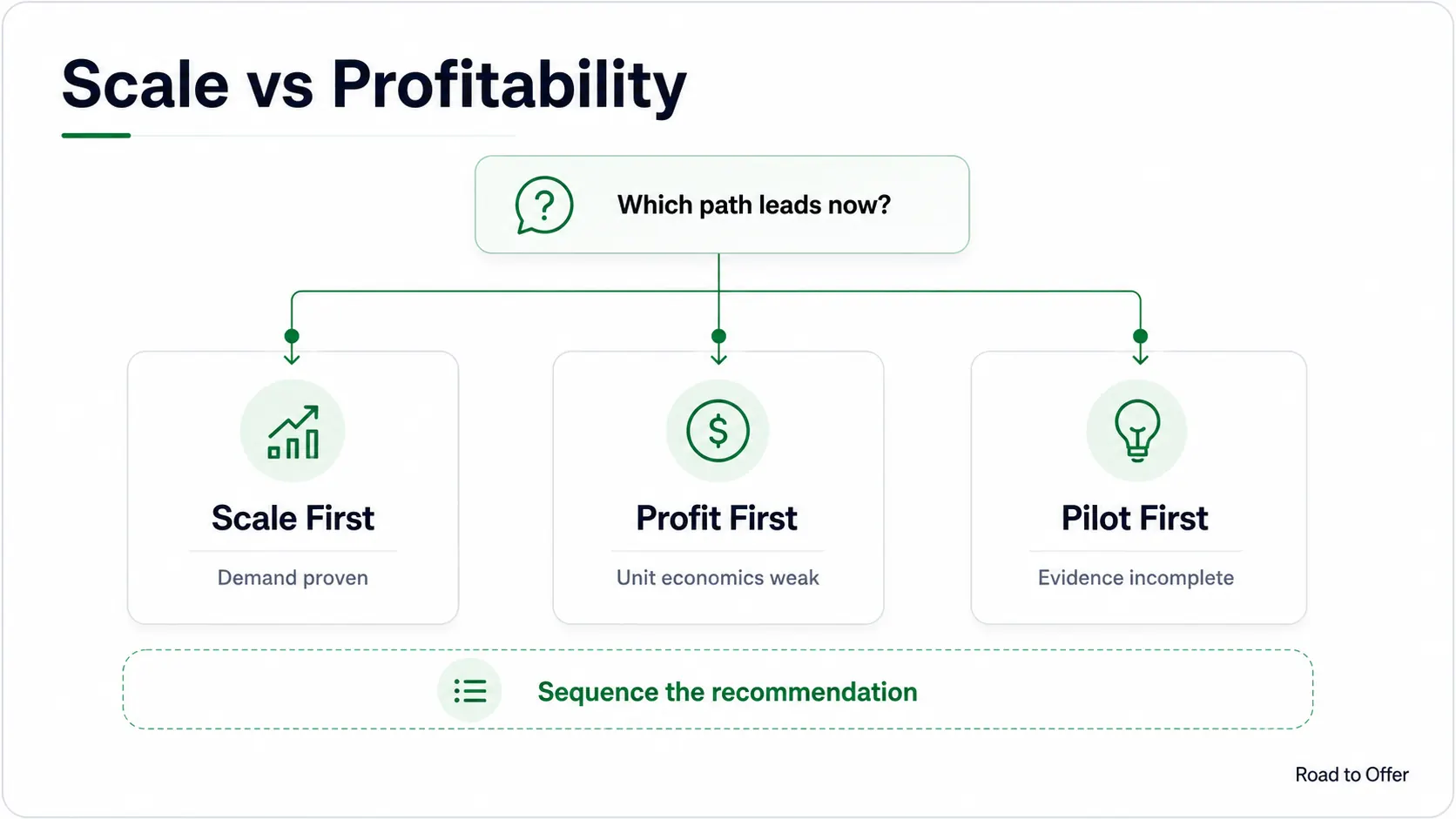
The diagnostic is only useful if you can turn it into a structure under time pressure. Take a prompt cold, build the branches, and get graded on whether the tree actually separates scale from margin.
How does the math actually flip the recommendation?
Every scale vs profitability case reduces to a handful of relationships. Keep them on your scratch paper so you can set up the decisive calculation in seconds:
- Profit = Revenue minus Cost
- Revenue = Price times Volume
- Variable Cost = Cost per Unit times Volume
- Contribution Margin = Price minus Variable Cost per Unit
- Breakeven Volume = Fixed Cost divided by Contribution Margin per Unit
The first calculation worth running is the mix check, because revenue can rise while profit falls. PrepLounge uses a chewing-gum manufacturer to make this concrete. The non-flavored line earns 100 of revenue at 60 of cost, a 40 percent margin. The flavored line earns 150 of revenue at 120 of cost, a 20 percent margin. Sales shift toward the flavored line, total revenue climbs, and total profit still erodes because the mix moved toward the lower-margin product (PrepLounge). Run the blended number to see it directly. Selling one unit of each gives 250 of revenue and 70 of profit, a blended margin of 28 percent. Sell two flavored units and one non-flavored unit and you get 400 of revenue but only 100 of profit, a blended margin of 25 percent. More revenue, lower margin, and in a capacity-constrained plant possibly lower absolute profit. That is the entire scale vs profitability problem in one calculation: more units is not more profit unless the next unit carries acceptable economics.
The second calculation governs fixed-cost leverage. Suppose a site carries 200,000 of annual fixed cost and each customer contributes 40 of margin. Breakeven volume is 200,000 divided by 40, or 5,000 customers. Customer 5,001 adds a clean 40 of profit because fixed cost is already covered, so above breakeven scale is pure margin expansion. Now suppose winning the next 2,000 customers requires a 25 percent price cut that drops contribution from 40 to 30. Those 2,000 customers add 60,000 of contribution (2,000 times 30), but if the discount also applies to the existing 5,000 customers, the price cut costs 5,000 times 10, or 50,000. Net gain is only 10,000, and that is before any added service or capacity cost. Run the breakeven both ways in the room, with and without the discount spilling onto the existing base, and the recommendation usually decides itself. The same logic underpins any break-even analysis case interview, so the reps transfer.
Worked example: should an EV charging operator scale or fix margins first?
Imagine a client operates EV charging hubs. Demand is rising, but profits are weakening. Management wants to know whether to add more locations or fix margins at existing sites first.
Start with the objective: maximize sustainable profit while protecting strategic position in priority regions. Then create hypotheses. Scale may be right if utilization is rising, new sites can reach healthy usage, and higher volume spreads fixed site costs. Margin recovery may be right if energy costs, maintenance, underused sites, or fleet discounts are making each incremental session less attractive.
Your first data requests should separate demand from economics. Ask for utilization by site, revenue per charging session, energy cost by time of day, maintenance cost, fleet versus retail mix, discount levels, capex needs, and site-level margins. Now put numbers on it so the branch choice is not a hunch. Say each retail session bills 12 of revenue against 7 of energy and processing cost, a contribution of 5 per session. A hub runs 120,000 of annual fixed cost (lease, network fees, maintenance). Breakeven is 120,000 divided by 5, or 24,000 sessions a year, roughly 66 a day. A mature retail site clearing 90 sessions a day earns (90 minus 66) times 5 times 365, about 43,800 of annual profit, so scale clearly helps where retail demand is real.
The fleet contracts look like growth but behave differently. A fleet session bills 9 instead of 12 against the same 7 of cost, so contribution is only 2 per session. That site needs 120,000 divided by 2, or 60,000 sessions a year, roughly 164 a day, just to break even. If new "growth" is mostly discounted fleet volume, adding sites multiplies a 2-per-session economics problem instead of the 5-per-session one. The math setup compares incremental contribution from additional sessions against fixed site costs and expansion capex, and it tells you the growth is not all the same growth. The same contribution and breakeven logic appears in any break-even analysis case interview.
The branch choice is now grounded. If utilization growth is concentrated in retail-heavy sites and new hubs resemble those sites, scale can lead. If growth is coming from discounted fleet contracts, high-cost energy windows, or sites that need expensive upgrades, profitability should lead. If the client lacks evidence on new locations, pilot first.
A concise recommendation could be: the client should pause broad expansion and focus on margin recovery at existing hubs (renegotiating fleet pricing and shifting load away from peak energy windows), while piloting new sites only in regions where utilization, energy costs, and retail mix match the profitable locations. The main risks are losing a competitive window and underinvesting in high-demand regions, so the next step is to test a small number of priority locations while fixing pricing, energy procurement, and site operations.
The test of this reasoning is whether it holds when the interviewer pushes back. Defending the sequence out loud, not just the structure, is the skill that separates a strong recommendation from a tidy tree.
Choose scale or margin in a McKinsey profitability case. A Spanish EV charging hub network saw profits fall sharply in a single year. Answer this McKinsey profitability case step in the article, then continue the full case. Continue the full case on Road to Offer
Which branch-selection questions should you ask first?
Before drawing a full tree, ask questions that tell you which branch deserves attention.
For market demand: is demand proven through repeat behavior, or is it management optimism? Are customers profitable, retained, and willing to pay without heavy discounts? Is there a competitive window where delay makes the opportunity meaningfully worse?
For unit economics: does the next unit sold improve contribution margin or weaken it? Are fixed costs spreading across more volume, or are variable costs rising with every extra customer? Is the client gaining economies of scale, or hitting diseconomies of scale through complexity, coordination, and service failures?
For cash and funding: can the client fund expansion without starving operations? Funding often settles the whole case. A company with a long runway and cheap capital can scale through a temporary margin dip to capture a market window, while a company burning cash with months of runway left must fix unit economics first, because a downturn or a missed raise turns an aggressive growth plan into a solvency problem. State the runway assumption out loud, then test how the recommendation changes if funding is abundant versus scarce.
For operations: is capacity actually available, or would growth require overtime, rushed hiring, or weaker customer experience? Is the margin leakage structural (a broken business model) or fixable (pricing discipline and process control)?
Bain case guidance emphasizes clarifying the objective, structuring your thinking, thinking aloud, listening to cues, and highlighting key insights (Bain & Company). These questions help you do that before you lock into the wrong tree.
What are interviewers actually testing with this case?
Interviewers are not testing finance vocabulary. They are testing whether you can reason through an ambiguous client problem, which is how Yale's consulting career guidance frames the work: problem solving across profitability, effectiveness, and short- and long-term growth strategy (Yale Office of Career Strategy). Strong candidates do four things. They show objective clarity by asking what the client is optimizing for before assuming growth is good. They make sensible assumptions, stating what would need to be true for scale to help when the cost curve is unknown. They set up the one calculation that decides the recommendation rather than turning the case into a spreadsheet. And they adapt: toward scale when evidence shows growth improves economics, toward profitability when volume is hiding a worse cost problem. Bain describes the same bar, client problems where candidates show assumptions, math, and constructive problem solving (Bain & Company).
What are the most common mistakes in these cases?
The first mistake is recommending both goals without sequencing. Saying the client should grow while improving margins sounds balanced, but it dodges the decision. Interviewers want to know what leads now and why.
The second mistake is assuming scale automatically improves margins. More volume can spread fixed costs, but it can also bring discounts, service failures, maintenance complexity, and weaker customer mix. If you never test unit economics, your scale recommendation is just a growth slogan.
The third mistake is choosing profitability without competitive context. Delaying expansion can hand a competitor the best customers, locations, or partners. Profit-first can be right, but only after you test whether the delay creates strategic risk.
The fourth mistake is doing math that does not move the recommendation. A clean margin calculation is wasted if it never answers the decision. Tie every calculation to the path: scale first, profit first, or pilot first.
The fifth mistake is treating the framework as a script. The best structures change as evidence arrives. Start with a clean tree, then let the case decide which branch matters. If your tree runs too broad, use the case structure drill to practice turning revenue, cost, utilization, and margin into a focused structure.
Test the decision in a live case
Run a free Road to Offer case and see whether your structure, math, and recommendation handle the scale versus profitability trade-off.
How should you practice this case type?
Reading the framework is not enough. Penn Career Services notes that case interviews present business problems candidates may encounter on the job and that practice matters after learning the basics (University of Pennsylvania Career Services). Practice this case type in a sequence: structure, then math, then the close.
Start with the case interview structure drill to split the problem into objective, demand, unit economics, cash, operations, and competition, then test whether each branch is decision-relevant. Move to case interview math practice for contribution margin, utilization, breakeven, and payback setups, training yourself to find the one calculation that decides the recommendation rather than doing arithmetic for its own sake. Finish with the synthesis drill to turn a messy trade-off into a crisp answer: lead objective, supporting evidence, risk, and next step.
Finally, attempt a full case so the pattern becomes recognizable on sight. Use the case interview questions page to keep the reps varied and work through full case interview examples. For adjacent archetypes, the growth strategy cases guide covers the scale path, the profitability case interview guide covers the margin path, and the revenue growth case interview covers the top-line investment side. The restructuring case interview applies when the trade-off breaks toward distress and the company must stabilize first, and the market entry framework applies when scaling means entering a new geography or segment. Switching into consulting from another field changes the prep emphasis, not the math, which the case interview prep for career changers guide walks through.
Sources
Checked June 18, 2026.
- PrepLounge - Profitability Cases: How to Approach One of the Most Common Cases
- Bain & Company - Interviewing
- Bain & Company - Preparing for the Case Interview
- Harvard Business School Online - How to Leverage Economies of Scale to Grow Your Platform Business
- Yale Office of Career Strategy - Consulting
- University of Pennsylvania Career Services - Consulting
Frequently asked questions
Resources and related guides
- Practice profitability in a real case interviewPractice
- Browse all free resourcesResource hub
- Cost Reduction Case Interview: Framework, Worked Examples, and Common Traps (2026)Frameworks · Mar 20, 2026
- Growth Strategy Framework: How to Structure Growth CasesFrameworks · Feb 3, 2026
- Profitability Framework: Formula, Steps & ExamplesFrameworks · Feb 3, 2026