
Revenue Decline Case Interview: Diagnose and Fix Issues
Learn how to solve a revenue decline case interview with a clear diagnosis tree, worked example, question bank, root-cause fixes, and practice plan.
On this page
A revenue decline case interview asks you to diagnose why sales are falling, fix the issues behind the drop, and explain what the client should do next. The mistake is treating it like a generic profitability case. Revenue decline is narrower: you need to isolate whether the issue sits in price, volume, mix, realization, customer behavior, channel performance, product demand, or market pressure. Start by clarifying the metric and scope, then segment the decline before choosing a branch. If the decline is concentrated in a product, region, customer group, or channel, that segment should drive your structure. If the decline is broad, split revenue into the main drivers and test the most likely cause. Your recommendation should come only after the evidence explains the drop. Strong candidates sound diagnostic, not frantic: they ask targeted questions, request useful exhibits, calculate impact cleanly, and connect the fix to the root cause.
For broader prep context, use the consulting interview process guide after this article.
How to recognize a revenue decline case
A revenue decline case usually starts with a prompt like: sales are down, growth has slowed, a business line is underperforming, or a customer segment is buying less. The client wants to know what changed and how to respond.
That is different from a profit decline case. Profit decline asks whether the issue is revenue, cost, or both. Revenue decline has already narrowed the arena. You may still care about margin when choosing a fix, but your diagnostic tree should focus on sales drivers before cost levers.
Official firm guidance supports this skill-first approach. BCG describes case interviews as realistic business challenges where reasoning, communication, logic, business intuition, and creativity matter, not memorized answers (BCG case interview preparation). Bain also frames cases around client problems, assumptions, quick math, and structured discussion (Bain interviewing).
So your goal is not to recite a formula. Your goal is to show a clean path from prompt to root cause to action.
The revenue decline diagnosis tree
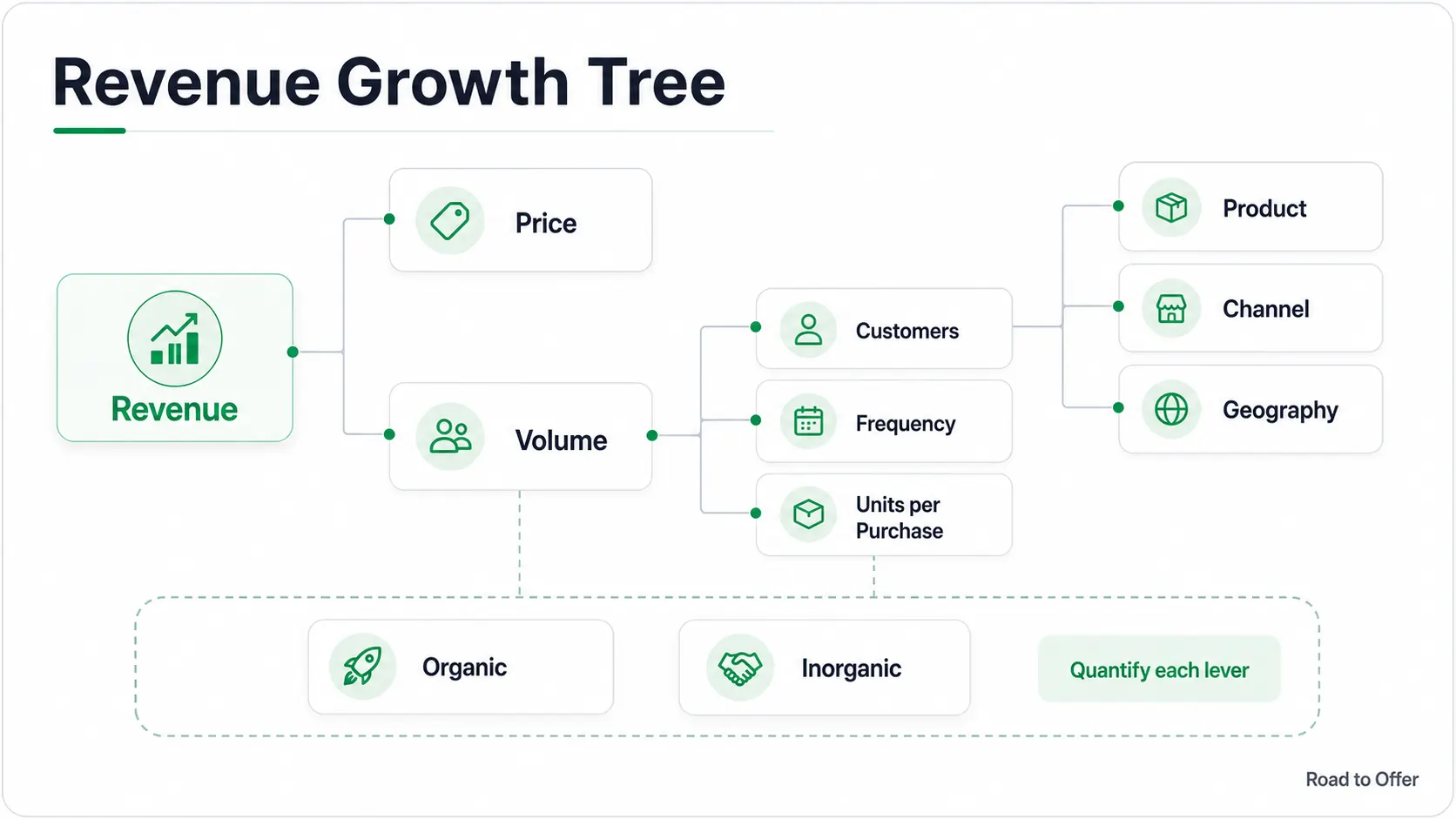
Use a driver tree, not a pasted profitability framework. The top level is revenue. The next branches are price, volume, mix, and realization.
Price asks whether list price, effective price, discounting, or promotional depth changed. Volume asks whether fewer units, transactions, subscriptions, orders, or customers are coming through. Mix asks whether the company is selling a different blend of products, customers, geographies, or channels. Realization asks whether the company is failing to capture the price it expects because of discounts, leakage, returns, cancellations, chargebacks, or payment issues.
Then expand volume. Volume can fall because the market is smaller, share is down, acquisition is weaker, retention is lower, frequency is reduced, channel access is worse, or supply and service constraints are blocking demand.
A clean spoken structure could sound like this: I would first confirm where revenue is declining. Then I would split the decline into price, volume, mix, and realization. Within volume, I would separate market demand from our share and then look at acquisition, retention, frequency, channel access, and any fulfillment constraints.
If your structure feels hard to say aloud, train it with the Case interview structure drill before adding more branches. A revenue tree only helps if the interviewer can follow it.
Worked example: diagnosing a retailer with falling sales
Suppose the client is a fashion retailer with declining sales. Bain publishes a public FashionCo case built around a company facing declining revenue, with prompts that push candidates toward market trends, customer preferences, pricing, volume, and commercial actions (Bain FashionCo case). Use that type of case as the model: diagnose before prescribing.
A strong opening could be: I want to understand whether the decline is broad or concentrated. I would start by splitting revenue by product category, customer segment, channel, and region. Then I would test whether the issue is price, volume, mix, or realization.
If the interviewer says traffic is stable but sales are falling in a specific apparel category, the best branch is not market demand. You should ask for average basket, conversion, category mix, discounting, and return data. If the exhibit shows customers still visit but shift toward lower-priced items, the root cause may be mix and positioning. If discounts are rising while conversion is flat, realization may also be part of the issue.
The recommendation should match that evidence: refresh the weak category assortment, reduce blanket discounting, test targeted promotions on items that protect brand perception, and track whether the shift improves both sales quality and customer response. The risk is that a quick promotion could lift volume while training customers to wait for discounts.
If you want to test the full flow aloud, run a free Road to Offer case practice session after reading this example.
If you want to see whether this diagnosis holds under pressure, Road to Offer helps by turning the article into a live case: structure the tree, ask for data, do the math, read the exhibit, and finish with a recommendation.
Diagnose a revenue drop in a McKinsey profitability case. A Latin American railroad has watched passenger revenue slide for ten straight years. Answer this McKinsey profitability case step in the article, then continue the full case. Continue the full case on Road to Offer
Questions to ask before choosing a branch
Good revenue decline questions are targeted. Bad questions sound like a fishing trip. Before choosing a branch, ask what would change your next move.
For scope: Which revenue measure is declining? Is the decline broad or concentrated? Which products, customer groups, channels, or regions are most affected? Did the decline start suddenly or gradually?
For pricing: Did list price change? Did discounts or promotions change? Are customers trading down? Are returns, cancellations, or payment issues affecting realized revenue?
For volume: Are we selling fewer units or serving fewer customers? Is traffic down? Is conversion down? Are customers buying less often? Is the market shrinking, or are we losing share?
For retention: Are repeat purchases weaker? Are renewals falling? Are loyal customers leaving, or are new customers lower quality? Are customer complaints or service issues rising?
For competitor and market pressure: Did a competitor launch a better product, lower prices, add channels, or shift messaging? If the issue seems external, the market attractiveness framework helps separate category headwinds from company execution.
For branch choice, use the decision tree framework: choose the question that most sharply separates plausible causes, then follow the answer.

Profitability · easy
Practice revenue decline in a real case interview
Matched to this revenue decline guide: a live CPG profitability case with an AI interviewer. Free, scored on every step.
Root-cause-to-fix table
The strongest revenue decline answers connect evidence to action. This table gives you that bridge.
Use the table as a thinking tool, not a script. Road to Offer is useful here because each drill isolates a weak link: structure, case math, exhibit reading, or synthesis.
Practice a revenue-style case
Use a free Road to Offer case to test whether your structure, math, and synthesis hold up when the prompt is live.
Common mistakes that make revenue cases messy
The common failure is using a full profitability framework when the prompt already points to revenue. That wastes time and makes the interviewer wait for you to reach the obvious branch. If you catch yourself doing it, recover by saying: since the issue is revenue, I will focus the tree on sales drivers first and return to costs only when evaluating the fix.
Another mistake is treating price and volume as independent. They interact. A price increase can reduce volume. A discount can increase volume but reduce realization. The interviewer wants to hear that tradeoff.
Candidates also ignore mix. A company can keep total units stable while selling more low-value items, weaker customer segments, or less attractive channels. That is why segmentation matters.
Unfocused questioning is another signal of weak control. Do not ask every possible question. Ask the question that determines the next branch.
The final mistake is recommending promotions too early. Promotions can be right, but they can also damage margin, train customers to wait, or hide a product problem. Tie the action to the evidence and name the next test.
Practice drill plan for revenue decline cases
A good practice plan follows the case sequence. Start with structure. Use the Case interview structure drill until you can say a revenue tree aloud without sounding memorized.
Then train arithmetic. Use Case interview math practice to calculate price, volume, mix, and realization impact while still explaining what the numbers mean. Case math is not a spreadsheet exercise in the interview. It is business judgment under pressure.
Next, train exhibits. Revenue decline cases often turn on a segment chart: product, channel, customer type, region, or time period. Use the Chart and exhibit drill to practice reading the pattern and saying the so-what.
Then train the close. Use the Synthesis drill to turn diagnosis into a recommendation with evidence, action, risk, and next step.
When you need more prompts, the case interview questions article gives you broader practice material, and the case interview prep guide helps you place revenue decline inside a full prep plan. For adjacent archetype cases, the profitability case interview guide frames revenue decline inside the full profit equation. The cost reduction case interview covers the other branch you will need when revenue recovery alone is not enough. The customer profitability case interview applies when the revenue decline is concentrated in specific segments or accounts. The restructuring case interview is the next case type to study when revenue decline has reached distress levels and cash flow is at risk. The revenue growth case interview gives you the mirror framework for when the client has stabilized and is ready to invest in growth again.
Road to Offer works best when you do not treat this as reading. Pick the weak skill, drill it, then return to a full case once your structure and final answer are stable.
Practice a full revenue decline case
Run a full Road to Offer case after this guide, then use the drills above only for the specific skill that breaks under pressure.
Sources and Further Reading (checked 2026-06-01)
Frequently asked questions
Resources and related guides
- Practice revenue decline in a real case interviewPractice
- Browse all free resourcesResource hub
- Accenture Salary Guide 2026 - Pay by Level and Career PathFundamentals · May 20, 2026
- Campus Consulting Clubs: Benefits, Recruiting, and How to Get InFundamentals · Jun 3, 2026
- Case Interview Cheat Sheet: Frameworks, Formulas & PDF (2026)Fundamentals · Mar 20, 2026
- Issue Tree: How to Build One for Case Interviews (2026)Fundamentals · Mar 20, 2026