
McKinsey Sophomore Summer Business Analyst (SSBA): 2026 Guide to Eligibility, Pay & Odds
An honest, sourced guide to the McKinsey SSBA: who it is for, eligibility, the application timeline, real pay ranges, the Solve and interview process, and the return-offer path.
On this page
The McKinsey Sophomore Summer Business Analyst (SSBA) program in 2026 is a roughly 10-week paid summer internship McKinsey created for second-year undergraduates from historically underrepresented groups in North America, a full year earlier than the firm's standard junior-summer Business Analyst internship. According to Leland, the program runs about 10 weeks, interns work in teams of 3 to 5 consultants on live client engagements, and fewer than 1% of applicants receive an offer. Eligibility centers on current sophomores in a four-year degree, any major welcome, with no official GPA cutoff. Pay is reported as roughly $6,000 to $9,000 per month (Leland), with getsmartresume separately citing about $1,923 per week, landing near $19,000 over a 10-week summer for US Business Analysts. The SSBA is not a direct full-time pipeline; a strong summer typically converts to a return offer for the junior-year BA internship, which then feeds full-time hiring. Below, sourced facts are separated from prep-provider estimates.
What the SSBA actually is, and who it is designed for
The Sophomore Summer Business Analyst program is McKinsey's earliest formal on-ramp for undergraduates. Most students do not recruit for consulting until their junior summer. The SSBA moves that window up by a full year, giving second-year students real client work before the standard Business Analyst internship even opens to them.
Per getsmartresume, the program is built for second-year undergraduates and is diversity-focused for Black, Hispanic, Latino, and/or Indigenous students in North America. CaseBasix describes it as a 10-week internship running from roughly June to August, while MyConsultingOffer frames it as 8 to 10 weeks of real consulting experience across one of 24 North American office locations.
The point of the program is not a shadowing tour. Interns are staffed on a live engagement and expected to contribute, which is why the bar to get in is so high.
Practice a real case before you apply
The SSBA selects on case and structured-thinking ability. Run a free AI-scored case to see where your structure, math, and synthesis stand today.
Eligibility and fit: who can actually apply
The eligibility core is consistent across sources. You should be a current sophomore in a four-year degree program in North America. CaseBasix describes the anticipated graduation window as between December of your junior year and the summer after your senior year. Leland cites a more specific window for the 2025 cycle: graduation between December 2027 and August 2028. These two descriptions are compatible; they are just expressed differently.
Any major is welcome. Business, economics, engineering, computer science, math, and liberal arts students all apply and get in. McKinsey does not hire BAs only from business programs, and the SSBA is no exception.
On GPA, the sources disagree, so treat it as a strong-but-soft signal rather than a hard gate:
The honest read: there is no published GPA floor, and the two best-known write-ups cite different numbers (3.5+ versus 3.8+). Aim high, but do not assume a 3.6 disqualifies you or that a 3.9 guarantees anything. Leadership and community signals carry real weight alongside academics.
A note on the diversity criteria and post-2023 context
The SSBA has historically been positioned for Black, Hispanic, Latino, and/or Indigenous students in North America. This is the single most misreported detail in competing guides, which tend to handle it in one sentence. Two things are worth being precise about.
First, since the 2023 US Supreme Court decision ending race-conscious college admissions, employers across the board have revisited how diversity-focused programs define eligibility and what they evaluate. Older write-ups may describe criteria that have since been reworded.
Second, the only reliable source for current eligibility language is McKinsey's own live program posting. If you belong to a group the program is designed to support, read the official application page directly and do not rely on a third-party article (including this one) for the binding criteria. If you are exploring adjacent early-identification programs, the Deloitte Discovery Internship guide covers a comparable sophomore-year diversity track at a different firm.
Application timeline and key deadlines
This is where the sources genuinely conflict, so treat timing as a range and confirm dates against the official posting.
The conflict is real and worth naming: CaseBasix describes a July-open, early-October-close window, while Leland lists specific 2025-cycle dates of May 1 to June 10. Both cannot be simultaneously correct for every cycle, which is exactly why you should not anchor on a single article. Set a calendar reminder to check McKinsey's posting in late spring and again in early summer.
For the broader recruiting calendar across firms and programs, our consulting application deadlines for 2026 guide tracks when the major windows open and close so an early program like the SSBA does not slip past you.
Compensation: what the SSBA pays in plain dollars
Here is the pay picture, with the disputed figures flagged rather than averaged into a fake-precise single number.
First, a note on reading the table: the monthly figure (Leland) and the weekly figure (getsmartresume) come from different sources using different pay periods, and they do not reconcile to each other. A $1,923 week annualizes well above a $7,000 month, so treat them as independent reference points, not one converted into the other. The roughly $19,000 summer total tracks the weekly figure ($1,923 times about 10 weeks), not the monthly average.
Intern pay pro-rates off the full-time first-year Business Analyst base salary, which is why the disputed base figure matters. getsmartresume cites about $112,000 base, while Leland cites about $124,000. That is a meaningful gap, and neither is an official McKinsey number. The defensible statement is that a US first-year BA base sits somewhere in the low-to-mid $100,000s, and SSBA interns earn a pro-rated slice of that over roughly 10 weeks, landing near $19,000 before tax for US Business Analysts. Treat any guide that states a single exact salary with confidence as overselling its precision.
Application materials and the McKinsey Solve assessment
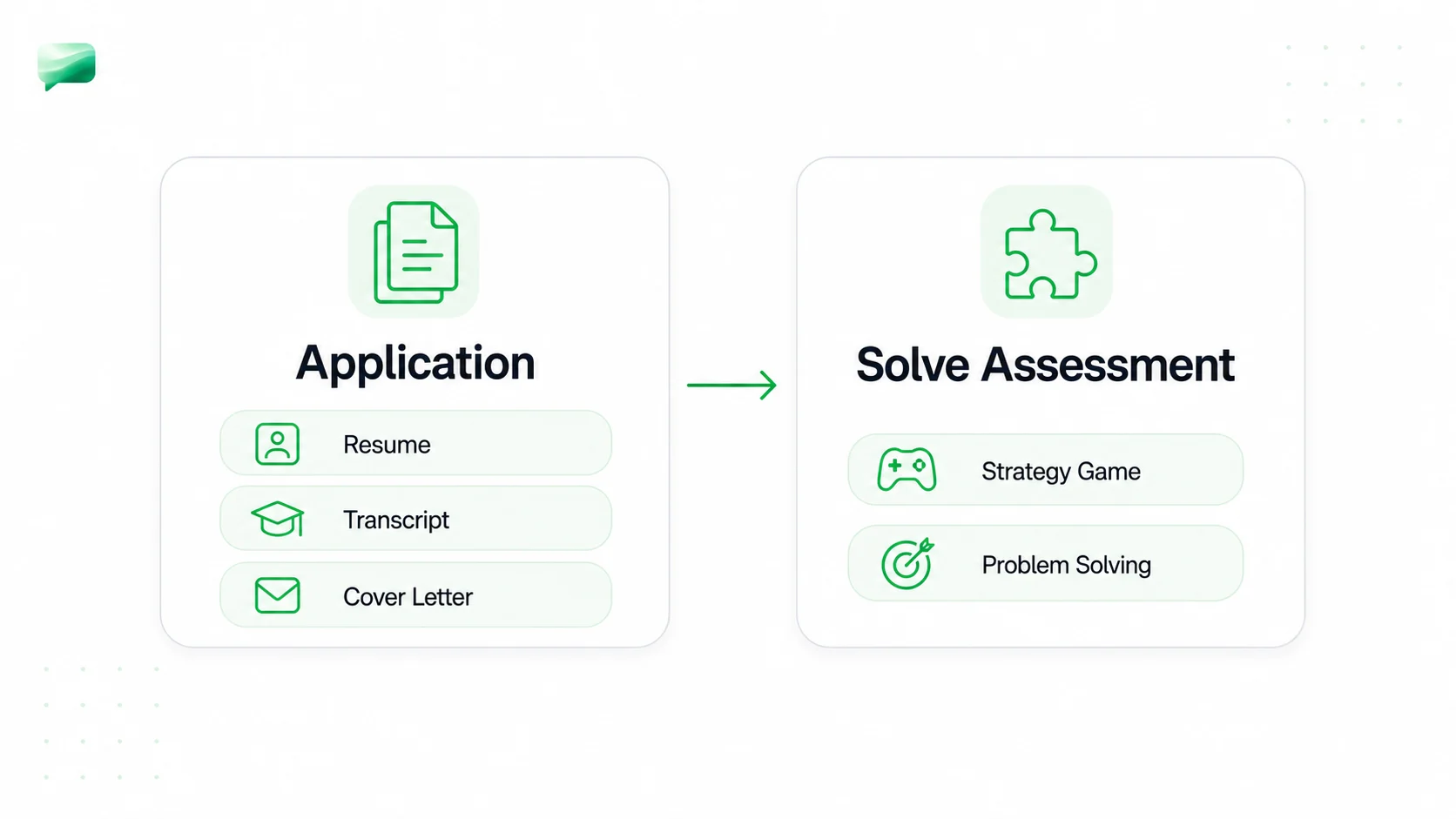
The application package is light by design: a resume, an optional cover letter, and a transcript. The differentiator early in the funnel is the McKinsey Solve assessment (the gamified, imbettable-style online exercise), not the paperwork.
- Resume: weighted on impact and leadership signals, not just titles. Quantify results and show progression.
- Cover letter (optional): use it to make an authentic case for consulting and for McKinsey specifically. Generic letters add nothing.
- Transcript: confirms standing and academic signal. There is no official GPA cutoff, but it is part of the read.
- McKinsey Solve: a scenario-based digital assessment that tests data interpretation, decision-making, and problem-solving under time pressure rather than rote knowledge.
Solve is a real gate, and you cannot bluff it. The reasoning it rewards (reading data quickly, making structured decisions, managing time) is the same muscle that case interviews test, so prep compounds across both.
Build the reasoning Solve and cases both reward
Road to Offer runs timed, AI-scored cases and math drills that train the same structured decision-making the McKinsey Solve assessment measures.
The interview process: case plus Personal Experience Interview
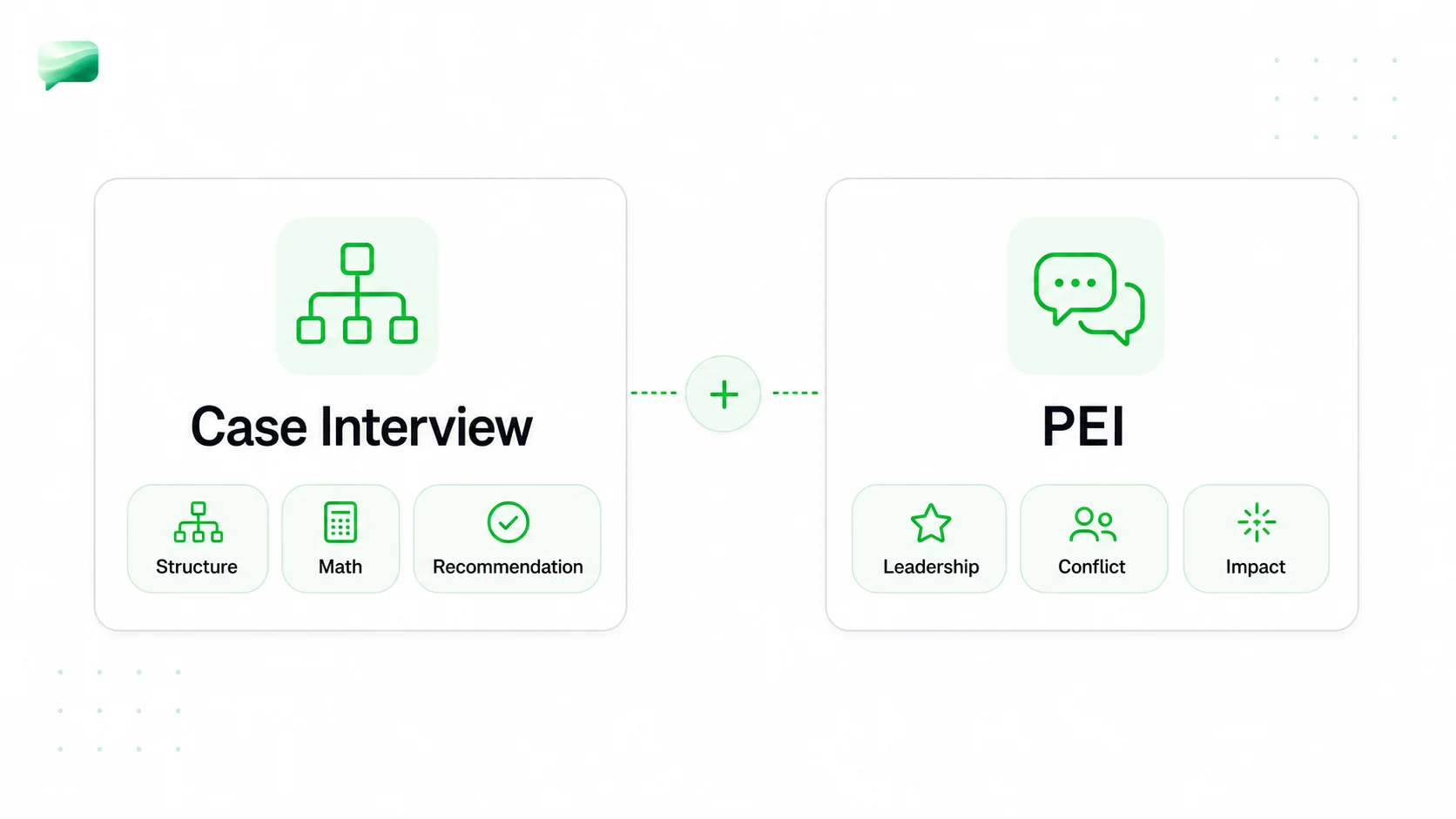
If you clear Solve and the resume screen, you reach interviews. The structure is described slightly differently across sources, which together point to a multi-interview, two-stage process.
Per Leland, the first round is two 60-minute interviews, and the final round is two to four 60-minute interviews. MyConsultingOffer frames the overall selection as 4 to 5 interviews with senior consultants and partners. Each interview blends two components:
- The case interview. A McKinsey case is interviewer-led: the interviewer walks you through a structured business problem, hands you data, and probes your logic. You are scored on structure, quantitative reasoning, business judgment, and synthesis. Our McKinsey case interview guide breaks down the interviewer-led format in depth and is the single most important read before an SSBA interview.
- The Personal Experience Interview (PEI). McKinsey's behavioral format asks for detailed stories on themes like personal impact, leadership, and entrepreneurial drive. Interviewers dig deep into one story rather than skimming several, so vague answers fall apart fast.
Prepare 3 to 4 PEI stories with specific actions and quantified outcomes, and practice cases until structuring a problem feels automatic. Both halves are scored, and a strong case will not rescue a thin PEI.
A week-by-week look at the 10-week SSBA
Competing guides describe what the program is but rarely what the 10 weeks feel like. Here is a realistic arc of a single live engagement, the day-to-day that Leland and MyConsultingOffer describe (small teams of 3 to 5, gathering and analyzing data, forming and testing hypotheses, presenting recommendations).
Per MyConsultingOffer, a representative team might include one engagement manager, one post-MBA associate, and one tenured Business Analyst, with you as the intern. You are not background staff; you own a slice of the analysis and are expected to present it.
How competitive is the SSBA?
Both Leland and getsmartresume describe an acceptance rate of about or under 1% of applicants. getsmartresume goes further with its own estimates (explicitly labeled as estimates, not official figures): roughly 10,000 to 15,000 applications, 5 to 10% of applicants reaching interviews, and about 15% of final-round interviewees receiving offers.
Two honest caveats. First, those funnel percentages are one author's estimate, so do not treat them as McKinsey-published facts. Second, the directional message is solid regardless: the SSBA is harder to land than the standard junior-year BA internship, because it recruits a full year earlier from a smaller, more specific applicant pool for fewer seats. A realistic read is that strong academics plus genuine leadership get you into the conversation, and case plus Solve performance decides the outcome.
SSBA vs. the standard junior-year BA internship
The fastest way to understand the SSBA is to compare it to the internship most students actually target.
The key insight: these are not competing options you choose between. The SSBA sits one rung below the junior internship on the same ladder. Doing the SSBA well is how you skip the junior-year application scramble.
The conversion path: what an SSBA offer leads to
This is the most misunderstood part of the program. An SSBA offer does not typically convert to a direct full-time offer. getsmartresume estimates (labeled as an estimate) that around 90% of SSBA interns receive a return offer for the junior-year Business Analyst internship. That junior internship is then the standard feeder into full-time BA hiring.
So the real pipeline is: SSBA (sophomore summer) leads to junior-year BA internship leads to full-time Business Analyst. Each step is a fresh evaluation, but each one you clear makes the next dramatically more likely. Framed that way, the SSBA is the highest-leverage early move available to an eligible sophomore: nail it, and you have effectively pre-cleared the recruiting gauntlet that most students do not even start until a year later.
How to stand out and prep
Generic "prepare for cases" advice will not move the needle. Here is the concrete playbook, mapped to what the SSBA actually screens for.
- Train Solve-style reasoning, not trivia. Solve rewards fast data interpretation and structured decisions under time pressure. Timed case-math and structuring reps build exactly that.
- Master the interviewer-led McKinsey case. This format is distinct from candidate-led cases. Drill it specifically using the McKinsey case interview guide, then practice full cases out loud until your structure is automatic.
- Build PEI stories with depth. Pick 3 to 4 stories on impact, leadership, and drive. Write the specific actions and quantified results, because McKinsey interviewers probe one story relentlessly.
- Show real leadership and community signal. With no hard GPA gate, demonstrated leadership is a genuine differentiator, not a checkbox.
- Be authentic about consulting. A specific, honest "why consulting and why McKinsey" beats a polished but generic pitch.
interviewer-led McKinsey structure from the Road to Offer drill engine. Answer a real prompt and get AI-scored feedback. Free accounts include 5 drills per day for the first 3 days after signup.
For the PEI side, rehearse a story with the live behavioral simulator so a follow-up question doesn't catch your quantified result unprepared.
The single best use of prep time is reps on real cases with feedback on structure, math, and synthesis. That is the bar the SSBA interview is testing, and it is trainable.
Sources (checked June 26, 2026)
- Leland, The McKinsey Sophomore Summer Business Analyst Program
- CaseBasix, McKinsey Sophomore Summer Business Analyst
- MyConsultingOffer, McKinsey Sophomore Summer Business Analyst Program
- getsmartresume, McKinsey Internship Sophomore Summer Business Analyst
Run a free McKinsey-style case next
Test your structure, math, and synthesis on an interviewer-led case, then use the feedback to sharpen your SSBA interview prep.
Frequently asked questions
Resources and related guides
- Consulting application trackerPractice
- Browse all free resourcesResource hub
- Bain CREW Program 2026: Eligibility, Deadlines & Internship PathRecruiting · Jun 29, 2026
- BCG Growing Future Leaders Program (GFL): Eligibility, Deadlines & How to Get In (2026)Recruiting · Jun 28, 2026
- Bain BASE Program 2026: Eligibility, BASE Camp & How to Get the OfferRecruiting · Jun 29, 2026
- EY Launch Internship Program 2026: Eligibility, Pay, Deadlines & How to Get InRecruiting · Jun 29, 2026