
BCG Growing Future Leaders Program (GFL): Eligibility, Deadlines & How to Get In (2026)
A current, honest guide to the BCG Growing Future Leaders (GFL) program: who is eligible, the exact application materials, the interview process, and how the sophomore internship leads to a return offer.
On this page
The BCG Growing Future Leaders (GFL) program is, as of 2026, a selective 10-week sophomore summer internship that BCG runs at its U.S. and Canada offices to develop students from underrepresented groups into future consulting and business leaders. According to CaseBasix, GFL is a "selective 10-week sophomore consulting internship," open to current sophomores who identify as part of an underrepresented group, including Black or African American, Hispanic or Latino/Latinx, and Indigenous, Native American, or Alaska Native students. You do not need a business major or prior consulting knowledge to apply. The core application asks for a resume, an optional cover letter, a college transcript (unofficial is accepted), self-reported SAT or ACT scores with a subscore breakdown for U.S. offices, and your top three office preferences. Exact deadlines shift every cycle, so confirm current dates on BCG's official GFL page before applying, and send questions to [email protected].
What the BCG Growing Future Leaders Program Is
GFL is BCG's early-identification internship for sophomores. Instead of waiting until junior year (when most consulting recruiting happens), BCG uses GFL to find and develop high-potential students from underrepresented backgrounds a year early. CaseBasix describes it as a "selective 10-week sophomore consulting internship," which tells you two things: it is competitive, and it is a real internship rather than a one-day diversity event.
One honest caveat up front. BCG does not publish an acceptance rate, a headcount, or an exact compensation figure for GFL on the public pages reviewed here. CaseBasix's deadline page confirms there is no concrete acceptance rate or class-size number published for the program. If you see a precise "X% acceptance" or "Y interns per office" claim somewhere, treat it skeptically. What is documented is the structure, the eligibility, the materials, and the payoff, which is what this guide focuses on.
Start building case interview skills early
GFL interviews include a real case. Run a free AI-guided case to start building the structure and math that BCG interviewers look for.
Who Is Eligible for GFL
The eligibility bar is specific. GFL is for current sophomores at a four-year U.S. or Canadian institution who identify as part of an underrepresented group. Northeastern University's pipeline programs page confirms the program is sophomore-only and aimed at underrepresented minorities, naming Black/African American, Hispanic/Latinx, and Indigenous/Native American students, run during the summer at BCG offices.
A few points candidates often get wrong:
- No business major required. BCG is not screening for finance or economics majors. Students from the humanities, sciences, and engineering are all in scope.
- No prior consulting knowledge required. You are not expected to already know frameworks or case mechanics. The program exists to teach that.
- Academics and leadership still matter. "No prerequisites" does not mean "no bar." Strong grades and demonstrated leadership in clubs, work, research, or community roles are what differentiate applicants.
Because eligibility wording can be refined each cycle, confirm the current definition on BCG's official GFL page rather than relying on any single third-party summary, including this one.
Application Requirements and Materials
The materials list is consistent across sources. For a U.S. office application, expect to submit:
Jumpstart Advisory Group's GFL writeup documents that a past cycle required a resume with an optional cover letter, a college transcript (unofficial acceptable), and self-reported ACT/SAT scores with subscore breakdowns. Northeastern's page lists the same core set: an application, resume, cover letter, transcript, and ACT and/or SAT scores with a subscore breakdown.
One practical detail that saves headaches: applicant questions go to [email protected], per Jumpstart's documentation. If something about the form, your eligibility, or score reporting is ambiguous, email that address rather than guessing.
Application Timeline and Deadlines
This is where most competing articles quietly mislead readers, so read carefully. CaseBasix reports that GFL applications typically open in spring with deadlines around early summer. Jumpstart documents a specific past cycle in detail: a resume deadline of October 1 at 11:59 pm EST, decisions communicated by October 8, and interviews completed by the end of October.
The takeaway: GFL recruiting generally clusters in the spring-to-summer window of your sophomore year, but the only deadline that matters is the one currently posted by BCG. If you are tracking GFL alongside other firms' sophomore and junior programs, our consulting application deadlines 2026 guide helps you map the full recruiting calendar so nothing slips.
The GFL Selection and Interview Process
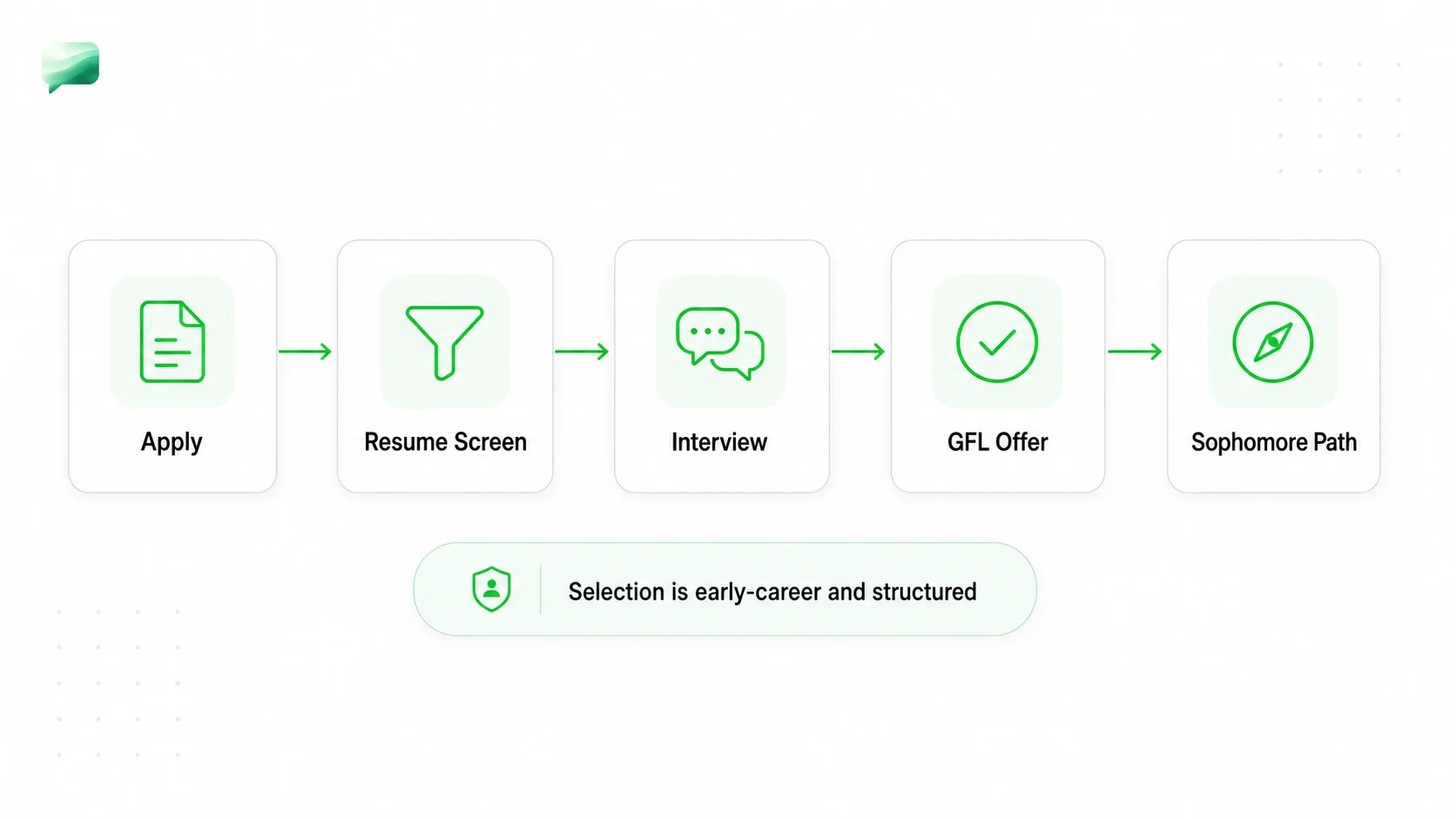
Once your application clears the initial screen, selection runs in two broad stages.
1. Online assessment. CaseBasix reports that the process includes online assessments of your analytical and problem-solving skills. This is a timed screen, so treat it like any consulting aptitude test: stay calm, work quickly, and do not get stuck on one item.
2. Interviews. Candidates who advance face interviews covering two things:
- Behavioral and motivational questions, answered with the STAR method (Situation, Task, Action, Result). Expect "Tell me about a time you led a team" and "Why consulting, and why BCG?"
- A case interview, where you structure and solve a business problem using a clear framework. CaseBasix specifically notes case interviews that use structured frameworks alongside STAR-method fit interviews.
The case is the part sophomores underestimate most, because they have not seen one before. You do not need to be polished, but you do need to show structured thinking, clean math, and a clear recommendation. Our BCG case interview guide walks through BCG's candidate-led case style and is the single best place to start preparing for the GFL case round.
Practice GFL-style cases with instant feedback
Road to Offer runs live case simulations scored on structure, math, and recommendation quality, so you walk into the GFL case round having already done dozens of reps.
What You Actually Do During the 10 Weeks
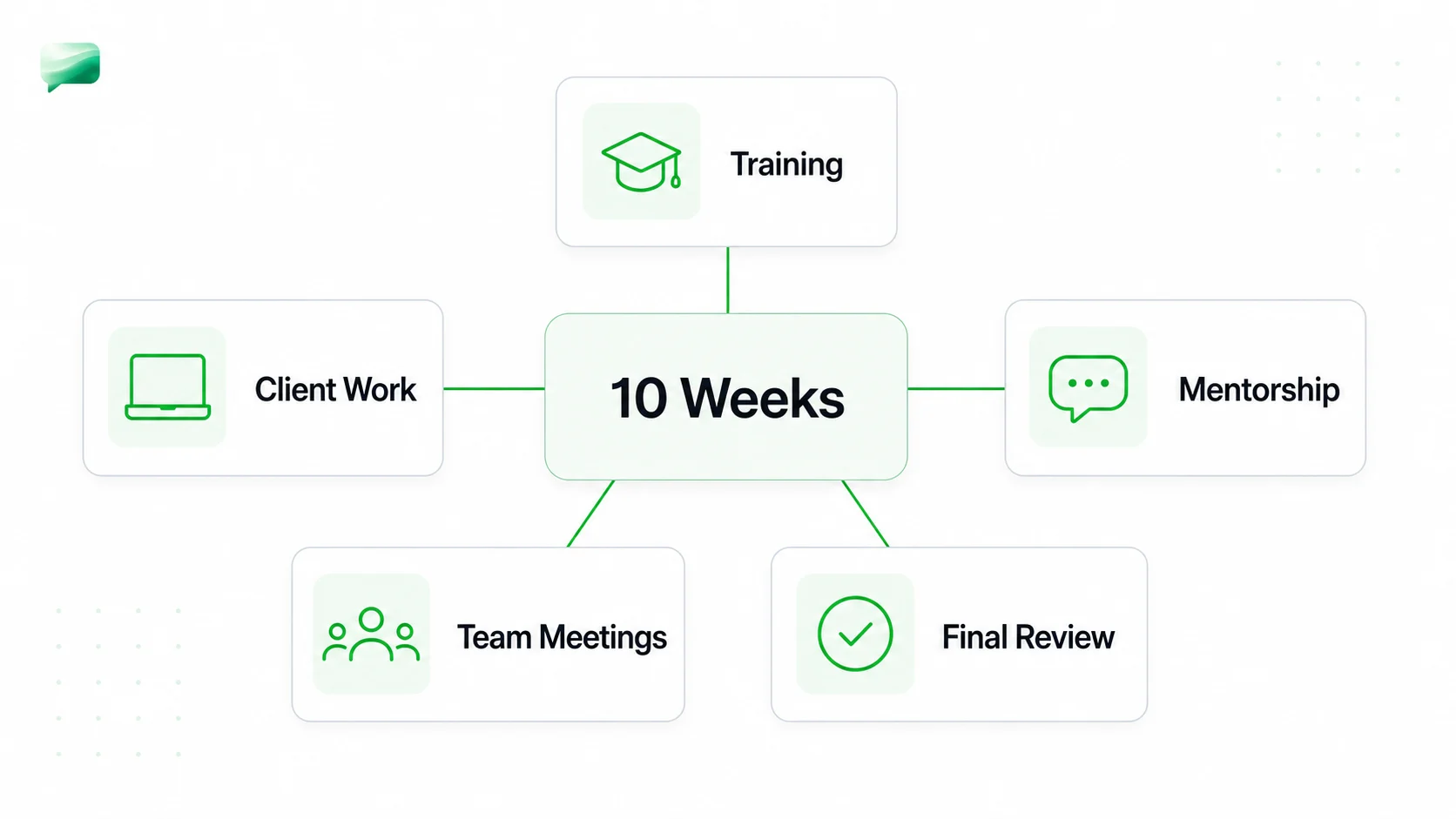
GFL is a working internship, not a shadowing program. Across the 10 weeks, participants are:
- Paired with a mentor who guides them through the summer and the recruiting relationship.
- Put through training and development programming to build the consulting toolkit (problem structuring, analysis, client communication) from the ground up.
- Staffed on a real BCG client team as a contributing member, not an observer.
Northeastern's page confirms this shape: mentorship, training and development, and team-based work, with access to recruiters built in. That last point matters, because the relationships you build over the summer are what convert into the next step.
What Happens After GFL: The Return-Offer Pipeline
This is the reason GFL is worth the effort. CaseBasix reports that top performers can be invited into BCG's internship pipeline toward full-time Associate roles. In practice, a strong GFL summer can earn you a return offer to come back as a Summer Associate after your junior year, which is the standard on-ramp to a full-time Associate offer.
How GFL Supports BCG's Diversity Mission
GFL exists because consulting, corporate boards, and executive ranks remain underrepresented relative to the broader population. By identifying talented sophomores from underrepresented groups early, mentoring them, and pulling the strongest into the Summer Associate pipeline, BCG widens the funnel at the exact stage where representation gaps usually form. For applicants, the practical implication is that GFL is not a token program. It is a genuine recruiting channel with a real internship and a real path to full-time conversion.
How to Stand Out in Your GFL Application
Since BCG does not publish an acceptance rate, assume the bar is high and prepare accordingly. Four things move the needle:
- Lead with leadership and impact, not titles. A quantified result ("grew a campus club from 12 to 80 members," "raised $4,000 for a community project") reads stronger than a list of positions. Frame extracurricular and work experiences around what changed because of you.
- Make your motivation specific. "I want to learn and grow" is what everyone writes. Connect your interest to consulting's actual work (solving ambiguous business problems, working across industries) and to BCG specifically.
- Prepare for the case early. This is the highest-leverage prep because most sophomores have zero case reps. Start now, not the week before interviews.
- Build a clean STAR story bank. Have three to four stories ready (leadership, teamwork, overcoming a setback) that you can tell in under two minutes each.
If you are also looking at other early-career diversity programs, the Deloitte Discovery internship guide covers a comparable sophomore-focused pipeline, and applying to several increases your odds while building interview reps you can reuse for GFL.
Get GFL-ready with a free practice case
Run a free Road to Offer case to benchmark your structure, math, and recommendation quality before your Growing Future Leaders interviews.
Sources (checked June 26, 2026)
- BCG official, Growing Future Leaders program: https://careers.bcg.com/global/en/on-campus/programs/growing-future-leaders
- CaseBasix, BCG Growing Future Leaders overview
- CaseBasix, BCG application deadline notes
- Jumpstart Advisory Group, GFL sophomore internship writeup (dates are cycle-specific/historical): https://www.jumpstartadvisorygroup.com/growing-future-leaders-gfl-sophomore-internship-program-at-bcg/
- Northeastern University, BCG GFL pipeline program page: https://nuplace.northeastern.edu/pipeline-programs/bcg-growing-future-sophomore-internship-program/
Frequently asked questions
Resources and related guides
- Consulting application trackerPractice
- Browse all free resourcesResource hub
- Bain CREW Program 2026: Eligibility, Deadlines & Internship PathRecruiting · Jun 29, 2026
- McKinsey Sophomore Summer Business Analyst (SSBA): 2026 Guide to Eligibility, Pay & OddsRecruiting · Jun 29, 2026
- Bain BASE Program 2026: Eligibility, BASE Camp & How to Get the OfferRecruiting · Jun 29, 2026
- KPMG Embark Scholars Program 2026: Tracks, Pay, Eligibility & InterviewRecruiting · Jun 29, 2026