
EY Launch Internship Program 2026: Eligibility, Pay, Deadlines & How to Get In
A clear, free guide to the EY Launch internship program: who qualifies, how it differs from EY-Parthenon, pay, deadlines, the selection process, and a 2026 application play-by-play.
On this page
The EY Launch internship program in 2026 is EY's paid, early-insight summer program built for underrepresented college students who are still two or more years from graduation. According to the program overview on WayUp, eligibility centers on students from underrepresented groups, with a strong preference for members of diversity-focused organizations like NABA, ALPFA, and HBSA, and the experience spans EY's four integrated service lines plus a National Launch Training series. The biggest source of confusion is that Launch gets blurred with EY-Parthenon, EY's ultra-selective strategy track, and with standard EY summer internships. They are three different programs with three different bars. This guide separates the three programs cleanly, marks the confirmed facts versus the widely circulated estimates, and gives you a current 2026 application play-by-play so that a confused sophomore or junior knows exactly which program they qualify for, what it pays, and what to do this week.
What is the EY Launch internship program?
EY Launch is an early-careers program designed to give underrepresented students exposure to professional services before they hit the standard internship recruiting cycle. The point is access: students from Black, Latinx, Native American, LGBTQ+, veteran, and disability communities get hands-on experience, training, and a relationship with EY two or more years before graduation, which is when most firms barely talk to you.
Per the WayUp program overview, Launch includes a National Launch Training series and exposes participants to EY's work across multiple service lines. That same source notes EY operates four integrated service lines (Assurance, Consulting, Strategy and Transactions, and Tax), and that globally EY member firms work with more than 200,000 clients, nearly 80% of the Fortune Global 500, and over 400,000 employees across 150 or more countries. In short, Launch is a real foot in the door at one of the largest professional services networks in the world, aimed squarely at students who historically had less access to it.
Practice a free case before you apply
Launch consulting and tech tracks include a case interview. Run a free AI-scored case to see where your structure, math, and synthesis stand.
EY Launch vs EY-Parthenon vs standard EY internships
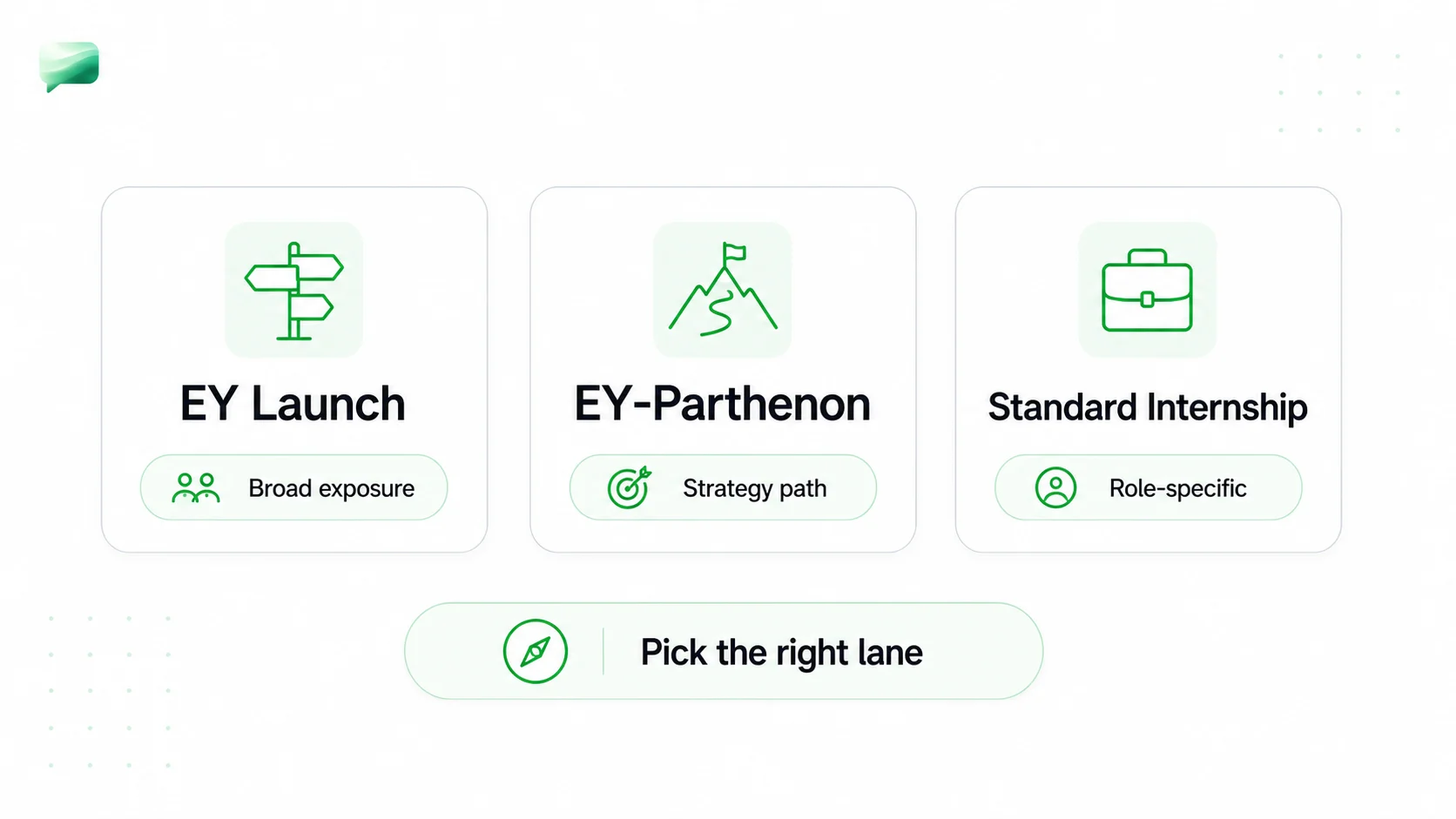
This is the single most confused part of EY recruiting, and getting it wrong wastes weeks. Some competitor pages even file Launch under a generic "EY Tech Consulting Internship" label, which buries the distinction. Here is the clean separation.
All selectivity, GPA, and pay figures above come from GetSmartResume, which explicitly labels them as informed estimates drawn from Glassdoor, Reddit, and LinkedIn rather than official EY data. GetSmartResume also estimates roughly 12,000 to 15,000 annual Launch applications versus 5,000 to 8,000 for EY-Parthenon, and roughly 800 to 1,000 total US Launch positions versus 100 to 150 for EY-Parthenon. Treat these as directional, not gospel.
The practical takeaway: if you are two or more years from graduation and from an underrepresented group, Launch is your entry point. EY-Parthenon is a different, far more competitive process you would target later. The two should not be planned for as if they were the same application.
Who is eligible to apply?
Eligibility is the clearest, most confirmable part of Launch. Per the WayUp overview, the program is for students who are at least two or more years from graduation, with a strong preference for members of diversity-focused organizations such as NABA (National Association of Black Accountants), ALPFA (Association of Latino Professionals For America), and HBSA (Hispanic Business Student Association). That two-years-out rule is what separates Launch from the standard penultimate-year internship pipeline, so freshmen and sophomores are very much in scope.
On academics, GetSmartResume estimates a competitive GPA baseline around 3.3 to 3.5 for Launch, versus 3.7 or higher for EY-Parthenon. EY does not publish an official GPA cutoff, so treat 3.3 to 3.5 as a rough floor that strong candidates clear rather than a hard rule. If your GPA sits below that band, a clear upward trend, a relevant club leadership role, or a strong story can still carry the application.
The membership preference is worth acting on early. If you are eligible for NABA, ALPFA, or HBSA and have not joined, do it before you apply. Active membership is both a signal on the resume and a direct channel to EY recruiters who staff these orgs' conferences and events.
How much does EY Launch pay, and how long is it?
Pay and length are where estimates and confirmed facts diverge, so here is both sides honestly.
On pay, GetSmartResume reports an estimated $25.53 to $37.00 per hour for Launch, varying by track and cost of living, with total summer earnings estimated around $8,000 to $13,000. A separate prep provider, CaseBasix, lists the EY tech and consulting internship at $25 to $40 per hour, which lines up closely. Both are third-party figures. The official EY early-careers internships page confirms EY offers paid summer and winter internships open to undergraduate, MBA, and advanced-degree students, but does not state pay, weeks, or acceptance rates.
On length, sources disagree. CaseBasix lists 4 to 8 weeks for the tech and consulting internship, while GetSmartResume estimates an 8 to 10 week Launch program duration. The honest answer is that program length varies by year, line, and office, and your offer letter is the source of truth.
Structurally, Launch interns work across EY's four service lines (Assurance, Consulting, Strategy and Transactions, and Tax) and complete the National Launch Training series, per WayUp. That training component is part of what makes Launch a genuine development program rather than just a short work placement.
When should you apply?
Timing beats polish here. CaseBasix reports an application deadline around January 31 for the EY tech and consulting internship, and EY recruits for many early-careers roles on a rolling basis. That combination means the deadline is a backstop, not a target.
Apply in the first one to two weeks after the application opens, which is typically late summer or early fall for the following summer. Rolling review means recruiters fill seats as strong applications arrive, so a great application submitted in week one competes for a fuller pool of spots than the same application submitted in late January. Waiting until the deadline is the most common self-inflicted wound in this process.
Practically: identify your target offices and lines now, set a calendar reminder for when EY's early-careers portal opens, and have your resume and stories ready to submit on day one rather than scrambling in January. A simple application tracker that logs each firm's open date, deadline, and your submission status keeps you ahead of the rolling cutoff.
Get interview-ready while applications are open
Road to Offer runs live case and behavioral simulations scored on structure, math, and communication, so you walk into the EY Launch process already sharp.
What does the selection process look like?
The Launch selection process typically moves through three checkpoints, and the case component is the one most diversity-program candidates underestimate.
Behavioral interview. Expect questions on why EY, why this service line, leadership and teamwork stories, and how you handle setbacks. This is where your NABA, ALPFA, or HBSA involvement and your motivation for the program come through. Structured stories outperform improvisation here every time.
Digital job simulation and online assessment. EY uses a digital job simulation, often around 90 minutes, that puts you in realistic work scenarios and measures judgment, prioritization, and basic reasoning rather than trivia. There is little to memorize. The value of practice is removing surprise from the format so you spend your attention on the decisions, not the mechanics.
Case interview (consulting and tech tracks). This is the differentiator. For consulting and technology roles, you should expect a case interview testing structure, quantitative reasoning, and a clear recommendation. The same skills apply across EY's consulting interviews, so the EY case interview guide is the right place to build that muscle. If you are weighing EY against other Big Four early programs, the Deloitte Discovery internship guide is a useful side-by-side, since the formats rhyme.
How to build your application package
The competitor consensus on what to prepare is consistent and worth following. Per CaseBasix, the core package is a 1-page resume, 6 to 8 unique behavioral STAR stories, and 5 to 10 practice case interviews.
- Resume: One page, quantified impact, and clear signals of leadership, analytical work, and involvement in NABA, ALPFA, or HBSA. EY recruiters scan fast, so lead each bullet with the result.
- STAR stories: Build 6 to 8 stories covering leadership, teamwork, conflict, failure, analytical problem solving, and motivation for EY. Practice each to under two minutes. Map them so you can repurpose one story across several common questions.
- Practice cases: Run 5 to 10 cases focused on structure, clean math, and a top-down recommendation. The goal is not to memorize frameworks but to make your thinking visible and organized under time pressure.
The behavioral stories and the cases reinforce each other. A candidate who can structure a case clearly usually also structures a behavioral answer clearly, because both reward the same top-down, evidence-backed habit.
Networking strategy
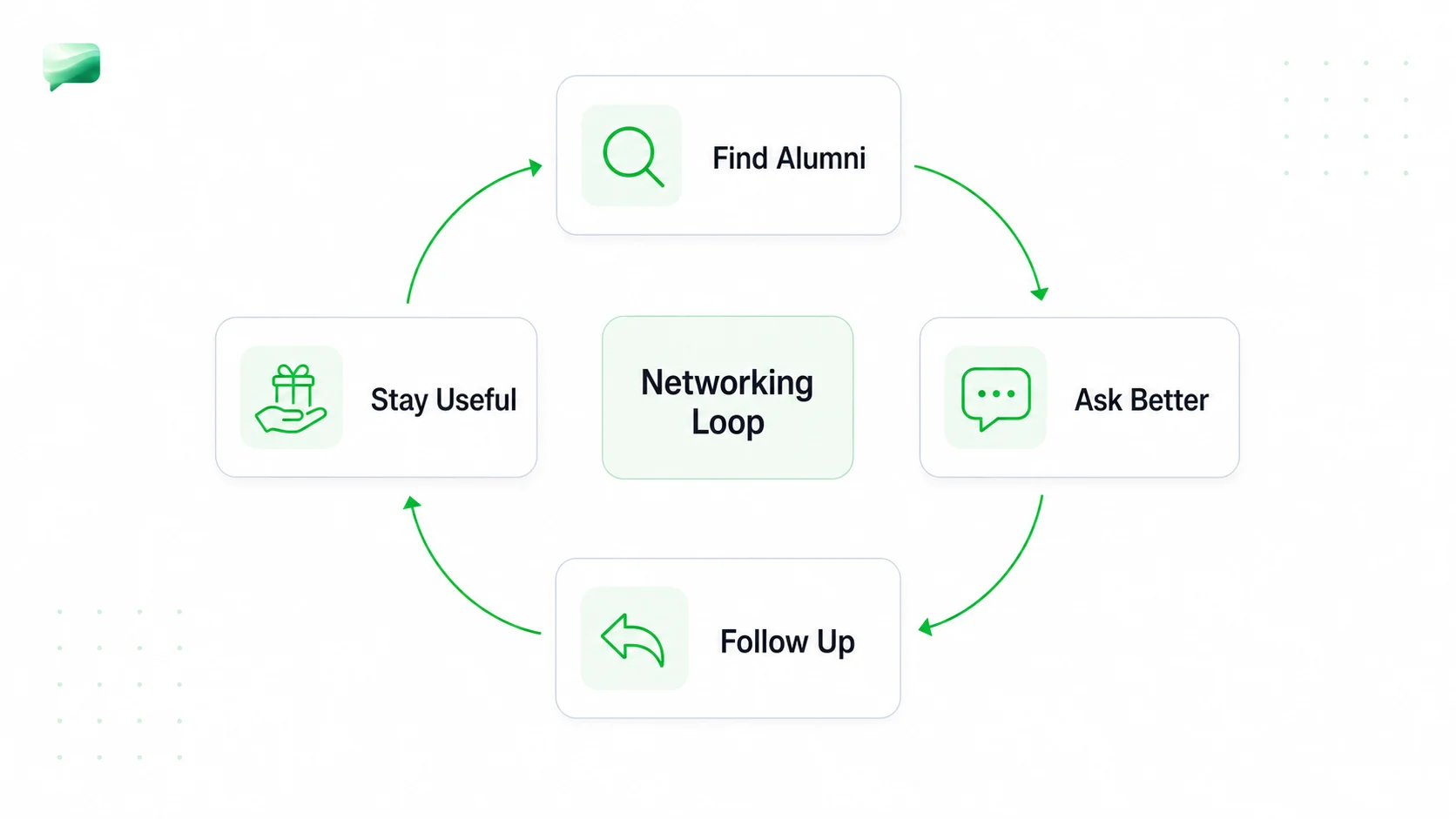
Affiliation and relationships move the needle more on Launch than on a blind online application. The program is explicitly tied to diversity organizations, so the highest-leverage networking is through NABA, ALPFA, and HBSA chapters and national conferences, where EY recruiters show up specifically to find Launch candidates.
Two moves matter most. First, become an active member, not a name on a roster, so you can credibly reference the org in interviews and get introduced to recruiters at events. Second, build a short, genuine relationship with the EY recruiter assigned to your school or region before you apply, so your application has a face attached to it. A single warm conversation often does more than ten cold applications.
Converting the internship into a return offer
The reason Launch is worth the effort is the pipeline. GetSmartResume estimates a return or full-time conversion rate around 70 to 85% for Launch, versus 85 to 90% for EY-Parthenon. As with all the figures from that source, these are crowd-sourced estimates rather than official EY data, but the direction is clear: a strong internship performance is the most reliable path to a full-time EY offer.
What drives conversion is unglamorous. Deliver clean, on-time work. Ask good questions early rather than guessing. Build relationships with your team and your reviewer. Treat the National Launch Training as a real evaluation, not a formality. Interns who are easy to staff and clearly coachable convert at the top of that estimated range. The internship is a long interview, and the people who treat it that way are the ones who get the call.
Common pitfalls and how top candidates avoid them
- Confusing Launch with EY-Parthenon. Applying to the wrong program, or assuming Launch carries EY-Parthenon's prestige and pay, sets you up for disappointment. Know which one fits your year and background.
- Waiting until the deadline. Rolling review punishes late applicants. Submit in the first one to two weeks.
- Skipping case prep on the consulting and tech tracks. The case is real. Underprepared candidates lose offers they were eligible for.
- Generic "why EY" answers. Connect to a specific service line and to your involvement in the diversity org that channels into Launch.
- A bloated resume. One page, quantified, scannable. Anything longer signals you cannot prioritize.
EY Launch in context: the Big Four early programs
EY is one of the Big Four alongside Deloitte, PwC, and KPMG, and each runs its own underrepresented-student early program. The reasoning and behavioral skills carry across all of them, which is why preparing well for Launch also strengthens your odds elsewhere.
If you are applying to more than one of these in the same cycle, build your STAR stories and case skills once and reuse them. The interfaces differ, but the underlying evaluation rewards the same structured thinking.
Your next steps
This week:
- Confirm you meet the eligibility bar: two or more years from graduation and from an underrepresented group.
- Join or reactivate your NABA, ALPFA, or HBSA membership if you are eligible.
- Set a reminder for when EY's early-careers portal opens, and log it in an application tracker.
Next 2 to 4 weeks:
- Tighten your resume to one quantified page.
- Draft 6 to 8 STAR stories and practice each under two minutes.
- Run 5 to 10 practice cases if you are targeting the consulting or technology track, using the EY case interview guide to structure your prep.
See where you stand before EY Launch interviews
Run a free case to benchmark your structure, math, and recommendation quality against what EY consulting and tech interviewers actually look for.
Sources
- WayUp: EY Launch Internship Program Overview (checked June 26, 2026)
- EY US Careers: Internships and student programs (checked June 26, 2026)
- GetSmartResume: EY-Parthenon and Launch internship programs (estimates, checked June 26, 2026)
- CaseBasix: EY tech and consulting internship offer (checked June 26, 2026)
Frequently asked questions
Resources and related guides
- Consulting application trackerPractice
- Browse all free resourcesResource hub
- Bain CREW Program 2026: Eligibility, Deadlines & Internship PathRecruiting · Jun 29, 2026
- BCG Growing Future Leaders Program (GFL): Eligibility, Deadlines & How to Get In (2026)Recruiting · Jun 28, 2026
- EY Internship Guide 2026: Technology Consulting Roles, Pay, and DeadlinesRecruiting · Sep 11, 2026