
Bain BASE Program 2026: Eligibility, BASE Camp & How to Get the Offer
A current, honest guide to the Bain BASE program: what BASE Camp is, who is eligible, the application timeline, the case and fit interviews, and how it converts to a paid Summer Associate offer.
On this page
The Bain BASE program in 2026 is Bain & Company's selective pre-MBA diversity initiative, where BASE stands for Building and Supporting Excellence, a program Bain launched in 2019 for incoming Black, Hispanic and Latin American, and Indigenous MBA students. Its centerpiece is BASE Camp, a week-long in-person experience. According to Bain's official BASE page, participants (called BASE Scholars) receive a full day of consulting training, then get staffed on a real Bain case team working on a component of an actual client project, with a dedicated mentor coaching their problem-solving. Per the UC San Diego Rady careers office, the 2026 application deadline is May 3, 2026, and the program runs in late July 2026 across roughly 13 US offices plus Toronto. The real payoff is a paid Summer Associate offer. One edge case worth stating plainly: that offer is performance-gated on your case and fit work during the week, not guaranteed by attendance.
What the Bain BASE program actually is
BASE (Building and Supporting Excellence) is Bain's pre-MBA diversity program, founded in 2019. It is built for incoming MBA students from historically underrepresented backgrounds: per the UC San Diego Rady careers office, that means incoming Black or African American, Latino or Hispanic, and Indigenous MBA students.
The framing matters. BASE is not a generic networking mixer and it is not an unpaid shadowing day. It is a structured, week-long working experience that puts you inside a real Bain case team. Bain calls participants "BASE Scholars," and the program is designed to do two things at once: give you a genuine look at consulting, and give Bain a genuine look at you. That second part is why the week is best understood as an extended, lower-pressure interview that leads toward the Summer Associate internship.
Practice a real case before BASE Camp
The BASE offer hinges on case and fit performance during the week. Run a free AI-scored case to see where your structure, math, and synthesis stand right now.
Inside BASE Camp: how the week is structured
BASE Camp is the heart of the program. Across multiple sources the structure is consistent. Per Bain's official page and corroborated by Vaia's program profile, the week runs roughly like this:
- A full day of consulting training. You learn how Bain structures problems, builds a hypothesis, and communicates a recommendation, before you ever touch a live problem.
- Staffing on a real case team. After training, you are placed on an actual Bain case team and work on a component of a real client project alongside Bain consultants. This is the part competitors gloss over: it is not a mock case, it is a slice of live work.
- A dedicated mentor. You get one-on-one coaching on your problem-solving from a Bain consultant throughout the week.
- Exposure to Bain's people and culture. Per Vaia, Scholars hear from business leaders and mentors connected to the Black at Bain (BAB) and Familia at Bain (FAM) affinity groups.
The reason the structure is worth studying is that it tells you exactly what is being evaluated. A full day of training followed by live case work means Bain is watching how quickly you absorb their approach and apply it under real conditions. The bottleneck for most Scholars is not enthusiasm, it is case fluency: structuring cleanly, doing the math without stalling, and synthesizing a clear answer. That is the skill to build before you arrive.
Eligibility: who BASE is for
The eligibility profile is narrower and more specific than a typical internship, so read it carefully before you apply.
- Incoming MBA students from underrepresented backgrounds. Per the UC San Diego Rady careers office, BASE is for incoming Black or African American, Latino or Hispanic, and Indigenous MBA students.
- You must be starting business school in the application year. BASE is a pre-MBA program, so it is aimed at students about to begin their MBA, not those already a year in.
- Fellowship pathways count. Per MyConsultingOffer, eligibility also includes MBA fellows coming through Management Leadership for Tomorrow (MLT) or The Consortium. If you are an MLT or Consortium fellow, surface that early in your application.
If you are still earlier in the funnel and exploring Bain's other early programs, our Bain BEL program guide covers a related Bain leadership pathway, and the Bain case interview guide explains the core case format you will be evaluated on regardless of which door you enter through.
Where BASE Camp is hosted
Per Bain's official page, BASE Camp is hosted across 13 US offices: Atlanta, Austin, Boston, Chicago, Dallas, Denver, Houston, Los Angeles, New York, San Francisco, Seattle, Silicon Valley, and Washington DC. The UC San Diego Rady careers office adds that Toronto participates alongside the US cities.
A note on accuracy, because this is where competing guides go stale: at least one prep site (CaseBasix) lists only 12 participating offices and an older 2024 deadline of May 5. Office counts and dates rotate, and outdated articles quietly carry old numbers forward. The list above reflects what Bain's own page shows as of our June 2026 review. Always treat bain.com as the source of truth for the current cycle.
Application timeline and the full funnel
BASE follows a familiar consulting-recruiting funnel, but the dates move every year. Here is what the sources show, plus the verification habit to keep.
The pattern is clear: applications tend to open in the spring with an early-May deadline and a late-July camp. Do not lock your calendar to an old date you read online. Confirm the current cycle on Bain's official BASE page before you build your plan. For a wider view of how Bain's calendar fits alongside other firms, our consulting application deadlines 2026 guide maps the season end to end.
The full application funnel typically runs: research the program and Bain, submit a resume and cover letter, complete any online tests, then move into interviews (case and fit). If you want to sharpen the written materials, the Bain cover letter guide covers how to write something Bain-specific rather than generic.
The BASE interview process, broken down
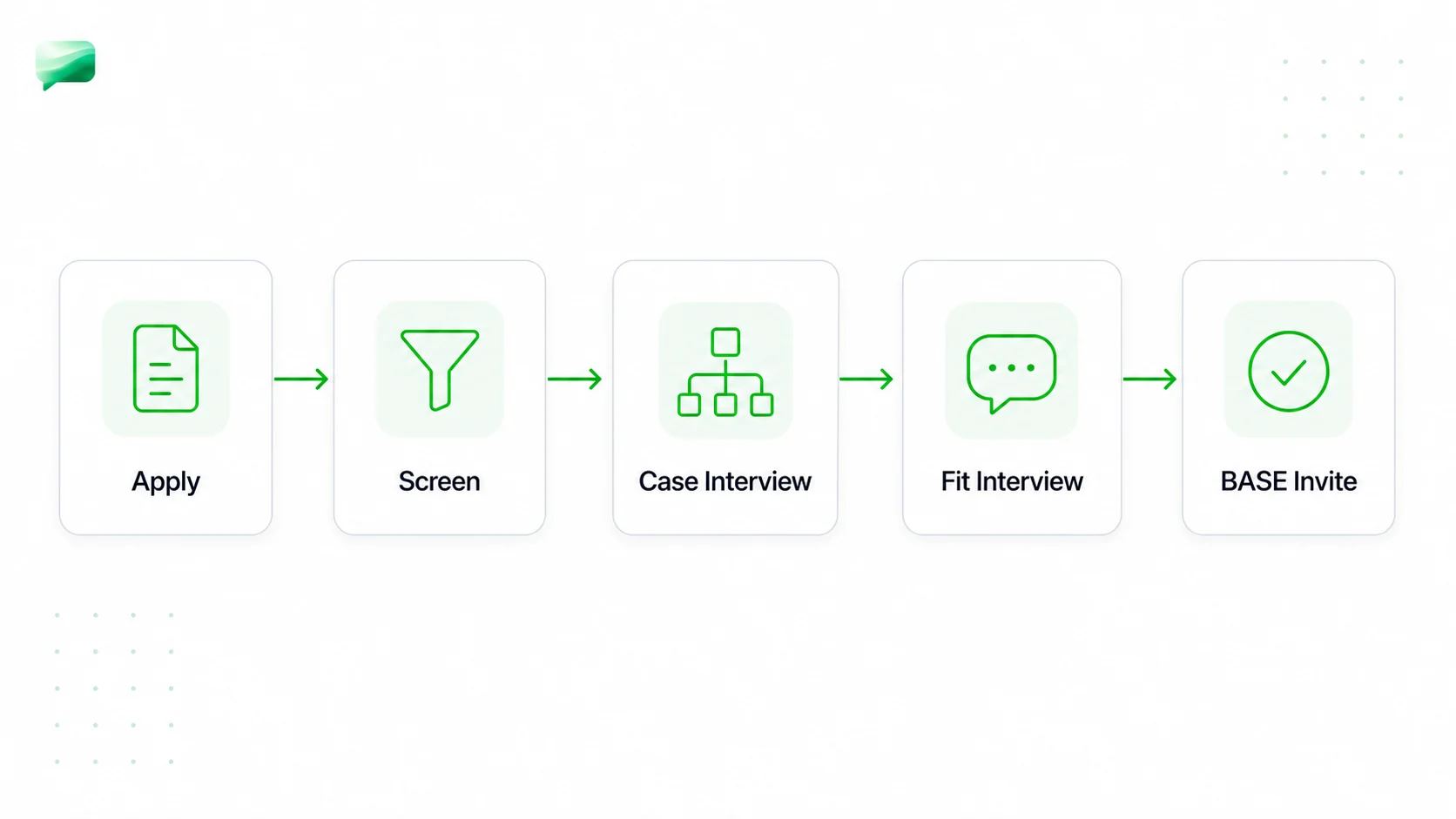
Per MyConsultingOffer, the BASE interview is two short interviews of around 30 minutes each. The split inside each is what you should prepare to:
- First 10 minutes: behavioral and fit. Expect questions about your background, your "why Bain," and a story or two that show leadership, drive, and how you work with others.
- Final 20 minutes: a short case interview. This is a compressed version of a standard Bain case. You will not get an hour, so structure fast, prioritize, and get to a defensible answer.
The compression is the trap. Twenty minutes is enough time to lose the case if you over-build your framework or stall on the math. Prepare to open with a tight, MECE structure, narrate your math cleanly, and land a clear recommendation with a reason. The Bain case interview guide walks through Bain's specific style and the kinds of cases you are most likely to see.
Drill the 20-minute case until it is automatic
BASE compresses the case into 20 minutes, so speed and structure decide it. Run timed AI cases and get scored on the exact dimensions Bain weights.
From BASE to a paid Summer Associate offer
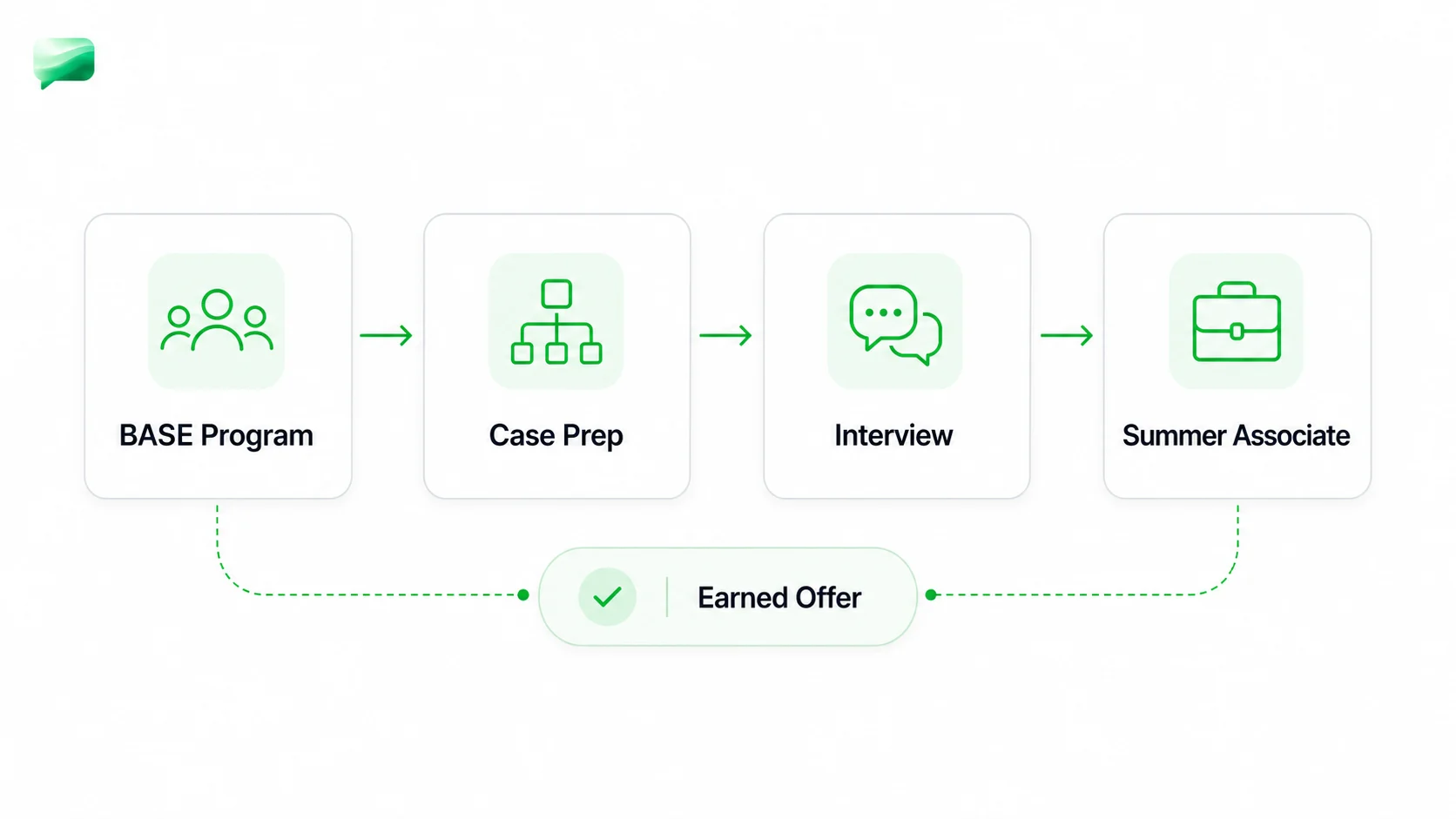
This is the part that justifies the whole week. Per the UC San Diego Rady careers office, on completing the program participants have an opportunity to learn more about joining Bain as a Summer Associate. The Summer Associate internship is the real prize, and it is paid.
Here is the honest framing competitors avoid: the offer is performance-gated. Bain spends a full day training you and then watches how you contribute to a live case team. High performers demonstrate three things consistently:
- Structure under pressure. You break an ambiguous problem into clean, prioritized parts without freezing.
- Reliable analysis. Your math is right and your insights connect to the client's actual decision.
- Fit and ownership. You behave like a teammate who can be trusted with client work: proactive, coachable, and clear in communication.
Attending BASE is necessary but not sufficient. The Scholars who convert are the ones who treat every working session as evaluated, take the mentor's coaching, and visibly improve across the week.
How competitive is BASE, and the acceptance rate question
We get this question constantly, so here is the straight answer: Bain does not publish the number of BASE spots, an acceptance rate, applicant counts, a conversion rate, or a stipend figure. Neither does the official page nor the reputable prep guides. CaseBasix's coverage, for example, contains no acceptance rate, number of spots, applicant counts, stipend, or conversion-rate statistics either.
So we will not invent one. Any article that quotes a precise BASE acceptance rate is guessing, and you should distrust it. What you can reasonably assume: BASE is a selective program at a top-tier firm, so competition is real. What you can actually control is your application quality and your case and fit performance during the week. Spend your energy there, not on chasing a number nobody has published.
BASE vs ExperienceBain vs rival firm diversity programs
A common point of confusion is how BASE sits next to Bain's other early programs and to McKinsey's and BCG's diversity offerings. This is the single comparison most BASE articles leave out. The table below is qualitative on purpose: we only attach specific figures to BASE, because those are the only ones our sources verify.
The takeaway: if you are eligible for BASE, it is the more direct route into the Bain internship than the broader ExperienceBain umbrella, because it ends with live case work and an offer conversation. Eligibility, length, and offer mechanics for McKinsey and BCG programs change yearly, so verify those on each firm's official site rather than trusting a static table.
How to stand out as a BASE applicant
Once you understand that BASE is an audition for the Summer Associate offer, the prep priorities reorder themselves.
- Make your resume and cover letter Bain-specific. Generic "I am passionate about consulting" copy gets filtered. Tie your stories to Bain's culture and to why BASE specifically. The Bain cover letter guide shows how.
- Build genuine case fluency, not trivia. The 20-minute case and the live case team work are where most candidates separate. Practice timed cases until structuring and math stop being the bottleneck.
- Prepare tight fit stories. You only get about 10 minutes of behavioral time per interview, so two or three crisp, high-signal stories beat a long list of mediocre ones.
- Connect with the affinity groups. Per Vaia, Scholars hear from leaders in Black at Bain (BAB) and Familia at Bain (FAM). Engaging authentically with these communities, before and during the week, helps you show real fit rather than performed interest.
If you want to see how Bain runs its other early-pipeline diversity programs, our Bain CREW program guide covers the firm's leadership workshop for second-year women and how it feeds the Associate Consultant Intern interview.
Sources and further reading (last verified June 2026)
- Bain official, BASE program page: https://www.bain.com/careers/work-with-us/internships-programs/base/
- UC San Diego Rady careers office, BASE pre-MBA diversity program: https://career.rady.ucsd.edu/resources/bain-base-pre-mba-diversity-program-2/
- MyConsultingOffer, BASE Scholar internship cover letter guide
- Vaia, Building and Supporting Excellence (BASE) program profile: https://talents.vaia.com/companies/bain-company/building-and-supporting-excellence-base-26519894/
- CaseBasix, Bain BASE program overview
See where you stand before BASE Camp
The week is an audition, and the case is what decides it. Run a free Bain-style practice case and benchmark your structure, math, and recommendation.
Frequently asked questions
Resources and related guides
- Consulting application trackerPractice
- Browse all free resourcesResource hub
- Bain CREW Program 2026: Eligibility, Deadlines & Internship PathRecruiting · Jun 29, 2026
- BCG Growing Future Leaders Program (GFL): Eligibility, Deadlines & How to Get In (2026)Recruiting · Jun 28, 2026
- How to Get Into MBB: McKinsey, BCG & Bain RoadmapRecruiting · Jun 12, 2026
- The Consulting Coffee Chat Playbook (2026)Recruiting · Apr 13, 2026