
Case Interview Rounds Structure: How Many Rounds and What Each Tests
How consulting case interview rounds actually work: how many rounds and interviews, who interviews you, what first round vs final round tests, firm formats, and how to prep each stage.
On this page
If you only remember one thing about case interview rounds, make it this: there is a common shape, and there is your firm's actual process, and you should prepare for both. The common shape across McKinsey, BCG, Bain, and most elite boutiques is two interview rounds after screening, with 2 to 3 interviews per round, so the path to an offer usually runs through 4 to 6 case interviews. First round checks whether your mechanics hold up. Final round checks whether senior people would trust you in front of a client. The exact sequence still shifts by firm, office, role, and recruiting channel, so the smart move is to learn the modal structure, verify your invite with the recruiter, and match your Road to Offer practice to the next signal rather than drilling everything with equal intensity.
For the full recruiting funnel from application to offer, pair this round map with the consulting interview process guide.
How many rounds are in a case interview?
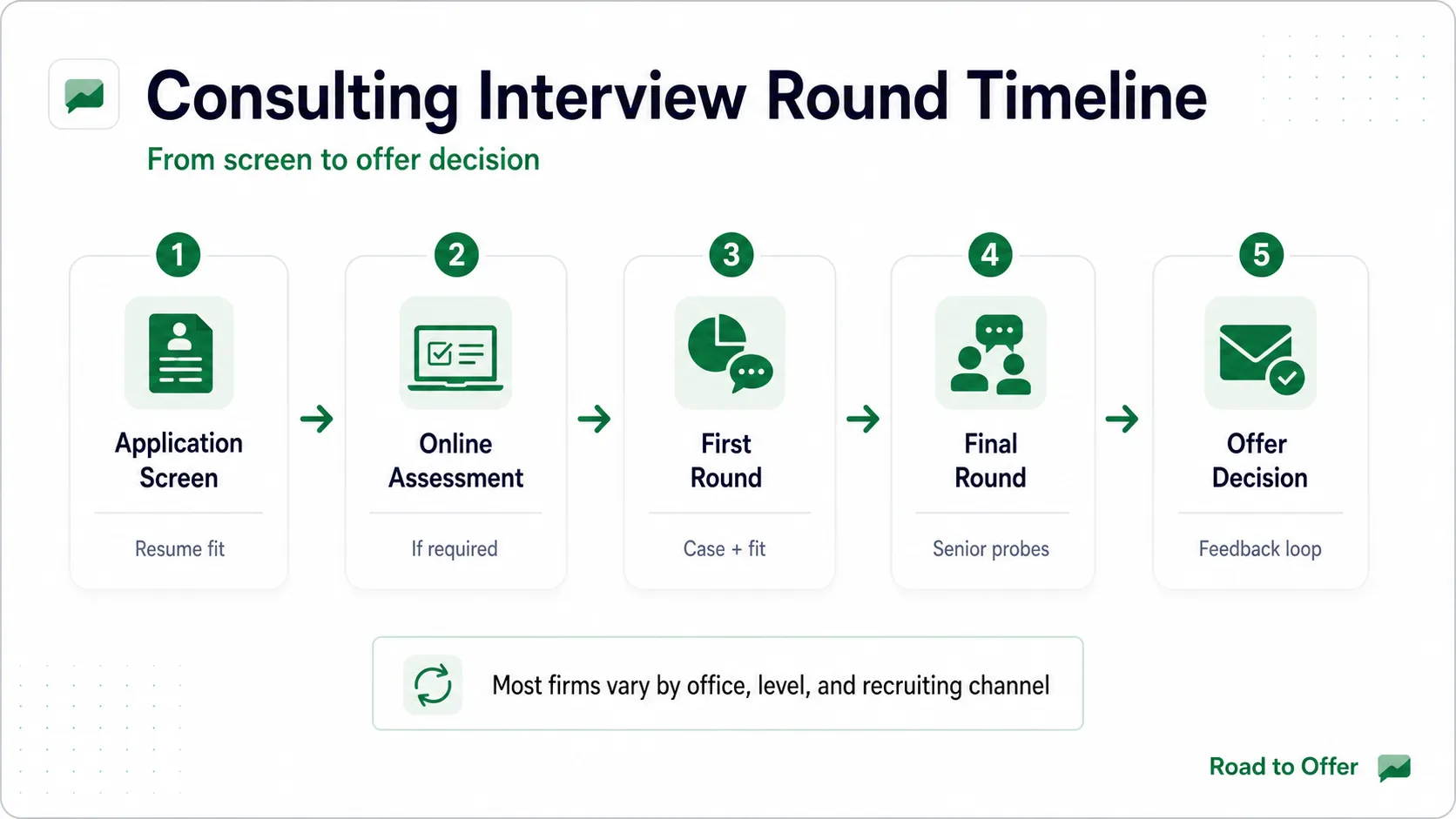
The standard answer for the top firms is two rounds, but that hides the parts that actually shape your prep. A typical timeline looks like this:
- Application and screening. Resume and cover-letter review, sometimes an online assessment before any human interview. McKinsey uses the Solve assessment, BCG uses online cases and the Casey chatbot, and Big Four and boutique firms increasingly screen with online cases too.
- First round. Usually 2 to 3 interviews, each roughly 45 to 60 minutes, each pairing a case with a short fit or behavioral discussion. Interviewers are consultants, engagement managers, project leaders, or principals.
- Final round. Usually 2 to 3 interviews, similar length, with more senior interviewers including at least one partner. Often delivered back to back in a single half-day.
- Decision and offer. Recruiter follow-up, references for some roles, then the offer or a hold.
So "two rounds" really means four to six cases across two distinct evaluation stages plus a screening gate. That count is the consensus across CaseCoach, IGotAnOffer, MyConsultingCoach, and HackingTheCaseInterview. Where it breaks down is at the edges: experienced-hire, campus, and non-MBB processes can compress to one round or add a third when an interviewer wants a second look. That is why you treat the number as a baseline and confirm the real one from your invite, not from a generic diagram.
What does each round test? A stage-by-stage map
Use the table as a routing map, not a fixed ladder. The labels are qualitative because the exact process can shift by firm, office, role, and channel.
If you want the full preparation sequence after mapping your next signal, pair this with the case interview prep guide.
First round vs final round: what actually changes
First round and final round are not the same case with harder arithmetic. They test different things, and the interviewer level is the tell.
The official firm pages back the underlying logic. BCG's case interview preparation page frames cases around structuring, asking questions, analyzing data, quick calculations, identifying key factors, and communicating clearly. That is the first-round mechanics checklist. Deloitte's case and scenario interview tips emphasize clarifying the issue, stating assumptions, summarizing findings, making recommendations, and outlining next steps, which is closer to what a senior interviewer listens for in a final round.
Practically: before a first round, tighten your opening structure and math hygiene. Before a final round, practice concise recommendations, risks, tradeoffs, and stories that prove judgment. A final round case can still include quant work, but weak synthesis is more expensive there because the partner is asking whether your answer would survive a client room.
How the format differs by firm
The round count is similar across MBB, but the case style is not, and prepping the wrong style is a common own goal.
- McKinsey runs mostly interviewer-led cases. The interviewer drives a set of predetermined questions regardless of your initial structure, so your job is to answer each prompt cleanly rather than steer the whole case. McKinsey also uses the Solve assessment as an online screen and weights the Personal Experience Interview heavily on the fit side.
- BCG runs mostly candidate-led cases. The interviewer knows every part of the case and is comfortable letting you choose which areas to explore, so structure and prioritization carry more weight. BCG screens with online cases and the Casey chatbot.
- Bain blends both. You lead the direction, but the interviewer steps in to guide when needed.
If your invite is from one of these firms, read the matching guide before you drill: McKinsey case interview, BCG case interview, or Bain case interview. For the cross-firm differences in one place, the MBB case interview prep guide is the hub.
Worked example: a first-round profitability case
First round rewards clean math under light time pressure. Here is the kind of arithmetic an interviewer expects you to run without a calculator.
A regional coffee chain has seen profit fall. The interviewer hands you the numbers for one store. Walk it as profit equals revenue minus cost.
- Revenue: the store sells 800 drinks per day at an average price of $5.00, so daily revenue is 800 x 5 = $4,000.
- Variable cost: each drink costs $1.50 in ingredients and cups, so variable cost is 800 x 1.50 = $1,200 per day.
- Fixed cost: rent, equipment, and salaried staff total $2,200 per day.
- Daily profit: 4,000 - 1,200 - 2,200 = $600 per day.
Now the interviewer reveals the problem. A new competitor opened nearby and volume dropped 25%, to 800 x 0.75 = 600 drinks per day.
- New revenue: 600 x 5 = $3,000.
- New variable cost: 600 x 1.50 = $900.
- Fixed cost is unchanged at $2,200 (that is the point of fixed cost).
- New daily profit: 3,000 - 900 - 2,200 = negative $100 per day. The store now loses money.
The contribution margin per drink is 5.00 - 1.50 = $3.50. To cover the $2,200 of fixed cost, the store needs 2,200 / 3.50 = 629 drinks per day to break even. At 600, it is 29 drinks short. The crisp first-round answer is not "profit fell." It is: "Volume dropped 25% to 600 drinks, which is below the 629-drink break-even, so the store now loses about $100 a day. The lever is either recovering roughly 30 drinks of daily volume, raising price, or cutting fixed cost." That converts arithmetic into a recommendation, which is exactly what a final-round partner wants more of. If your unit setup or mental math slows here, isolate it with case interview math practice before you run another full mock, and use the profitability framework to make the structure automatic.
Questions to ask recruiters before you prep the wrong format
Ask these before you change your prep calendar:
- Which format should I expect for this round: live case, fit interview, behavioral interview, written exercise, online assessment, or senior conversation?
- Will the case be interviewer-led, candidate-led, written, or data-heavy?
- Are behavioral questions separate from the case, or should I expect fit inside the same conversation?
- Who is likely to interview me: recruiter, consultant, manager, principal, or partner?
- Is there an online assessment such as Solve or Casey, and does it gate the next round?
- What materials are allowed during the interview?
- Will I get feedback after this round, and should I prepare differently for the next one?
These questions do not make you look unprepared. They make your prep less random. Deloitte's interview tips emphasize research, mock interviews, resume fluency, and story preparation, which is why format clarity matters before you decide what to drill.
Common mistakes by stage
Screening mistake: treating the call like a technical case and forgetting that the recruiter is checking clarity, motivation, logistics, and story fit. Your resume should sound owned, not recited.
First round mistake: forcing a memorized framework instead of building structure from the prompt. If you hear a profitability prompt and bolt on a template without tailoring it, the interviewer sees the weakness immediately. Drill structure with the Case interview structure drill.
Math mistake: only doing arithmetic inside full mocks, which hides slow unit setup and estimation. Isolate it with case interview math practice.
Exhibit mistake: reading charts as decoration. In data-heavy rounds the exhibit is often where the case changes direction. Use the Chart and exhibit drill if you describe data but fail to convert it into a business implication.
Final round mistake: over-talking the recommendation. Senior interviewers do not need a recap of every branch. They need a clear answer, the decisive evidence, a named risk, and a next step. Tighten this with the case interview synthesis guide.
Post-round mistake: not recording feedback while it is fresh. Keep a simple debrief in your consulting application tracker: prompt, structure, math, exhibit, synthesis, fit question, follow-up, next drill.
Practice plan for your next round
Start with the round you actually have, then assign the practice type.
If your next conversation is screening or fit-heavy, build story control first. Construct a story bank, rehearse your opening answer, and make sure every major resume line survives follow-up questions. Use the behavioral interview consulting guide, then rehearse the stories live.
If your next conversation is a first round case, spend most of the session on opening structure, math setup, and interviewer communication. Use case interview questions for prompts, but the real value comes from speaking the structure out loud and adjusting when new facts arrive.
If your next conversation is a written, online, or skills assessment, practice exhibits and assumptions. Your target is not beautiful notes. It is a defensible answer from incomplete data.
If your next conversation is a final round, practice synthesis and fit under pressure. Give the answer first, back it with the decisive evidence, name a risk, and state the next step. Then rehearse the behavioral story that explains why a team would trust you. The first round vs final round case interview guide goes deeper on this transition, and the final round case interview prep guide covers the half-day format.
The point is to make your prep a drill selector: full-case realism when the whole interview feels uncertain, targeted drills when a single signal is weak, and fit work when your stories are under pressure.
Practice the round, not just the theory
Run a free Road to Offer case and see whether your structure, math, communication, and synthesis are ready for the stage you are entering.
Sources and Further Reading (checked June 18, 2026)
- Boston Consulting Group - Consulting Interview Process
- Boston Consulting Group - Case Interview Preparation
- Bain & Company - Our Hiring Process
- McKinsey & Company - Interviewing
- Deloitte US Careers - Preparing for the case and scenario interview
- Deloitte US Careers - Recruiting tips: Interview tips
- CaseCoach - First round vs final round interviews at McKinsey, BCG or Bain
- IGotAnOffer - BCG Interview Process & Timeline
- MyConsultingCoach - Case Interview: A comprehensive guide
Frequently asked questions
Resources and related guides
- Practice a real case interviewPractice
- Browse all free resourcesResource hub
- Accenture Salary Guide 2026 - Pay by Level and Career PathFundamentals · May 20, 2026
- Best Consulting Behavioral Interview Resources (2026)Fundamentals · Jun 3, 2026
- Case Interview Prep for Non-Business Majors: A 2026 PlanFundamentals · Jun 3, 2026
- Is Case Interview Coaching Worth It? A 2026 Decision GuideFundamentals · May 22, 2026