
MBB Case Interview Prep: McKinsey vs BCG vs Bain (2026)
MBB case interview prep that works: the shared skills to build first, how McKinsey, BCG, and Bain interviews actually differ (interviewer-led vs candidate-led), and a week-by-week plan.
On this page
To prepare for MBB case interviews, build the shared consulting skill base first (objective clarification, custom structure, exhibit reading, clean math, synthesis, and fit stories), then adapt to each firm's format. All three firms test the same core skills, but the delivery differs. McKinsey runs interviewer-led cases plus a Personal Experience Interview and the Solve assessment. BCG runs candidate-led cases inside a four-step process. Bain has historically blended both styles but is moving toward interviewer-led cases for a more uniform candidate experience. Plan for 4 to 6 case interviews across first and final rounds, do 20 to 40 full timed practice cases with real feedback, and switch to firm-specific reps only once your core case muscles hold.
For the bigger firm landscape, start with what is MBB consulting. This page focuses on the case prep layer.
Practice one MBB-style case free
Run a full case and get feedback on structure, math, communication, and synthesis before you split prep by firm.
What is MBB case interview prep?
MBB case interview prep is preparation for the McKinsey, BCG, and Bain consulting interviews. It is not one generic case playlist. It is a sequence that builds the common consulting skills first, then adapts to each firm's format. If your core structure is weak, firm-specific nuance will not save the interview.
The shared base is simple to name and hard to execute: clarify the objective, build a custom structure, interpret data, do math cleanly, synthesize a recommendation, and answer behavioral questions with evidence. The case interview prep guide covers the general skill stack, and what is a case interview explains the format if you are new to it.
A useful prep plan covers four practice modes:
- Full cases for integration and pacing.
- Case math practice and math drills for speed and accuracy.
- Case synthesis practice and synthesis drills for clear final recommendations.
- Fit and behavioral stories tailored to each firm.
How do McKinsey, BCG, and Bain case interviews differ?
The single most important distinction is who drives the case. This is the axis most candidates miss when they treat MBB as one undifferentiated target.
McKinsey runs interviewer-led cases
McKinsey cases are built by a central team and tend to be interviewer-led. The interviewer presents a problem, then walks you through specific areas in a set order, asking targeted questions along the way. Your job is to answer each prompt thoughtfully while staying on the interviewer's track rather than choosing your own path. In first-round interviews this can feel scripted and fast-paced, with heavy emphasis on reading charts and tables accurately.
McKinsey also pairs the case with a Personal Experience Interview (PEI), where you go deep on real leadership, personal impact, and conflict stories, and most consulting roles include the Solve assessment, a gamified problem-solving test. That makes McKinsey prep unusually dependent on PEI depth and on solo reasoning discipline. Use the McKinsey case interview guide for the case rhythm, the McKinsey PEI guide for fit, and the McKinsey Solve guide for the assessment.
BCG runs candidate-led cases
BCG cases are often built by consultants from their own client work, so interviewers are comfortable letting you choose where to go. BCG uses a candidate-led format: the interviewer presents a business problem, and you define the question, structure an approach, decide which areas to explore, ask for data, run the analysis, and reach a recommendation, all while explaining your reasoning aloud. BCG officially lists four steps for client-facing roles: an application, a skill interview, a case interview, and a team interview. Its interviewers look for integrity, intellectual curiosity, creative thinking, a collaborative mindset, and drive. Use the BCG case interview guide and practice driving the case yourself instead of waiting for the next prompt.
Bain is shifting toward interviewer-led cases
Bain was long known for candidate-led cases, but it has been moving toward interviewer-led cases to give candidates a fairer and more uniform experience. Bain's own prep guidance is consistent across styles: understand the question before diving in, use a clear framework and walk the interviewer through your approach, share your reasoning and calculations even when unsure, watch interviewer cues and adapt, and highlight the important numbers and insights. Bain also weights composure and cultural fit heavily. Use the Bain case interview guide and practice concise, responsive delivery.
A practical caveat: the exact style often depends on your individual interviewer. A BCG interviewer who prefers structure may run a more interviewer-led case, and a McKinsey interviewer who likes natural flow may let you lead. Prepare for both modes so a surprise format does not throw you.
How are MBB interview rounds structured?
Plan for roughly 4 to 6 case interviews split across a first round and a final round, with each interview running about 45 minutes to an hour. A typical interview spends around half the time on the case and half on fit, motivation, and behavioral questions.
The rounds feel different. First-round cases, especially at McKinsey, are more scripted because interviewers follow a tested case closely. Final rounds are run by Partners who often use the same case for years and can deliver it without a script, so they tend to be looser and give you more room to lead. The skills do not change, but the experience does. Read first round vs final round case interview so the looser Partner format does not catch you off guard.
What skills should your MBB prep plan build first?
Build transferable skills before format-specific hacks. McKinsey, BCG, and Bain all reward logical business thinking that is easy to follow. If you can structure a profitability case, read a messy exhibit, and synthesize a recommendation clearly, you can adapt to each firm.
Start with case interview frameworks, but do not memorize them as scripts. Use them as a parts library. A market entry case may need demand, competition, economics, risks, and capabilities. A profitability case may need revenue, costs, mix, and operations.
Stabilize these four skills in order:
- Problem definition. If you misstate the client objective, every later branch gets weaker.
- Prioritization. Explain which branch you would test first and why, instead of marching through every box.
- Clear communication. All three firms need to hear your reasoning as you go, not just inspect your answer at the end. The structure-thinking guide covers how to think out loud cleanly.
- Coachability. BCG and Bain describe interactive settings, and even an interviewer-led McKinsey case is a conversation. When the interviewer gives a hint, use it visibly. Ignoring feedback makes the case feel like a solo performance instead of client work.
Define the output of your first prep block so progress is measurable. Each session should produce one custom structure for a new prompt, one clean exhibit read with a conclusion, one math setup with units stated out loud, and one recommendation that names a risk and a next step.
When should you switch to firm-specific case prep?
Switch to firm-specific prep when format, not fundamentals, is the bottleneck. Too many candidates jump to "McKinsey vs BCG vs Bain" before they can solve a standard profitability or market entry case cleanly. The mistake is starting with brand trivia. Interviewers do not reward knowing firm stereotypes if your structure is weak.
Once the base holds, adapt by behavior, not vocabulary. You should sound more rigorous and PEI-ready for McKinsey, more self-directed and structured for BCG's candidate-led cases, and more concise and fit-aware for Bain. For the broader recruiting picture, how to get into MBB covers networking, applications, and timing around the case.
How should you practice across all three firms?
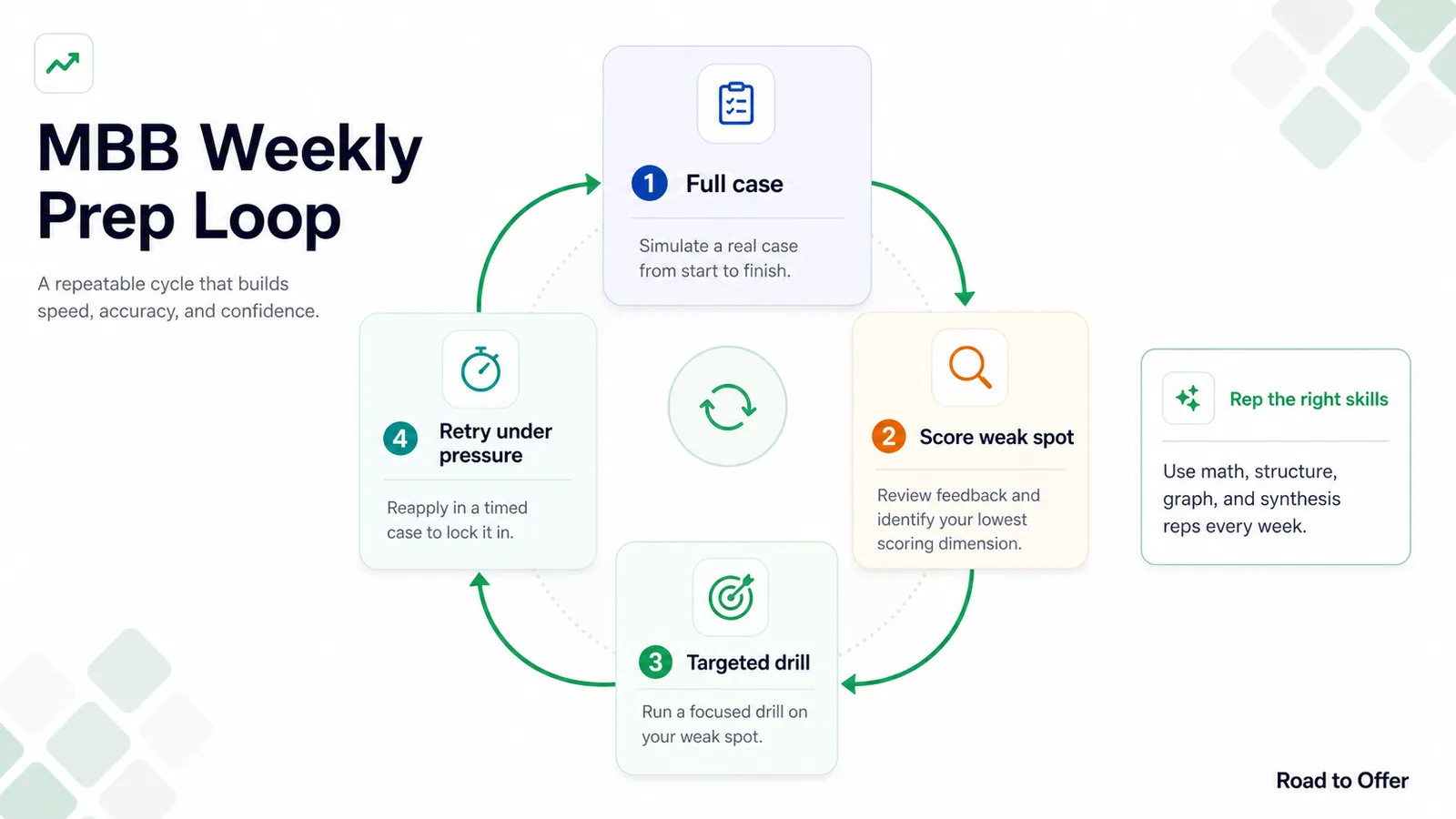
Use a rotation so you do not overfit to one format. Start each week with a general case, then run McKinsey practice cases with PEI follow-ups, a BCG-style candidate-led case, and a Bain-style case with concise fit delivery. Keep the scoring criteria constant: structure, analysis, communication, synthesis, and coachability. A consistent scorecard is what lets you compare reps and see real progress.
Do not let practice volume hide weak feedback. After each case, write one fix. If your math was slow, do market sizing practice or a math drill. If your issue tree was generic, rebuild it with a structure drill. If your final answer was just a recap, redo only the synthesis. Grading every rep against a fixed case interview scoring rubric keeps your feedback honest.
Separate live and solo reps. Solo reps are good for building structures, reading exhibits, and drilling arithmetic. Live reps test eye contact, pacing, coachability, and whether your explanation actually lands. MBB interviewers assess the client-ready version of your thinking, so both modes matter. For how to set up quality reps, see mock consulting case interview preparation.
On volume, most candidates who reach offers do 20 to 40 full timed cases, with a meaningful share live with a partner or coach who knows what MBB interviewers listen for. The exact number matters less than the feedback loop. Five well-debriefed cases beat twenty rushed ones.
See if your MBB prep is interview-ready
Run a free Road to Offer case and get a clear read on structure, math, synthesis, and communication before your firm interviews.
How should you sequence MBB prep across firms?
Start with shared mechanics before firm nuance. The first layer is universal: objective clarification, custom structure, clean math, exhibit interpretation, synthesis, and fit stories. That foundation supports McKinsey, BCG, and Bain.
A simple sequence works well over six to eight weeks. Spend the first 2 to 3 weeks building the shared base with full cases and daily drills. Then add firm-specific reps: interviewer-led pacing and PEI depth for McKinsey, candidate-led structuring for BCG, and concise, fit-aware delivery for Bain. Keep one weekly slot for pure math or exhibits, using Road to Offer math drills or graph drills, so fundamentals do not decay while you chase firm nuance. In the final weeks, simulate the real thing: timed, back-to-back cases with a fit interview attached, matching the 4-to-6-case load you will face on interview day.
This sequence also makes feedback cleaner. If one firm style keeps exposing the same weakness, the issue is almost always a core skill, not a brand-specific trick. Fix the core skill first, then return to the firm lens. Build the skill base, then adjust style, examples, and fit stories for each firm.
Sources
- McKinsey Careers, Interviewing: https://www.mckinsey.com/careers/interviewing (checked June 18, 2026)
- BCG Careers, Interview process: https://careers.bcg.com/global/en/interview-process (checked June 18, 2026)
- BCG Careers, Case interview preparation: https://careers.bcg.com/global/en/case-interview-preparation (checked June 18, 2026)
- Bain Careers, Preparing for the case interview: https://www.bain.com/careers/hiring-process/case-interview (checked June 18, 2026)
- CaseCoach, How do the interviews at McKinsey, BCG and Bain differ: https://casecoach.com/b/how-different-are-the-interviews-at-mckinsey-bain-and-bcg/ (checked June 18, 2026)
- CaseCoach, First-round vs final-round interviews at MBB: https://casecoach.com/b/whats-different-between-a-first-round-and-final-round-interview-at-bain-bcg-or-mckinsey/ (checked June 18, 2026)
Frequently asked questions
Resources and related guides
- Run a real case interviewPractice
- Browse all free resourcesResource hub
- Cabinets MBB 2026 : le guide McKinsey, BCG et BainFirm Specific · Jul 23, 2026
- BCG vs Bain: 10 Real Differences (2026 Guide)Firm Specific · May 1, 2026
- McKinsey vs BCG: 10 Real Differences (2026 Guide)Firm Specific · May 1, 2026
- Phone and Video Case Interviews: How to Verbalize When Notes Are InvisibleFirm Specific · May 1, 2026