
Supply Chain Case Interview: Framework, Worked Example, and Expert Prep (2026)
Master supply chain case interviews with the SIMDC framework, a fully worked procurement example with numbers, and the mistakes that sink operations candidates.

KearneyBumpers R UsOperations · Medium
Start a free case interview on supply chain
Hear the case, say or type your answer, get your score.

Don't know how to case yet? Learn how to case
On this page
A supply-chain case interview asks you to find the operational bottleneck, whether inventory, network, supplier, or service, then quantify the cost and choose a feasible fix. Use the Kearney case interview guide if Kearney is your target firm, and the top manufacturing consulting firms for sector-specific recruiting targets.
How Supply Chain Cases Differ from Profitability Cases
In a profitability framework case, you hunt across revenue and cost for the root cause of a financial gap. In a supply chain case, operations is already scoped as the problem. Your job is to navigate a multi-node chain to find which link is broken, by how much, and what fixing it is worth financially.
The solutions space is also more technical. You need working vocabulary around inventory economics, network design, procurement levers, and logistics trade-offs. Recommending "optimize inventory" without specifying whether you mean reducing safety stock, improving demand forecasting, or implementing vendor-managed inventory will lose an interviewer's patience immediately.
According to Hacking the Case Interview, supply chain cases recur across McKinsey Operations, Kearney, and BCG's Operations Practice in four archetypes: procurement cost reduction, inventory optimization, distribution network design, and supplier risk management.
The SIMDC Framework: Five Diagnostic Layers
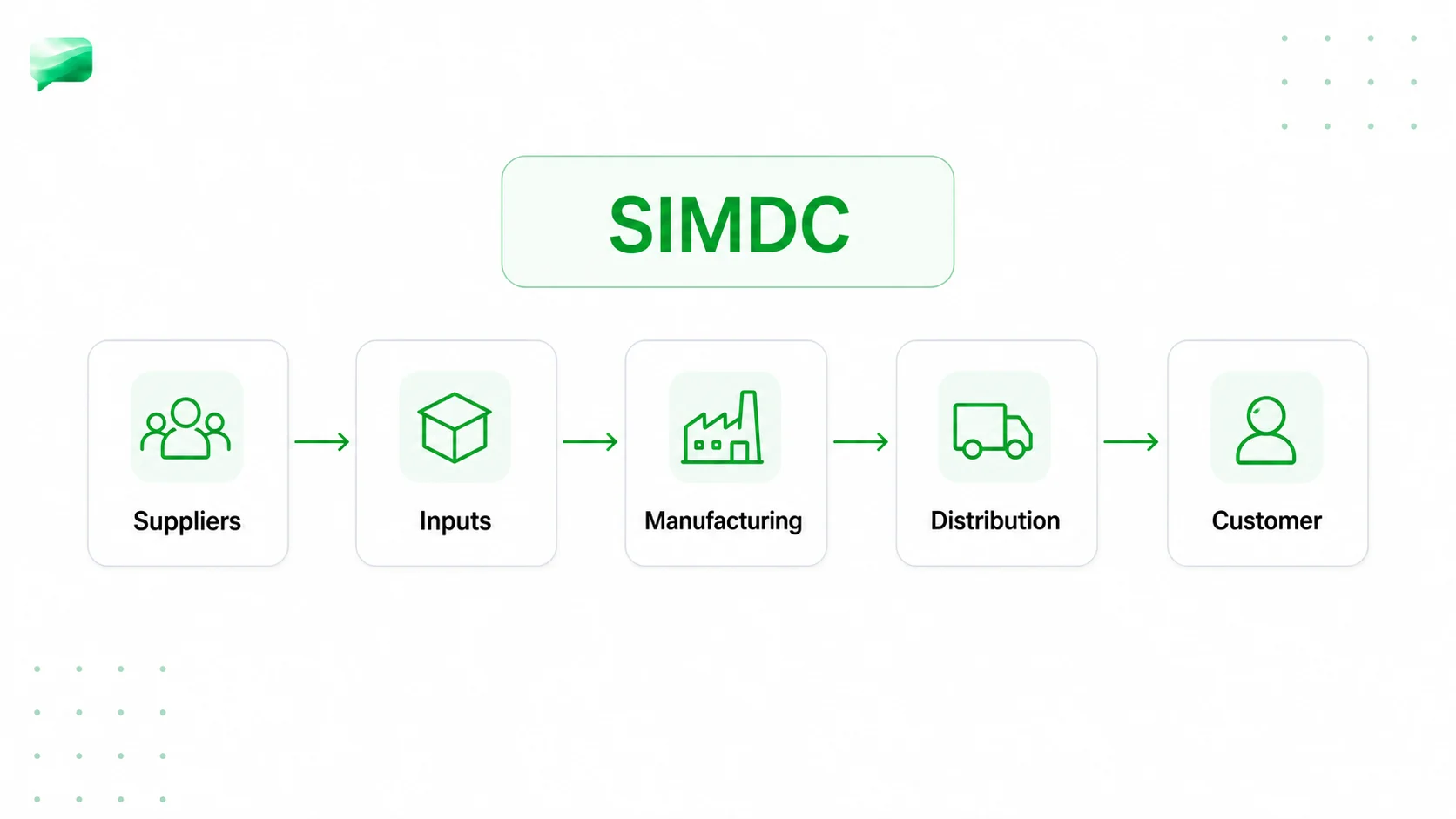
Every supply chain case maps to five layers. Use this as a diagnostic map, not a checklist. Form a hypothesis about which layer is most likely failing before asking your first clarifying question.
S: Suppliers. Who provides raw materials or components? How many suppliers per category? Is there single-source concentration risk?
I: Inputs/Procurement. How are inputs purchased? What are unit costs, contract structures, and negotiating leverage? Is there centralized procurement capturing volume discounts?
M: Manufacturing. Where and how are goods produced? What are capacity constraints, production yields, and unit cost? Where is the bottleneck?
D: Distribution. How do finished goods reach customers? What are transportation modes, warehouse locations, last-mile economics, and transit times?
C: Customers/Demand. How accurately is demand forecast? Are there seasonal spikes, stockout risk, or demand variability the chain cannot absorb?
Use the value chain framework to separate primary supply chain activities from support activities when the case spans a broader value chain.
Crawlable practice twin. A distributor has rising stockouts despite higher inventory. Structure the diagnosis across suppliers, inputs, manufacturing, distribution, and customers. First calculate whether the stockout increase is concentrated in one node. Feedback should score hypothesis quality, branch coverage, units, and the cost-service trade-off.
How to Structure Any Supply Chain Case
Regardless of case type, follow these four steps to structure your answer.
Step 1: Clarify the objective. Is this about reducing cost, shortening lead time, improving resilience, or improving service levels? A resilience objective points to supplier diversification and safety stock; a cost objective points to procurement leverage and network consolidation.
Step 2: Diagnose the chain using SIMDC. Identify which layer is performing below benchmark. State your hypothesis before asking clarifying questions: "I believe the issue is most likely in the distribution layer given logistics cost inflation. I want to test that by looking at cost breakdown across procurement, manufacturing, and logistics."
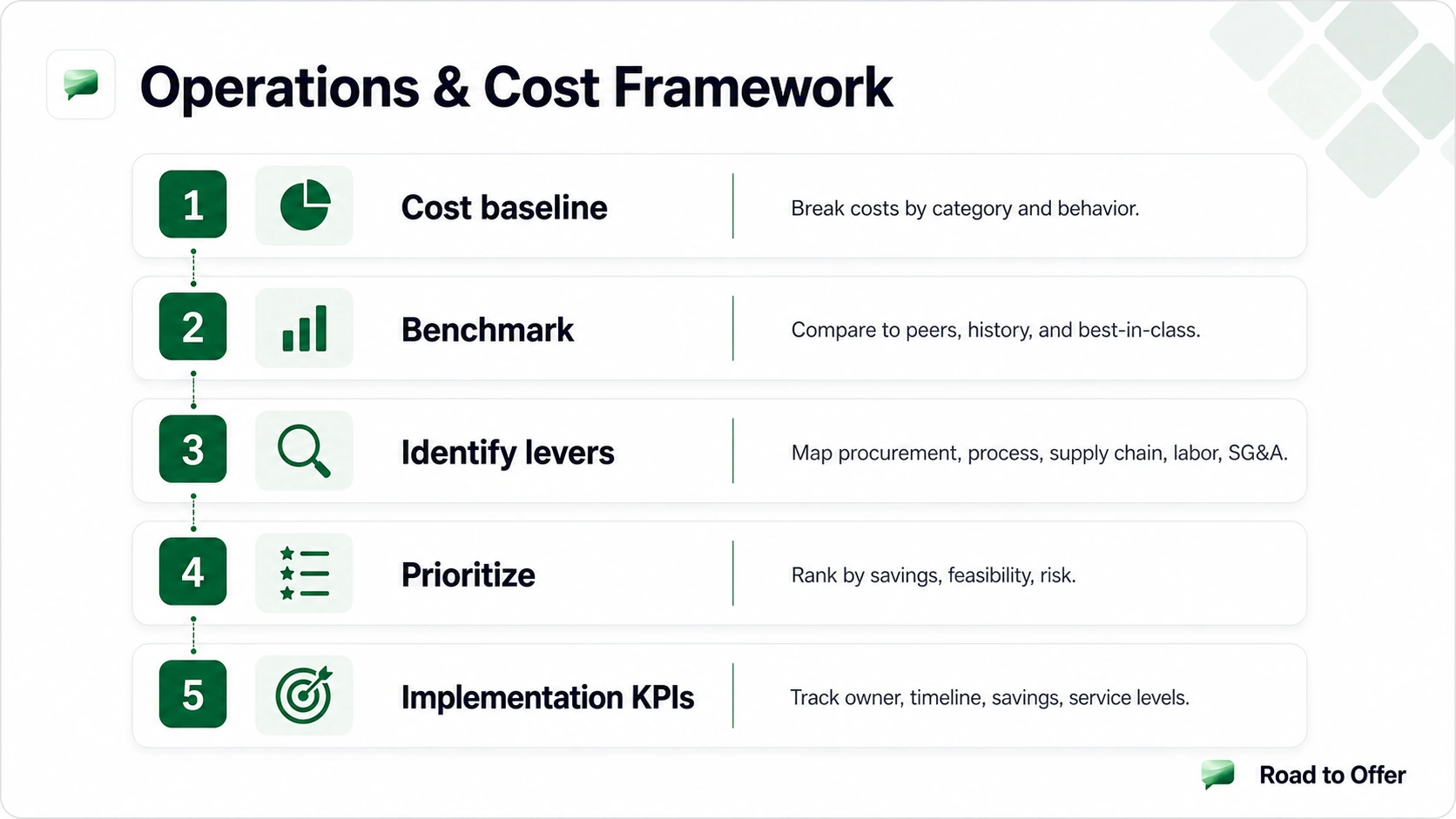
Step 3: Identify levers per layer. For each underperforming layer, identify the 2-3 highest-impact levers: renegotiate contracts (cost), reduce safety stock or improve forecasting (efficiency), diversify supplier base or nearshore manufacturing (risk).
Step 4: Quantify and prioritize. Calculate the financial impact of your top levers. Structure as Phase 1 (quick wins, 3-6 months) and Phase 2 (structural changes, 6-18 months).
Supply Chain Metrics, KPIs and Trade-offs
Interviewers expect you to name the metric that is broken before you quantify it. These are the five that come up most often in supply chain cases; formulas follow Klipfolio's supply chain KPI reference and Easyship's landed cost definition (both checked September 15, 2026).
Each metric hides a trade-off. Raising fill rate or OTIF usually costs inventory or expedite spend. Cutting days of supply frees cash but thins your disruption buffer. Chasing the lowest landed cost stretches lead times and raises minimum order quantities. In the interview, name the metric you are improving and the one you are knowingly spending, the same way the worked example below prices each procurement lever against its risk.
Worked Example: Procurement Cost Reduction
Prompt: "Our client is a European consumer goods manufacturer with EUR 800M in annual revenue. COGS has increased from 55% to 63% of revenue over two years. The CEO believes procurement is the primary driver. What would you investigate, and what do you recommend?"
Financial anchor: An 8-percentage-point COGS increase on EUR 800M revenue = EUR 64M of additional annual cost.
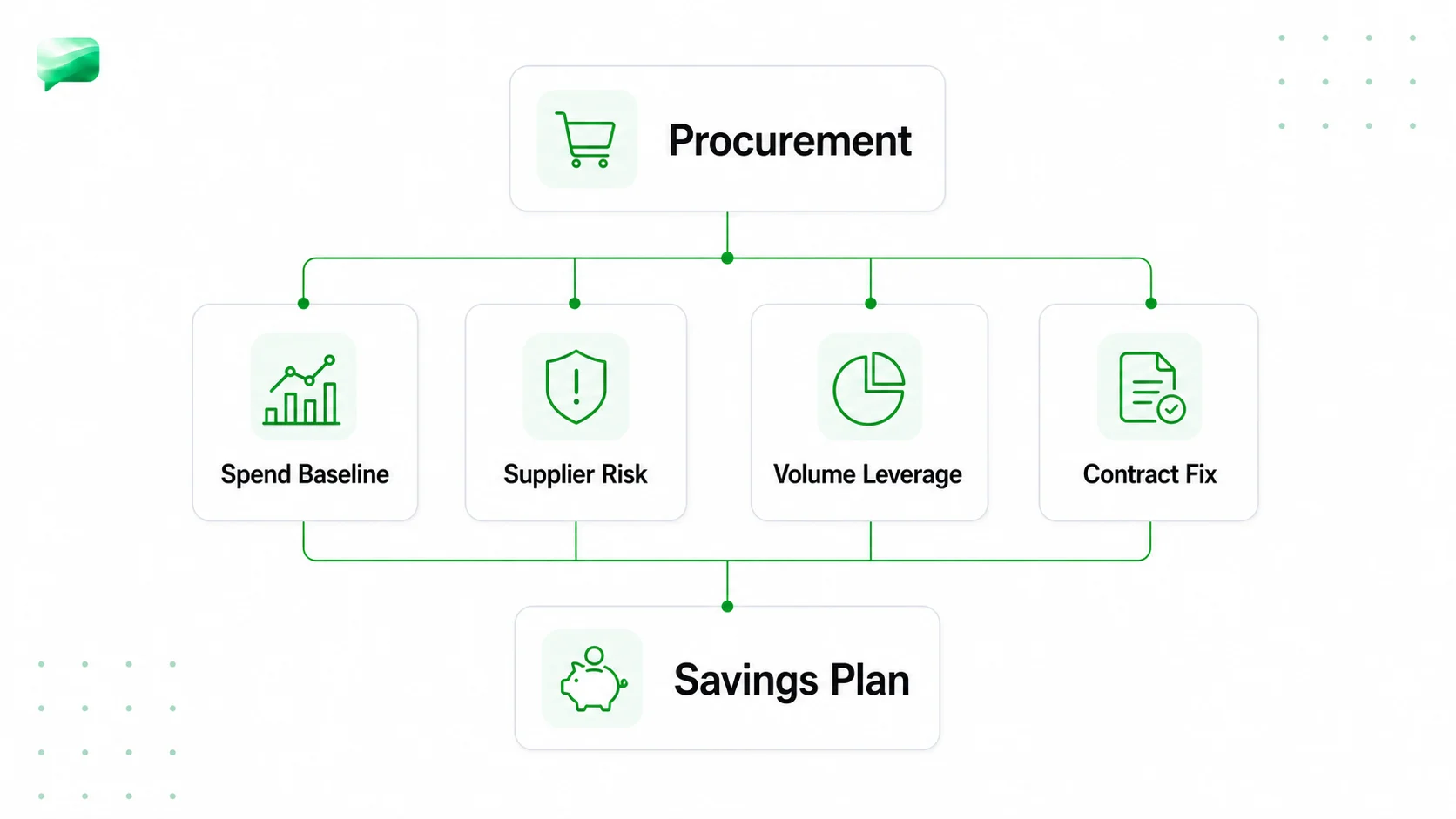
Diagnose procurement spend:
Identify levers and quantify each:
- Carrier contracts: Under the interviewer's illustrative 17% saving assumption, EUR 50M of spend yields EUR 8.5M annually. Stated timeline: 3-6 months. Risk: Low.
- Packaging consolidation: Under the illustrative 10% unit-cost assumption, EUR 126M of spend yields EUR 12.6M annually. Stated timeline: 9-12 months. Risk: Medium.
- Contract manufacturing renegotiation: Under the illustrative 7% assumption, EUR 101M of spend yields EUR 7.1M annually. Stated timeline: 6-9 months. Risk: Low.
Synthesis: "Phase 1 (months 1-6): lock in contracted carrier rates (EUR 8.5M) and launch packaging supplier RFPs. Phase 2 (months 6-12): complete packaging consolidation (EUR 12.6M) and renegotiate contract manufacturing (EUR 7.1M). Total: approximately EUR 28M in recoverable COGS, moving the ratio from 63% to approximately 60%, in line with industry median. The remaining gap to 55% reflects commodity inflation that hedging programs can partially offset over 18-24 months."
Logistics Bureau's supply chain case studies document retailers achieving 25-30% reductions in inventory carrying costs within 18 months through SKU rationalization and demand-driven replenishment.
If this procurement math feels slow, repeat the calculation aloud and state the business implication after each result.
Quick Math
- A packaging category has EUR 90M of annual spend across regional suppliers. Consolidation wins a 12% unit-cost reduction. What is the annual saving, to the nearest EUR 100K?
Saving = Annual spend x negotiated rate reduction. Consolidation leverage shows up as a rate, savings as spend times that rate.
- Consolidating warehouses saves EUR 1.4M of fixed cost a year but requires 20% more safety stock on a EUR 5M base. At a 10% annual carrying-cost assumption, what is the net annual saving?
Net = Fixed-cost saving - (added stock x carrying rate). The service check comes after the number, never instead of it.
- A sole supplier carries a 12% annual chance of a disruption that would lose EUR 4M of contribution. Dual-sourcing adds EUR 0.30 per unit across 800K units and cuts the disruption chance to 3%. Which option costs less per year, and by how much?
Compare expected totals: sole = chance x loss; dual = premium + reduced chance x loss. Decide on cost first, then weigh continuity.
Fix a broken service level in a McKinsey operations case. On-time-in-full service fell from 96% to 87% while cost per order rose. Answer this McKinsey operations case step in the article. Browse more practice cases in the case interview library
The Four Common Supply Chain Case Types
Beyond procurement, supply chain cases fall into four recurring archetypes.
Distribution Network Design: Should the client consolidate warehouses or open new distribution centers? Compare total cost (transportation + warehousing + inventory carrying cost from longer lead times) against alternative configurations. Always ask about service level constraints. Consolidation saves fixed cost but extends delivery lead time.
Make-vs-Buy: Should the client manufacture in-house or outsource? Compare total cost of ownership: in-house (fixed cost amortization + variable cost + overhead) versus outsourced (contract price + quality control + IP risk + lead time variability). For break-even math, see case interview math practice.
Supplier Risk and Resilience: Quantify risk as P(disruption) x revenue lost per day x expected disruption duration. In 2024, Houthi attacks disrupted $6 billion in weekly trade flows through the Red Sea, adding 10-14 days to shipping.
Demand Forecasting and S&OP: Diagnose forecasting gaps layer by layer. Is this a data quality issue, a model issue, or a process issue where salespeople override statistical forecasts? According to RocketBlocks, the most common follow-up is: "What's the cost of a 1pp improvement in forecast accuracy?"
Two short trade-off reps
Inventory and network. Assume two warehouses each hold EUR 6M of average inventory. Consolidation cuts fixed cost by EUR 1.4M a year but requires 20% more safety stock at the remaining warehouse, tying up another EUR 1.2M. At a stated 10% annual carrying-cost assumption, the added inventory costs EUR 120K a year, so the illustrative net annual saving is EUR 1.28M before transition cost. The service-level check is whether longer delivery times breach customer commitments.
Supplier resilience. Assume a sole supplier costs EUR 20 per unit and has a 10% annual chance of a disruption that would lose EUR 5M of contribution. A dual-source option raises unit cost by EUR 0.40 across 1M units, or EUR 400K a year, while reducing the stated disruption probability to 2%. Expected disruption loss falls from EUR 500K to EUR 100K, exactly offsetting the price premium in this illustrative case. The decision then turns on service continuity and downside risk, not a fictional universal saving.
Supply Chain Case Questions You Will Get
Prep trackers and candidate reports converge on the same question set. Ten prompts you should be able to open cold, each paired with the closest case-type or framework guide:
- "A consumer goods client's COGS climbed six points in two years. Walk me through your diagnosis." A cost reduction case scoped to procurement spend categories.
- "A distributor keeps raising inventory yet stockouts keep getting worse. What is going on?" An operations case where you separate cycle stock, safety stock, and obsolete stock before prescribing anything.
- "Should the client consolidate five warehouses into two?" Network design under an operations cost framework: fixed cost and transport versus lead time and service level.
- "Make this component in-house or outsource it?" A total-cost comparison that maps onto a cost-benefit analysis framework, priced on landed cost rather than unit price.
- "How much safety stock should the plant hold?" A consulting math formulas problem: demand variability, lead time, and target service level.
- "One supplier covers 40% of a critical input. What do you recommend?" Expected-value reasoning through a decision tree framework: disruption probability times contribution lost versus the dual-source premium.
- "A carrier redesign promises 15% freight savings but adds two days of lead time. Take it?" A second cost-benefit analysis rep, this time with the service-level cost made explicit.
- "Estimate the US market for warehouse automation." A market sizing question wearing an operations costume.
- "A PE firm is diligencing a cold-storage logistics provider. What do you examine?" PE due diligence applied to utilization, contract length, and customer concentration.
- "Should the client pass fuel-cost inflation into delivery pricing?" A pricing strategy case about elasticity and contract structure, not just cost recovery.
Notice the pattern: every prompt names a symptom and expects you to pick the metric, structure the chain, and quantify the trade-off. That is the whole game.
Common Mistakes in Supply Chain Cases
Treating the framework as the analysis. Listing SIMDC layers is a map, not a diagnosis. Form a hypothesis about which node is failing before asking a single clarifying question. Use MECE structuring to narrow quickly.
Ignoring cost-service level trade-offs. Every supply chain recommendation trades cost efficiency against service level. Consolidating warehouses saves cost but extends delivery lead times. Cutting safety stock frees working capital but increases stockout risk. Always articulate the trade-off explicitly.
Missing the make-vs-buy question. In manufacturing layer problems, the highest-impact lever is often make-vs-buy, but candidates forget to surface it. Asking "Is the client doing this in-house? What does the contract manufacturing market look like?" signals operational sophistication.
Not connecting operational impact to financial impact. Every lever should translate to a number: lead time reduction leads to lower safety stock leads to lower working capital. Better yield means lower scrap cost means lower COGS. Add "...and that translates to approximately $X in annual savings" to every recommendation.
Related Guides
- Value Chain Framework: maps full journey from raw materials to end customer
- Cost Reduction Case Interview: supply chain optimization is one of the four major cost reduction levers in any profitability case
- Airline Case Interview: MRO supply chains, fuel procurement, and catering logistics appear as operational cost cases in aviation
- Automotive Case Interview: just-in-time manufacturing, tiered supplier networks, and parts logistics make supply chain the dominant lens in auto cases
- ESG Sustainability Case Interview: Scope 3 emissions, ethical sourcing, and supply chain resilience are ESG supply chain cases
- Energy Case Interview: commodity procurement, pipeline logistics, and LNG distribution cases are supply chain cases in the energy sector
- Profitability Framework: COGS is a cost line item and supply chain is its primary driver
Re-run the MetroFresh turnaround with scored feedback
Carry the procurement math, service-level trade-off, and recommendation into a complete operations case.
Sources (checked June 17, 2026; additions September 15, 2026)
- McKinsey Supply Chain Risk Survey 2025: mckinsey.com/capabilities/operations/our-insights/supply-chain-risk-survey
- Klipfolio, 22 supply chain metrics and KPIs: klipfolio.com/resources/kpi-examples/supply-chain
- Easyship, What Is a Landed Cost (April 2026): easyship.com/blog/what-is-landed-cost
- CaseBasix, Supply Chain Case Interview Guide (updated August 20, 2026): casebasix.com/pages/supply-chain-case-interview-guide
- MHL News, 38% increase in global supply chain disruptions in 2024: mhlnews.com/global-supply-chain/news/55263602
- Logistics Bureau, supply chain cost reduction case studies: logisticsbureau.com/7-mini-case-studies
- Hacking the Case Interview, supply chain case guide: hackingthecaseinterview.com/pages/supply-chain-case-interview
- RocketBlocks, supply chain case interview analysis: rocketblocks.me/blog/supply-chain-case-interviews.php
- Z2Data, key supply chain statistics 2025: z2data.com/insights/9-key-supply-chain-statistics
Frequently asked questions
Resources and related guides
- Practice supply chain in a real case interviewPractice
- Browse all free resourcesResource hub
- 3Cs Framework: Company, Customer, Competitor (Worked Example)Frameworks · Feb 6, 2026
- 4C Framework Case Interview: The 4 Cs, a Worked Example & How to Use It (2026)Frameworks · Jun 28, 2026
- 4Ps Framework Case Interview: Product, Price, Place, PromotionFrameworks · Feb 6, 2026