
Altman Solon Case Interview: Format, Rounds and TMT Prep Guide
Altman Solon case interview guide: the real round structure (HR plus three first-round and two final-round interviews), interviewer-led TMT cases, a worked streaming math example, and free drills.
On this page
An Altman Solon case interview is a quantitatively heavy strategy case set almost entirely in telecommunications, media, and technology. Unlike many firm guides that hedge on process, this one does not have to: Altman Solon publishes its official interview structure, so you can plan against real rounds instead of rumors. The firm describes itself as the world's largest TMT-focused strategy consulting group, which is why generic profitability practice is not enough. Your reps should live in fiber rollout, streaming monetization, cloud go-to-market, software market studies, data center diligence, pricing, and investor decisions. This guide gives you the confirmed format, what interviewers assess, a fully worked TMT math example, the mistakes that sink prepared candidates, and a drill plan. Learn the broader system in the case interview prep guide first, then sharpen it through a TMT lens.
What is the Altman Solon case interview format?
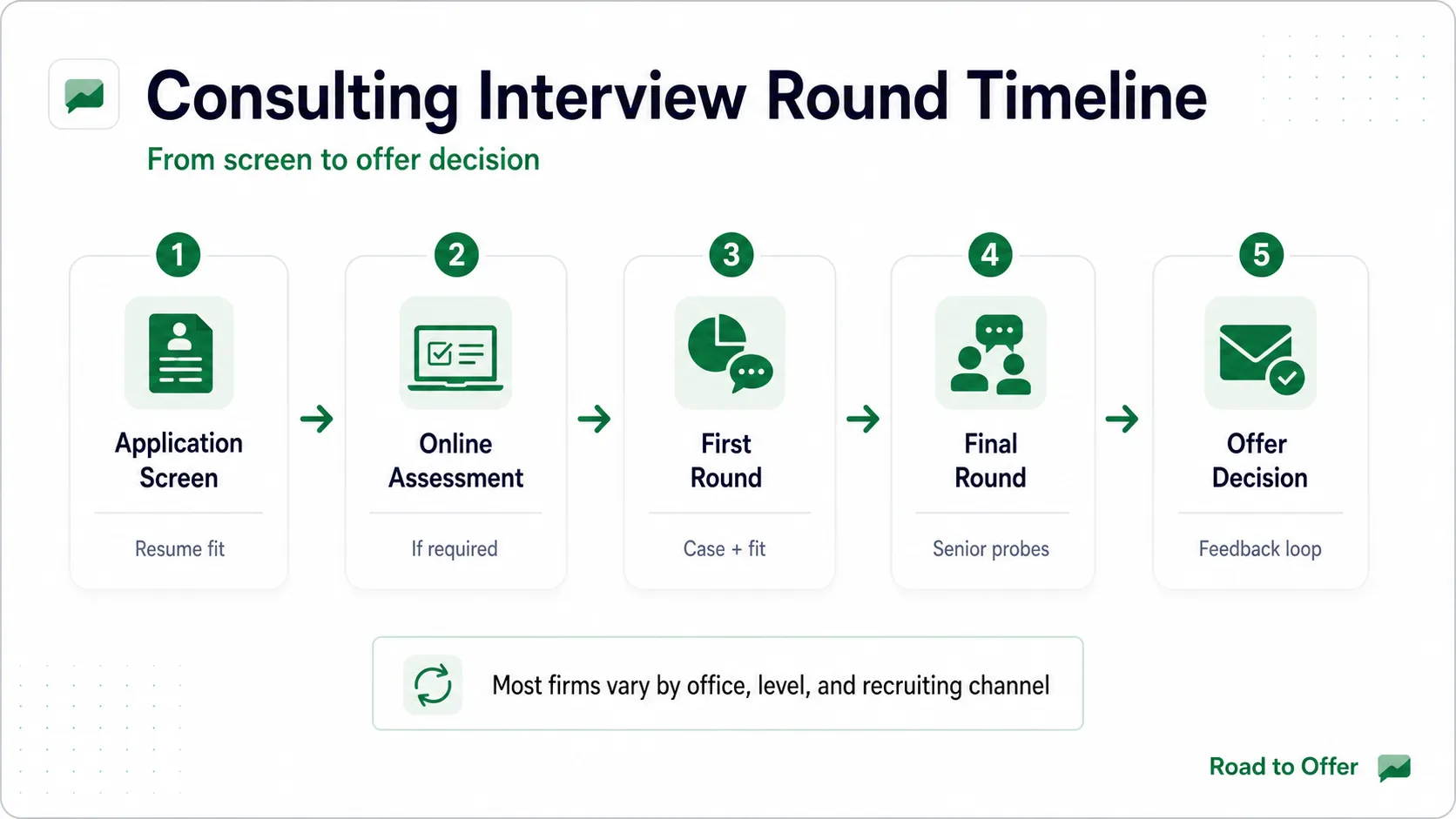
Altman Solon's own interview guide spells out the process, so this part is confirmed, not guessed. For full-time candidates it runs in three stages.
Intern candidates follow a near-identical path: a 30-minute HR interview, then three 60-minute interviews built from the same 15-minute fit, 40-minute case, and 5-minute Q&A blocks. After each round the firm holds a discussion to review your progress and decide next steps, and it aims to give feedback after every round.
Two things matter for planning. First, the case is only 40 minutes inside a 60-minute slot, so wandering structure and slow math are expensive. Second, every interview pairs a fit conversation with a case, so behavioral preparation is not optional. For the broader vocabulary of consulting stages and what a recruiter looks for at each one, keep the consulting interview process open while you prepare.
Drill Altman Solon market sizing now
Market sizing is reported as one of Altman Solon's most common case types. Get a scored rep before you build the rest of your prep.
Are Altman Solon cases interviewer-led or candidate-led?
Altman Solon cases are mostly interviewer-led. The interviewer drives the discussion, hands you data and exhibits at set points, and steers you with follow-up questions, rather than letting you roam the way a classic candidate-led case allows. Some candidates report an occasional more candidate-led prompt, so prepare for both, with the weight on interviewer-led.
That format changes how you should practice. In an interviewer-led case you score points by answering the exact question on the table cleanly, structuring quickly, and moving when the interviewer moves, not by laying out a sprawling framework and exploring every branch. The skills are the same as the case interview types you already know, but the rhythm is tighter and more directed. For how other Tier-2 strategy firms structure their interviews by comparison, see the Oliver Wyman case interview guide and the Strategy& case interview guide.
What does Altman Solon assess in the case?
The case rewards the same core signals every strong consulting case does, expressed through TMT business logic.
- Structure: Can you build a case interview structure that fits the specific TMT model (subscriptions, fiber economics, ad-supported media, cloud channels) instead of forcing a canned profitability tree?
- Quantitative reasoning: Can you set up and execute math under time pressure, including market sizing, CAGR, breakeven, percentage change, and market share?
- Exhibit interpretation: Can you read a cohort, pricing, adoption, or local-market chart and convert it into a business implication, not just a description?
- Business judgment: Do you understand TMT drivers such as ARPU, churn, penetration, utilization, capex, and channel economics?
- Communication and fit: Do your answers sound like the work in what management consultants do, with clear reasoning, ownership, and clean delivery?
Because market sizing and quant come up so often, the highest-leverage habit is simple: lay out your calculation structure and assumptions out loud, get the interviewer to confirm the approach, then execute. If your structure is sound, the rest is clean arithmetic. Accuracy and a clear explanation beat raw speed.
TMT case examples: telecom, media, technology, and investors
The examples below are source-backed practice themes drawn from Altman Solon's public telecommunications, media, and technology focus, its strategy and go-to-market work, and its private equity support. They are realistic prep prompts, not leaked interview cases.
A single full case touches structure, math, exhibits, and synthesis in one conversation, which is why a complete TMT-style practice case is the best diagnostic. Road to Offer turns a firm-specific prep plan into an actual spoken case and then shows which skill needs the next drill.
Practice a TMT-style case
Run a free Road to Offer case and see whether your structure, math, and synthesis hold up under interviewer-led pressure.
Worked example: streaming premium-tier math
Use this as an illustrative TMT case, not a claim about an actual prompt. Prompt: a streaming platform with 20 million subscribers is considering a premium tier at a higher price. The client wants to know the first-year revenue upside and whether the math justifies launch.
Start by stating the structure before any arithmetic: upgrade revenue equals subscribers who upgrade multiplied by the price uplift, minus the cost to serve the tier, adjusted for any churn the change causes. Confirm that approach, then ask for the inputs. Suppose the interviewer gives you these.
- Base: 20,000,000 subscribers at $10 per month.
- Premium tier: $15 per month, so a $5 monthly uplift per upgrader.
- Expected upgrade rate: 15% of the base in year one.
- Incremental content and support cost: $120,000,000 per year for the tier.
- Risk to check: a 2% churn increase on the 85% who do not upgrade.
Now execute cleanly, narrating each step.
- Upgraders: 20,000,000 x 15% = 3,000,000 subscribers.
- Monthly uplift revenue: 3,000,000 x $5 = $15,000,000 per month.
- Annual uplift revenue: $15,000,000 x 12 = $180,000,000.
- Net of tier cost: $180,000,000 - $120,000,000 = $60,000,000 contribution.
- Churn check: non-upgraders are 20,000,000 x 85% = 17,000,000. A 2% churn increase is 340,000 lost subscribers at $10 x 12 = $120 each, so $40,800,000 of lost annual revenue.
- Net effect: $60,000,000 - $40,800,000 = roughly $19,200,000 positive in year one.
The number is positive but thin, and it is almost entirely sensitive to the churn assumption. That is the insight the interviewer wants. A strong recommendation is conditional and decision-led: launch if the upgrade rate holds and base-tier churn can be contained through smart packaging, otherwise pilot in one segment first to test churn before a broad rollout. State the two assumptions you would most want to validate (real upgrade rate and actual churn lift) because naming what would change your answer is exactly the judgment Altman Solon is testing. For the underlying logic, the driver tree and case interview math practice pages break down the structure-then-execute habit.
How should I prepare for the fit interview?
Every Altman Solon interview includes a 15-minute fit block, so do not treat behavioral prep as an afterthought. Prepare stories about analytical ownership, teamwork, conflict, and learning a new sector quickly, and tie at least one to data: a time you used numbers to solve a problem is a frequently reported prompt. Use case interview fit questions to build a small bank of structured stories you can flex across prompts.
Do not fake deep TMT expertise. Show curiosity and a disciplined way to learn a sector, and turn networking calls into useful intelligence with coffee chat questions: ask what kinds of TMT problems the office sees most often and what a strong case discussion feels like compared with a generic business-school answer.
Practice drill plan for Altman Solon cases
Move from diagnosis to repetition. Run one full interviewer-led TMT case end to end with free case practice as the diagnostic, note where quality drops, then drill the exposed weakness with the matching free tool.
- Structure: Use the case interview structure drill to build issue trees for fiber rollout, streaming monetization, cloud go-to-market, and investor diligence. Force each one to reflect customer, economics, competition, and execution.
- Market sizing: Use market sizing questions to size broadband demand, AI software use cases, or data center capacity. Because market sizing is one of the most common case types here, over-index on this drill, and study the market sizing step by step method.
- Math: Use case interview math practice for subscription economics, ROI, payback, unit economics, and diligence-style business-plan checks.
- Charts: Use the chart and exhibit drill to read cohorts, local-market comparisons, adoption curves, and share shifts, stating the implication after every observation.
- Synthesis: Use the synthesis drill to close each case with the decision, the reason, the main risk, and the next evidence you would want. The case interview synthesis guide shows the structure.
Isolated reps are most powerful after the diagnostic because they target the exact skill that broke under pressure. If you are switching from another field, the case interview prep for career changers guide covers how to build the base skills fast.
Mistakes to avoid before interview day
These are the mistakes that make a prepared candidate sound generic.
- Doing math before stating your approach. In a quant-heavy interviewer-led case, structure-first is the whole game; confirm the method, then calculate.
- Forcing canned frameworks onto TMT prompts where the real drivers are adoption, ARPU, churn, utilization, capex, and channel economics.
- Treating fit as filler. Every interview has a fit block, so bring real, structured stories.
- Reading exhibits as decoration instead of using them to change the recommendation.
- Ignoring investor logic on diligence cases (market attractiveness, defensibility, value creation) when the prompt is clearly a private-equity question.
- Ending with a recommendation that does not answer whether the client should invest, launch, price, expand, or stop.
The fix is consistent: structure the math out loud, practice TMT business models, prepare your fit stories, and make every recommendation answer the client's actual verb.
Sources and Further Reading (checked June 18, 2026)
- Altman Solon Interview Guide (official PDF)
- Altman Solon - Interviewing With Altman Solon
- Altman Solon - About Us | TMT Consulting
- Altman Solon - Expertise in Telecommunications, Media, Technology
- Altman Solon - Strategy Consulting
- Altman Solon - Go-to-Market Consulting
- Altman Solon - Private Equity Consulting
- Hacking the Case Interview - Altman Solon Case Interview Guide
- CaseBasix - Altman Solon Case Interview
- PrepLounge - Altman Solon Questions & Answers
- Glassdoor - Altman Solon Analyst Interview Questions
Frequently asked questions
Resources and related guides
- Practice for Altman Solon in a real case interviewPractice
- Browse all free resourcesResource hub
- Bates White Case Interview: Expert Tips & ExamplesFirm Specific · May 30, 2026
- McKinsey vs BCG: 10 Real Differences (2026 Guide)Firm Specific · May 1, 2026
- Accenture Assessment Test 2026: Identify Your Route & PrepareFirm Specific · Jun 27, 2026
- Cornerstone Research Case Interview Guide: Process, Economic Analysis Cases, and Worked ExamplesFirm Specific · Apr 8, 2026