
Revenue Growth Case Interview: Framework, Levers, and Worked Examples (2026)
Master revenue growth cases with a structured framework covering organic and inorganic levers, pricing vs volume, and fully worked examples.
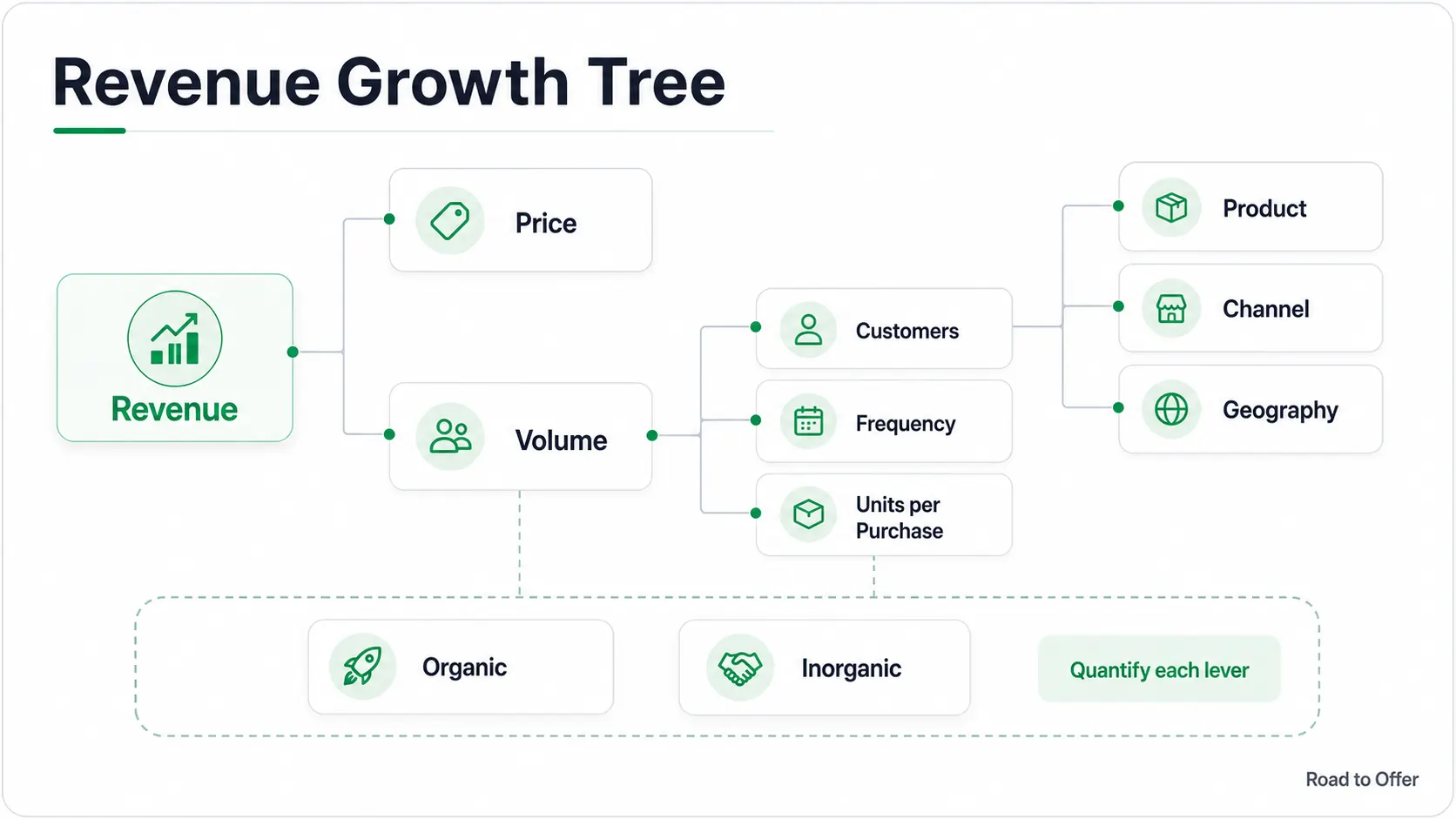
A revenue growth case asks how a company can increase top-line revenue. The framework: decompose Revenue into Price x Volume, segment by product/channel/geography, then evaluate organic levers (price increases, volume expansion, new products, new markets) and inorganic levers (acquisitions, partnerships). Revenue growth cases represent approximately 20-25% of first-round MBB interviews (My Consulting Offer). The key differentiator is quantification. Every growth lever must have a dollar estimate and feasibility assessment.
Practice a revenue growth drill
Revenue growth answers need structured lever generation before they need a polished recommendation. Run one real brainstorming drill below: bucket growth ideas, pick the highest-impact next test, and continue into the same drill type after completion.
The Revenue Tree
Every revenue growth case starts with this decomposition. Segment revenue before proposing solutions. "Increase sales" is too vague; "increase online channel revenue in the Northeast by 15% through paid acquisition" is actionable (PrepLounge).
Organic Growth: Price Levers
Price-based growth is the highest-margin path. According to Simon-Kucher, companies adopting value-based pricing see 15-25% revenue improvement within 12 months. Five price levers ranked by impact:
- Value-based pricing: Shift from cost-plus to willingness-to-pay. If customers derive $100K in value, charging $30K vs. $20K is justifiable.
- Reduce discounting: Tightening discount authority (e.g., VP approval above 10%) recovers 2-3% of revenue.
- Tiered pricing / upsell: Create premium tiers. Typical upsell rates: 10-20% of customer base per year.
- Across-the-board increase: Raise list prices 3-5%. Works when the market is growing and competitors are also raising prices.
- Mix management: Promote higher-margin products. Shifting a 50/50 mix (60% vs. 35% margin products) to 60/40 raises blended margin 5 points.
Organic Growth: Volume Levers
Volume growth requires more investment but carries less churn risk than price increases.
- New customers in existing markets: Expand marketing, sales team, or improve conversion. Track CAC to ensure profitability.
- Increase wallet share: Cross-sell, upsell, increase frequency. It is 5-7x cheaper to sell to existing customers than acquire new ones (Bain & Company).
- New geographies: Expand domestically or internationally. See the Market Entry Framework.
- New products: Adjacent products (existing customers, new offerings) are lower risk than entirely new categories.
- New channels: Add e-commerce, wholesale, or marketplace partnerships. Each has a different margin profile.
The Price-Volume Trade-Off
A 10% price increase rarely causes zero volume loss. Model the trade-off explicitly:
Formula: Net Impact = (1 + Price Change%) x (1 + Volume Change%) - 1. For most consumer goods, price elasticity ranges from -1.5 to -2.5.
Inorganic Growth: When Organic Is Not Enough
When the growth target exceeds what organic levers can deliver, or the market is consolidating, acquisitions become necessary (Hacking the Case Interview).
Worked Example: B2B SaaS Growth
Prompt: A B2B SaaS company (5,000 customers, $100M ARR, 8% YoY growth) needs 20% growth ($20M incremental). How?
Revenue segments:
Lever 1: Enterprise upsell (price). Launch enterprise-plus tier at $220K. Convert 40% (80 accounts). Incremental: 80 x $70K = $5.6M.
Lever 2: Mid-market acquisition (volume). Add 6 sales reps (50 deals/year each). 300 new accounts x $25K = $7.5M. Investment: $900K (8.3x ROI).
Lever 3: Integrations marketplace (new product). Charge partners 15% commission. Benchmark: 5-10% of core ARR within 2 years. Target: $7M.
Lever 4: Churn reduction (retained revenue). Reduce annual churn from 12% to 9% with $1.5M customer success investment. Saves $3M, net $1.5M. Over 5 years, 3-point churn improvement retains $15M cumulatively. Bain & Company research shows increasing retention by 5% can boost profits 25-95%.
Total: $5.6M + $7.5M + $7M + $1.5M = $21.6M (meets $20M target).
Common Mistakes
Related Guides
- Profitability Framework: revenue growth is the top-line half of profitability
- Revenue Decline Case Interview: the diagnostic mirror: before building a growth plan, understand why the current revenue fell
- New Product Launch Case Interview: product line extension as a volume growth lever; launch cases are often nested inside revenue growth cases
- Pricing Strategy Cases: price-based growth in depth
- Customer Profitability Case Interview: segment-level revenue analysis to identify which customer cohorts to grow and which to deprioritize
- M&A Case Framework: inorganic growth through acquisitions
Sources
- My Consulting Offer: Revenue Growth Case Interview (accessed March 20, 2026)
- Hacking the Case Interview: Growth Strategy Case Interview (accessed March 20, 2026)
- CaseCoach: Framework for Revenue Growth Case Questions (accessed March 20, 2026)
- PrepLounge: Growth Strategy Case Interview (accessed March 20, 2026)
- Simon-Kucher: Unlocking Potential with Revenue Growth Management (accessed March 20, 2026)
- Management Consulted: Growth Strategy Case Interview (accessed March 20, 2026)
FAQ
Frequently asked questions
Keep reading
Related articles
Growth Strategy Framework: How to Structure Growth Cases
Learn how to structure growth strategy cases in consulting interviews. Split organic and inorganic levers, decompose revenue into price and volume, prioritize by size and feasibility, and quantify with two worked examples.
Pricing Case Interview: Strategies, 7-Step Approach, Worked Example
Master the pricing case interview with the three pricing strategies, a 7-step approach, the three question formats, a full worked example, mistakes, and FAQs.
Scale vs Profitability Case Interview: Decision Frameworks
Decide between scale and profitability in a case interview with a 4-step decision model, a decision table, a numeric worked example, branch questions, and drills.