
SCQA Framework: Structure Your Case Recommendation (2026)
The SCQA framework (Situation, Complication, Question, Answer) for consulting interviews: how to structure your final case recommendation and fit story, with a fill-in-the-blank template and worked example.
On this page
The SCQA framework in 2026 is the quickest way to make a case interview recommendation, a fit story, or a client memo actually land, because it forces you to lead with the answer instead of burying it. SCQA stands for Situation, Complication, Question, Answer, and it was popularized by Barbara Minto, the first female consultant hired at McKinsey, in her book The Pyramid Principle. As the Corporate Finance Institute explains, SCQA inverts the usual pyramid so your conclusion comes first and the supporting logic follows underneath it. The structure is deliberately top-down: you state facts the audience already accepts, name the change that forces a decision, surface the question that naturally follows, then deliver your recommendation. In CFI's worked Steel Supplies example, the entire narrative resolves to one concrete answer, increasing steel bar production by 23,800 tons per year. For a consulting candidate, SCQA is the line between a synthesis that persuades and one that rambles.
What SCQA Stands For: Situation, Complication, Question, Answer
SCQA is a four-part structure for any persuasive message. Each letter does one job, and the parts only work in sequence:
The Four Parts of SCQA
- 01
S: Situation. Agreed, uncontroversial facts the audience already accepts. This is the shared starting point, not new analysis.
- 02
C: Complication. The trigger that changes the picture and creates urgency. This is the 'why act now' that the Situation alone does not explain.
- 03
Q: Question. The question that naturally arises from the Complication. Often implicit, but it must follow logically from what just changed.
- 04
A: Answer. Your recommendation. This is the apex of the pyramid and, in a strong message, the very first thing you say out loud.
The counterintuitive move is that although you build the message in S, C, Q, A order, you usually deliver the Answer first and let the Situation, Complication, and Question become a short setup. That is what people mean when they say SCQA "inverts the pyramid." For a consulting candidate, this is more than a slide trick. It is how you turn forty minutes of analysis into a thirty-second recommendation a Partner will actually act on.
Practice structuring a recommendation with AI feedback
Run a free case and get instant feedback on how clearly you lead with the answer.
Where SCQA Came From: Barbara Minto and the Pyramid Principle
SCQA did not start as a case interview tactic. It came out of McKinsey. Barbara Minto, the firm's first female consultant, formalized it in The Pyramid Principle as the standard way to open a business document so the reader grasps the recommendation immediately. The Corporate Finance Institute credits Minto with introducing SCQA and describes it as a way to "invert the pyramid" so the answer leads and the evidence supports.
That heritage is exactly why SCQA matters for interviews. MBB firms run on documents and verbal recommendations that open with the answer. When you use SCQA in a case, you are speaking the native communication language of the firm you are trying to join. The same structure shows up in executive summaries, steering committee updates, and the first slide of almost every consulting deck.
Component by Component: How to Build Each Part
Situation: only what the audience already accepts
The Situation is shared ground. State the facts your listener will nod along to without argument: who the client is, what business they are in, how things have worked until now. Resist the urge to put analysis or opinion here. If the listener could disagree with a sentence, it does not belong in the Situation.
Complication: the trigger that forces a decision
The Complication is the engine of the whole structure. It is the change, threat, or opportunity that makes the Situation no longer good enough. Growth has stalled. A competitor has entered. Margins are slipping. Without a sharp Complication, there is no reason for the listener to care, and the Answer feels like a solution in search of a problem.
Question: what naturally follows
The Question is the natural reaction to the Complication. If sales are falling, the question is "how do we restore growth?" You often state it implicitly, but it has to follow logically from the Complication. A Question that does not connect to the Complication is the fastest way to lose your listener.
Answer: the apex of the pyramid
The Answer is your recommendation, ideally in one sentence. It is the apex of the Minto pyramid, and everything else exists to support it. In a strong delivery, the Answer is the first thing out of your mouth, and the Situation, Complication, and Question become a quick frame around it.
How SCQA Connects to the Minto Pyramid: Think Bottom-Up, Communicate Top-Down
SCQA is the introduction. The Minto Pyramid is the whole building. As ModelThinkers explains, SCQA is the introduction model within Barbara Minto's Pyramid Principle, and the core discipline is to think bottom-up but communicate top-down. You analyze from the bottom up (raw data, then findings, then a single governing answer), but you present from the top down (answer first, supporting arguments below).
Underneath the Answer sit your supporting points, and Minto's rule is that they should be MECE: mutually exclusive and collectively exhaustive. No overlap between branches, no gaps in coverage. That is the link most candidates miss. SCQA is not just a nicer way to open. It tells you to structure your entire synthesis as a pyramid, with two or three MECE pillars holding up the recommendation, not a flat list of observations. For the full structure beneath the introduction, see our Pyramid Principle guide.
Build an SCQA case structure from the Road to Offer drill engine. Answer a real prompt and get AI-scored feedback. Free accounts include 5 drills per day for the first 3 days after signup.
A Full Worked Example: A Growth-Slowdown Case
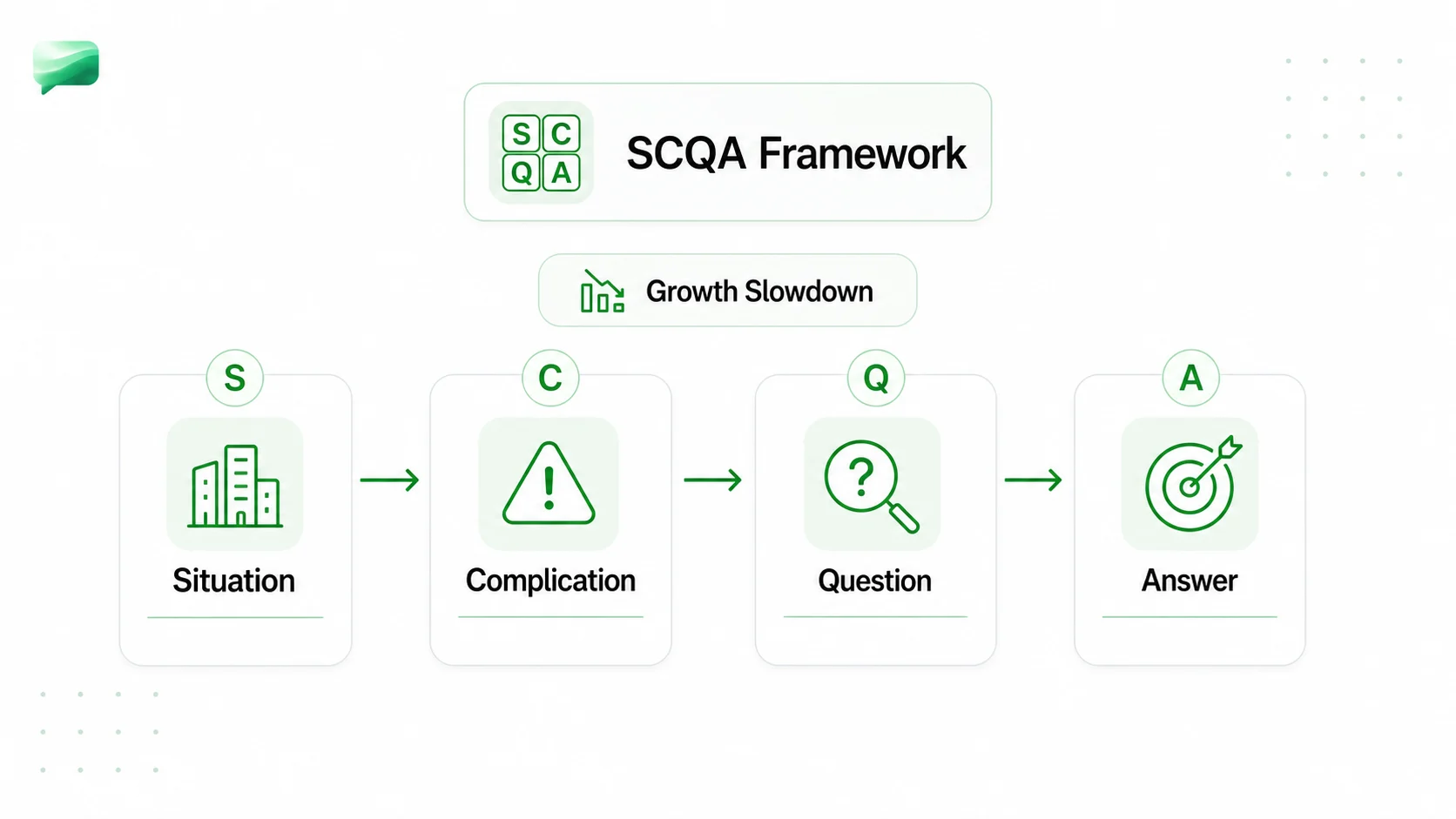
Here is SCQA assembled end to end, using a hypothetical market-entry scenario like the ones you meet in a case.
Situation. Imagine a $2B home goods retailer that has grown revenue roughly 8% a year for five years, almost entirely by opening new stores across the United States. Everyone agrees on this; it is the shared starting point.
Complication. In the last two quarters, same-store sales went flat and the US store base is approaching saturation. The growth engine that worked for five years is running out of room. This is the trigger.
Question. Where should the retailer find its next wave of growth?
Answer. The retailer should enter the Canadian market, leading with e-commerce and following with selective physical stores, because Canada offers the closest demographic match and the lowest entry cost. The recommendation rests on three MECE pillars: (1) demand fit, Canadian consumer preferences mirror the existing US base; (2) cost to enter, e-commerce avoids the capital of a full store rollout; (3) competitive headroom, no dominant incumbent owns the category there.
The copy-paste SCQA template
Fill in the blanks, then say the Answer line first:
- Situation: [The agreed context your audience already accepts.]
- Complication: [The change or trigger that creates urgency.]
- Question: [The question that naturally follows from the Complication.]
- Answer: [Your recommendation, in one sentence, plus two or three MECE reasons.]
Structure a Bain growth strategy case first. A Korean beauty marketplace in the US has slowing growth and wants to stay the leader. Answer this Bain growth strategy case step in the article, then continue the full case. Continue the full case on Road to Offer
Ordering Variations: When to Lead With the Complication or the Answer
Standard order is S, C, Q, A, but the strongest communicators reorder the front of the structure to fit the audience and the moment:
- Answer first (the consulting default). State the recommendation, then use a compressed Situation and Complication as a one-line frame. Best when time is short or the decision-maker is senior and impatient. This is the version most case interviewers reward.
- Complication first. Open with the threat or the change to create urgency before anyone relaxes. Useful when the audience does not yet feel the problem. StrategyU's university-budget example does this, opening on a funding gap that has to be closed in the next twelve months, then breaking the answer into three workstreams.
- Standard S, C, Q, A. Best when the audience is new to the situation and needs the shared context before the problem will make sense.
Same four ingredients, different entry point. Read the room: a Partner who lives in the client's business wants the Answer now; a fresh stakeholder may need the Situation first.
Using SCQA to Deliver Your Final Case Recommendation
The end of a case is where SCQA earns its place in your toolkit. When the interviewer asks "so what should the client do?", do not narrate everything you found. Give them an SCQA synthesis:
- Situation and Complication, compressed: "The client's growth has stalled as its US store base saturates."
- Answer, stated first and clearly: "I recommend entering Canada, starting with e-commerce."
- MECE support: "for three reasons: demand fit, lower entry cost, and open competitive space."
- Risk and next step: name the biggest risk and what you would test next.
This is exactly the muscle our case interview synthesis guide drills: lead with the answer, support it with non-overlapping reasons, and close with a risk. SCQA gives you the skeleton so you never freeze on the most important thirty seconds of the case.
Using SCQA in Fit Stories, Emails, and Slide Summaries
SCQA is not only for the final recommendation. It structures the rest of your interview and your future job.
Fit and PEI answers. A strong behavioral story has a built-in SCQA: the Situation sets the scene, the Complication is the obstacle or stakes, the Question is the decision you faced, and the Answer is the action you took and the result. Leading with the outcome, then explaining how you got there, beats a slow chronological build.
Emails and memos. Put your ask in the first two lines. Situation and Complication become one sentence of context, the Question is implied, and the Answer (what you need and by when) leads. Busy readers should never have to scroll to find the point.
Slide executive summaries. The action title of your summary slide is your Answer. The body becomes the MECE support. This is the document pattern SCQA was originally built for, and it is the same skill that maps onto every case interview framework you will use to structure the analysis itself.
Before and After: Turning a Rambling Update Into SCQA
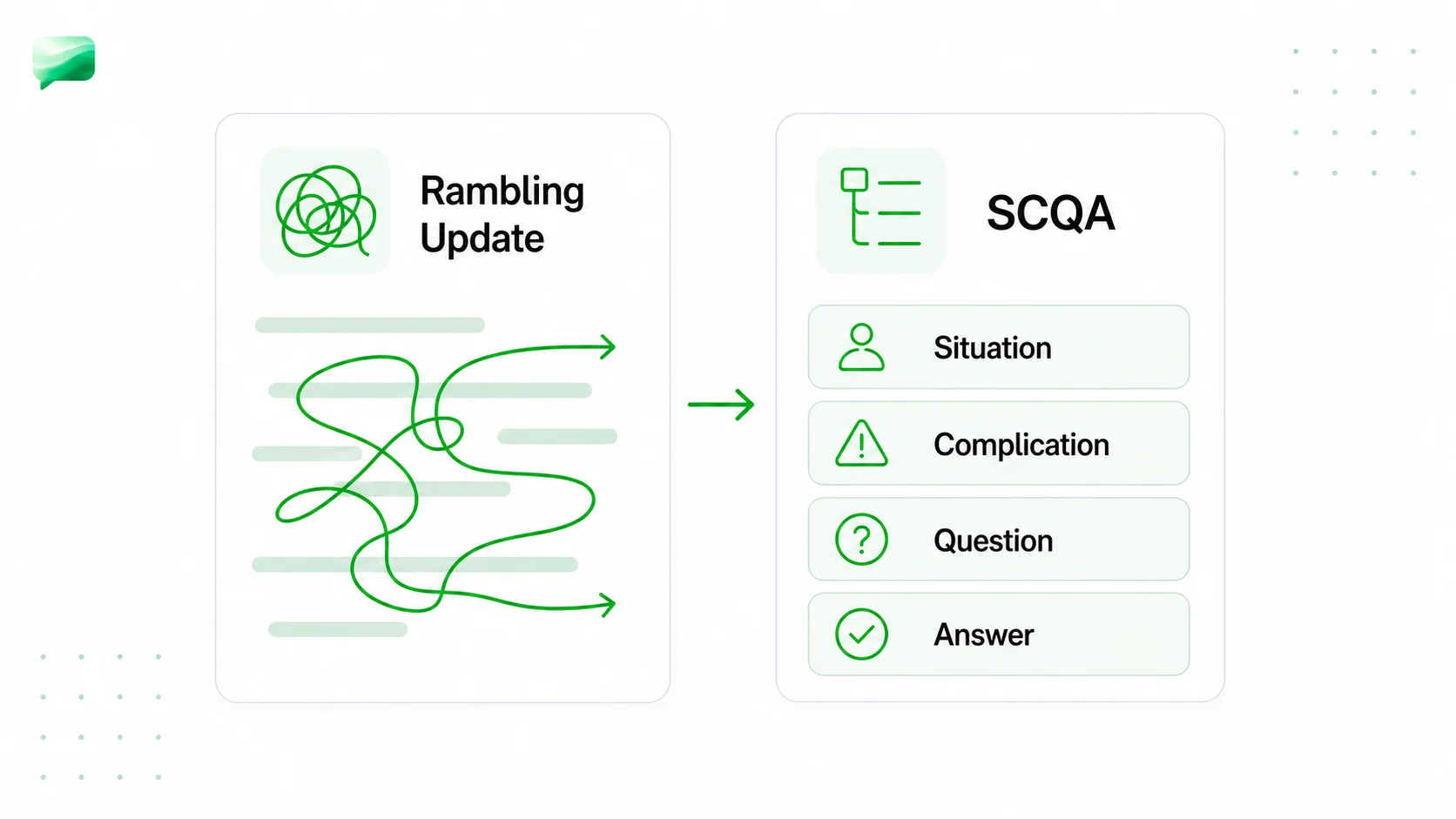
Before (no structure): "So, I looked at the data, and our biggest region is the Northeast, which has always been strong, and I also checked churn, and there are a few things going on, and I think maybe we should consider some options around retention, possibly, depending on budget."
After (SCQA): "We should launch a retention program for Northeast enterprise accounts this quarter (Answer). Northeast is our largest region (Situation), but enterprise churn there jumped last quarter and is now dragging total revenue (Complication). The question is how to stop the bleeding fastest (Question), and retention beats new acquisition on both cost and speed."
Same information, completely different impact. The "after" version is shorter, leads with the decision, and a listener could act on it immediately.
Common SCQA Mistakes
- A bloated Situation. Spending thirty seconds on company history before anyone hears the point. Keep the Situation to the few facts that make the Complication make sense.
- A weak or missing Complication. With no clear trigger, your Answer sounds like a solution looking for a problem. Name the change that forces a decision.
- Burying the Answer. Saving the recommendation for last is the single most common mistake. Lead with it, then support it.
- A Question that does not follow from the Complication. If the Complication is falling margins but the Question is about brand awareness, the structure breaks. The Question must be the natural reaction to the Complication.
Master those four and SCQA becomes automatic: a reliable way to make any recommendation, in a case or on the job, land in seconds instead of minutes.
Drill your SCQA synthesis on a live case
Road to Offer scores your structure, recommendation, and synthesis the way a real interviewer would, so you can practice leading with the answer until it is automatic.
Sources
- Corporate Finance Institute, SCQA framework overview: https://corporatefinanceinstitute.com/resources/career/scqa/
- SlideModel, SCQA framework guide: https://slidemodel.com/scqa-framework-guide/
- StrategyU, SCQA for defining problems and hypotheses: https://strategyu.co/scqa-a-framework-for-defining-problems-hypotheses/
- ModelThinkers, Minto Pyramid and SCQA: https://modelthinkers.com/mental-model/minto-pyramid-scqa
Frequently asked questions
Resources and related guides
- Practice SCQA in a real case interviewPractice
- Browse all free resourcesResource hub
- Pyramid Principle (Minto) for Consulting: How to Deliver a Case Synthesis (2026)Frameworks · Jun 27, 2026
- 3Cs Framework: Company, Customer, Competitor (Worked Example)Frameworks · Feb 6, 2026
- 4C Framework Case Interview: The 4 Cs, a Worked Example & How to Use It (2026)Frameworks · Jun 28, 2026