
KPMG Embark Scholars Program 2026: Tracks, Pay, Eligibility & Interview
What the KPMG Embark Scholars program really is in 2026: CPA vs Technology tracks, the $63,000 to $75,000 pay band plus scholarship, 2026 eligibility, and the behavioral interview that decides offers.
On this page
The KPMG Embark Scholars program in 2026 is a multi-year, paid summer internship that gives freshmen and sophomores early, hands-on exposure to public accounting before formal recruiting begins. According to KPMG's official careers page, Embark trains scholars across all of the firm's service areas and welcomes students pursuing a bachelor's or master's in accounting, or an IT-related degree, who are serious about a public accounting career. The program runs roughly eight weeks and spans two school years, with a return internship the following summer. Compensation is real: a current Summer 2026 CPA Track posting on WayUp lists a salary band of $63,000 to $75,000 (prorated), and the program pairs that with a separate scholarship of $1,000 to $5,000. Acceptance sits in the single digits, so this guide breaks down both tracks, the 2026 eligibility gates, and the behavioral interview that actually decides offers.
What is the KPMG Embark Scholars program?
Embark Scholars is KPMG's early-identification internship for first-year and second-year students. Unlike a one-summer internship, it is structured as a multi-year relationship. You join in one school year, complete an internship of roughly eight weeks, and return for a second summer. During the internship you get exposure across KPMG's three service lines, Audit, Tax, and Advisory, so you see the full firm before committing to a function.
Per KPMG's official careers page, scholars receive training across all of the firm's service areas and are pointed toward a public accounting career. The point of the program is pipeline building: identify strong students early, give them real client exposure and a scholarship, and convert them into return interns and eventually full-time hires.

CPA Track vs Technology Track: which one fits you?
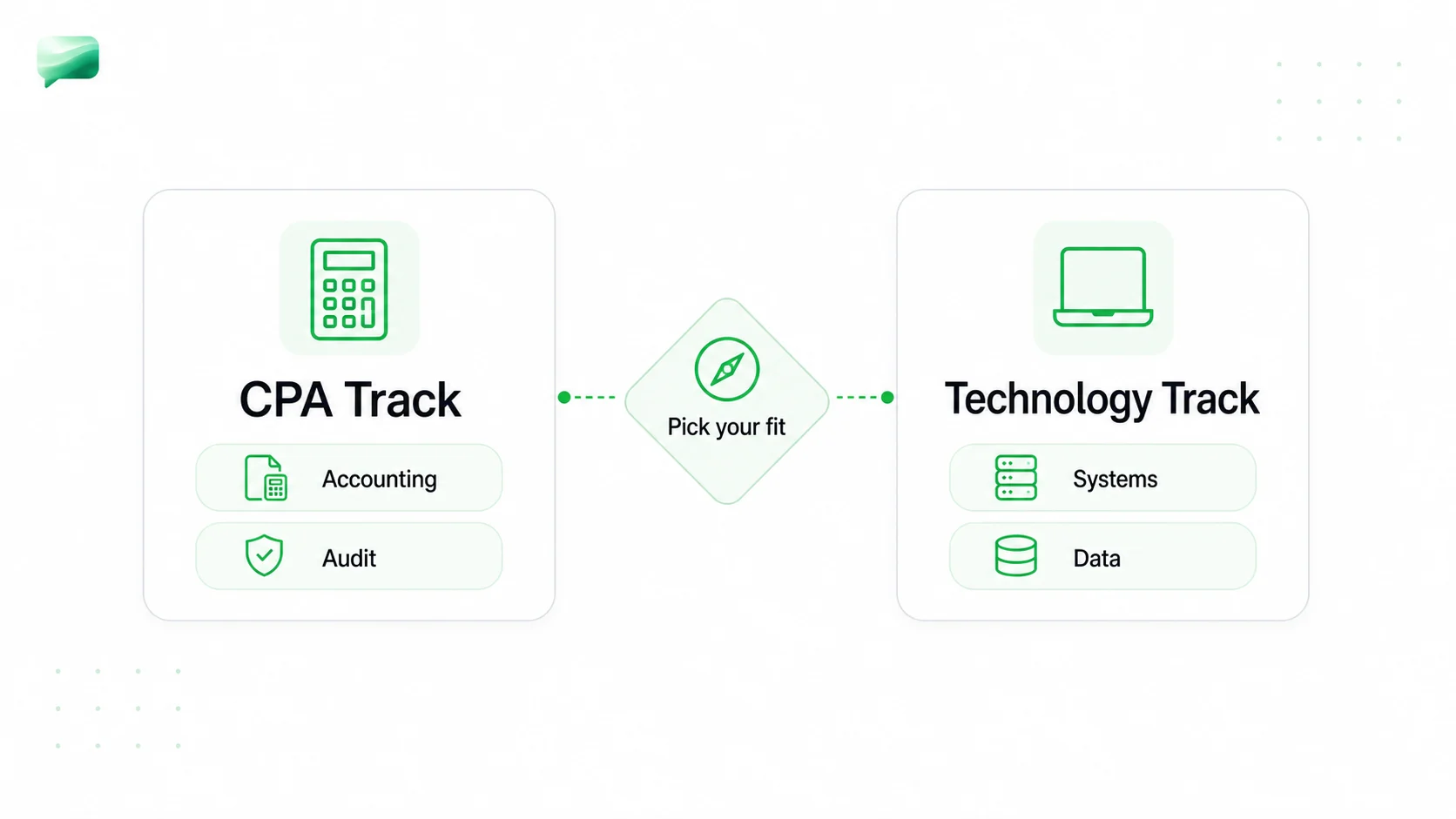
Embark splits applicants into two tracks, and you choose before you apply. Getting this right matters, because the majors and the day-to-day work differ.
The CPA Track is the classic accounting route toward licensure and KPMG's Audit and Tax practices. The Technology Track is for students whose strengths sit in data, systems, and engineering and who want a technology-led path inside a public accounting firm. Both run the same multi-year structure and carry the same scholarship. The verified salary band of $63,000 to $75,000 comes specifically from the WayUp CPA Track Summer 2026 posting, so treat it as the CPA reference point rather than a blanket figure for every market.
Who is eligible for Embark Scholars in 2026?
Eligibility is built around catching students early, while they still have most of their degree ahead of them. Based on the Summer 2026 CPA Track posting and the program write-ups, you generally need:
- Class year: Freshman or sophomore standing
- Semesters remaining: At least three additional semesters, roughly two years of study still ahead
- Semesters completed: At least one semester already done
- GPA: A preferred GPA of 3.00 or above
- Age: 18 years or older by June 1, 2026
- Work authorization: Required
- Major: Accounting or taxation for the CPA Track, or IT, computer science, or engineering for the Technology Track
The WayUp Summer 2026 CPA Track posting lists graduation windows of December 2027 to September 2030 and a primary office of Stamford, CT, which is a useful sanity check: if your graduation date falls outside that range, you are likely too far along for this early-career program.
The eligibility update most guides miss
This is where stale articles go wrong. KPMG's official careers page now frames Embark around first-generation college students and community college students, broadening well beyond the older "students of color" positioning that some third-party write-ups still repeat. Per KPMG's careers page, the program targets first-generation or community college students pursuing a bachelor's or master's in accounting (or an equivalent IT-related degree) who are interested in a public accounting career.
How much does Embark Scholars pay?
There are two separate forms of money, and good guides keep them distinct.
- Prorated internship salary. The Summer 2026 CPA Track posting on WayUp lists $63,000 to $75,000, prorated for the roughly eight-week internship. This is your wage for the work you do during the summer.
- Embark scholarship. Separate from wages, Northeastern's NU Place pipeline page describes a scholarship of $1,000 to $5,000 tied to the multi-year program (School Years 1 and 2).
What do you need to apply?
The application itself is light on documents. Per CaseBasix and the program postings, prepare:
- A one-page resume (CaseBasix recommends keeping it to a single page)
- An unofficial transcript
- Educational and contact information
- An optional cover letter
Because the document list is short, each item carries more weight. A clean, quantified one-page resume does more for you here than it would in a process with essays and assessments to hide behind.
When should you apply, and why does early matter?
KPMG reviews Embark applications on a rolling basis, which changes the optimal strategy. Per CaseBasix, there is a priority window roughly four to six weeks after the application opens, and a deadline that has landed around March 30 in some years but shifts annually. Confirm the live posting for your cycle rather than trusting a fixed date.
The practical rule with rolling review: apply inside the priority window, not at the deadline. Spots and interview slots fill as strong applications arrive, so a polished application submitted early beats a marginally better one submitted in the final week.
What does the Embark Scholars interview look like?
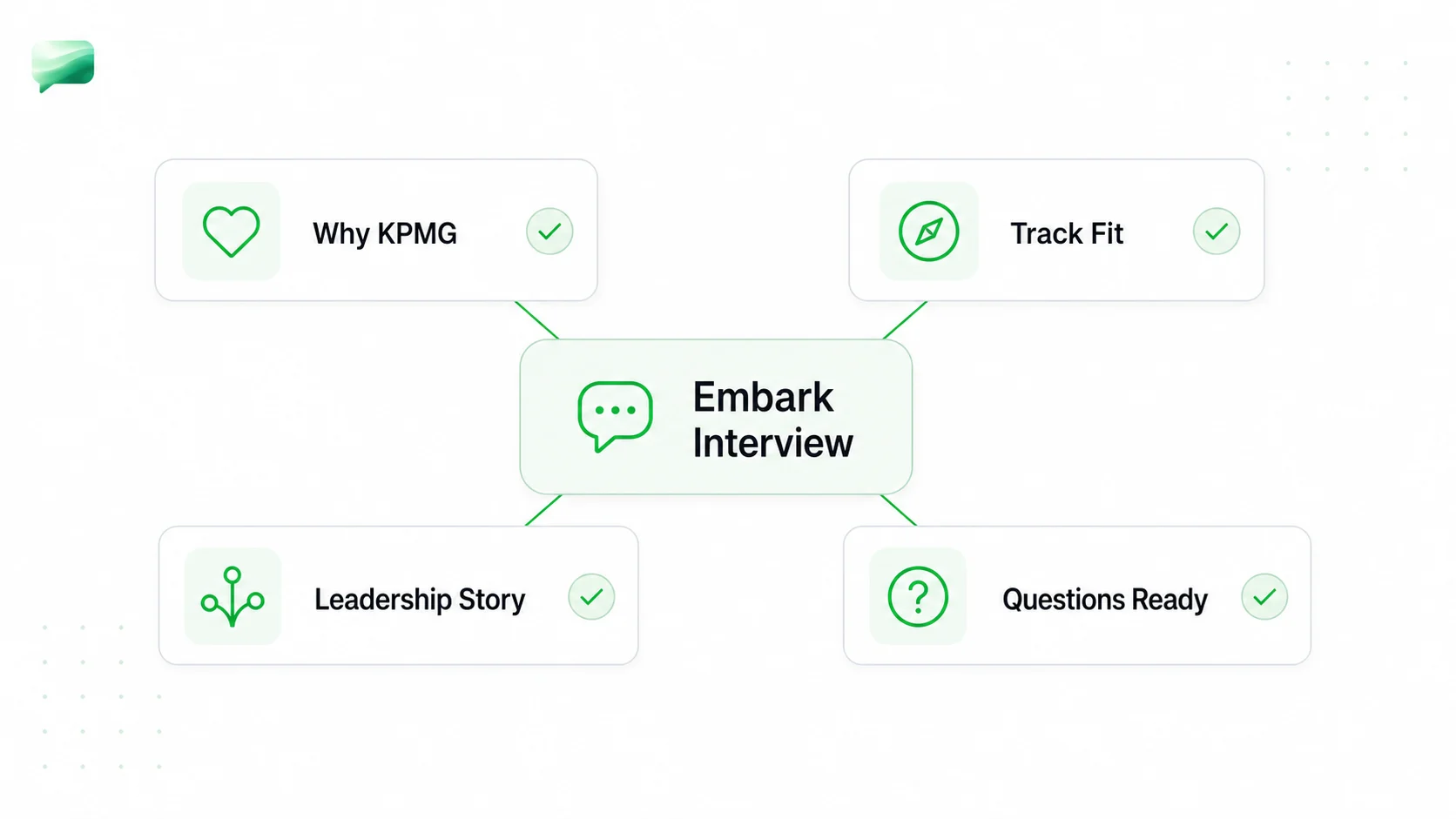
This is the part most applicants over-prepare in the wrong direction. The Embark interview is behavioral and motivational, not a case-interview gauntlet. You are a freshman or sophomore, and KPMG is screening for fit, drive, and communication, not McKinsey-style structuring.
Expect questions like:
- Why accounting (or technology), and why KPMG specifically?
- Tell me about a time you led a team or a project.
- Describe a setback and what you learned from it.
- How do you balance competing priorities under pressure?
- What does an inclusive team look like to you?
Prepare three to four structured stories you can adapt across these prompts, and a specific, non-generic answer for "why KPMG." If you are also recruiting for KPMG's full-time analyst roles later, the contrast with the KPMG case interview guide is worth reading, because that process does test structured problem solving in a way Embark does not. For a comparable early-career program at a peer firm, the Deloitte Discovery internship guide shows how Big Four firms run these freshman and sophomore pipelines.
How competitive is Embark Scholars?
Acceptance is characterized as being in the single digits per CaseBasix, which puts Embark in the same selectivity tier as a competitive early internship. GPA gets you past the first filter, but it is not what wins the spot.
Beyond the 3.0-plus GPA, KPMG screens for soft skills, leadership, and inclusion fit. That maps directly to the behavioral interview: the firm is trying to find students it can develop over two summers and convert to full time, so signals of coachability, teamwork, and genuine interest in public accounting carry real weight. Treat the interview as the differentiator, not your transcript.
KPMG Lakehouse and the path to a full-time offer
A meaningful part of Embark's value is the national intern training experience at KPMG Lakehouse, the firm's dedicated learning and innovation center. Scholars get firmwide training and networking alongside the broader intern population, which is part of what makes the program a genuine on-ramp rather than a summer of coffee runs.
The intended arc is clear: Embark to return internship to full-time offer. That progression, not a single summer, is the reason the program is worth applying to early and treating seriously.
How to make your Embark resume stand out
Because the application leans on a one-page resume, optimize it deliberately:
- Quantify achievements. "Managed a budget" is weak. "Managed a $4,000 club budget across 6 events" is strong.
- Use strong action verbs. Lead each bullet with led, built, analyzed, or organized rather than "responsible for."
- Balance technical and soft skills. Show coursework or tools (Excel, accounting software, a programming language for the Tech Track) alongside leadership and teamwork.
- Cut the jargon. Plain, specific language reads better than buzzwords to a recruiter scanning hundreds of resumes.
- Keep it to one page. This is the explicitly recommended length, and discipline here signals judgment.
Sources
- KPMG US Careers: Early Career Program (official) (checked June 26, 2026)
- WayUp: Embark Scholar Intern, CPA Track, Summer 2026, KPMG LLP (checked June 26, 2026)
- CaseBasix: KPMG Embark Scholars overview (checked June 26, 2026)
- Northeastern NU Place: KPMG Embark Scholars Program (checked June 26, 2026)
Frequently asked questions
Resources and related guides
- Consulting application trackerPractice
- Browse all free resourcesResource hub
- Bain CREW Program 2026: Eligibility, Deadlines & Internship PathRecruiting · Jun 29, 2026
- BCG Growing Future Leaders Program (GFL): Eligibility, Deadlines & How to Get In (2026)Recruiting · Jun 28, 2026
- EY Launch Internship Program 2026: Eligibility, Pay, Deadlines & How to Get InRecruiting · Jun 29, 2026