
Case Interview Mistakes to Avoid
Avoid the case interview mistakes that hurt structure, math, exhibits, synthesis, communication, and final recommendations.
The most damaging case interview mistakes are usually visible habits: rushing into analysis, forcing a memorized framework, doing silent math, ignoring units, reading exhibits too quickly, and ending with a recommendation that does not answer the client question.
These mistakes are fixable because they are behaviors. You do not need to read ten more frameworks. You need to identify the recurring failure, drill it directly, and then test whether it holds during a full case.
Mistake 1: Rushing Into Analysis
The fastest way to lose the case is to solve the wrong problem well.
Before building a structure, confirm:
- What decision the client needs to make.
- What success metric matters.
- Whether the goal is diagnosis, recommendation, sizing, or implementation.
- Whether there are constraints such as timing, geography, budget, or risk.
Weak opening:
"I would look at market, competition, company, and customer."
Stronger opening:
"I want to confirm the objective. The client is deciding whether to enter Spain, and success means profitable growth within three years. I would structure this around market attractiveness, client capability, and entry economics."
The stronger version frames the case around the decision.
Mistake 2: Forcing A Memorized Framework
Frameworks are training tools. In a live case, the structure should be built from the client's problem.
If the client has declining profit, profitability is a useful starting point. If the client is deciding whether to launch a new product, a plain revenue-minus-cost tree may miss customer need, channel fit, and launch risk.
Use this test: if the branch does not change the recommendation, cut it or move it lower.
Mistake 3: Doing Silent Math
Silent math creates two problems. First, the interviewer cannot see whether your setup is right. Second, you lose the chance to show business judgment while calculating.
Use this format every time:
- "I am calculating [metric]."
- "The formula is [formula]."
- "The units are [units]."
- "The result is about [answer]."
- "That means [business implication]."
The implication matters. A correct number without a business meaning is not a case insight.
Mistake 4: Losing Units And Scale
Many case math errors are not math errors. They are unit errors.
Common examples:
If your number looks surprising, pause and sanity-check before moving on.
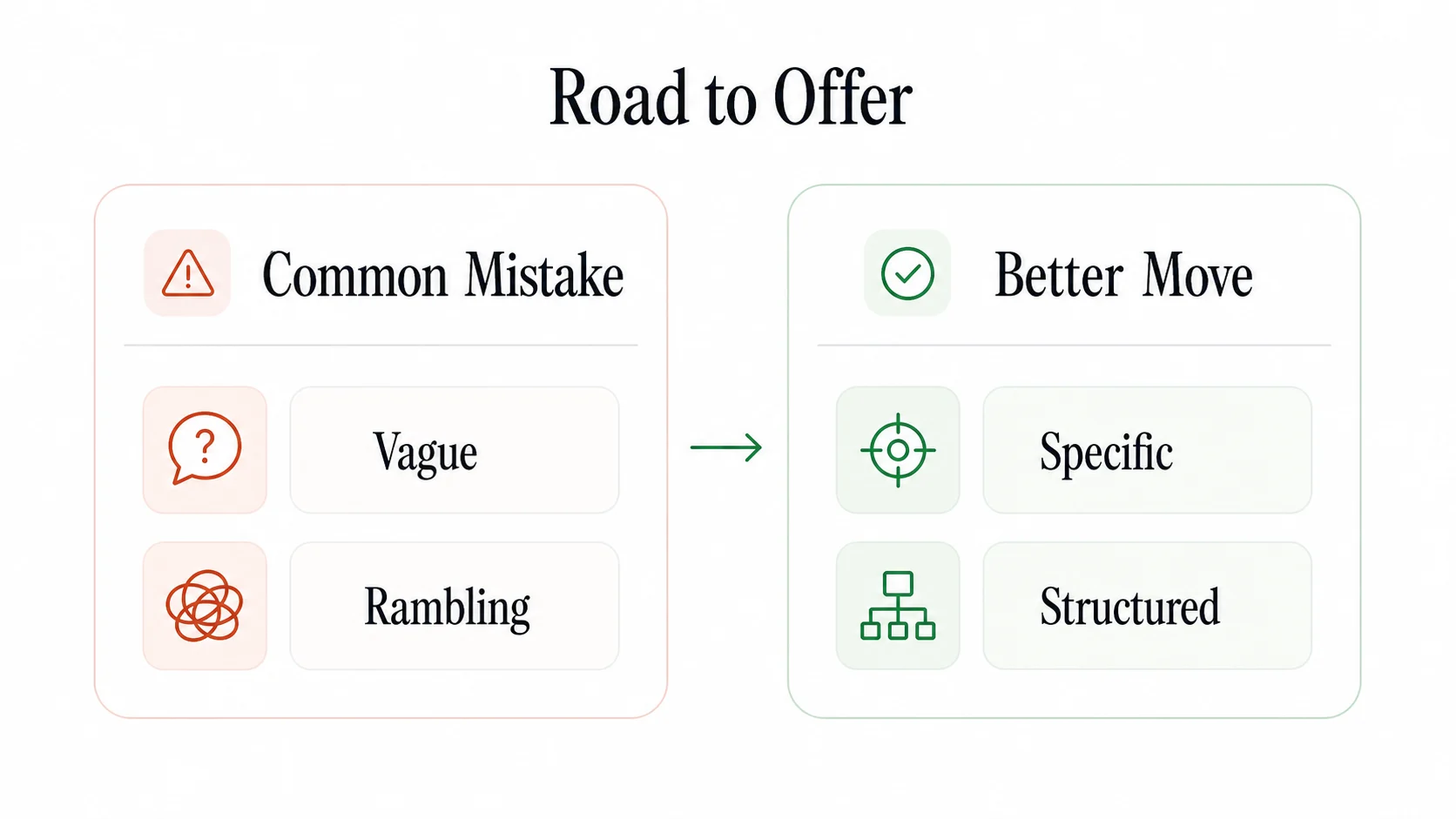
Mistake 5: Reading Exhibits Without A Takeaway
An exhibit readout is not a chart description. The interviewer wants the implication.
Use this flow:
- "This exhibit shows..."
- "The main pattern is..."
- "The implication is..."
- "I would next test..."
Weak:
"Segment A is 40%, Segment B is 30%, and Segment C is 20%."
Stronger:
"Segment A is the largest and has the highest margin, so I would prioritize it unless acquisition cost is materially higher."
Mistake 6: Weak Synthesis
Many candidates do good analysis and then end with a recap. A synthesis is not a recap. It is the answer.
Use this structure:
- Recommendation first.
- Two or three reasons.
- One key risk.
- One next step.
Example:
"I recommend entering the market through a pilot in two cities. The market is large enough, the client has a distribution advantage, and the economics work at conservative volume. The main risk is regulatory delay, so the next step is to validate licensing timelines before committing national launch spend."
Mistake 7: Ignoring Pushback
Interviewer pushback is not always a signal that you are wrong. Sometimes the interviewer is testing whether your recommendation is grounded in evidence.
Weak response:
"Okay, then I would change my recommendation."
Stronger response:
"That is a fair concern. I would still recommend the pilot because the margin case is strong, but I would adjust the rollout plan to include a regulatory checkpoint before the second city."
The stronger response listens, incorporates the challenge, and preserves the logic unless the new information truly changes the answer.
Mistake 8: Practicing Full Cases Without Fixing The Pattern
If every mock debrief says "math was messy," doing five more full cases will not solve the problem. It will rehearse the same mistake.
Use a simple loop:
This is how you turn feedback into improvement instead of just collecting more feedback.
Sources and Further Reading (checked June 17, 2026)
FAQ
Frequently asked questions
Keep reading
Related articles
Case Interview Scoring System Explained
Understand the case interview scoring system across structure, math, business judgment, communication, synthesis, and coachability.
Case Interview Synthesis: 60-Second Recommendation Template + Examples
Deliver a 60-second case interview synthesis that closes strong: the template MBB candidates use, with three worked examples.
Accenture Salary Guide 2026 - Pay by Level and Career Path
A practical consulting-candidate guide to Accenture salary by level and track, with sourced figures, recruiter questions, and Road to Offer drills to make the advice usable.
Reapplying to Consulting After Rejection: Ban Periods and a Comeback Plan (2026)
Rejected by McKinsey, BCG, or Bain? Learn the real ban periods, why they apply globally, how to diagnose your rejection, and how to reapply stronger.