
Case Interview Structure and MECE Framework Practice
Use this hub when your case openings sound too generic, too memorized, or too broad. The goal is a structure that tells the interviewer what you will test first.
Skill improvement: candidates need a better opening structure and a way to practice it repeatedly.
Opening move
A strong structure is specific, testable, and prioritized
Interviewers do not reward frameworks because they are famous. They reward structures that fit the client's objective and make the next analysis step obvious.
A practical opening has three pieces: clarify the objective, build non-overlapping buckets, then name the branch you would test first.
- Use the client's words in the branch names.
- Separate revenue, cost, market, customer, operations, and risk only when those cuts fit the prompt.
- End with a priority, not just a list.
Practice
Drill the first two minutes separately
The opening is short, but it controls the rest of the case. Practicing it inside full cases gives you too few reps. Short structure drills let you build the habit before the math and exhibit work starts.
- Timebox the structure to a few minutes.
- Check for overlap before adding sub-branches.
- Explain why your first branch matters.
Recommended reading order
 1Frameworks
Case Structure vs Case Framework
Why case structure and case frameworks are not the same thing, and how to use frameworks as a starting point instead of a memorized script.
Updated Jun 10, 2026
 2Fundamentals
MECE Meaning: Definition, Examples & Case Interview Use
MECE means Mutually Exclusive, Collectively Exhaustive. Learn the overlap/gap test, McKinsey origin, and case interview examples.
Updated Jun 30, 2026
 3Fundamentals
Clarifying Questions in Case Interviews: What to Ask and Examples
The clarifying questions to ask after a case prompt, with word-for-word examples, two fully worked openings, case-type variations, and the phrasing that signals consultant judgment.
Updated Jun 18, 2026
 4Frameworks
How to Structure Your Case Interview Opening Statement
Master the first 2 minutes of a case interview: clarifying questions, structuring the problem, and opening in a way that signals top-tier quality.
Updated Jun 10, 2026
 5Frameworks
Case Interview Frameworks: 7 Essential Models with Examples
Master case interview frameworks with our complete guide. Learn profitability, 3Cs, 4Ps, Porter's Five Forces, and M&A strategies to structure answers like a consultant.
Updated Jun 10, 2026
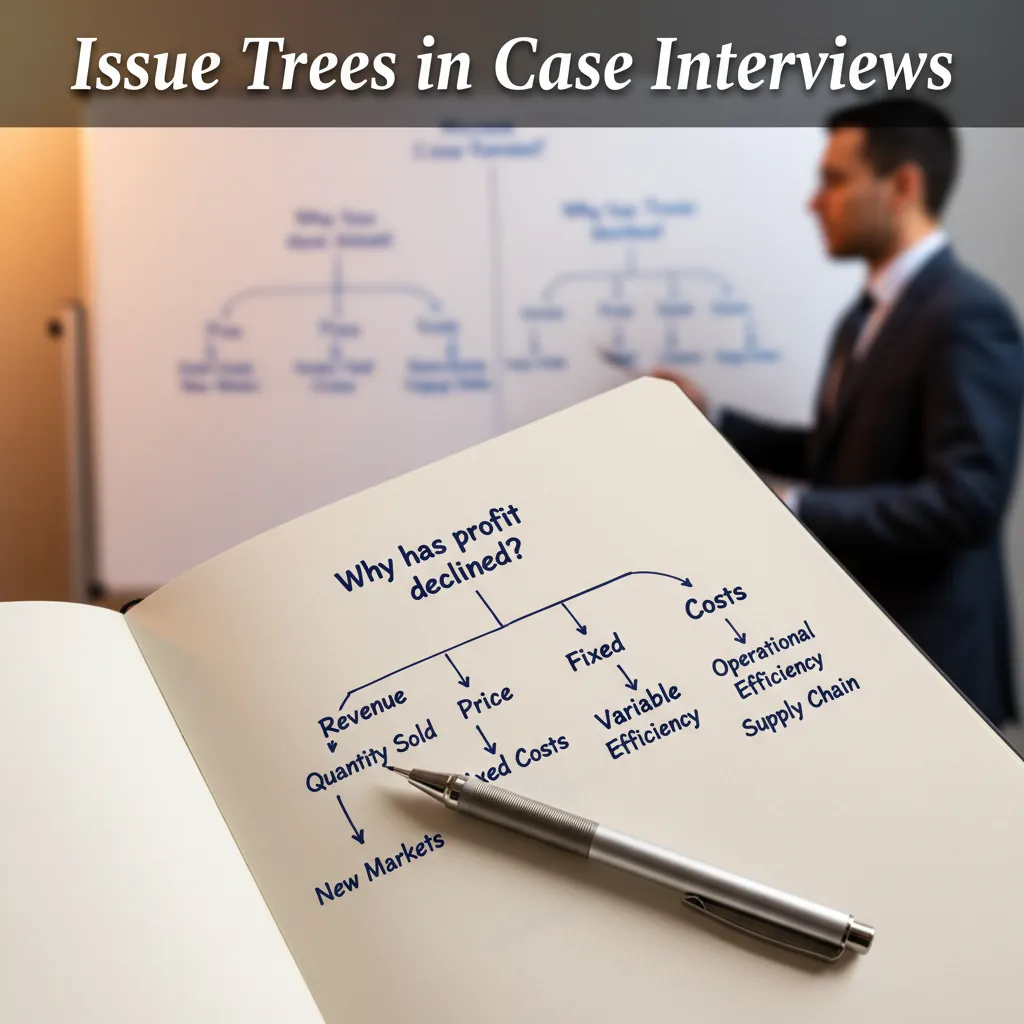 6Fundamentals
Issue Tree Case Interview: Build a MECE Tree (Example)
How to build a MECE issue tree in a case interview: the diagnostic vs solution split, a 4-step method, two worked numeric examples, and the mistakes that get structures rejected.
Updated Jun 18, 2026
 7Fundamentals
How to Structure Your Thinking in a Case Interview (Fast)
A step-by-step method to structure case interview thinking fast: clarifying questions, MECE issue trees, a worked profitability example, and a readiness rubric.
Updated Jun 17, 2026
 8Frameworks
When To Use Consulting Frameworks (And When To Skip Them)
When to use a consulting framework in a case interview, when to skip it, how to pick from profitability, market entry, 3C, and Porter's Five Forces, and how to adapt the branches to the prompt.
Updated Jun 17, 2026
 9Frameworks
Impact-Effort Matrix: How to Prioritize Like a Consultant
The impact-effort matrix ranks 4 quadrants in 5 minutes. Use it to sequence 20+ competing recommendations into a 3-action plan with a worked case example.
Updated Jun 12, 2026
 10Frameworks
Consulting Framework Mistakes: 9 That Get You Rejected (2026)
The 9 consulting framework mistakes that get candidates rejected at McKinsey, BCG, and Bain, with worked fixes, branch-selection questions, and a free structure drill.
Updated Jun 17, 2026
Quick answers
What does structure mean in a case interview?
It is the way you break the client's objective into clear, non-overlapping branches and choose the first branch to investigate.
Should I memorize case interview frameworks?
Know the common patterns, but adapt them. A memorized framework that ignores the prompt usually sounds weaker than a simple, case-specific tree.