
KPMG Consulting Cover Letter: Structure & Example
KPMG consulting cover letter guide: application role, Advisory fit, one-page structure, Why KPMG paragraph, and annotated example.
Free consulting resume review
Check the resume behind your KPMG application
Get a consulting-specific score, evidence-backed strengths, and priority fixes before you submit to KPMG.
By uploading, you agree to resume analysis and report storage until you delete it. See the privacy policy.
On this page
A KPMG consulting cover letter in 2026 has one job: prove you understand what KPMG actually is and why you want its Advisory practice specifically, not consulting in the abstract. Per KPMG's own early-career application guide, the application itself takes about 10 minutes and centers on your resume and transcript, which means a cover letter is your chance to carry the "why" those documents cannot. KPMG's own guidance names communication, working with others, integrity, and enthusiasm as the qualities that make a candidate profile stand out. This guide grounds every paragraph in KPMG's real application flow, its stated candidate strengths, and its FY25 scale (per KPMG's FY25 global results release: US$39.8 billion revenue, 138 countries, 276,030 people), so you write a letter that could not be copy-pasted to any other firm.
Does KPMG actually read your cover letter?
Yes, and the structure of the application is the reason. Per PrepLounge, KPMG's online form collects your resume, cover letter, personal details, and work experience together in one submission of roughly five to ten minutes. The letter is not a separate optional attachment that a recruiter might never open. It is part of the same package a human reviews when deciding whether you advance to the assessment and interview stages.
Two facts about that funnel raise the stakes. First, MyConsultingCoach reports that more than half of consulting candidates are rejected based on their application alone, before reaching an interview. Second, CaseBasix notes that recruiters typically spend around 30 seconds reviewing a consulting cover letter. So you are writing a document that helps gate a real decision, and you have roughly half a minute to make it land.
One more orientation point: at KPMG, consultants sit in the Advisory line, not in Audit or Tax. Per PrepLounge, KPMG delivers services across Audit, Tax, and Advisory, and consultants typically work in the Advisory department. Address your letter to that practice, because a letter that talks vaguely about "KPMG" without naming Advisory reads like it was written for any Big 4 firm.
Practice the interview your letter is trying to unlock
A strong KPMG cover letter gets you to the case. Road to Offer scores your structure, math, and synthesis with instant AI feedback so you are ready when it lands.
What KPMG looks for in a candidate, and how to evidence it
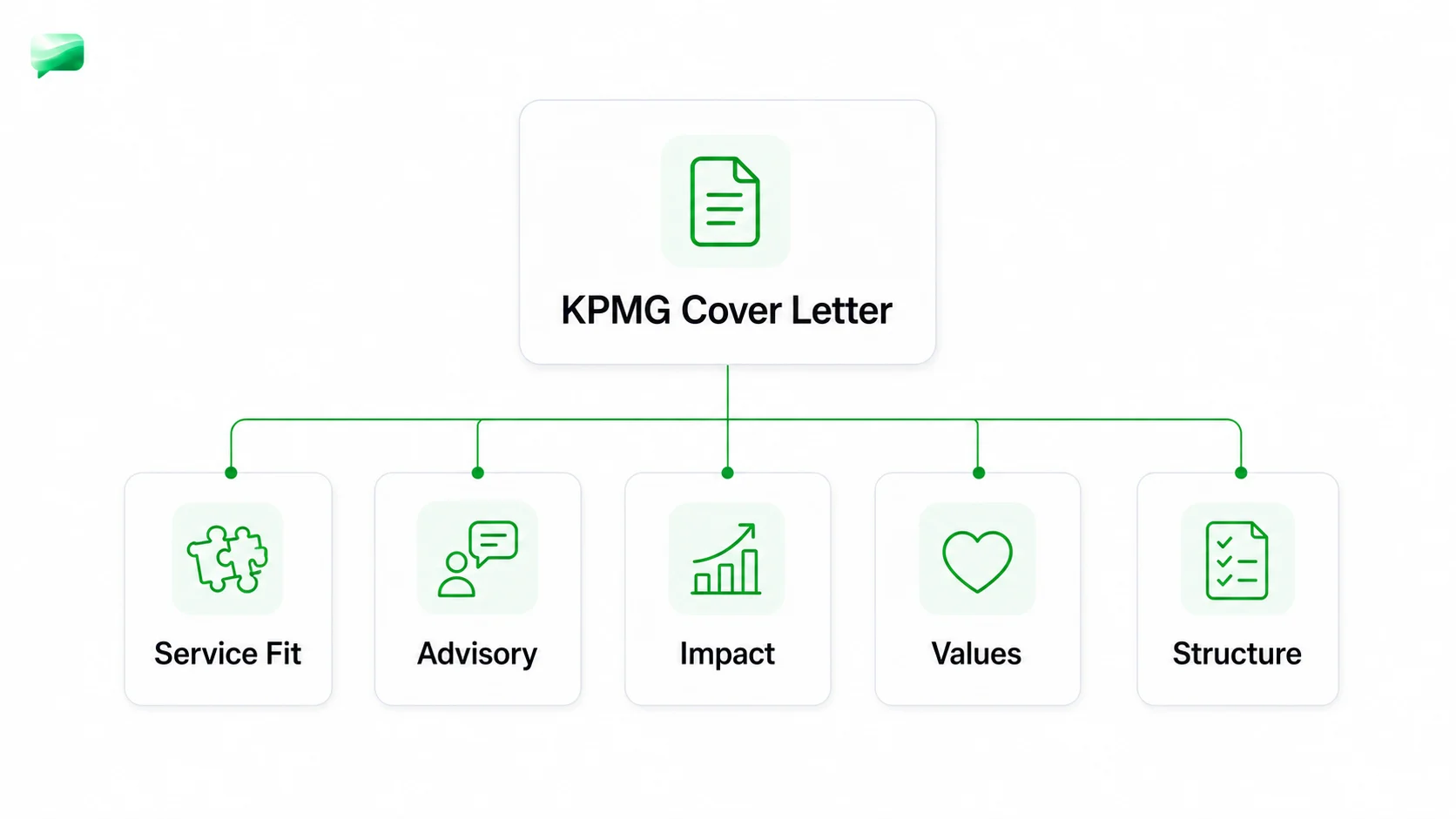
KPMG describes the strengths it wants in candidates in fairly consistent terms: career motivation, teamwork, critical thinking, resilience, integrity, tech-savviness, and curiosity. A cover letter that simply lists those words is worthless. The job is to evidence each one with a specific moment, so the reviewer infers the trait rather than reading the label.
You will not fit all seven into 400 words, and you should not try. Pick the two or three that your strongest stories prove, and let critical thinking plus teamwork plus tech-savviness carry the weight, since those map most directly to Advisory delivery.
The ideal KPMG cover letter structure
Keep it to one page. CaseBasix recommends roughly 400 to 450 words on a single page maximum, and the length is itself a test of the prioritization KPMG screens for. Use four paragraphs:
Draft it out of order. Write paragraph four first, because choosing your proof forces the rest of the letter to point at it. Then paragraph three, because it forces real KPMG research. Then the hook, then the close. This stops you from polishing an opening before you know what evidence the letter actually carries.
Writing a genuinely KPMG-specific Why KPMG paragraph
This is the paragraph that separates a KPMG letter from a recycled MBB one, and it is the one most candidates fudge. The fix is the swap test: replace "KPMG" with a competitor name. If the paragraph still reads as true and complete, it is generic and you rewrite it.
What makes it genuinely KPMG-specific is the multidisciplinary model. KPMG runs Audit, Tax, and Advisory under one network, and consultants sit in Advisory. That integration is the real reason to choose KPMG over a pure-strategy shop: Advisory teams can pull in risk, tax, and technology specialists on a single client engagement. Anchor the paragraph in something concrete you can defend in an interview:
- A conversation with an associate or recruiter in the Advisory practice
- KPMG's FY25 scale, which gives the firm reach you want to work inside
- A specific Advisory service area that matches your background
Per the KPMG FY25 global revenue release, KPMG's globally aggregated revenue reached US$39.8 billion for FY2025, up 5.1% in local-currency terms, across 138 countries and territories, with a global headcount of 276,030. Advisory revenue rose 2.9% in FY25, while Audit rose 6.0% and Tax and Legal Services rose 7.5%. Citing the right number, the Advisory figure rather than a random headline stat, signals you did the homework on the practice you are actually applying to.
Proving fit with two or three quantified achievements
Paragraph four is where you show, not tell. Every proof point should carry a concrete number, because a quantified result is what survives a 30-second skim. Weak proof reads "I have strong analytical skills." Strong proof reads "I traced a 22% customer-churn spike to a single onboarding step by segmenting six months of signup data, and the fix I proposed pulled churn back to 9% the next quarter."
The pattern for each proof point is action plus method plus measured outcome. Pick achievements that map to KPMG's screens: one that proves critical thinking or analytical horsepower, one that proves teamwork or stakeholder judgment, and at most one more if it adds a genuinely new dimension such as tech-savviness. Do not introduce a claim the resume cannot substantiate. The letter adds context to your evidence; it does not invent new evidence.
The opening line that earns a recruiter's 30 seconds
Kill "I am writing to apply for the position of." It wastes the most valuable line in the document on a sentence that carries no information. With a 30-second skim, the first line decides whether the reviewer leans in.
Open instead with evidence or a specific reason. Lead with the outcome you are proudest of, the moment that pointed you toward Advisory work, or a precise reason for the role. Then name the exact position and office. A reviewer who reads "Last year I rebuilt a regional retailer's forecast that was running 28% over budget" in line one already knows you have something to prove, before you have asked for anything.
Common KPMG cover letter mistakes
- Wrong firm name. MyConsultingCoach reports that at one firm about 20% of applicants got the firm's name wrong in their cover letter. A stray "BCG" or "Deloitte" in a KPMG letter is an instant rejection, and it is the easiest mistake to prevent.
- A generic Why us paragraph. If your firm paragraph survives the swap test, it is doing nothing. Anchor it in KPMG's Audit, Tax, and Advisory model.
- Restating the resume. The letter explains and contextualizes two or three proof points. It never repeats your bullets line by line.
- Going over one page. Past 450 words you are signaling weak prioritization to a firm that screens for exactly that skill.
- Forgetting it is Advisory. Writing about "KPMG" generically, with no mention of the Advisory practice consultants actually join, reads as un-researched.
KPMG vs MBB and the other Big 4: why the emphasis shifts
An MBB cover letter leans on pure strategy and prestige. A KPMG letter should shift toward advisory delivery, technology, and client impact, because that is the work. KPMG consultants operate inside an integrated Advisory practice, so evidence of execution and teamwork beats positioning yourself as a lone strategist.
This is also why a one-to-one MBB template fails for KPMG. Swapping the firm name in a McKinsey letter leaves the strategy-first framing intact, and a KPMG reviewer notices immediately. The MyConsultingCoach note that the average consulting recruit stays at a firm for roughly two years is worth keeping in mind too: the firm is screening for someone who actually wants this work, not a resume line, so the motivation has to read as real. For the interview that follows, the KPMG case interview guide covers the Advisory case format, and the broader consulting cover letter guide covers the swap test and format layer in more depth.
Annotated KPMG cover letter example
A four-paragraph example you can adapt. Copy the logic, not the words.
Dear KPMG Advisory Recruiting Team,
Last year I rebuilt a regional retailer's inventory forecast that was running 28% over budget, and the project showed me I want to solve operational problems like that for a living, at a firm that treats technology and execution as part of the answer. I am applying for the Advisory Associate role in KPMG's Chicago office.
Two summers of project work convinced me consulting is where structured problem solving meets real client impact. On a student consulting team for a community health nonprofit, I broke a six-week appointment backlog into intake, staffing, and no-show causes, found that missed appointments were quietly eating most of the clinic's capacity, and the reminder-and-rebooking system I proposed cut the backlog to under a week in two months.
I am applying to KPMG specifically because of its multidisciplinary model. KPMG's Advisory practice, which grew 2.9% in FY25 within a US$39.8 billion network across 138 countries, sits alongside Audit and Tax under one roof, so Advisory teams can pull in risk, tax, and technology specialists on a single engagement. After speaking with two associates in the practice, I understood that this integration is what lets KPMG advise on transformation end to end rather than handing off the build.
I bring three things KPMG screens for: critical thinking, proven by the forecasting and capacity work above; resilience, built across two years balancing a 20-hour analytics job with a full course load; and curiosity that pushed me to learn SQL and Power BI on my own to query the datasets my analyses depended on. I would welcome the chance to discuss how I can contribute to the Advisory team.
Why it works:
- Hook: Opens on a quantified result and names the exact role and office. No "I am writing to apply."
- Why consulting: One story, structured into three causes, with a measured before and after.
- Why KPMG: Names the Advisory practice and the multidisciplinary model, cites the right FY25 number (Advisory, not a random headline), and references a real conversation. It fails the swap test, which is the point.
- Why you: Three proof points, each mapped to a KPMG strength (critical thinking, resilience, tech-savviness), and each tied to evidence the resume can back up.
For a fill-in-the-blank version to adapt to your own profile, grab the free resume and cover letter starter kit.
Pre-submission checklist
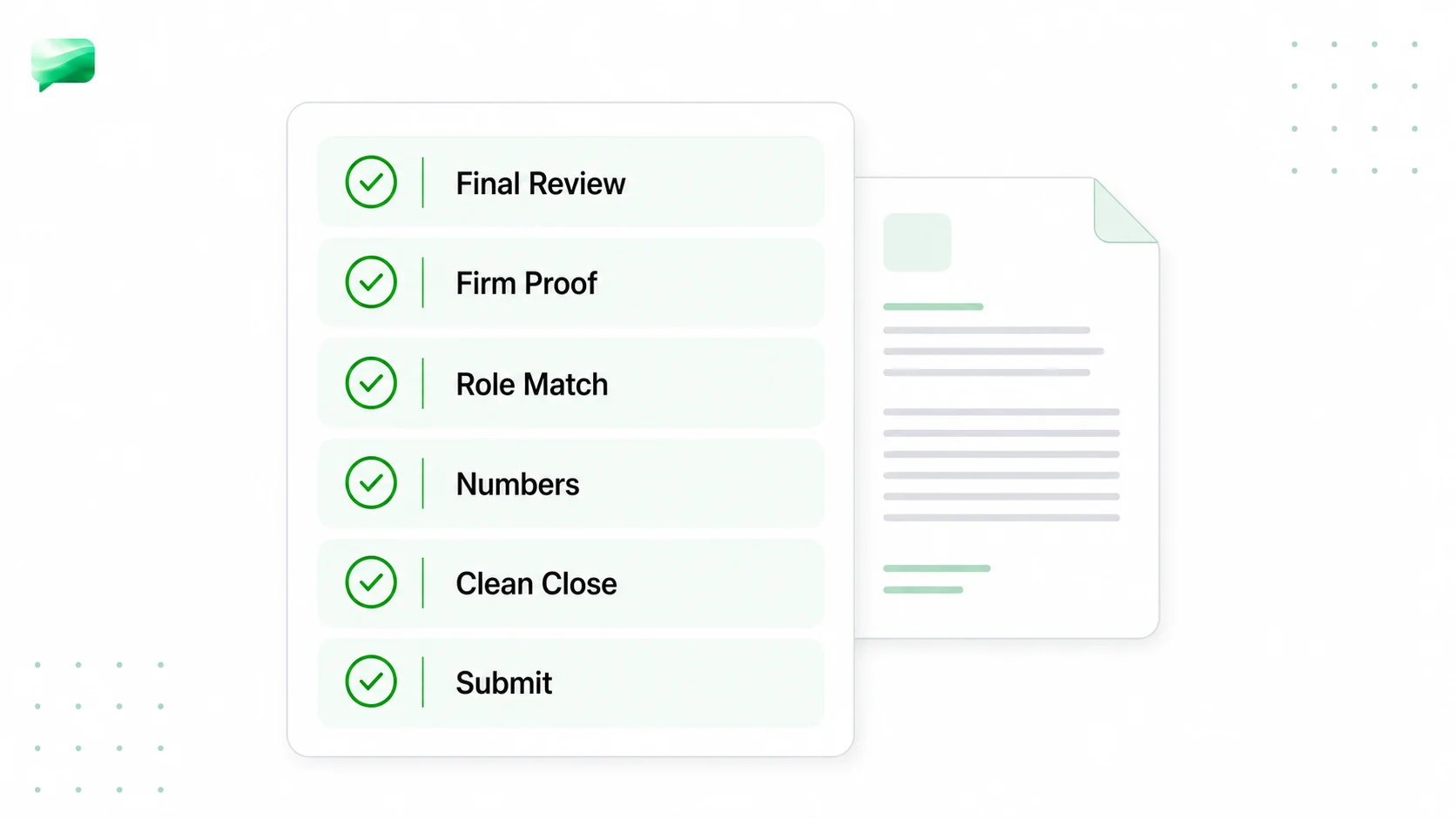
The letter gets you into the room. The skills it advertises, structure, clarity, and judgment under pressure, are the same ones the Advisory case interview tests next. For the format layer and the swap test in detail, keep the consulting cover letter guide open, and when the application advances, move into the KPMG case interview guide.
Once the resume and letter are both tight, the next gate is the interview itself.
Practice the KPMG Advisory case next
Once the letter gets you through the screen, Road to Offer helps you pressure-test the structure, math, and recommendation skills KPMG Advisory interviews probe.
Sources
- KPMG, KPMG delivers rise in global revenue (FY25) (checked June 26, 2026)
- PrepLounge, KPMG firm profile and application process (checked June 26, 2026)
- CaseBasix, consulting cover letter guide (checked June 26, 2026)
- MyConsultingCoach, consulting cover letter guide (checked June 26, 2026)
Frequently asked questions
Resources and related guides
- Free consulting resume graderPractice
- Browse all free resourcesResource hub
- Deloitte Consulting Cover Letter: Template & ExamplesGetting Started · Jun 30, 2026
- EY Consulting Cover Letter: Structure & ExampleGetting Started · Jun 30, 2026
- Video Cover Letter Guide: Script, Examples, and Consulting TipsGetting Started · Jul 1, 2026