
Alvarez & Marsal Case Interview: Format, Restructuring, Prep (2026)
Alvarez & Marsal case interviews are candidate-led with a focus on restructuring, liquidity, and performance improvement. Learn the format and 30-day prep plan.

Salty Sole ShoeProfitability · Medium
Start a free case interview for Alvarez & Marsal
Hear the case, say or type your answer, get your score.

Don't know how to case yet? Learn how to case
On this page
Alvarez & Marsal case preparation should emphasize restructuring, liquidity analysis, and operational turnaround. Round count, case style, timing, and any back-to-back Super Day vary by office and role, so use the current invitation as the source of truth.
Practice A&M-style restructuring cases with AI
Road to Offer's AI plays a restructuring-focused interviewer. No scheduling, no $250/hour coach. Practice candidate-led cases with immediate feedback on your financial analysis and synthesis.
Alvarez & Marsal Interview Format: Rounds, Timeline, and What to Expect
The A&M interview process is structured differently from MBB. The first round is behavioral-dominant: A&M wants to assess fit and operational mindset before investing time in case evaluation. The case intensity builds in the second and third rounds.
Campus recruiting timelines run September–November for full-time and November–February for summer internships. Off-cycle hiring moves faster. A&M's careers page confirms that the process averages approximately one month from application to offer. Rehearse the behavioral-heavy first round with Road to Offer's behavioral practice, then run the candidate-led case rounds in the free case library so the format isn't new on interview day.
A&M Interview Process
- 01
Application + Screening. Resume review. Some offices require an online numerical/verbal assessment (25–40 min). Not universal; check your invitation. Campus recruiting skips the recruiter phone screen.
- 02
Round 1: Behavioral-Heavy. 1–2 interviews focused on behavioral questions, fit, and why A&M / restructuring. May include a short case or case-related discussion. Primarily tests communication and motivation.
- 03
Later Rounds. Case, behavioral, or modeling components may apply. Confirm the count, timing, and delivery format from your invitation.
- 04
Round 3 / Networking. Senior partner or MD-level interviews. Often includes a networking lunch or dinner. Cultural fit and commercial judgment are heavily weighted at this stage.
- 05
Offer. Typically within 1–2 weeks of final round. Some offices provide limited feedback to unsuccessful candidates upon request.
How A&M Cases Differ from MBB
The single most important thing to understand before walking into an A&M interview: this is not McKinsey. The case types, the expected analytical depth, and the format all reflect A&M's operational DNA.
Candidate-Led, Not Interviewer-Led
A&M uses candidate-led case interviews. Unlike the McKinsey-style where the interviewer walks you through specific questions in a structured sequence, A&M expects you to independently structure the problem, decide which areas to prioritize, request data proactively, and synthesize findings without prompting. When you finish presenting your framework, the interviewer waits. You drive the next move.
This is a meaningful difference in practice. Candidates who trained heavily on McKinsey-style cases often pause and look at the interviewer after presenting their structure. That pause is scored as passivity at A&M. You need to say, "I'd like to start with the liquidity analysis because in a distressed situation, cash runway is the most urgent constraint. Can I see the current cash balance and the weekly burn rate?" and move forward.
For a detailed breakdown of how candidate-led interviews differ mechanically, see case interview frameworks complete guide.
Finance-Heavy, Not Strategy-Heavy
MBB cases are designed for generalists who will staff across industries. A&M cases are designed for consultants who will parachute into distressed situations and immediately contribute to financial analysis. Expect:
- Liquidity analysis: How many weeks of cash does the company have? What's the burn rate? Can they make payroll next quarter?
- Profitability diagnosis: Where exactly is the margin erosion? Is it gross margin, SG&A, or both?
- Capital structure: Is the company insolvent (liabilities > assets) or illiquid (cash flow negative)? That distinction matters for what actions are available.
- Cost optimization: Which cost lines can be cut without destroying revenue-generating capacity?
- 13-week cash flow modeling: A&M's signature tool for managing distressed companies through restructuring engagements.
For background on the profitability framework that underpins many A&M cases, see profitability framework. For M&A-related case types, see M&A case framework.

M&A · medium
Practice for Alvarez & Marsal in a real case interview
Matched to this Alvarez & Marsal guide: a live logistics M&A case with an AI interviewer. Free, scored on every step.
Operational, Not Advisory
A&M consultants often take interim executive roles (CFO, COO, CRO) inside client companies. The cases reflect this: you're not advising the CEO from the outside, you're operationalizing a solution from the inside. That shifts the framing from "what should they do" to "how would you actually do it, and what could go wrong."
How should you align your Alvarez & Marsal resume and cover letter before this interview?
Use restructuring or performance-improvement language only when the target role and your record support it. The resume should show owned diagnosis and follow-through, while the letter supplies the role rationale.
- Before: Analyzed a distressed business.
- After: Built the weekly cash view, isolated the working-capital pressure, and prepared the options used in the sponsor decision.
Check that the line does not overstate restructuring exposure and that the result can be traced to a record or safe proxy. Recruiters read the documents together: the resume proves the evidence, while the letter explains why the practice and role make sense. Compare the revised line with the guide's liquidity case so your spoken explanation uses the same fact pattern.
Pressure-test the proof behind the role fit
Drop the resume here for a graded report on whether the restructuring evidence holds up. Road to Offer's score, not a firm decision.
By uploading, you agree to resume analysis and report storage until you delete it. See the privacy policy.
Revise one line, rehearse its diagnostic logic, and use it in the next restructuring case rep.
The A&M Restructuring Case Framework
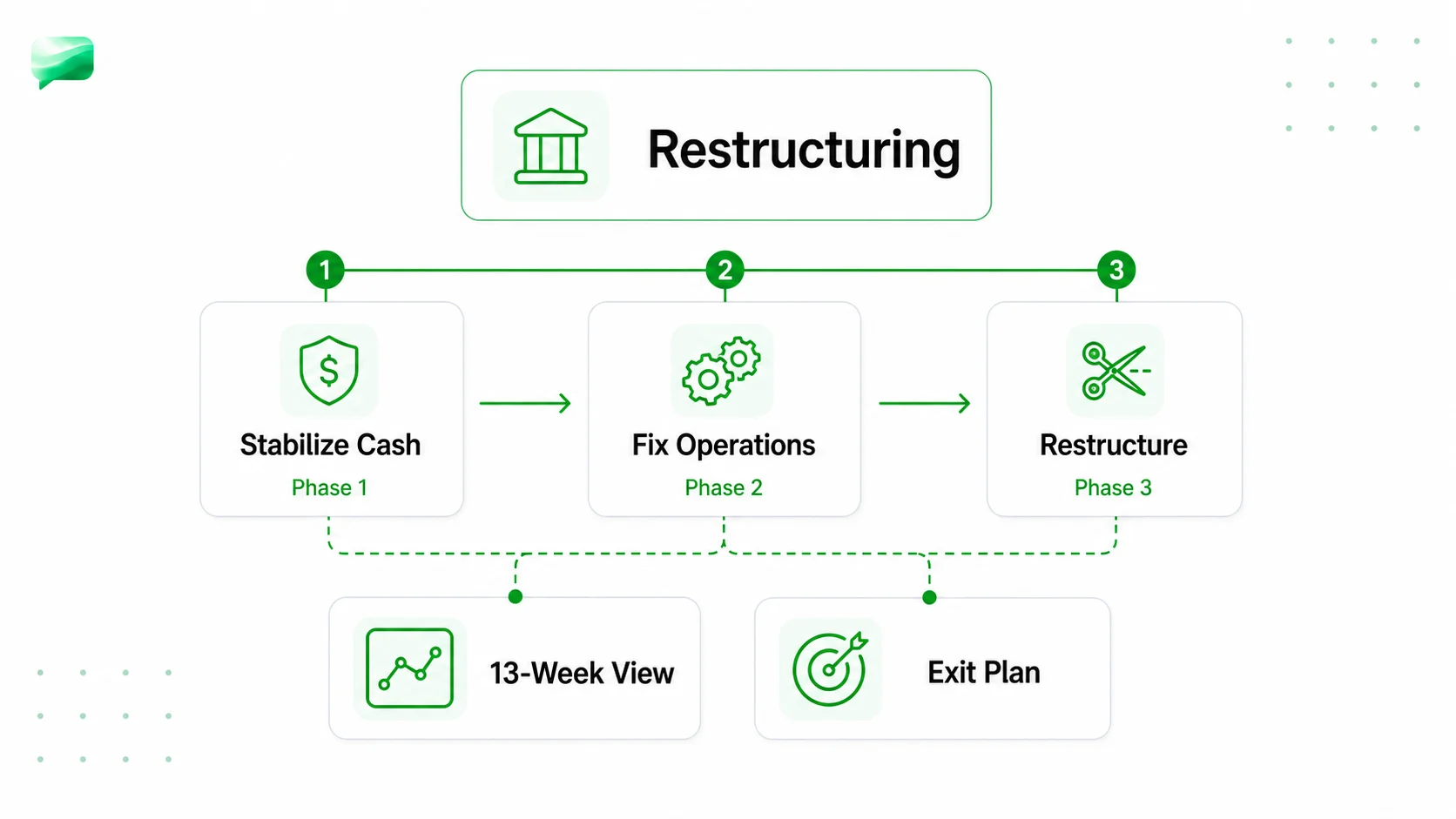
Generic consulting frameworks (3Cs, Porter's Five Forces, standard profitability trees) are insufficient for A&M restructuring cases. You need a turnaround-specific structure that reflects how distressed situations actually work.
The core A&M restructuring framework operates in three phases:
Phase 1: Stabilize Cash (Immediate, 0–13 Weeks)
The first question in any distressed situation is: will the company run out of cash before the restructuring can be executed? Everything else is secondary.
- Cash runway: Current cash balance ÷ weekly cash burn = weeks of runway
- 13-week cash flow forecast: Direct method (weekly receipts minus weekly disbursements). Not EBITDA, not net income. Actual cash in and out.
- Emergency levers: Delay AP payments, accelerate AR collections, sell non-core assets, draw on revolving credit
- Minimum viable liquidity: What cash balance must be maintained to keep operations running (payroll, critical vendors, leases)?
Phase 2: Fix the Business (Medium-Term, 3–18 Months)
Once the cash emergency is stabilized, address the underlying business problems:
- Revenue: Is revenue declining? Why (volume, price, or mix)? Can it be recovered or should capacity be rightsized?
- Cost structure: What is the fixed vs. variable cost breakdown? What can be eliminated without destroying revenue?
- Working capital: Inventory days, receivables days, payables days. Where are the inefficiencies?
- EBITDA bridge: From current EBITDA to target EBITDA, quantify each lever
Phase 3: Restructure the Balance Sheet (Concurrent or Following)
- Debt capacity: Based on stabilized EBITDA and cash flow, how much debt can the business service?
- Creditor negotiation: What do secured vs. unsecured creditors get in a restructuring scenario?
- Options: Out-of-court restructuring, Chapter 11 reorganization, or sale process (363 sale)?
- Stakeholder management: Lenders, suppliers, employees, and customers all have different interests and different leverage
For a deeper treatment of restructuring case structures, see restructuring case interview.

Profitability · medium
Practice a real energy profitability case
Matched to this Alvarez & Marsal guide: a live energy profitability case with an AI interviewer. Free, scored on every step.
Worked Example: A&M-Style Liquidity and Cash Flow Case
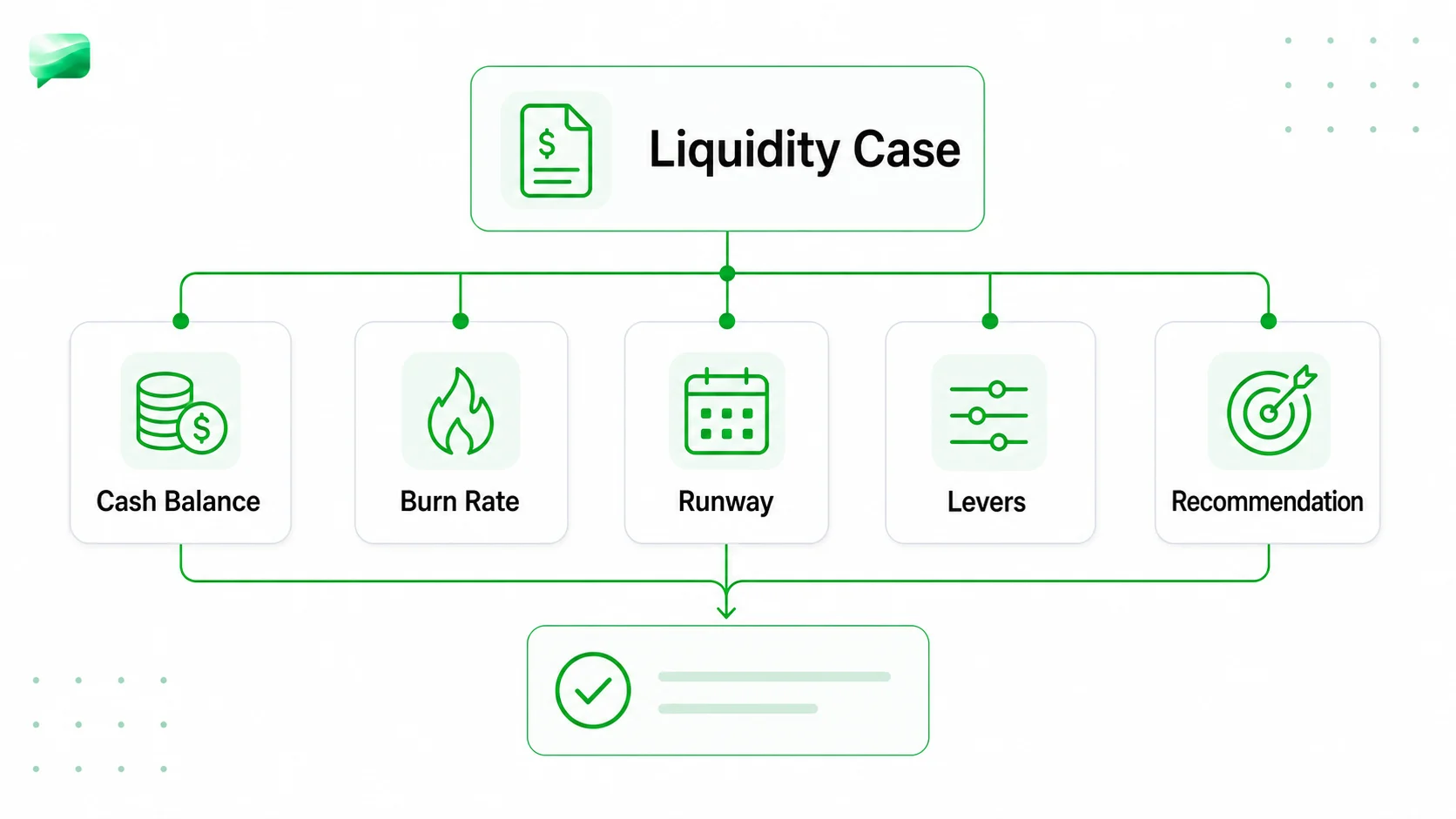
This example reflects the type of quantitative case you should expect in a Round 2 A&M interview.

Profitability · medium
Practice a real consumer packaged goods profitability case
Matched to this Alvarez & Marsal guide: a live consumer packaged goods profitability case with an AI interviewer. Free, scored on every step.
Case Prompt: Your client is a mid-sized specialty retailer with $180M in annual revenue. Over the past 18 months, EBITDA has declined from $14M to -$2M. The CEO has hired A&M. You've been assigned as the lead. Your first task: assess whether the company can make it to the end of Q2 (14 weeks from now) without a liquidity crisis, and outline the immediate actions.
Data provided when you ask:
Step 1: Calculate cash runway
Current cash: $4.2M Weekly burn: $0.8M Weeks of runway without any action: $4.2M ÷ $0.8M = 5.25 weeks
The company cannot make it to the debt service payment in Week 6. Without intervention, it runs out of cash in approximately 5 weeks.
Step 2: Assess available liquidity levers
Available revolving credit: $2.5M → Total available cash with revolver draw: $4.2M + $2.5M = $6.7M
Weeks of runway with full revolver draw: $6.7M ÷ $0.8M = 8.4 weeks
Still short of the 14-week horizon. Need additional actions.
Step 3: Working capital acceleration
- AR collections acceleration: Can we collect $2M of the $6.4M AR in the next 4 weeks by offering a 2% early payment discount? Cost of discount: $40K. Cash benefit: $2.0M in Weeks 2–4.
- AP extension: Renegotiate $5M of the overdue AP to 90-day terms. Frees up $5M over the next 8 weeks (~$625K/week).
Revised cash flow with these actions:
- Start with $6.7M after drawing the revolver: $4.2M + $2.5M = $6.7M.
- Baseline burn through Week 14: 14 × -$0.8M = -$11.2M.
- AP deferral: 8 × $0.625M = +$5.0M over Weeks 1–8.
- AR acceleration net of the 2% discount: $2.0M - $0.04M = +$1.96M in Weeks 2–4. Do not add this to opening cash if it is also included in weekly receipts.
- Debt service in Week 6: -$3.0M.
- During weeks when the AP deferral applies, recurring cash flow is -$0.8M + $0.625M = -$0.175M/week; the AR benefit is a separate $1.96M inflow.
Ending cash at Week 14: $6.7M - $11.2M + $5.0M + $1.96M - $3.0M = -$0.54M. The three stated levers do not reach Week 14; they leave a $0.54M shortfall.
Step 4: Recommendation
"The company is 5 weeks from a cash crisis at current burn, not 14 weeks. Three immediate actions improve liquidity: (1) draw the remaining $2.5M revolving credit facility immediately; (2) accelerate AR collections with a 2% early-pay incentive ($2M collected in 4 weeks at a $40K cost); (3) renegotiate overdue AP to 90-day terms ($5M deferred, reducing weekly disbursements by $625K for 8 weeks). The full cash bridge is $6.7M - $11.2M + $5.0M + $1.96M - $3.0M = -$0.54M, so these levers do not reach Week 14. Secure at least $0.54M of additional liquidity or equivalent cash savings before committing to the plan. The key risk is AP vendor refusal; we need to identify which vendors are critical and ring-fence them before the negotiation. Parallel to cash stabilization, I'd want to understand the EBITDA decline to identify the sustainable burn rate post-stabilization."
This is the quality of answer A&M interviewers expect: precise numbers, clear sequencing of levers, a stated recommendation with a risk, and a bridge to the next phase of analysis. For more on structuring synthesis this way, see case interview synthesis.
Run a cash runway calculation as a live drill from the Road to Offer drill engine. Answer a real prompt and get AI-scored feedback. Free accounts include 5 drills per day for the first 3 days after signup.
Practice this next: Use case math drills for runway, burn-rate, and working-capital calculations, then run a free A&M-style turnaround case.
Common Mistakes in A&M Case Interviews
Leading with strategy before establishing cash position. Restructuring cases start with liquidity, not strategy. An 18-month operational improvement plan is useless if the company runs out of cash in Week 6. Anchor in cash before addressing business performance.
Using a generic profitability framework. "Revenue minus costs" is not a restructuring framework. A&M interviewers want to see the Phase 1/2/3 turnaround structure: stabilize cash, fix operations, restructure the balance sheet. Apply a context-specific structure.
Conflating insolvency with illiquidity. These are different problems requiring different solutions. An illiquid company has good long-term prospects but cannot meet near-term obligations; it needs bridge financing or working capital management. An insolvent company has structural liabilities exceeding assets; it may need Chapter 11 or a sale process. Knowing the difference signals finance sophistication.
Ignoring stakeholder dynamics. A&M restructuring engagements involve creditors, lenders, equity holders, employees, and suppliers with conflicting interests. A recommendation that ignores creditor consent requirements or supplier leverage misses a real-world constraint that practitioners think about constantly.
Weak behavioral stories. Round 1 is behavioral-heavy. A&M wants evidence of resilience, leadership in high-pressure situations, and operational judgment. Generic STAR stories about team projects don't resonate; they want stories about navigating ambiguity, making decisions under incomplete information, and driving outcomes with limited resources.
For behavioral interview preparation, see behavioral interview consulting. For a full prep timeline that sequences your preparation intelligently, see consulting interview prep timeline.
30-Day A&M Prep Plan
30-Day Alvarez & Marsal Prep Plan
Week 1: Study 13-week cash flow model mechanics and liquidity vs. solvency distinction. Restructuring fundamentals and financial vocabulary are the foundation; A&M expects fluency from Day 1. Drill the math with Road to Offer's math drill
Week 1: Build behavioral story bank (3 high-pressure decisions, 2 operational problems, 1 failure). A&M's Super Day format includes behavioral questions between cases; stories must be rehearsed and under 2 minutes
Week 2: Practice candidate-led protocol with 2 profitability cases per day. A&M uses candidate-led format; run them in Road to Offer's free case library so no one hints or prompts you
Week 2: Drill cash runway and working capital calculations (AR days, AP days, inventory days). Restructuring cases require fast, accurate financial math without a calculator; use the case math drill
Week 3: Study M&A diligence types (sell-side, buy-side, distressed 363 sale) and capital structure concepts. A&M's Transaction Advisory practice runs M&A cases alongside restructuring; practice one in guided mode
Week 3: Complete 3 back-to-back mock interviews in a single sitting (Super Day simulation). A&M Super Days run 4+ cases consecutively; stamina and consistency matter as much as individual case performance
Week 4: Run 2 full Super Day simulations and close your single weakest dimension. Targeted improvement beats even practice; identify your weakest area from Weeks 1 to 3 in the free case library and drill it specifically
Week 4: Finalize 5 core behavioral stories and research A&M's recent engagements. Fit questions at A&M test genuine interest in restructuring and operations; generic consulting answers won't land
Practice A&M restructuring cases with structured feedback
Road to Offer's AI gives you immediate feedback on your turnaround framework, cash analysis, and synthesis, the three dimensions that matter most in A&M interviews. No scheduling.
How A&M Fits Into Your Consulting Prep Strategy
If you're targeting A&M alongside other firms, the content overlap with standard MBB prep is partial, not complete. The candidate-led format transfers from firms like Oliver Wyman. The profitability and cost frameworks transfer from general consulting prep. What doesn't transfer: the restructuring-specific vocabulary, the liquidity-first analytical sequence, and the operational stakeholder framing.
Candidates with investment banking, private equity, or corporate finance backgrounds will find the financial content more familiar than the average MBB-prepped candidate. Candidates with pure strategy consulting backgrounds need to spend deliberate time on the finance fundamentals in Week 1.
A&M is part of a tier of firms (alongside AlixPartners, FTI Consulting, and Kroll) that specialize in situations-based advisory rather than pure strategy. To understand how A&M's restructuring focus compares to other consulting firm types, it helps to map where turnaround advisory sits next to strategy, operations, and Big 4 practices. The interview prep logic is different: you're not learning to impress a generalist interviewer with elegant frameworks, you're demonstrating that you can operate effectively inside a distressed company under time pressure.
For the framework skills that underpin strong A&M performance, review case interview frameworks complete guide and restructuring case interview. For understanding how the case interview scoring works in candidate-led formats, see the behavioral interview consulting guide on demonstrating leadership under pressure.
Ready to prep for Alvarez & Marsal?
Run a free restructuring, turnaround, or PE diligence case and get immediate feedback on your liquidity analysis, financial logic, and synthesis.
Sources (checked June 17, 2026)
- Alvarez & Marsal firm overview: alvarezandmarsal.com/about-am
- A&M Corporate Finance & Restructuring practice: alvarezandmarsal.com/expertise/global-corporate-finance
- A&M on 13-week cash flow methodology: alvarezandmarsal.com/thought-leadership/the-13-week-cash-flow
- A&M firm history: alvarezandmarsal.com/our-history-bp
- Alvarez and Marsal Wikipedia: en.wikipedia.org/wiki/Alvarez_and_Marsal
- Wall Street Oasis A&M interview questions (2026): wallstreetoasis.com/company/alvarez-marsal/interview
- Hacking the Case Interview, A&M guide: hackingthecaseinterview.com/pages/alvarez-marsal-case-interview
- Management Consulted, A&M interview: managementconsulted.com/alvarez-marsal-interview
- Wall Street Prep, 13-week cash flow model: wallstreetprep.com/knowledge/demystifying-the-13-week-cash-flow-model-in-excel
- A&M campus recruiting FAQs: careers.alvarezandmarsal.com
Frequently asked questions
Resources and related guides
- Practice for Alvarez & Marsal in a real case interviewPractice
- Browse all free resourcesResource hub
- Expedition EY: assessment format, practice plan, and consulting prepFirm Specific · May 22, 2026
- KPMG Case Interview Guide: Format, Written Case, and Prep Strategy (2026)Firm Specific · Mar 31, 2026
- McKinsey vs BCG: 10 Real Differences (2026 Guide)Firm Specific · May 1, 2026
- Korn Ferry Interview: Process, Cases & How to Prepare (2026)Firm Specific · Apr 8, 2026