
AlixPartners Case Interview: Process, Test & Turnaround Case
AlixPartners case interview guide: process, psychometric test, turnaround case types, and a worked liquidity-crunch example.
On this page
The AlixPartners case interview in 2026 differs sharply from a typical MBB strategy screen, because AlixPartners is a turnaround and restructuring firm rather than a market-entry strategy shop. According to PrepLounge, the process runs three rounds over two to three months: a roughly 30-minute recruiter screen, a 45-minute consultant interview that pairs one case with behavioral questions, and a final round of two to three 45-minute cases with senior directors. The detail that surprises most candidates is a psychological and psychometric assessment in that final round, which PrepLounge puts at roughly 30 minutes, a stage most consulting firms never require. Cases are candidate-led and operational, built around profitability turnarounds, liquidity and cash-flow crises, and cost-structure reduction across retail, financial services, healthcare, automotive, and manufacturing. PrepLounge advises completing at least 15 to 20 practice cases. This guide treats AlixPartners as the crisis operator it actually is and walks one liquidity-crunch retailer case from structure to recommendation.
Why AlixPartners Is a Turnaround Firm, Not a Strategy Shop
If you prepare for AlixPartners the way you would for a generic strategy firm, you will prepare for the wrong interview. Per Wikipedia, AlixPartners was founded in 1981 by Jay Alix, originally in Southfield, Michigan, and is now headquartered in New York City, with more than 3,700 employees and offices in over 20 cities. It built its name on crisis: the firm has advised on major Chapter 11 reorganizations including General Motors, Kmart, Enron, Kodak, and JC Penney.
The firm's fingerprints are on some of the most famous distressed situations of the last two decades. On the Bernie Madoff case, AlixPartners identified the 13,000 investors affected by the scandal for the prosecuting team. For Ukraine's PrivatBank, it helped recover over $5 billion in allegedly stolen assets in 2016. On the William Morris Endeavor and IMG integration, its work involved $120 million in cost-cutting measures.
Practice a candidate-led operational case
AlixPartners runs candidate-led turnaround and liquidity cases. Drill one with voice AI that reacts as you reason and grades the fix you land on.
The AlixPartners Interview Process and Timeline
Per PrepLounge's AlixPartners guide, the process runs three rounds and takes roughly two to three months end to end.
Two things matter here. First, the bar rises across rounds: the final-round cases with senior directors are where most candidates are made or broken, and they come in sequence, so stamina and consistency count. Second, fit is not a single early gate. The recruiter screen opens with it, but behavioral probing continues into the case rounds, because the firm wants people who stay composed when a client is in crisis. Treat the whole funnel as one continuous evaluation.
The Psychological Assessment: What It Actually Is and How to Prep Calmly
The stage that drives the most anxiety is the one no other firm seems to use. PrepLounge reports that the AlixPartners final round includes a roughly 30-minute psychological and psychometric assessment, blending personality and cognitive testing. Candidates land on AlixPartners pages worried about a test they have never seen, so here is the calm version.
You cannot cram a personality assessment, and trying to game it backfires, because these instruments are built to detect inconsistent answering. The cognitive portion rewards the same speed and accuracy you are already building for case math. So the preparation is mostly logistics and mindset:
- Rest beforehand and protect a quiet, uninterrupted window. Fatigue hurts the cognitive section more than anything else.
- Read each item carefully and answer honestly and consistently. The assessment looks for stable patterns, not the most consultant-sounding answer.
- Keep moving on the timed cognitive items. If a question stalls you, make a reasoned choice and continue rather than burning the clock.
- Treat it as one input among several. It sits alongside your cases and fit, not above them.
What AlixPartners Cases Actually Look Like
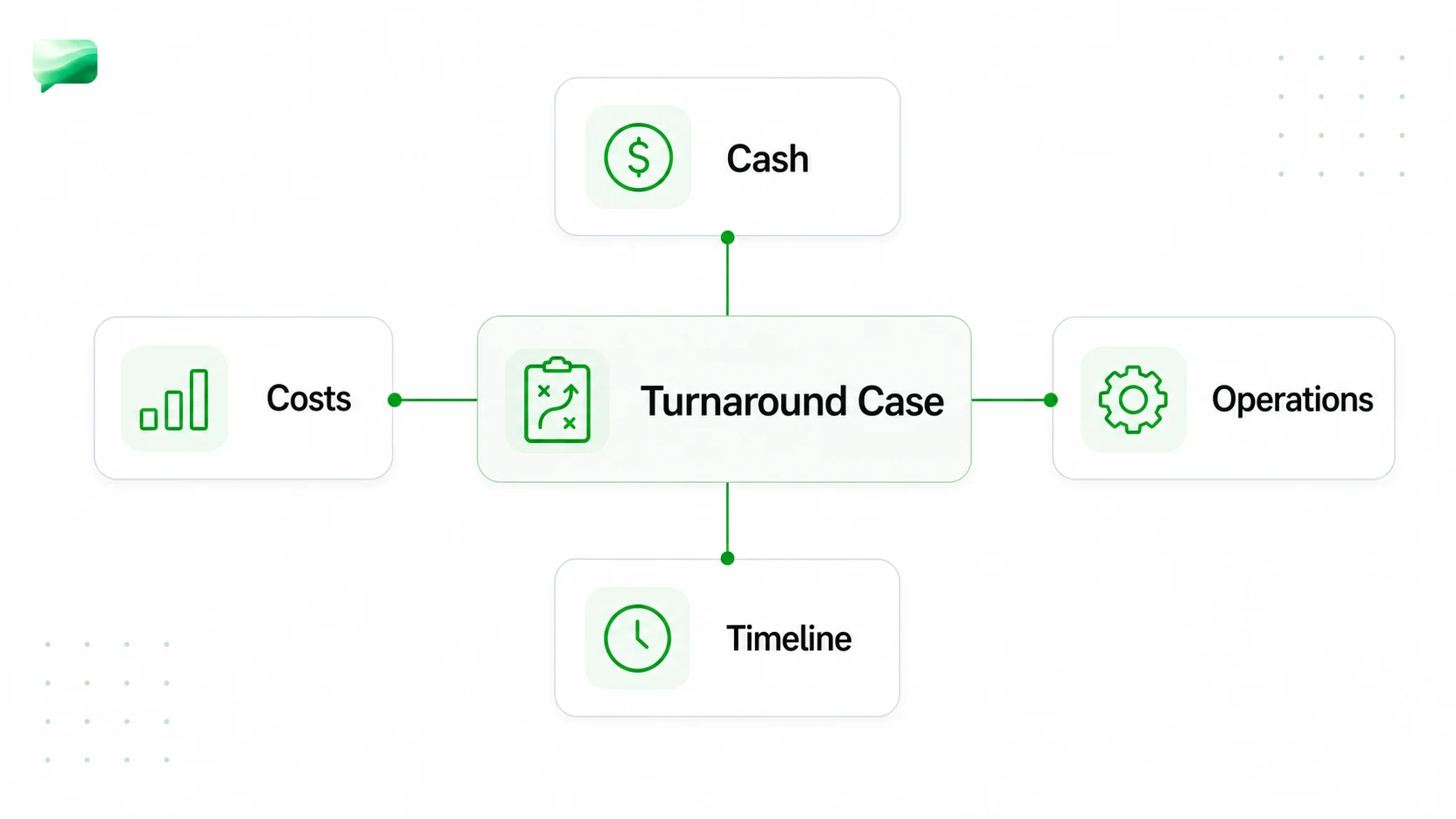
Per CaseBasix's AlixPartners guide, the cases are candidate-led and skew operational and execution-focused: turnaround, restructuring, operational improvement, profitability, and financial-performance analysis. The common archetypes:
- Profitability turnaround: a business whose margins have collapsed, where you isolate the driver and rebuild profit.
- Liquidity or cash-flow crisis: a company that may run out of cash before a debt payment, where the first job is survival, not strategy.
- Cost-structure reduction: stripping fixed and variable cost out of a bloated operation.
- Restructuring: deciding between an out-of-court fix and a formal reorganization.
Because these are candidate-led, you drive: you ask for a moment to structure, lay out your approach, request the data you need, and synthesize as you go rather than waiting for exhibits. If your candidate-led muscle is rusty, the same mechanics apply at peer firms covered in the Kearney case interview guide and the Oliver Wyman case interview guide. For the distress-specific mechanics, the restructuring case interview guide is the closest companion to this one.
How should you align your AlixPartners resume and cover letter before this interview?
For a turnaround, restructuring, or performance role, make speed, diagnosis, and implementation visible only where your experience supports them. The target practice and office determine which evidence belongs on top.
- Before: Worked on a cost project.
- After: Built the operating baseline, isolated the delayed handoff, and proposed the intervention used in the sponsor review.
Check that the line separates your action from the team's outcome and that any confidential figure uses an approved proxy. Recruiters read the resume and letter together: the resume proves the turnaround evidence, while the letter explains your interest in the role and its pace. Rehearse the line against the guide's turnaround case method before the interview.
Find the evidence that needs a tighter baseline
Upload the resume for an independent graded report with priority fixes.
Revise one line, rehearse the matching story, and carry the evidence into the next turnaround case rep.
How to Crack an AlixPartners Turnaround Case: A Step-by-Step Method
A turnaround case is not a profitability case with a darker theme. The order of operations changes, because a company that is running out of cash cannot wait for a six-month strategic fix. Use this sequence.
AlixPartners Turnaround Case Method
- 01
1. Clarify the crisis and the clock. Pin down the metric that is failing (margin, cash, covenant) and the deadline. Ask what triggered the engagement and how long until the company runs out of cash or breaches a covenant.
- 02
2. Structure around stabilize, then fix, then grow. Lead with liquidity and immediate cost, then the structural cost base, then any growth or strategic moves. Sequencing the buckets by urgency is the signal AlixPartners wants.
- 03
3. Lead the analysis. Drive the case. Request the P&L and cash position, build a quick view of the cost structure, and prioritize the levers with the biggest, fastest impact.
- 04
4. Nail the math. Run the EBITDA bridge, the weekly cash burn, and the runway. Operational arithmetic is the part competitors gloss over and the part senior directors test hardest.
- 05
5. Add the qualitative insight. Layer in feasibility and risk: lender relationships, vendor leverage, union or lease constraints, and the human cost of store or plant closures.
- 06
6. Deliver a crisp recommendation. Lead with the answer, sequence the actions by urgency, quantify the impact, and name the biggest risk. Vague advice loses; specific, executable moves win.
Interactive drill set. Write an answer before revealing the worked solution, then continue into Road to Offer for scored practice and AI feedback.
The Quant You Must Be Fast At
AlixPartners cases lean on operational arithmetic that generic strategy prep skips. Three calculations should be automatic.
1. The profitability (EBITDA) bridge. You will be asked why EBITDA fell from one year to the next and to decompose the change. Suppose EBITDA dropped from $70M to $12M, a $58M decline. A clean bridge might read:
Being able to build and read that table fast tells the interviewer you understand where the money actually went.
2. Cash burn and runway. Liquidity, not profit, is what kills a distressed company. If a business holds $25M in cash and burns $2M per week, its runway is about 12.5 weeks. If a $40M debt payment is due in 13 weeks, the company cannot make it without action. That single comparison reframes the whole case.
3. Cost-structure reduction. Splitting fixed from variable cost and quantifying the savings from a specific action (closing the bottom 25 stores, renegotiating a supply contract, cutting an overhead layer) is the core operational move. If you want to drill these peer firms' quant-heavy cases too, the Oliver Wyman case interview guide covers comparable math intensity.
Drill the cash and runway math
AlixPartners cases move fast once the client is running out of cash. Practice burn rate and runway math before the final-round pressure starts.
The Behavioral and Fit Interview
AlixPartners assesses fit against a clear value set. Per CaseBasix, the six core values are commitment, common sense, communication, personal respect, professionalism, and teamwork. The behavioral questions probe the traits a crisis operator needs:
- Entrepreneurial spirit: times you took ownership and built or fixed something without a playbook.
- Working under pressure and ambiguity: a high-stakes situation with incomplete information and a hard deadline.
- Delivering difficult messages: when you told a client, manager, or team something they did not want to hear, and how you handled it.
For the "why AlixPartners" question, generic culture answers fail. Connect to the firm's actual identity: turnaround and restructuring work, the appetite for hard problems, and named situations like the GM or JC Penney reorganizations. Prepare three to four stories that each map to more than one value, and rehearse them to under two minutes.
Industries to Know Cold
Per CaseBasix, AlixPartners cases cluster in five sectors: retail, financial services, healthcare, automotive, and manufacturing. That maps directly onto its public track record: the Kmart and JC Penney retail reorganizations, the General Motors automotive restructuring, and financial-crisis work like the Madoff investigation and the PrivatBank asset recovery, all documented on Wikipedia. You do not need deep sector expertise, but you should be able to reason about the basic economics of each: store-level P&L and inventory in retail, plant fixed costs and utilization in automotive and manufacturing, and balance-sheet and liquidity dynamics in financial services.
A Concrete Prep Plan
PrepLounge recommends a minimum of 15 to 20 practice cases. Weight them toward operational, candidate-led scenarios, not market entry.
Execution checklist
Cases 1 to 5: operational foundations. Build comfort with candidate-led structure on profitability and cost-reduction cases. Practice asking for the P&L and cost structure rather than waiting for exhibits.
Cases 6 to 10: cash and liquidity. Drill cash-flow and liquidity-crisis cases specifically. Get fast at burn rate, runway, and the EBITDA bridge. This is the math AlixPartners weights most.
Cases 11 to 15: restructuring decisions. Practice the out-of-court versus formal reorganization call, vendor and lender negotiation levers, and store or plant closure trade-offs.
Cases 16 to 20: full mocks under pressure. Simulate the final round: two to three 45-minute candidate-led cases back to back, scored on structure, math, and recommendation specificity.
Behavioral story bank. Build four stories mapped to the six core values, emphasizing entrepreneurial drive, ambiguity, and delivering difficult messages. Rehearse each to under two minutes.
Psychometric logistics. Rest, secure a quiet window, and plan to answer honestly and consistently. Treat the assessment as one input, not a pass/fail gate.
To simulate candidate-led operational cases without a live partner, run AI-scored practice cases and review the feedback on your structure, math, and synthesis. A representative warm-up from MyConsultingOffer is an ice-cream company facing falling revenues and profits, asking what the company should do, a clean example of the candidate-led profitability-turnaround format.
Worked Example: A Retailer in a Liquidity Crunch
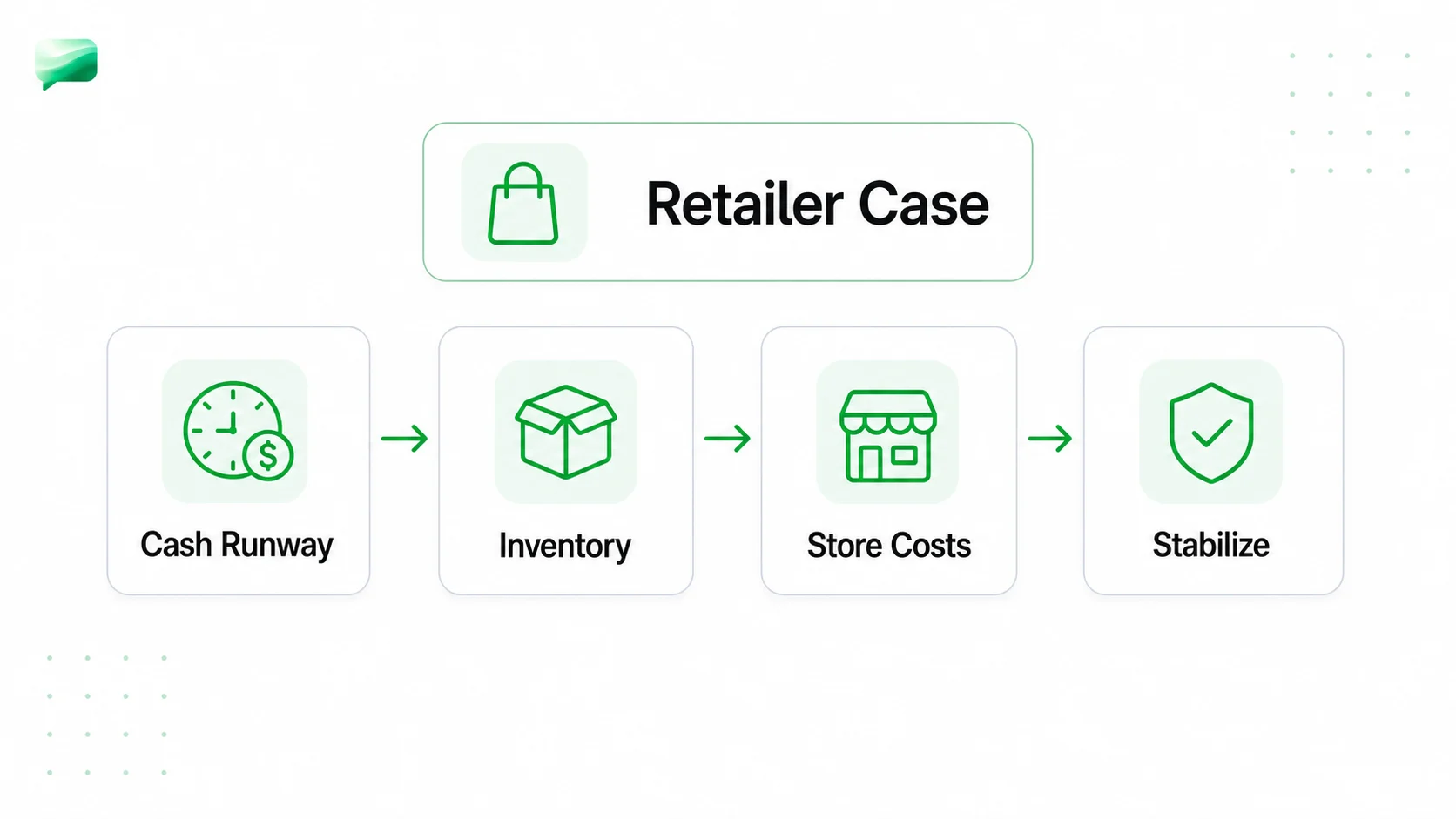
This is the kind of problem AlixPartners hands you, and the kind no competitor guide actually works through with numbers.
Prompt: A regional apparel retailer runs 120 stores and generated $600M in revenue last year, down from $700M the year before. EBITDA has fallen from $70M to $12M. The company holds $25M in cash, is burning roughly $2M per week, and has a $40M debt payment due in 13 weeks. What should management do?
Step 1: Clarify the crisis and the clock
The headline is liquidity. At $25M of cash and a $2M weekly burn, the runway is about 12.5 weeks, and the $40M payment lands in week 13. Survival, not strategy, is the first job.
Step 2: Structure: stabilize, fix, grow
Step 3: Run the math on the levers
The inventory liquidation and payables stretch raise roughly $37M of near-term cash, which, on top of the $25M on hand, covers the $40M payment and extends runway well past 13 weeks. Closing the worst 25 stores adds about $10M of annual EBITDA, lifting run-rate EBITDA from $12M toward $22M and addressing the structural problem behind the cash crisis.
Step 4: Recommendation
Stabilize first: stand up a 13-week cash forecast, stretch payables to 60 days, and clear $30M of excess inventory to raise about $37M. In parallel, close the bottom 25 stores to add roughly $10M in annual EBITDA. With liquidity secured, negotiate an amendment or extension of the $40M maturity with lenders, and keep a formal reorganization in reserve only if an out-of-court deal fails. The biggest risk is that aggressive inventory markdowns train customers to wait for discounts, so the clearance should be time-boxed and ring-fenced to dead stock.
Drill AlixPartners-style turnaround cases
Run a free candidate-led case scored on structure, math, and recommendation quality, then practice the liquidity and cost-reduction scenarios AlixPartners interviewers favor.
Sources and Further Reading (checked June 26, 2026)
- AlixPartners overview, history, and engagements: https://en.wikipedia.org/wiki/AlixPartners
- PrepLounge, AlixPartners interview process and psychometric assessment
- CaseBasix, AlixPartners case interview format and core values
- MyConsultingOffer, AlixPartners practice case example
Frequently asked questions
Resources and related guides
- Practice for AlixPartners in a real case interviewPractice
- Browse all free resourcesResource hub
- AlixPartners Careers 2026: Turnaround Salary and Interview GuideFirm Specific · Sep 11, 2026
- Roland Berger Practice Cases: 8 Candidate-Led Worked Examples (2026)Firm Specific · Jul 31, 2026
- BCG vs Bain: 10 Real Differences (2026 Guide)Firm Specific · May 1, 2026
- Capital One Power Day: Format, Cases & Prep (2026)Firm Specific · Jun 29, 2026