
Capital One Power Day: Format, Cases & Prep (2026)
Capital One Power Day guide: final virtual loop, role-by-role lineup, per-round elimination, case math, product interview, and prep plan.

GreenBite Snacks Profitability ResetProfitability · Easy
Start a free case interview for Capital One
Hear the case, say or type your answer, get your score.

Don't know how to case yet? Learn how to case
On this page
Will one bad round end your whole day? By several prep accounts, on Capital One Power Day in 2026 it can. Power Day is Capital One's final, single-day virtual interview loop, and per Verve it is a 3 to 4 hour assessment of 3 to 5 back-to-back interviews on Zoom with one substantial break of roughly an hour, where each interview is treated as an independent elimination step rather than one averaged score. It sits at the end of a funnel that starts with a recruiter phone screen, then a timed online or case screen, then a hiring manager pre-screen. According to OphyAI, the full process runs 3 to 5 weeks for new grads and 2 to 3 weeks for experienced hires. The lineup is role-specific: a Business Analyst faces two 60-minute case interviews plus one 60-minute product interview, with behavioral woven into every block.
What Capital One Power Day actually is
Most competitor pages define Power Day loosely or bury it inside a broad "Capital One interview process" article. Here is the precise definition: Power Day (written as "PowerDay" or "Capital One PowerDay" in candidate forums and prep materials) is the final, single-day loop where Capital One makes its hire or no-hire decision. It is fully virtual, conducted over video on Zoom, and it compresses 3 to 5 interviews into one continuous morning or afternoon.
The official Capital One careers page confirms the logistics candidates can rely on: interviews are virtual with video required for the full duration, your recruiter sends your schedule in advance, and campus, business analyst, product manager, and finance positions typically require a case or mini-case interview. What the official page deliberately does not disclose is the round count, the total duration, or the fact that a Business Analyst gets two cases plus a product interview. That is the gap this guide fills.
Practice a Capital One-style case before Power Day
Power Day rewards fast, accurate, calculator-light math under pressure. Run a free AI-scored case and see where your structure and numbers stand.
The full pre-Power-Day funnel and timeline
Power Day is the finish line, not the starting gun. By the time you reach it you have already cleared several screens. Per Exponent, the pre-Power-Day funnel runs like this:
For technical roles, Exponent describes the technical screen as a 70-minute CodeSignal assessment with four questions. Leland adds detail on that 70-minute window: one easy, one easy-to-medium, one medium, and one hard question. Non-technical roles get mini case studies instead of code, and the official page notes mini-case interviews last about 30 minutes.
On timeline, Verve puts the full application-to-offer process at roughly one month, and OphyAI breaks that down to 3 to 5 weeks for new grads and 2 to 3 weeks for experienced hires. Leland notes Capital One typically has about five distinct interview rounds across the whole process, varying by role, with Power Day as the final cluster.
Power Day format and logistics
The shape of the day is consistent across roles. Expect 3 to 4 hours total, 3 to 5 interviews back to back, fully virtual on Zoom with video on, and one break of approximately one hour positioned mid-loop. Verve and The Business Analyst Job Description both describe the single substantial break, which exists so you can reset between dense, quantitative rounds.
The practical implication is fatigue management. Five back-to-back interviews on camera is taxing in a way a single one-hour interview is not. The candidates who fade in rounds four and five are usually the ones who did not plan their break around food, water, and a screen-free reset.
Role-specific Power Day lineup
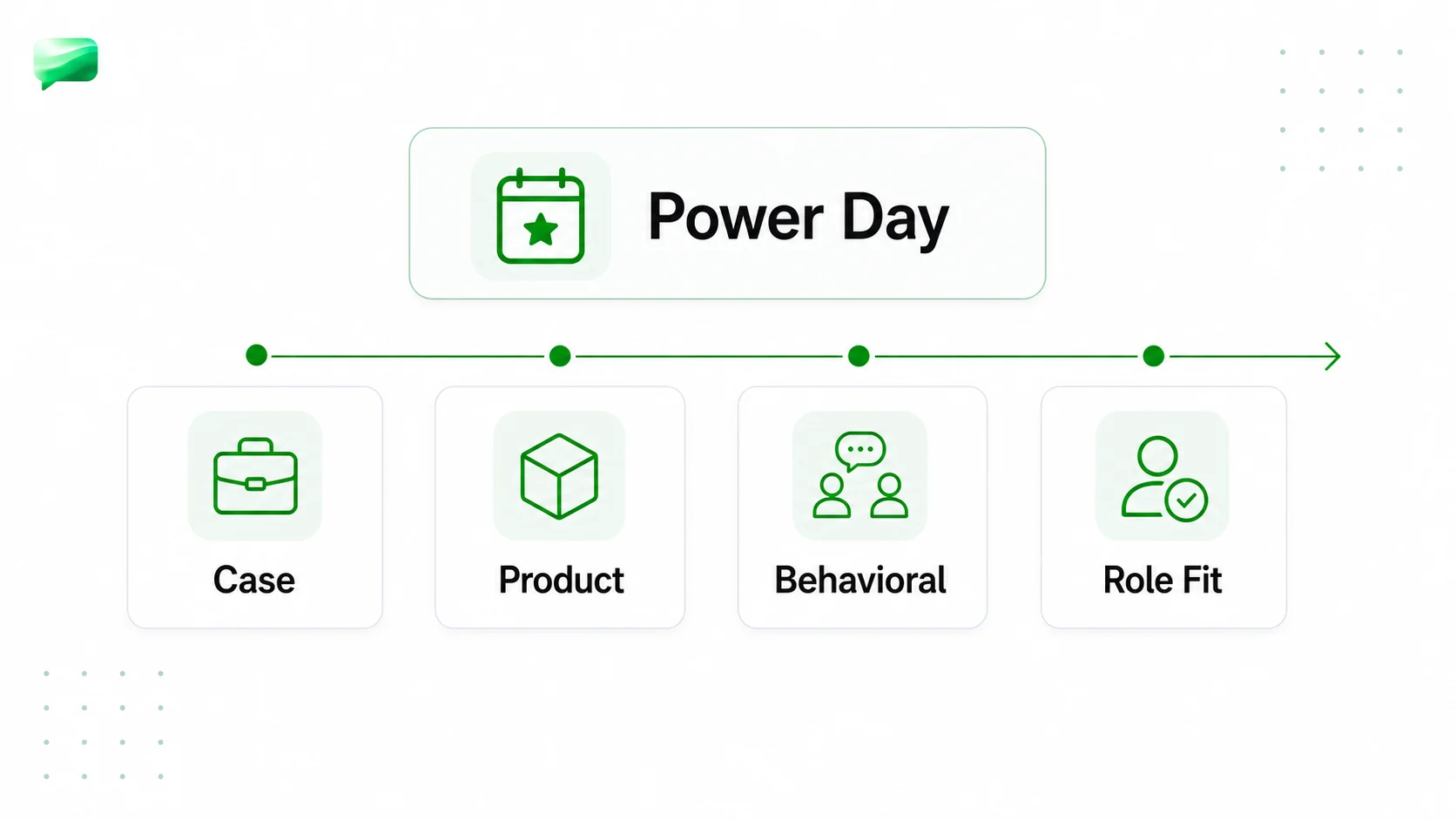
This is the table no single competitor assembles in one place. The lineup shifts by role, but the Business Analyst version is the most documented. Per The Business Analyst Job Description, the BA Power Day is two business case interviews of 60 minutes each, one product interview of 60 minutes, and behavioral questions integrated throughout, with a one-hour break between interviews. Exponent frames the same loop as one to two job-fit interviews, a behavioral, and a case.
The official page confirms campus, business analyst, product manager, and finance positions typically require a case or mini-case, and that candidates complete one or two job-fit interviews. The exact count varies by role and level, which is why your recruiter-sent schedule is the source of truth for your specific day.
The Capital One case interview deconstructed
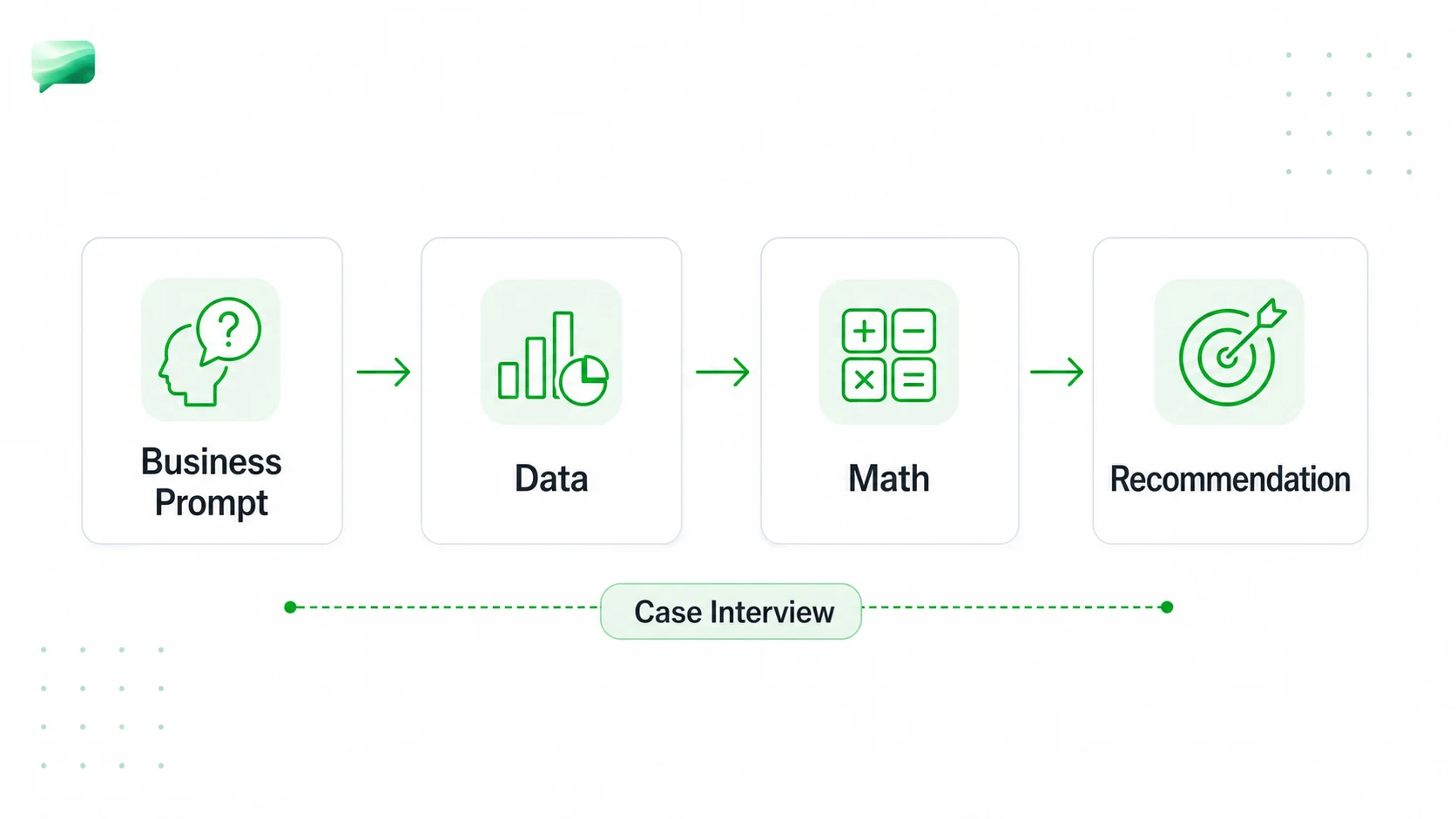
This is the single most important thing to internalize, and the place most generic guides go vague: the Capital One case is not an MBB case.
It is interviewer-led, not candidate-led. Instead of you driving the structure and asking for data, the interviewer walks you through a structured set of questions, mostly quantitative. The math is the main event. The numbers are bigger and messier than a clean MBB case, and a basic non-scientific calculator is permitted, which both The Business Analyst Job Description and Leland confirm for the quantitative sections.
Here is the 60-minute internal breakdown, per The Business Analyst Job Description:
Notice the imbalance: 35 to 40 of the 60 minutes is calculation. That is why MBB-style framework polish matters far less here than calculation accuracy and speed. For a deeper breakdown of the case itself, see our Capital One case interview guide. To benchmark whether your arithmetic is fast and accurate enough for this calculation-heavy format, work through case interview math practice.
Practice calculation-heavy case math from the Road to Offer drill engine. Answer a real prompt and get AI-scored feedback. Free accounts include 5 drills per day for the first 3 days after signup.
The calculator is allowed but it is a trap if you lean on it. The clock is the constraint, not the arithmetic, so candidates who reach for the calculator on every line lose time. Use it for the genuinely messy multiplications and division, and keep estimation in your head for the rest. For reference on case difficulty, RocketBlocks rates its Capital One-Discover M&A practice case as Intermediate and builds it around Capital One's $490 billion in assets, testing financial synergies, regulatory risk, and strategic alternatives.
Run Power Day math out loud, against the clock
Capital One cases spend most of the hour on calculations. Run a voice case and get scored on percentages, breakeven, and multi-step business math.
The product interview
For Business Analyst and Product Manager candidates, one 60-minute block is a product interview, distinct from the cases. Where the case tests whether you can grind multi-step math to a defensible number, the product interview tests product judgment: how you would prioritize features, evaluate a product decision, reason about users and tradeoffs, and tie a recommendation back to business value.
The difference matters for prep. A case rewards quantitative discipline and a clean recommendation off the math. The product interview rewards structured product thinking: who is the user, what is the problem, what are the options, how would you decide, and how would you measure success. Do not walk into the product block running a profitability framework. Walk in with a product-decision structure.
Behavioral and job-fit interviews
Behavioral assessment is not a separate isolated round you can skip preparing for. Per Exponent and The Business Analyst Job Description, behavioral questions are integrated into every interview block, and the official page confirms candidates complete one or two job-fit interviews assessing role, team, and culture fit.
Expect STAR-format questions (Situation, Task, Action, Result) inside the case rounds and the product round, plus dedicated job-fit conversations. Capital One maps these to its values, so generic "I am a hard worker" answers fall flat. The strongest stories emphasize data-driven decisions, since that is the throughline of the entire company and the case format itself.
How candidates are scored and eliminated
Per Verve, each Power Day interview works as an independent elimination step, and a single weak round can be decisive. Capital One does not publish how it scores Power Day, so treat this as prep-source guidance rather than confirmed policy. It should still reshape your prep priorities: if rounds are scored independently, no brilliant case offsets a shaky product round, and a clear miss in any one block can sink the offer.
The strategic consequence: prep to raise your floor, not your ceiling. A candidate who is excellent at cases but weak on product judgment is more at risk than a candidate who is solid across all three. Identify your weakest component now and spend disproportionate time there, because that is the round most likely to end your day.
How to prepare for each Power Day component
Execution checklist
Timed case-math drills without the calculator. 35 to 40 of every 60-minute case is calculation. Drill multi-step arithmetic, percentages, and break-even under a timer so the calculator is a backup, not a crutch. The clock is the real constraint.
A product-thinking framework. The 60-minute product interview tests user, problem, options, decision, and success metrics, not a profitability tree. Build and rehearse a product-decision structure separate from your case framework.
A STAR story bank emphasizing data-driven decisions. Behavioral questions are woven into every block. Prepare 6 to 8 STAR stories mapped to Capital One values, weighted toward analytical and data-driven decisions.
Full-loop stamina simulation. Run 3 cases back to back to build the endurance Power Day demands. Five rounds on camera is a fatigue test as much as a skill test.
Raise your weakest round. Per-round elimination means your floor decides the outcome. Diagnose your weakest component and over-invest there.
The math drills are the highest-leverage prep because the case format is so calculation-heavy and the calculator can lull you into slowness. Pair structured case interview math practice with realistic, interviewer-led cases so you rehearse the actual Capital One dynamic, not a candidate-led MBB simulation.
Day-of execution and common mistakes
The logistics can sink an otherwise strong candidate. Run your tech check 24 to 48 hours before, not the morning of: test Zoom, your camera, your microphone, and your connection, since the entire loop requires video for the full duration per the official page.
The most common mistakes:
- Burning out by round four. Five back-to-back interviews on camera is exhausting. Use the one-hour break to eat, hydrate, and get off the screen.
- Letting one round bleed into the next. Because rounds are scored independently, a stumble in interview two is irrelevant to interview three unless you carry the anxiety forward. Reset.
- Over-using the calculator. It is allowed, but reaching for it on every line costs time. Estimate in your head, calculate the messy bits.
- Skipping the recommendation. Candidates spend so long in the 35 to 40 minutes of calculation that they neglect the 5 to 10 minute synthesis. The recommendation, with risks and next steps, is where the interviewer sees your judgment. Leave time for it.
- Treating behavioral as filler. STAR questions are embedded in every block and the job-fit rounds are scored. A weak story in a case round can be the elimination.
Run a full Capital One-style loop before your Power Day
Practice interviewer-led, calculation-heavy cases with AI scoring on your math, structure, and recommendation, then drill your weakest round until it stops being the one that sinks you.
Sources (checked June 26, 2026)
- Verve, Capital One Power Day tips
- Exponent, Capital One interview process
- The Business Analyst Job Description, Capital One BA case interview: https://thebusinessanalystjobdescription.com/capital-one-business-analyst-case-interview/
- Capital One Careers, what to expect: https://www.capitalonecareers.com/what-to-expect-during-your-capital-one-interview-students-101
- OphyAI, Capital One interview guide
- Leland, 50 Capital One interview questions
- RocketBlocks, Capital One-Discover M&A case
Frequently asked questions
Resources and related guides
- Rehearse a Capital One answer livePractice
- Browse all free resourcesResource hub
- BCG vs Bain: 10 Real Differences (2026 Guide)Firm Specific · May 1, 2026
- Accenture Internship 2026: Salary, Eligibility, and Interview GuideFirm Specific · May 22, 2026
- Accenture Case Interview Examples: 10 Practice Cases and the Official Workbook (2026)Firm Specific · Jul 31, 2026