
IQVIA Case Interview: Process, Case Types & Worked Case
IQVIA case interview guide: candidate-led life-sciences format, process, written case, pharma literacy, and a worked drug-launch case.

Biopharma Outsourcing to MexicoOperations · Medium
Start a free case interview for IQVIA
Hear the case, say or type your answer, get your score.
Don't know how to case yet? Learn how to case
On this page
The IQVIA case interview in 2026 is not a generalist McKinsey-style exercise. It is a candidate-led, life-sciences case run by a $16.3 billion healthcare data, technology and analytics firm. According to Wikipedia, IQVIA was formed in October 2016 when Quintiles merged with IMS Health, and it reported roughly $16.3 billion in revenue with about 93,000 employees in 2025. That heritage matters, because instead of generic profitability prompts, IQVIA interviewers hand you drug launches, market-access questions, and pharma forecasting problems, then expect you to drive the structure and ask for the data yourself. The process is compact, usually 3 to 4 weeks: a short phone screen, a Round 1 of two back-to-back interviews, and a final round that adds a written case. This guide gives you the verified company facts, the candidate-led mechanics, the pharma literacy you need walking in, and a fully worked drug-launch case so you can practice the real thing.
What should you expect in an IQVIA case interview?
IQVIA cases are shaped by the role, office, and life-sciences context. Prepare for a process table, a case type that uses healthcare or commercial evidence, and a recommendation that respects the client decision rather than a generic consulting prompt.
Use the life-sciences case method: 1. clarify the patient, provider, or commercial decision, 2. structure the relevant market or evidence, 3. test the highest-value branch, 4. recommend with a risk and next step. In the existing case example, the business implication is that domain context changes the decision rule even when the general case logic transfers.
What IQVIA Is and Why Its Interview Is a Different Animal
IQVIA is a healthcare-specific firm, not a generalist consultancy. Per Wikipedia, it was created in October 2016 when Quintiles (incorporated in North Carolina in 1982) merged with IMS Health to form QuintilesIMS, later renamed IQVIA, headquartered in Durham, North Carolina. It reported approximately $16.3 billion in revenue and around 93,000 employees in 2025, and MyConsultingOffer notes it operates in more than 100 countries.
One quick correction before you prep: several competitor guides still repeat a stale "65,000+ employees" figure. The current number is about 93,000 as of 2025. If a prep page is wrong on headcount, treat its other details with the same caution and verify against your recruiter.
What this means for your interview is simple. The firm sits at the intersection of clinical data, technology, and analytics for pharma, biotech, and medical-device clients. So the cases test whether you can reason about a real drug-launch, pricing, or forecasting problem, not whether you can recite a generic 2x2 framework. The closest comparables are healthcare-focused practices at firms like ZS and pricing specialists like Simon-Kucher, which is why our ZS Associates case interview guide and Simon-Kucher case interview guide are useful companion reads.
Practice a candidate-led case with instant AI feedback
IQVIA cases live in pharma: drug launches, market access, and forecasting. Run a candidate-led life-sciences case and get feedback the second you wrap.
The Full IQVIA Interview Process and Timeline
The IQVIA process is shorter than a typical MBB gauntlet, but each stage carries weight. Across prep sources the shape is consistent.
CaseBasix reports a 20 to 30 minute phone screen for non-target candidates, a Round 1 of two 30-minute interviews (one case, one behavioral), and a Round 2 of three to four interviews that includes a written case, with the full process usually taking 3 to 4 weeks from first contact to offer. MyConsultingOffer similarly describes first-round interviews at core schools as two back-to-back 30-minute interviews and final-round interviews as 3 to 4 back-to-back interviews, with the recruiting timeline running over four weeks. Leland adds that the first round includes a 30 to 45 minute case plus a behavioral component, the final round is 2 to 3 back-to-back interviews, and a decision typically lands 1 to 2 weeks after the final round.
What Makes IQVIA Cases Unique: Candidate-Led and Life-Sciences-Grounded
Two things separate an IQVIA case from a generic practice case.
First, it is candidate-led. You are expected to drive. In a candidate-led case you:
- Ask for a moment to structure your approach before talking
- Present a clear framework, then state which branch you will explore first and why
- Request specific data ("Do we have the eligible patient population and the net price per patient?") rather than waiting for an exhibit
- Synthesize as you go and signpost your next move
- Deliver a recommendation without being prompted
The interviewer is not there to feed you the next number. They answer what you ask, and silence is your cue to keep driving. If you have only prepped interviewer-led McKinsey-style cases, this is the adjustment to make.
Second, the content is grounded in real life-sciences problems. Instead of "a widget maker's profits are down," you get "a biotech is deciding whether to launch a new therapy" or "a pharma client needs to forecast revenue after a patent expires." The structure skills transfer, but the data you request and the levers you pull are specific to the industry. Our life-sciences consulting case interview guide goes deeper on the sector mechanics that show up here, and the broader healthcare case interview guide maps the payer, provider, and pharma landscape these prompts sit inside.
The Most Common IQVIA Case Types
You can prepare for roughly five archetypes. Knowing them in advance lets you pattern-match fast and spend your structuring time on the specifics.
- Drug or therapy launch go/no-go. Should the client bring an asset to market? You weigh the addressable patient population, payer access, competition, and launch economics. This is the flagship IQVIA case and the one worked in full below.
- Healthcare market sizing. Size a patient population, a therapy area, or a device market. The trick is moving from prevalence to eligible patients to treated patients to realistic share, not just multiplying big numbers.
- Pricing and market access. What net price clears payers while protecting margin? You reason about gross-to-net discounts, formulary placement, and reimbursement. This overlaps heavily with the pricing logic in our Simon-Kucher case interview guide.
- Capacity expansion. Should a manufacturer or lab add capacity? A cost-benefit and risk case with CapEx, utilization, and demand growth.
- Revenue forecasting. Project revenue for a biotech or pharma client, often around a launch curve or a patent cliff. You build a simple uptake model: addressable population, share ramp, net price, and erosion after loss of exclusivity.
The common thread is that every input is a pharma input. That is why the literacy section below is not optional.
The IQVIA Written Case: Building a Tight 5-Slide Deck
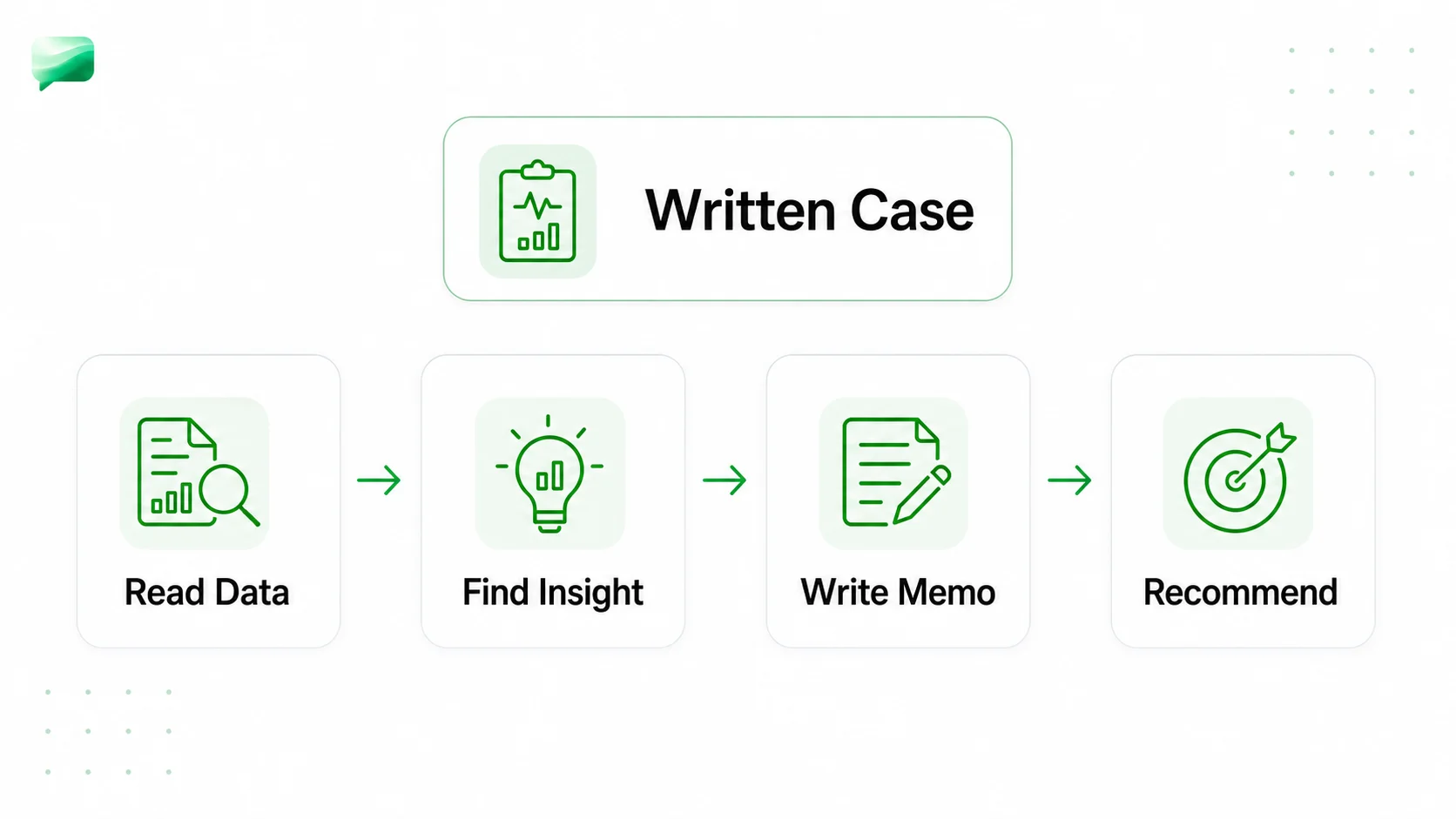
The final round includes a written case. CaseBasix describes it as a short deck of roughly 5 slides structured as recommendation, supporting points, then summary and next steps. The skill being tested is not whether you can find the answer, it is whether you can organize it so a client would act on it.
A reliable 5-slide structure under time pressure:
Pharma and Healthcare Literacy You Need (No Science Degree Required)
You do not need to be a scientist, but you cannot fake fluency in the basics. Here is the minimum you should walk in knowing.
Drug-development phases. Preclinical (lab and animal testing), Phase I (safety in a small healthy group), Phase II (efficacy and dosing in patients), Phase III (large-scale efficacy and safety), then FDA review of the New Drug Application or Biologics License Application, and Phase IV (post-market surveillance). Each phase is more expensive and most candidates fail at Phase II or III, which is why a Phase III asset is valuable.
The FDA approval pathway. A drug must clear FDA review before it can be sold in the US. Approval is the gate to revenue, and the label the FDA grants (which patients, which indication) defines the addressable market.
Payer mix. In the US, someone other than the patient usually pays. Commercial insurers, Medicare, and Medicaid each negotiate differently. A drug can be approved and still fail commercially if payers will not cover it or demand steep rebates. This is why access, not approval, often decides a launch.
Patent cliff. A drug has a patent-protected window to earn back its R&D. When the patent expires (loss of exclusivity), generics or biosimilars enter and revenue can fall sharply, sometimes by the majority within a year or two. Forecasting around this cliff is a recurring IQVIA task.
How pharma actually makes money. Roughly: net revenue equals treated patients times net price per patient, where net price is the list price minus gross-to-net discounts (rebates to payers, channel fees). Profit is that net revenue minus cost of goods (often low for small molecules, higher for biologics), minus the sales and marketing cost of reaching prescribers, against largely sunk R&D. Internalize that equation and most IQVIA economics cases become arithmetic.
IQVIA Behavioral and Fit Questions
One of your Round 1 interviews is purely behavioral, and fit threads through the rest. CaseBasix recommends preparing 5 to 7 reusable behavioral stories. Expect questions in these buckets:
- Why IQVIA and why healthcare consulting. Generic answers fail. Connect to the firm's data-and-analytics identity and to a genuine reason you want life sciences, not just "consulting."
- Teamwork and client management. A time you worked across a team or managed a difficult stakeholder.
- Handling shifting priorities. A time priorities changed mid-project and how you adapted. IQVIA work is project-driven and timelines move.
- Leadership and failure. Standard, but have a real failure with a real lesson.
Build 5 to 7 stories that you can flex across these prompts, each tight enough to tell in under two minutes. Map each story to the trait it proves so you can deploy the right one on demand. If you are also recruiting at adjacent firms, the behavioral prep in our ZS Associates case interview guide covers the same analytics-firm fit themes.
How should you align your IQVIA resume and cover letter before this interview?
Use life-sciences or analytics language only when the target IQVIA role supports it. Show the evidence question, method, stakeholder implication, and bounded result without inventing patient, client, or revenue claims.
- Before: Analyzed healthcare data.
- After: Tested the adoption question across two segments and summarized the bounded implication for the project lead.
Check that the result stays within the data and that the role, business unit, and process come from current sources. Recruiters read both documents together: the resume proves analytical and domain evidence, while the letter explains why the applicant wants this role. Rehearse the line against the guide's healthcare-case logic.
Keep the domain evidence bounded and clear
Drop the resume here for an independent graded report on whether the life-sciences work reads to a generalist. Road to Offer's score, not an IQVIA evaluation.
By uploading, you agree to resume analysis and report storage until you delete it. See the privacy policy.
Revise one evidence line, rehearse its limitation, and bring the implication into the next case rep.
A Fully Worked Candidate-Led IQVIA Case: Should a Biotech Launch a New Therapy?
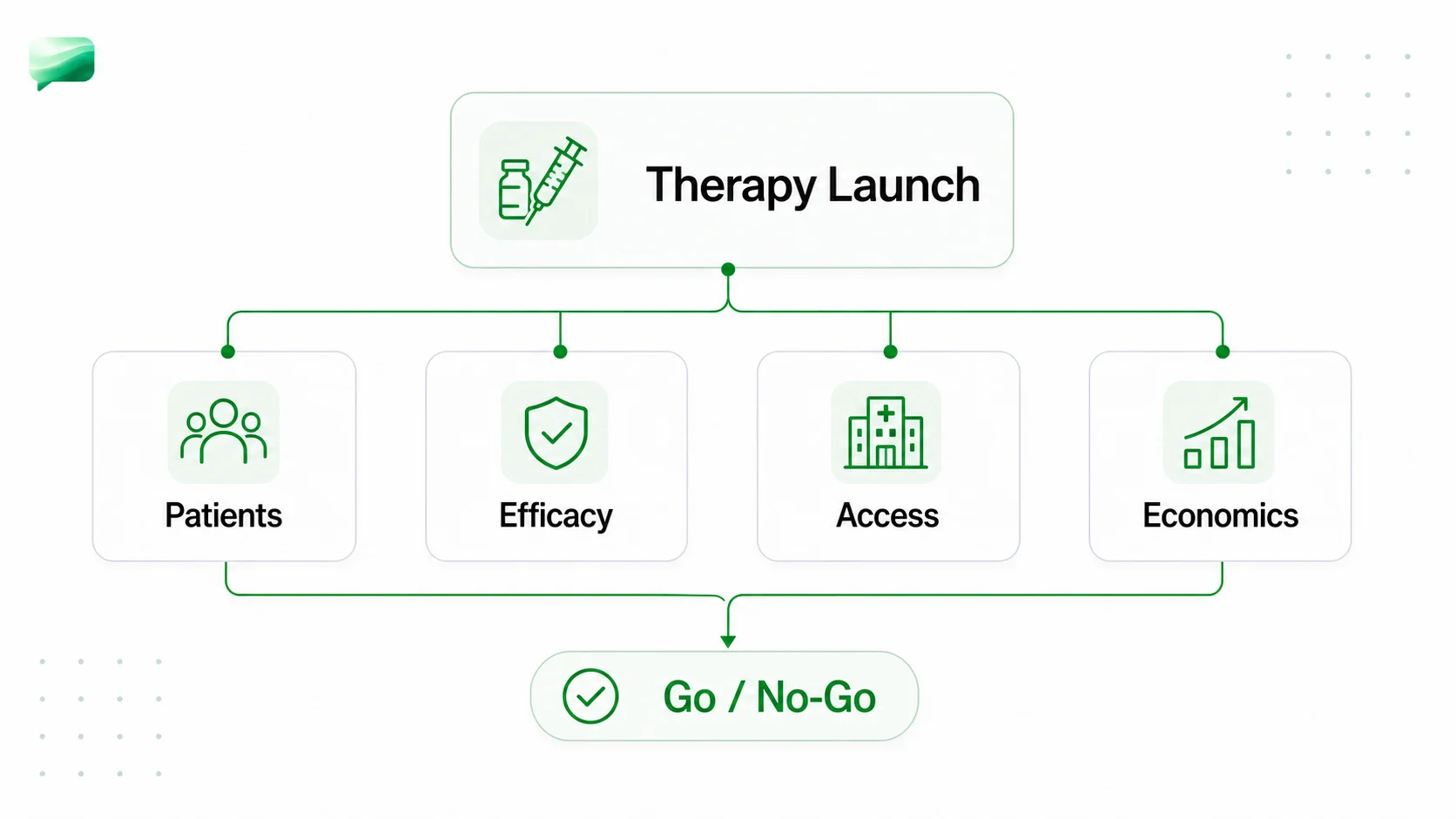
This is the section the other guides skip. Below is a complete candidate-led walkthrough showing how to structure, what data to request, the math, and the recommendation.
Prompt: A mid-size biotech has just completed a successful Phase III trial for a new therapy treating a chronic autoimmune condition. Should they launch it themselves, and is the launch financially attractive?
Step 1: Clarify, then structure (out loud)
"Before I dive in, two quick clarifications: are we deciding both whether to launch and how to launch (build versus partner), and is the goal peak revenue, profit, or a specific return hurdle?" Assume the answer is profit, and both questions are in scope.
Then present the structure:
- Market. How many patients can we realistically treat?
- Access and pricing. What net price will payers accept?
- Competition and differentiation. Who else is in the space, and how long is our patent runway?
- Launch economics and capabilities. Can we make money, and do we have the sales force to do it ourselves?
- Risks. Clinical, regulatory, and payer.
State your first move: "I will start with the market to see if the prize is big enough to justify the rest."
Step 2: Request data and size the market
Ask for the numbers, do not wait for them. Suppose the interviewer confirms:
- US diagnosed prevalence of the condition: 1,000,000 patients
- Eligible (moderate-to-severe, failed first-line therapy): 20 percent
- Of eligible patients, reachable and treated: 50 percent
- Realistic peak market share given two entrenched competitors: 12 percent
- Net price per patient per year (after gross-to-net discounts): $30,000
The math, step by step:
So peak revenue is about $360 million per year. That is a real prize, worth continuing.
Step 3: Test the economics
Request the cost structure. Suppose:
- Gross margin (biologic, cost of goods about 15 percent): 85 percent
- Annual sales, marketing, and field force for a specialty launch: $120M
- R&D is already sunk (Phase III complete)
The math:
With roughly a decade of patent runway before loss of exclusivity, the cumulative value clearly justifies launching the asset. The economics work at peak.
Step 4: Find the real decision (the twist)
The number that makes or breaks this is not the math, it is access. At a net price of $30,000, payers will scrutinize formulary placement, and the 12 percent share assumes the drug actually gets covered by major payers. If access slips and share falls to 6 percent, peak revenue halves to about $180 million and peak profit drops to roughly $33 million after the same $120 million cost base, which is far less attractive and far riskier.
The second decision is build versus partner. A mid-size biotech may not have an established specialty sales force or payer relationships. Building one is the $120 million annual cost and a major execution risk.
Step 5: Recommendation
"Launch the therapy, because at realistic share it generates about $186 million in peak annual profit over a roughly ten-year patent window, which more than justifies the launch cost. But the decision hinges on payer access, so I would make the full self-launch contingent on securing formulary coverage with at least two major payers within 12 months. If access looks slow, I would partner with or license to a firm that already has the specialty field force and payer relationships, trading some upside for a faster, lower-risk launch. The key risk to monitor is gross-to-net erosion, which can quietly cut net price and collapse the economics."
A Concrete Prep Plan for Candidate-Led Healthcare Cases
You can be ready in three to four weeks. Focus on the format and the literacy, not on memorizing frameworks.
Execution checklist
Week 1: Candidate-led mechanics. Drill driving the case yourself. Run baseline cases, force yourself to request data and signpost every move, and get comfortable with interviewer silence as your cue to continue.
Week 1: Pharma literacy. Learn the drug-development phases, the FDA pathway, payer mix, patent cliffs, and the net-revenue equation. One focused study block is enough to stop these from tripping you up.
Week 2: Market sizing and market entry. Practice healthcare market sizing (prevalence to eligible to treated to share) and drug-launch go/no-go drills until the population funnel and launch economics are automatic.
Week 2: Behavioral story bank. Build 5 to 7 reusable stories mapped to why IQVIA, teamwork, client management, shifting priorities, leadership, and failure. Get each under two minutes.
Week 3: Written-case practice. Build 3 timed 5-slide decks: recommendation first, two supporting analyses, risks, next steps. Practice writing slide titles that each carry one message.
Week 3 to 4: Full mock interviews. Run 4 to 6 full mocks, ideally including a final-round simulation of multiple cases plus a written case in one sitting, and debrief each on structure, math, and recommendation quality.
The fastest way to internalize the candidate-led format is repetition with feedback. Run pharma-flavored launch, market-sizing, and pricing cases, then tighten the gaps the feedback surfaces.
Drill IQVIA-style cases until the format is automatic
Run candidate-led launch, market-sizing, and pricing cases with AI scoring on structure, math, and recommendation, the three things IQVIA interviewers weight most.
Sources and Further Reading (checked June 26, 2026)
- IQVIA company overview, formation, revenue, and headcount: https://en.wikipedia.org/wiki/IQVIA
- MyConsultingOffer, IQVIA consulting interview overview
- CaseBasix, IQVIA case interview guide
- Leland, IQVIA case study interview preparation guide
Frequently asked questions
Resources and related guides
- Practice for IQVIA in a real case interviewPractice
- Browse all free resourcesResource hub
- Gupta Strategists Case Interview: Process and Practice (2026)Firm Specific · Aug 13, 2026
- Huron Consulting Case Interview: Healthcare Cases + PrepFirm Specific · Apr 1, 2026
- Life Sciences Consulting Case Interview: Pharma, Biotech, and MedTech Cases (2026)Firm Specific · Apr 1, 2026