
Guesstimate Questions: 10 Examples + Answers (2026)
10 guesstimate examples with worked answers, the 5-step method top MBB candidates use, and five AI-graded drills to rehearse before your interview.
On this page
Guesstimate interview questions in 2026 ask candidates to estimate an unknown quantity (piano tuners in a city, daily haircuts in the US, gas stations on a highway) using logic and stated assumptions rather than memorized facts. A guesstimate is a Fermi problem, and McKinsey, BCG, and Bain all use some version of it: McKinsey typically embeds a guesstimate inside a larger interviewer-led case, BCG sometimes runs it as a standalone estimation, and Bain folds market sizing into candidate-led cases. Interviewers score reasoning quality and assumption defensibility, not exact accuracy: a structured estimate that lands within an order of magnitude of the true figure typically scores higher than an unstructured guess that happens to land closer. The transferable skill is building a clean tree before touching numbers, anchoring on a reliable aggregate like US population (330M) for top-down problems, calculating without losing units, and sanity-checking the result. Confirm the exact format and time box from the interview process rather than assuming one firm-wide pattern.
What are common guesstimate questions and answers?
Below are 10 representative guesstimates spanning every major category. Each row shows the approach and answer; the three most-asked types are then worked through in detail.
These 10 examples span population, revenue, physical volume, rates, and market sizing. For market-specific variants see our market sizing step-by-step guide, or use the free case practice book to work through estimation prompts on paper. Finance candidates can add the Capital One case interview guide, where estimation turns into business analyst case math.
First choose the right estimation method. This guided rep teaches the difference between a population chain, a throughput chain, and a physical-volume chain before you write a full answer.
Choose the right guesstimate method from the Road to Offer drill engine. Start with guided choices and explanations, then answer the same skill in your own words for AI-scored feedback. Free accounts include 5 drills per day for the first 3 days after signup.
What are guesstimate questions for interviews?
A guesstimate (also called a Fermi problem, after physicist Enrico Fermi) is a structured estimation exercise where you build an unknown quantity from logic, segmentation, and reasonable assumptions. Evaluation focuses on reasoning quality and assumption defensibility, not exact accuracy (MConsultingPrep).
Every guesstimate is solvable with the same 5-step framework regardless of topic. The difference between candidates is rarely math speed; it is whether they structured the problem before naming numbers.
The 5-step guesstimate method
Every guesstimate follows the same five moves in order. Skip the structure step and you land in the most common failure mode interviewers penalize.
Execution checklist
Clarify scope. Lock down geography, time period, and units before doing anything else, so you estimate the quantity actually asked
Structure and choose your approach. Break the problem into 2-4 components and commit to top-down or bottom-up before naming a single number
Estimate each component. Use round anchors and state every assumption, flagging the one you are least sure about
Calculate aloud. Round aggressively and keep units attached so the interviewer can follow and challenge your logic
Sanity-check. Compare against a known reference point and adjust; a missing sanity-check is a visible red flag
For the market-sizing version of this sequence, use the market sizing step-by-step guide.
Now use the population chain yourself. State the segments, frequency, and one sanity check. The AI grader checks the reasoning, not only the final number.
Estimate daily US coffee cups from the Road to Offer drill engine. Answer a real prompt and get AI-scored feedback. Free accounts include 5 drills per day for the first 3 days after signup.
When should you use top-down vs bottom-up?
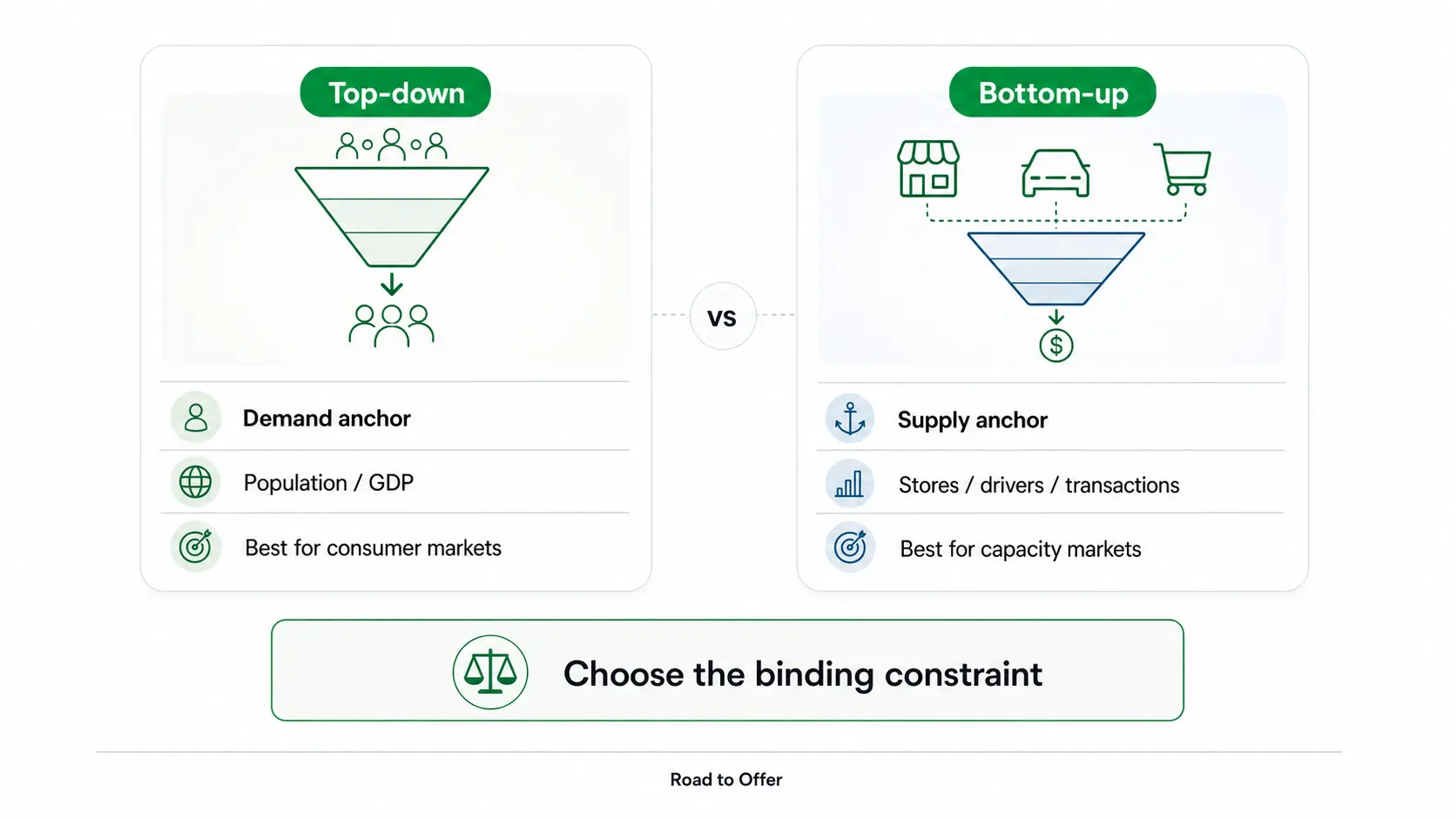
Top-down works when you have a reliable aggregate to anchor on (US population 330M, US households 130M, US cars 280M). Bottom-up works when the quantity is best built unit by unit (revenue per store × number of stores). Doing both and reconciling is the strongest signal a candidate can send (Hacking the Case Interview). For the decision rule and worked examples of each, see the top-down vs bottom-up market sizing guide. The free market size calculator runs both paths on the same prompt, which is the fastest way to see when the two answers disagree and why.
How do you solve the three most-asked guesstimate types?
Below are full walkthroughs of a population-based, a revenue-based, and a physical-volume guesstimate. Each is the most-asked variant in its category at MBB and Tier 2 firms.
1. Piano tuners in NYC (population-based)
NYC has 8.3M people in roughly 3.3M households. Assume 5% own a piano (165,000) plus 35,000 institutional pianos (schools, theaters, churches), totaling 200,000 pianos. At 1.5 tunings per piano per year, that is 300,000 tunings annually.
Supply side: a tuner does 4 tunings per day (1.5 hours each plus travel) across 250 working days. Divide demand by capacity to get the headcount. NYC Yellow Pages historically lists 200-300, right in range.
Pianos = 3.3M households x 5% + 35,000 institutional = 200,000
Annual tunings = 200,000 x 1.5 = 300,000
Tuner capacity = 4 per day x 250 days = 1,000 per year
Tuners = 300,000 ÷ 1,000 = ~300
- Anchor: 8.3M population, 3.3M households
- Key assumption: 5% piano ownership (above national due to music density in NYC)
- Sanity-check: 1 tuner per ~28,000 people, reasonable for an urban market
Try the same demand-versus-capacity chain with a new city. Write the full answer before you compare it with the worked example above.
Estimate piano tuners in Chicago from the Road to Offer drill engine. Answer a real prompt and get AI-scored feedback. Free accounts include 5 drills per day for the first 3 days after signup.
2. McDonald's revenue per store (revenue-based)
Build bottom-up from daily transactions by daypart. Breakfast (4 hrs × 60/hr = 240), lunch (3 hrs × 100/hr = 300), afternoon (3 hrs × 40/hr = 120), dinner (4 hrs × 80/hr = 320), late night (3 hrs × 25/hr = 75). Total: 1,055 daily transactions at $9.50 average ticket = ~$10,000/day.
McDonald's reports a US franchise average of approximately $3.7M, within 2% of our estimate.
Daily transactions = 240 + 300 + 120 + 320 + 75 = 1,055
Daily revenue = 1,055 x $9.50 = ~$10,000
Annual revenue = $10,000 x 365 = ~$3.65M
- Anchor: 18 operating hours segmented into 5 dayparts
- Key assumption: $9.50 average ticket (varies by location and channel)
- Sanity-check: ~$10K daily revenue is reasonable for a high-traffic QSR
Now build annual revenue from users, frequency, and spend. Keep dollars and time units attached to every line.
Estimate annual US pet food spend from the Road to Offer drill engine. Answer a real prompt and get AI-scored feedback. Free accounts include 5 drills per day for the first 3 days after signup.
3. Golf balls in a school bus (physical volume)
Start from the bus interior, strip out space for seats and the engine, convert to cubic inches, then apply the packing efficiency that trips up most candidates. Published answers range 200K-500K depending on bus size, so the estimate sits squarely in the published range.
Usable volume = (20 x 6 x 6) x 75% = 540 cu ft
In cubic inches = 540 x 1,728 = 933,120
Golf balls = 933,120 x 64% ÷ 2.5 cu in = ~239,000
"Skipping the packing-efficiency adjustment (spheres fill only ~64% of space) is the single most common error on physical-volume guesstimates." Street of Walls 2026 case training.
- Anchor: Standard school bus dimensions (20 × 6 × 6 ft)
- Key assumption: 64% packing efficiency for randomly packed spheres
- Sanity-check: ~240K golf balls in a bus passes gut check
The exact school-bus geometry drill is linked in the summary table. This adjacent physical-unit rep tests the same discipline on annual demand: define the population, attach a usage rate, and keep units clean.
Estimate annual US tennis ball sales from the Road to Offer drill engine. Answer a real prompt and get AI-scored feedback. Free accounts include 5 drills per day for the first 3 days after signup.
What are the most common guesstimate mistakes?
The five most frequent errors, per Street of Walls:
- Calculating before structuring. Lay out your tree first.
- Unflagged assumptions. State every number, mark the ones you are least sure about.
- Skipping the sanity-check. A reference comparison is non-negotiable.
- Over-segmenting. 3 segments beats 8. More segments compound error.
- Math-test mindset. Guesstimates are reasoning exercises with arithmetic, not the other way around.
Round aggressively and state your rounding. "I am rounding 8.3M to 8M for simplicity" reads more competent than fumbling 8,300,000 x 0.05 in your head. For shortcuts see our case interview math mental shortcuts and case interview math practice, or run Quick Math to build the rounding reflex before your next mock.
Practice a rate-based guesstimate under a clock
Rate questions punish missing time units. This final rep asks for flights per day. Build annual demand, convert it into flights, then divide by days. Give one airport-capacity cross-check before you submit.
Estimate daily US commercial flights from the Road to Offer drill engine. Answer a real prompt and get AI-scored feedback. Free accounts include 5 drills per day for the first 3 days after signup.
How do guesstimates appear inside a full case?
Standalone guesstimates are getting rarer at MBB. More often, an estimation step is embedded inside a larger case: "Before we assess market entry, size the Indian snack market" or "How many customers per day to break even?" The same 5-step framework applies, but the time budget compresses to 2-3 minutes since estimation is one node in a wider analysis.
For full worked cases that include estimation, see case interview examples, the case interview frameworks complete guide, and the market sizing questions bank.
Before your next mock, use the five scored reps above to compress the same chain into the two to three minute budget a case allows.
Sources (checked June 17, 2026)
- Hacking the Case Interview guesstimate questions: hackingthecaseinterview.com/pages/consulting-guesstimate-questions
- MConsultingPrep market sizing and guesstimates: mconsultingprep.com/case-interview-market-sizing-guesstimate
- Street of Walls consulting guesstimate cases: streetofwalls.com/finance-training-courses/consulting-case-study-training/consulting-guesstimate-cases
- Wikipedia Fermi problem: en.wikipedia.org/wiki/Fermi_problem
- McKinsey careers interview prep: mckinsey.com/careers/interviewing
- IGotAnOffer market sizing: igotanoffer.com/blogs/mckinsey-case-interview-blog/market-sizing-questions
Frequently asked questions
Resources and related guides
- Try a free casePractice
- Browse all free resourcesResource hub
- Case Interview Math Practice: 12 Graded Mental Math DrillsMath And Quant · Feb 6, 2026
- Calm Case Math: A Repeatable Process for Interview DayMath And Quant · May 1, 2026
- Case Interview Math: Mental Shortcuts to Calculate FasterMath And Quant · Mar 1, 2026