Four interactive numerical tasks plus four work-style questions, all on a single 12-minute clock and scored the moment you finish — the independent way to rehearse the Consulting Career Assessment.
Free diagnostic
One complete CCA journey: four interactive numerical tasks, then four unscored work-style decisions. The full debrief is included.
Your work-style answers do not receive a score.
Offers landed at






Trusted by candidates at






The Consulting Career Assessment (CCA) is an online test BCG sends many candidates before or alongside interviews. BCG publicly describes it as a short, multidimensional assessment and does not publish one universal blueprint: vendor, item mix and section order can vary by office and cohort, so your invitation email is the source of truth. Candidates consistently report two kinds of content — timed numerical problem-solving and untimed work-style questionnaires — which is exactly what this page lets you rehearse: a free, independent diagnostic with four interactive numerical tasks plus four work-style questions, run against a single shared clock and scored instantly.
If you want the full research first, the complete BCG CCA guide below covers format, scoring and a four-week prep plan, and the CCA simulator comparison sits under it. Preparing for the chat-based online case as well? BCG runs that separately — rehearse it on the Casey-style case simulator.
BCG describes the CCA as a short, multidimensional assessment and does not publish its blueprint. This diagnostic drills the four numerical families timed candidates report, plus both work-style formats — all inside the shared 12-minute diagnostic clock.
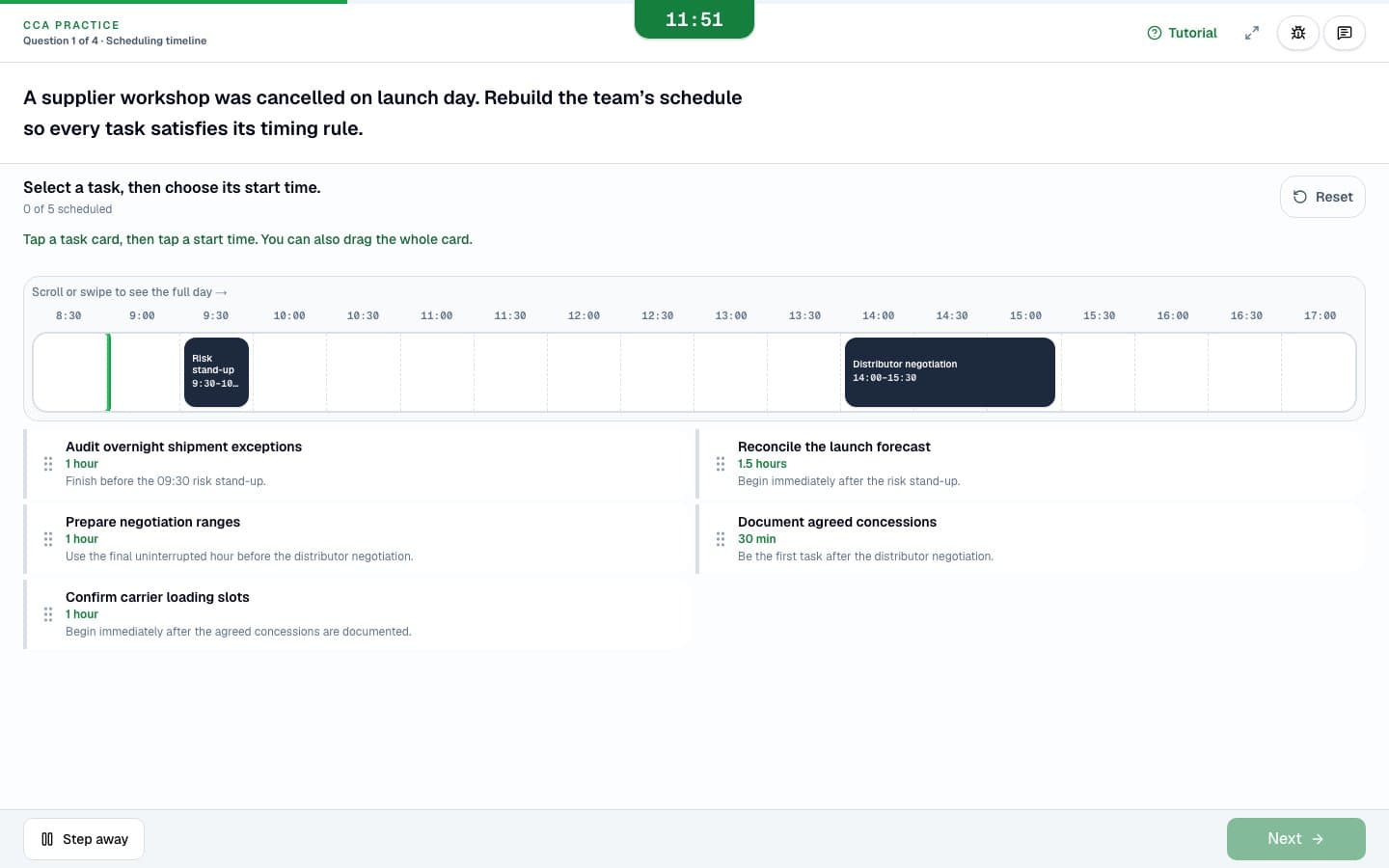
Rebuild a plan so every task satisfies its timing rule — the calendar and timeline formats the assessment uses.
Move a fixed budget of hours between activities under hard constraints, then read off the consequence.
Case-style arithmetic on shares, growth and unit rates — built as interactive charts, not multiple-choice trivia.
Trace sequences and allocation rules through interactive nodes, the reasoning shape behind the pattern items.
The BCG Consulting Career Assessment, or CCA, is an early recruiting assessment used in some BCG processes. BCG's public recruiting material describes it as a short, multidimensional assessment designed to surface potential beyond the application. The exact experience can vary by geography and cohort, and your invitation governs.
That distinction matters because third-party guides often present one vendor, one sequence, and one set of item counts as universal. The official BCG pages reviewed for this guide do not publish those details. Candidate reports are still useful for familiarization, but they should be labeled as reports, not converted into official facts.
Current BCG pages support three practical conclusions:
Public BCG material reviewed here does not establish a universal assessment vendor, item count, behavioral scoring model, camera rule, calculator rule, or section order. If your invitation includes an official practice link or system check, use that before any third-party resource.
This page covers the CCA. Third-party guides often use "BCG online assessment" loosely, and an invitation described that way can refer to the CCA, to the chatbot-style online case often called Casey, or in some processes to both. They reward different preparation, so confirm yours before you start:
Preparing for the wrong format wastes a limited completion window. Confirm the name first, then prepare.
BCG does not publish a section list or item counts. What follows is the structure consistently reported by candidates and by every major prep provider, which is the best available picture and is labelled as reported rather than official. Treat your invitation as the authority and expect variation by office and cohort.
Two things in that table are firmer than the rest. The 30-minute overall duration comes from BCG's own recruiting pages, cited at the end of this guide. The 8 questions in 12 minutes numerical block is the figure the named third-party prep pages in the sources below publish independently of each other.
Do not read that row as a description of Road to Offer's free diagnostic. Ours is also eight questions on one 12-minute clock, but it is four scored numerical questions plus four unscored work-style questions, because it practises both halves of the assessment in one sitting. The five additional timed numerical mocks behind full access are the surface that drills a numerical block at length.
The rest is softer. Nobody outside BCG publishes the scoring model, the number of dimensions behind the work-style sections, or whether the vendor is identical in every geography. A guide that states those confidently is guessing.
Candidates consistently report the CCA as an early screen, after the application and before live case rounds. Passing it is what moves you forward. It is not the case interview and it does not replace one.
That placement is the practical point: the CCA is worth preparing for because it gates everything after it, but it rewards timed numerical accuracy and a stable work-style reference frame, not case structuring. Preparing for it with case frameworks is preparing for the wrong stage. Once you clear it, the BCG case interview guide covers the live rounds and the BCG Casey page covers the online case.
No. Reports vary by office, programme and cohort. Some candidates receive the CCA, some receive the Casey online case, some receive both, and some receive neither. There is no public rule that predicts which you will get, so do not infer your process from someone else's Reddit thread. Your invitation is the only reliable signal, and it arrives with its own deadline.
If you have not received an invitation yet, preparing the transferable numerical skills below costs nothing and carries over to Casey and to live case math.
Across public candidate discussions, some North American candidates describe a numerical reasoning block alongside workplace-style choices. Ranking three plausible statements from most to least like you is a recurring report. Other accounts differ, which is why this guide does not promise that every CCA uses the same mechanic.
Candidate reports can help you avoid interface surprise. They cannot establish BCG's current scoring logic, hidden dimensions, or an ideal answer. A forced-choice screen also does not imply a simple personality score: the meaning of a response depends on the instrument and scoring model, neither of which BCG publishes for the CCA.
The transferable skills are straightforward: percentage change, ratios and rates, capacity or scheduling constraints, and chart or table reading. The highest-value sequence is learn, then time.
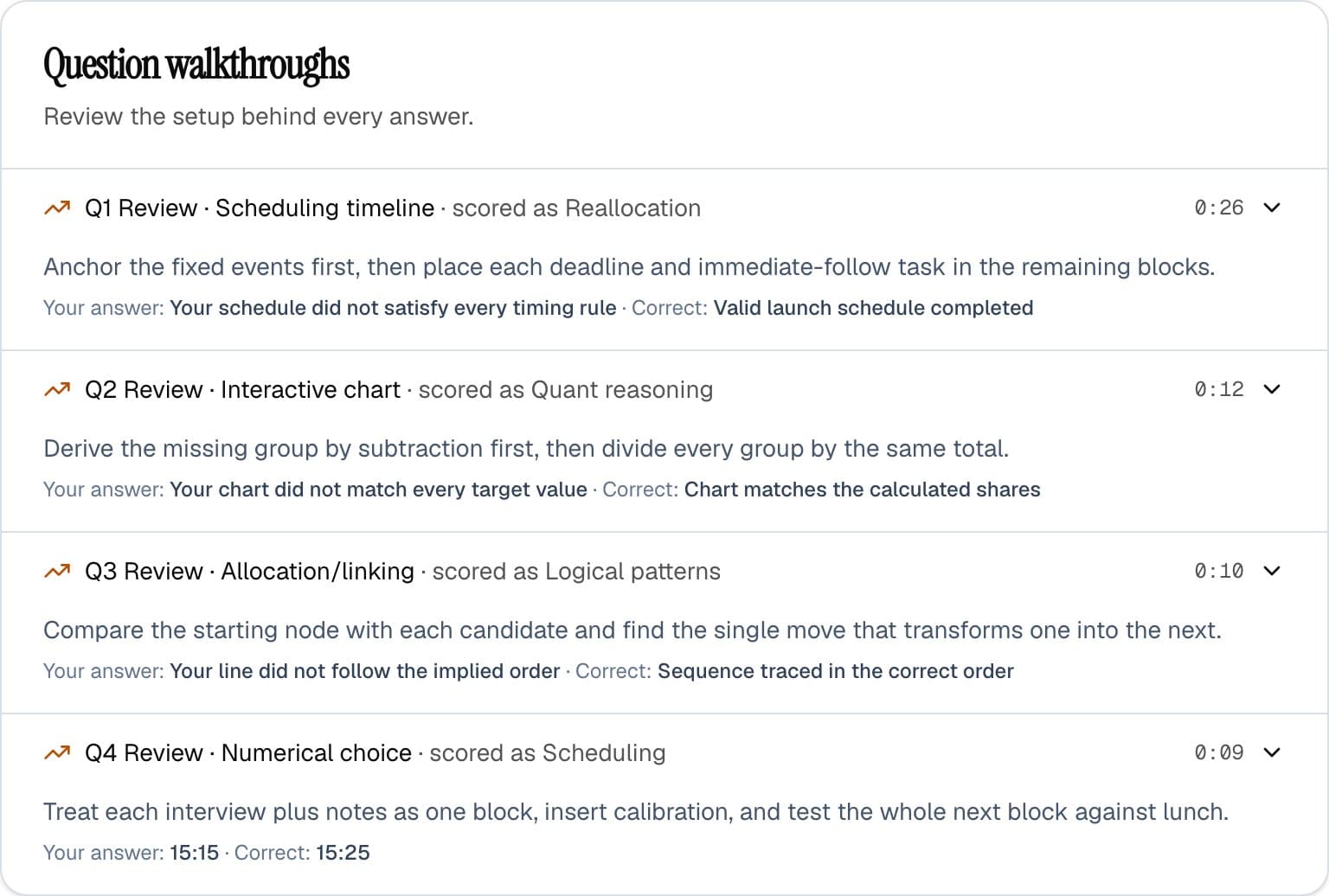
Road to Offer's free diagnostic is an original 8-question, 12-minute practice run with forward-only navigation: four scored numerical questions and four unscored work-style questions. The free result shows every outcome and a worked solution for all four numerical questions. The active bank covers four transferable families: scheduling, reallocation, quantitative reasoning, and logical patterns.
The signed-in learning path adds the full mock, focused family practice, and a deterministic next-family recommendation based only on numerical accuracy and time.
Reallocation is the family candidates most often lose time on, because the trap is setup rather than arithmetic. A representative question, original to Road to Offer:
Four analysts each spend 6 hours a week on manual reporting. A new tool removes 75% of that reporting work. The saved hours are redistributed equally across the four analysts for client analysis. How many hours a week does each analyst gain?
Write the relationship before touching a number:
18 and 4.5 are both correct numbers, and only one answers the question. The question asked per analyst, so 4.5 is the mark and 18 is the trap sitting one line above it in your own working. Under a shared 12-minute clock the arithmetic is rarely what costs you. Re-reading the final sentence before you answer is worth more than calculating faster.
Scheduling items look like logic puzzles and are usually arithmetic with a hidden addend. A representative question, original to Road to Offer:
A project room is free from 09:00 to 13:00. Three sessions must run inside it: discovery (90 minutes), synthesis (60 minutes), and a client readout (45 minutes). The readout runs last and must finish by 12:45. Synthesis cannot start until discovery has finished. A 15-minute reset is required between sessions. Does it fit, and what is the latest discovery can start?
Place the fixed points before the preferences, and work backwards from the hard deadline:
It fits, and it fits exactly. The latest discovery can start is 09:00, the moment the room opens, with zero slack. The 30 minutes of resets is the whole answer: drop it and the schedule appears to have half an hour spare, which is the single most common way this family is lost. Count the gaps, not just the blocks.
Pattern items reward translating each condition literally and then refusing to go past what the conditions actually support. A representative question, original to Road to Offer:
Four proposals, W, X, Y and Z, are each either approved or deferred, and each is either domestic or international. Exactly two are approved. Every international proposal is deferred. W and Y are domestic. X is international. Z is approved. What is determined about Z, and what is not determined about W and Y?
Translate each condition, then combine:
The mark here is knowing that step 4 is the answer rather than a failure to finish. Under time pressure the expensive mistake is picking one of W or Y because the question felt like it wanted a single name. Read the contrapositive, take what is forced, and stop.
Percentage items are usually one relationship written in one line, wrapped in a number that does not matter. A representative question, original to Road to Offer:
A regional team's revenue fell 20% in Q1, then rose 25% in Q2. Support costs were flat at 180,000 across both quarters. Q2 revenue was 900,000. What was revenue before the Q1 fall?
Write the relationship first:
Two traps sit in one short question. The support costs never enter the calculation: they are there to be carried through four lines of arithmetic that change nothing. And a 20% fall followed by a 25% rise reads like a net gain, when it is exactly break-even. Estimating the direction before calculating catches both.
Treat work-style familiarization as reflection, not answer coaching. Research on workplace forced-choice assessments shows why simplistic gaming advice is unreliable: several statements may all sound desirable, response formats differ, and the scoring model matters.
Use one stable reference frame: how you typically behaved in recent, comparable work situations. Read every statement before ranking. Choose the closest description of your usual behavior, not the most impressive sentence in isolation. Normal context differences do not prove inconsistency, and repeating a practice set is not a way to discover a hidden ideal profile.
Road to Offer's work-style module uses 91 original items across rank-three and self-rating formats so both interfaces feel familiar on test day. Its output is descriptive: it surfaces aggregate themes and neutral paired-context reflections from that practice session. Raw rankings and item IDs are not retained.
Rank-three blocks are the part candidates most often try to game, so it helps to see why the format resists it. A representative item, original to Road to Offer, in the two-step ranking shape candidates report and the Road to Offer runner reproduces:
Rank these three statements. Pick the one most like you, then the one most like you of the two that remain.
A. I rework a deliverable until the detail is right, even when the deadline is close. B. I keep a stakeholder informed even when there is no progress to report. C. I take on the part of a project nobody has claimed.
Notice what is missing: a wrong answer. All three describe behaviour a consulting firm can reasonably want, and that is the design. A rating scale lets a candidate agree with everything; forcing a full ranking of three removes that escape and makes the block measure which trait you will trade away, not whether you recognise a good trait.
That is why "pick the most consulting-sounding option" fails here. Every option sounds consulting-sounding. A candidate optimising block by block also drifts: A over B in one block and B over A in the next is the inconsistency these formats are built to surface.
The workable approach is the one this guide recommends throughout. Fix a reference frame before you start, your typical behaviour in recent comparable work, and answer every block against that same frame even when an option feels unflattering. Choosing D honestly is worth more than choosing C strategically.
Learn the four numerical setups without a timer. For every miss, label the cause as setup, units, exhibit read, arithmetic, or pacing. Run the free mock only after the methods are familiar enough to produce a meaningful baseline.
Practice the family with the lowest accuracy. When accuracy ties, use the slower average completion time as the tiebreaker. This is the same deterministic rule the Road to Offer progress loop uses; behavioral responses never influence numerical readiness.
If you are unsure which skill is weakest, run the free CCA-style numerical diagnostic at the top of this page first. Its report separates the four numerical families so you can practice the weakest one.
Complete a short rank-three preview once. Notice where context changes your instinct, then write down the reference frame you will use on assessment day. Do not memorize rankings or rehearse a supposed BCG answer key.
Run a fresh timed numerical set in one sitting, review each walkthrough, and practice the weakest family once more. Confirm the deadline, device requirements, accommodations, and support contact in your invitation. Then move your preparation toward the online case and live interview stages relevant to your process.
The CCA, the chatbot-style online case often called Casey, and live case interviews are different experiences. The CCA is an early assessment whose implementation varies. Casey-style online cases focus more directly on structured problem solving and recommendations. Live cases add a human interviewer and test how you communicate and adapt in real time.
Do not assume every candidate receives every step or receives them in the same order. Use the BCG Casey page for Casey-style preparation and the BCG case interview guide for live rounds.
No. The CCA assessment is BCG's own branded screen, and BCG does not publish which vendor builds it; nothing in the invitation flow presents it as an SHL product. SHL-style numerical, verbal, and inductive batteries do appear in some other firms' processes depending on country and role, which is why the two get conflated in searches: both sit at the same stage of the funnel, both lean on timed numerical reasoning, and many candidates face both formats in the same recruiting season. If your invitation names SHL, prepare with the SHL test guide for consulting instead; if it names the Consulting Career Assessment or links a BCG assessment portal, this page is the right preparation.
The overlap that does transfer: data interpretation from charts and tables, percentages and ratios under a clock, and not stalling on a single hard item. Candidates searching for the BCG test or the BCG online assessment usually mean either this screen or Casey; the BCG online assessments overview separates them.
If an instruction in your invitation conflicts with a third-party guide, including this one, follow the invitation.
A useful CCA practice test should expose the section, timing, answer format, and version caveat before the first question. CCA practice is not the same as Casey or a live case, so the candidate should confirm the invitation before relying on one simulation.
Use the CCA practice method: read the format contract, run the section under its stated constraint, log the error type, and repeat only the weak skill. The business implication is better diagnosis, not a promise that a practice score predicts selection.
The names that come up most for the BCG Consulting Career Assessment are Road to Offer, CaseBasix, Prepmatter, SHL, StrategyCase, and Management Consulted. Here is how they compare on what each provider publicly shows before purchase.
Different candidates weight the same simulator differently, so the honest answer is "best for what":
A useful CCA simulator trains the reasoning the numerical block rewards, under a shared clock:
Choose on evidence, not on the number of marketing claims:
If you only do one thing before your invitation arrives, run a timed numerical mock and compare the experience with the rules in your invitation.
Reported-structure table: the section counts in the format table above (about 76 prompts in the first work-style block, eight numerical questions in 12 minutes, and about 15 further prompts in the second) are not published by BCG. They are the figures that independent third-party prep pages state publicly, including CaseBasix's BCG CCA guide and Prepmatter's BCG CCA pages, both checked 2026-08-25, and they match what candidates describe. They are presented as reported for that reason and are deliberately not hyperlinked here. Your invitation overrides all of it.
Candidate discussions and third-party prep pages informed the reported-structure table and the recurring interface reports above. They are not authority for BCG's official current structure, scoring model, or vendor, none of which BCG publishes. Simulator comparison checked July 2026.
BCG, Casey, and CCA are trademarks of Boston Consulting Group; SHL is a trademark of SHL Group. Road to Offer is not affiliated with or endorsed by BCG or SHL. All practice questions are original.
The diagnostic is free. Lifetime CCA access adds six timed numerical mocks, focused practice per family, worked walkthroughs, progress history and 91 work-style familiarization items.
$69one-time, lifetime access
Also included in the 90-Day Sprint and Annual plans.
One free diagnostic, timed and scored like a real sitting. No credit card.
Independent CCA-style simulator, not affiliated with or endorsed by BCG.
BCG describes the CCA as a short, multidimensional online assessment intended to show potential beyond the application. Details can vary by office and cohort, so follow your invitation.
No. BCG uses different online assessment experiences across recruiting processes. The CCA and the chatbot-style online case commonly called Casey are distinct; your invitation tells you which assessment you have.
BCG's public pages do not publish one universal section or item blueprint. Candidate accounts describe numerical reasoning and work-style choices in some cohorts, but counts and mechanics vary and are not an official contract.
Current US Associate recruiting material says the CCA is normally completed within 48 hours of invitation. Other cohorts may differ, so use the deadline and time zone in your own email.
Practice percentages, rates, ratios, scheduling constraints, and chart reading. Learn each setup without a clock first, then rehearse forward-only decisions under a shared time budget.
Yes. Get comfortable with the trade-off and ranking interface so it is not new on test day, and choose a stable reference frame such as your typical recent behavior at work. Read every statement before ranking and pick the closest description of how you actually work.
General aptitude tests can help with timed reasoning, but they may not match the provider or rules in your invitation. Use the provider named in your invitation for platform-specific familiarity; Road to Offer separately provides an original shared-clock numerical and behavioral diagnostic.
Yes. Road to Offer lets you try two CCA-style numerical questions with no account, then resume at Question 3 and complete a free 4-numerical, 4-behavioral diagnostic after a no-card signup.
BCG publicly describes the CCA as a short, multidimensional assessment but does not publish one universal numerical blueprint. Candidate reports mention numerical reasoning in some cohorts. This simulator provides original practice across four transferable families.
Road to Offer's canonical mock uses one 12-minute countdown for eight original questions and forward-only navigation, so you rehearse the shared-budget pacing the CCA rewards before test day.
It is independent practice, not the official assessment: 8 original questions on one 12-minute clock with forward-only navigation. The free report shows every outcome and the worked solution to all four numerical questions; full access adds timed mocks and family practice.
Road to Offer offers a free original 8-question, 12-minute diagnostic with four scored numerical questions, four unscored behavioral questions, every numerical outcome, and a worked solution for all four numerical questions. A one-time $69 option adds five more timed numerical mocks, focused family practice, and unscored work-style familiarization.
Two preview questions require no account, the full 8-question diagnostic is free after signup, and the complete Road to Offer CCA pack is a one-time $69 purchase. Sprint and Annual plans also include CCA access. Check other providers' current pages before comparing price or inventory.