
Consulting Resume: The Guide + Free AI Review (2026)
Build a consulting resume with official templates, a metrics-first bullet formula, before-and-after examples, ATS vs human-screen reality, and a free AI review.
Free consulting resume review
See how your consulting resume holds up
Get the score, evidence-based strengths, and priority fixes before recruiters scan it.
By uploading, you agree to resume analysis and report storage until you delete it. See the privacy policy.
On this page
A consulting resume in 2026 has one job: earn a first-round interview from a fast human screen, not an automated keyword filter. Ladders' 2018 eye-tracking study found recruiters spend an average of 7.4 seconds on the first pass of a resume, so a consulting resume (or consultant resume) has to make ownership, quantified impact, and consulting-relevant judgment visible in a single glance. At McKinsey, BCG, and Bain a real person reads the page, which is why generic keyword-stuffing backfires: it crowds out the evidence a screener is actually scanning for. The fastest path is to start from a real career-center template, rewrite every bullet with Outcome + Measure + Mechanism, then grade the finished page for bullet impact, consulting relevance, quantification, and formatting clarity before a recruiter ever sees it. This guide gives you the structure, the metrics-first bullet formula with before-and-after examples, and a free AI review.
Grade your consulting resume before a recruiter does
Upload your draft and get a free consulting-specific AI review: an overall score, bullet-impact and quantification feedback, and the priority fixes to make first.
Do not start from a made-up internet template if your school or a trusted career center already gives you a reusable file. Use the sources below directly, then adapt the order and bullets for consulting.
Real templates you can use
These links are the template layer. Road to Offer should not replace them with a parallel document. The job of this page is to help you choose the right source, then make the content consulting-specific.
How to choose among templates
Pick one source template and keep it. Most messy consulting resumes are not messy because the candidate picked the wrong school template. They are messy because the candidate blended three formats, changed spacing by hand, and tried to make every experience look equally important.
Use this decision rule:
Once you choose the source, make only four changes: put the strongest section first, tighten line spacing enough to fit one page, remove sections that do not help the target role, and rewrite bullets for impact. Do not add graphics, rating bars, headshots, icons, or columns just because another resume online looks more designed. Consulting screeners reward clarity.
The source template gives you permission to stop designing. Spend the remaining time on evidence quality.
Once the score gives you a correction order, save the target firms, deadlines, contacts, and follow-ups in the consulting application tracker. This keeps the resume iteration attached to a real application instead of creating another isolated document.
What should a consulting resume include?
A consulting resume should include a clear header, relevant education, impact-led experience, selective leadership, and concise skills. The exact order depends on candidate stage, but every section should help a reviewer understand your evidence quickly.
Use this order unless your career center template gives a stronger field-specific reason to change it:
If your application also needs a letter, pair this page with the consulting cover letter guide. If you are targeting a referral before applying, use the consulting networking guide before submitting. Once your resume is ready, also consider your broader application channel strategy, since LinkedIn versus resume application strategy affects which roles you realistically reach at each firm.
Does a consulting resume go through an ATS or a human screen?
At MBB and most Tier 2 strategy firms, a real recruiter reads your resume: it is a human screen, not a pure applicant-tracking-system (ATS) keyword filter. This matters because the advice written for corporate ATS pipelines (stuff the job-description keywords, mirror the posting language, optimize for a parser) actively hurts a consulting resume. The screener is not counting keyword matches; they are looking for evidence of structured problem solving in seconds. If you want to see how your draft reads to both a parser and a human before you submit, upload it to the free consulting resume grader. It is a public page, so you can read the score, the bullet-impact notes, and the formatting flags on your current draft first, and it checks the same scanability a screener reacts to in the seconds they give you.
Even where a portal parses your file first, the format that survives an ATS (standard headings, no text boxes, no columns, PDF) is the same format a human screener prefers. So you never have to choose between the two. Write for the human, keep the format machine-readable, and stop treating case-interview vocabulary as ATS keywords: naming "MECE" or "hypothesis-driven" on the page does not help a screen and often reads as filler.
Check that your format survives both the parser and the human
Upload your draft for a free consulting-specific AI review of formatting clarity, bullet impact, and quantification, so the version a screener reads is clean on the first pass.
What are the common kill-signals on a consulting resume?
A kill-signal is a single line that makes a fast screener stop reading. Consulting screens are selective, so one clear tell can end the review before your best bullet is seen.
If a line trips one of these, fix it or remove it before you grade the page.
How are consulting resume bullets scored?
Strong consulting bullets make ownership, analytical judgment, measurable impact, and communication easy to see. The rubric below is an editorial practice tool, not a claim that every firm uses one identical scorecard.
The fastest upgrade is rewriting every bullet from "what I did" to "what changed because I did it." A strong consulting resume bullet has three parts:
A weak outcome says "worked on customer retention." A stronger one says "reduced churn in the highest-risk customer segment." A weak measure says "improved reporting speed." A stronger one says "cut weekly reporting time from eight hours to three." A weak mechanism says "helped with analysis." A stronger one names the tool, model, stakeholder process, or decision rhythm you changed.
Consulting resume example: before vs after
Before:
Supported pricing analysis for a retail client and worked with senior stakeholders.
After:
Identified two underpriced product groups by comparing margin, basket size, and competitor pricing, giving the commercial team a clear price-change list for the next quarterly review.
Quiz
Which revision best turns a responsibility into consulting evidence?
Before:
Managed club sponsorship outreach and coordinated events.
After:
Secured five new sponsors for the consulting club by rebuilding the alumni outreach list, creating a tiered sponsorship offer, and assigning weekly follow-ups to a six-person team.
Numbers help, but the number is not the whole point. The screen is asking whether you can define a problem, take ownership, and make the result visible.
When a number is confidential, use a safe proxy. You can say "largest customer segment," "regional leadership team," "two-week reporting cycle," or "executive review process" without disclosing private data. When a result is qualitative, make the change observable: a recommendation adopted, a process reused, a stakeholder decision made, a team unblocked, or a deadline protected.
NDA-safe before:
Supported a confidential client transformation and prepared analysis for senior stakeholders.
NDA-safe after:
Identified two process bottlenecks in a confidential operations program and built the decision pack leaders used to prioritize the first implementation wave.
The rewrite protects the client name and private economics while preserving your problem, action, and decision impact. Do not anonymize by inventing a sector, result, or number.
Weak bullets usually fail in one of three ways:
If a bullet cannot pass one of those fixes, cut it. A one-page consulting resume has no space for neutral evidence.
The skill underneath a strong bullet is the same one a case interview scores: state the answer first, then the evidence that supports it. Take one rep on it now, graded, before you rewrite the rest of the page.
Lead with the result, then the proof from the Road to Offer drill engine. Answer a real prompt and get AI-scored feedback. Free accounts include 3 drills per day for the first 3 days after signup.
What does the Road to Offer resume grader check?
The free AI review reads your uploaded resume against the same standard this guide teaches, so the report tells you exactly which of these to fix first instead of leaving you to self-grade. The resume grader is a public page: you upload the draft and read the report before creating anything. It checks the four things a human screener reacts to in the first pass:
It then returns an overall score, evidence-based strengths, the highest-priority fixes in order, and the interview risks a line might create. Use it as a private second pass after you have applied the bullet formula, not as a substitute for writing the evidence yourself.
Adapt the bullets to your candidate type
The same clarity standard applies to everyone, but the proof you lead with should match your background. Use the pattern that fits you, then verify each claim with the question in the last column. If you cannot answer the question honestly, the bullet is not ready.
Undergraduates do not need famous internships. A campus consulting project counts if it shows structure. If you are technical, keep technical detail only where it proves analysis, communication, or business impact, and cut the rest.
Current consultants and lateral applicants need a different emphasis. An incumbent consultant should show progression, workstream ownership, client decisions, and implementation impact without exposing confidential information. A lateral candidate should also clarify why the target role is a step toward deeper sector, functional, geographic, or leadership scope rather than presenting a vague prestige move.
If the resume supports an exit from consulting, translate client delivery into the destination's language. A strategy role needs decisions and market judgment; an operations role needs implementation and operating results; a product role needs customer, prioritization, and launch evidence. The same project can support different exits, but the selected evidence should change.
How should a current management consultant write the resume?
A current management consultant should lead with progression and selected engagements, not a client list. Choose two to four projects that prove different kinds of ownership, keep every client anonymous unless disclosure is public and permitted, and make the decision or implementation impact visible.
For confidential metrics, use honest scale markers such as business-unit size, number of markets, team size, or decision cadence. Never replace a protected number with invented precision. A private-equity or corporate-strategy exit may prioritize diligence and market judgment; an operator role may prioritize implementation, recurring ownership, and measurable operating change.
Five specifics separate a strong experienced-hire resume from a senior corporate one.
Aim at the right entry level before you write a line. Firms band experienced hires by years of experience, and applying a level too high reads as mis-calibration. Bain's experienced-professionals recruiting page puts candidates with "1-4 years' work experience" at Associate Consultant and "5+ years' work experience" at Consultant. Check the live posting for your office, then write the resume for that level's scope of ownership.
Check what else the application wants. The same Bain page states that candidates submit "a cover letter and my academic transcripts as part of the application process", so experienced-hire paths are not always resume-only. Draft the letter alongside the resume with the consulting cover letter guide rather than writing it the night of the deadline.
End each bullet on a decision, not on the analysis. Firms recruit experienced professionals to walk in and advise decision-makers immediately: BCG describes the work as "Spotting trends. Advising senior leaders." on its experienced-professionals page. A bullet that stops at the model you built stops one step short of the screen.
Show a track record, not a tour. BCG says it looks for people with "proven success, deep expertise, and a passion for creating change", which is why two or three engagements described in depth beat a client logo list.
One-page discipline does not relax with seniority. The fast first-pass screen (roughly 7.4 seconds on the initial scan) is the same whether you have two years of experience or fifteen, so a longer career means harder prioritization, not more pages. If you carry an advanced degree, build from materials made for that level rather than an undergraduate template: MIT keeps separate sample libraries for master's, PhD, postdoc, and alumni candidates, which translate research and technical depth into business-facing evidence instead of a publications list. For the interview that follows, PhD candidates and MBA candidates prepare from different starting points too.
Write the firm-specific version against the firm's own resume page, whether that is McKinsey, BCG, or Bain. The same treatment exists for Oliver Wyman, Kearney, EY-Parthenon, and PwC applicants.
How should you tailor the resume for MBB?
Do not create three unrelated resumes or pretend each firm publishes a secret resume rubric. Keep one evidence-backed core document, then adjust the top bullets and leadership examples against the live role, official firm language, and evidence from current conversations. The emphases below are tailoring prompts, not universal firm scorecards.
The firm name should change the ordering and vocabulary of real evidence, not cause you to invent three personalities. Keep every bullet defensible under follow-up questions.
Track the role, tailoring decision, referral context, and submission deadline in the consulting application tracker. Then use the behavioral interview simulator to check whether the resume also contains defensible interview stories.
For interview preparation after the screen, use the McKinsey case interview guide, BCG case interview guide, and Bain case interview guide. Your resume should already hint at the stories you will later use in behavioral interviews.
Resume checklist before submitting
Use this final pass against the career-center template you chose:
The defensibility check matters more than it looks. Your resume can become the start of a live interview, so read it like a skeptical interviewer. If a line would feel uncomfortable to discuss under probing, rewrite it or remove it. A copied or exaggerated bullet is risky precisely because the interviewer can test it.
The easiest cut is anything that only says you participated. Consulting screeners reward ownership. Replace memberships, duty lists, and broad skill claims with fewer proof points that show judgment.
Read the page backward before sending. Start with the final section and ask whether every line would still matter if the recruiter only had a minute. This catches the common problem where education and recent experience are strong, but older activities remain vague because they were added years ago and never rewritten.
Then do one firm-specific pass. For McKinsey, underline the bullets that show personal impact. For BCG, underline the bullets that show problem framing or intellectual range. For Bain, underline the bullets that show team results. If the target firm has no obvious underlined evidence, the resume may be clean but not targeted.
Finally, compare the resume against the cover letter. The documents should tell the same story at different levels of detail. The resume proves the facts. The letter explains why those facts point to consulting and to the specific firm.
Run the final page through a free AI review
Before you submit, upload the tailored resume for a free consulting-specific score, strengths, and priority fixes, so the version a recruiter reads is the strongest one you have.
Can the claims on your resume survive the interview?
A strong resume creates follow-up questions. Before submitting, pick the analytical bullet you are proudest of and explain the problem, structure, calculation, decision, and result without adding facts that are absent from the page. Then pick one leadership bullet and turn it into a complete behavioral story.
The leadership half is the one candidates underprepare. A bullet gives you a sentence; an interviewer wants the situation, your specific decision, the resistance you met, and what changed. The STAR method for consulting interviews is the structure that holds up under probing, and leadership story examples show what a defensible version sounds like. If you want the method taught before you rehearse it, start with the lesson.
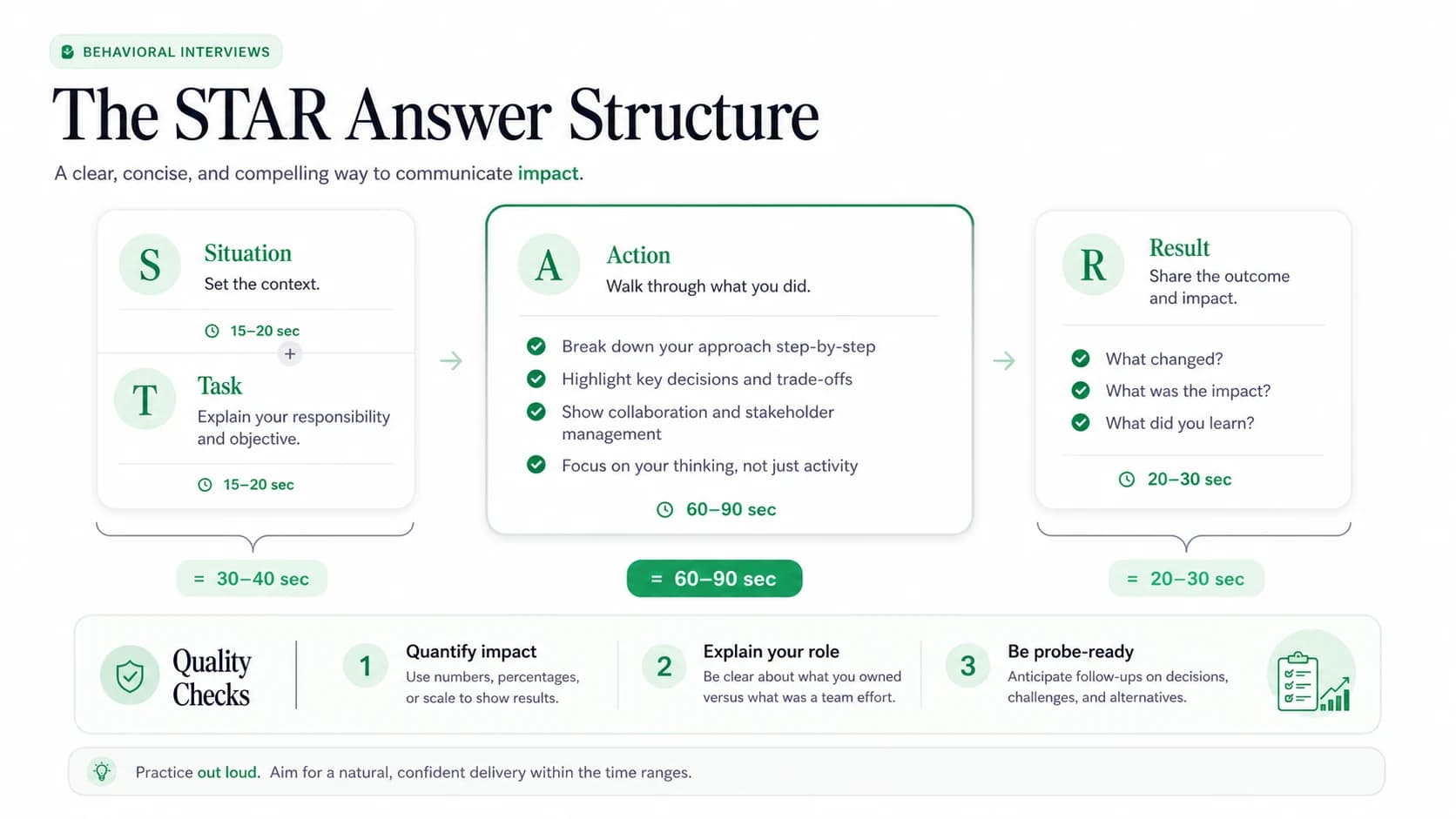
Learn the behavioral method
STAR that survives probing, linked to the live AI interviewer.
The analytical half is faster to test. Take the bullet you are proudest of and build the structure you would use if an interviewer turned it into a case prompt, then get it scored.
Structure the problem behind your strongest bullet from the Road to Offer drill engine. Answer a real prompt and get AI-scored feedback. Free accounts include 3 drills per day for the first 3 days after signup.
When that short drill feels natural, carry the same evidence into a free full case rehearsal. The goal is not another card on the page. It is proving that the analysis and communication promised by the resume still hold up live.
Sources and Further Reading (checked 2026-07-20)
- Penn Career Services, undergraduate resume templates: Penn resume templates
- Penn Career Services, undergraduate student resume samples including a sample consulting resume: Penn undergraduate samples
- Yale Office of Career Strategy, resume templates: Yale resume templates
- Harvard Mignone Center for Career Success, Harvard College resumes and cover letter guide: Harvard resume and cover-letter guide
- MIT Career Advising and Professional Development, sample resumes and cover letters: MIT resume and cover-letter samples
- Ladders Inc., 2018 eye-tracking study reporting a 7.4-second average initial resume screen: Ladders eye-tracking study
- BCG Careers, experienced professionals: what the firm looks for and what the role involves: BCG experienced professionals (checked July 24, 2026)
- Bain and Company, experienced-professionals recruiting page giving entry level by years of experience and the required application materials: Bain experienced professionals (checked July 24, 2026)
Frequently asked questions
Resources and related guides
- Free consulting resume graderPractice
- Browse all free resourcesResource hub
- 5 Consulting Cover Letter Examples + Format and Free Review (2026)Getting Started · Jun 12, 2026
- MBB Resume Template: McKinsey, BCG and Bain Format (2026)Getting Started · Jun 4, 2026
- Case Interview Questions by Stage (With Worked Solutions)Getting Started · Feb 6, 2026
- Consulting Resume Keywords: 87 Keywords and Action Words by Signal (2026)Getting Started · Jun 3, 2026