


Sustainable Futures Lab
New 2026
Save $20$49
$29one-time
- Eleven SFL simulations
- Thirteen linked decisions per run
- Scored debrief on every decision
Practice
Learn
Assessments
Road to Offer is independent and not affiliated with or endorsed by McKinsey. This is original practice content built from publicly available information about the assessment format, not a copy of the live assessment. Formats change between offices and recruiting cycles.
New to the Sustainable Futures Lab? Read the complete SFL guide below and the full McKinsey Solve guide.
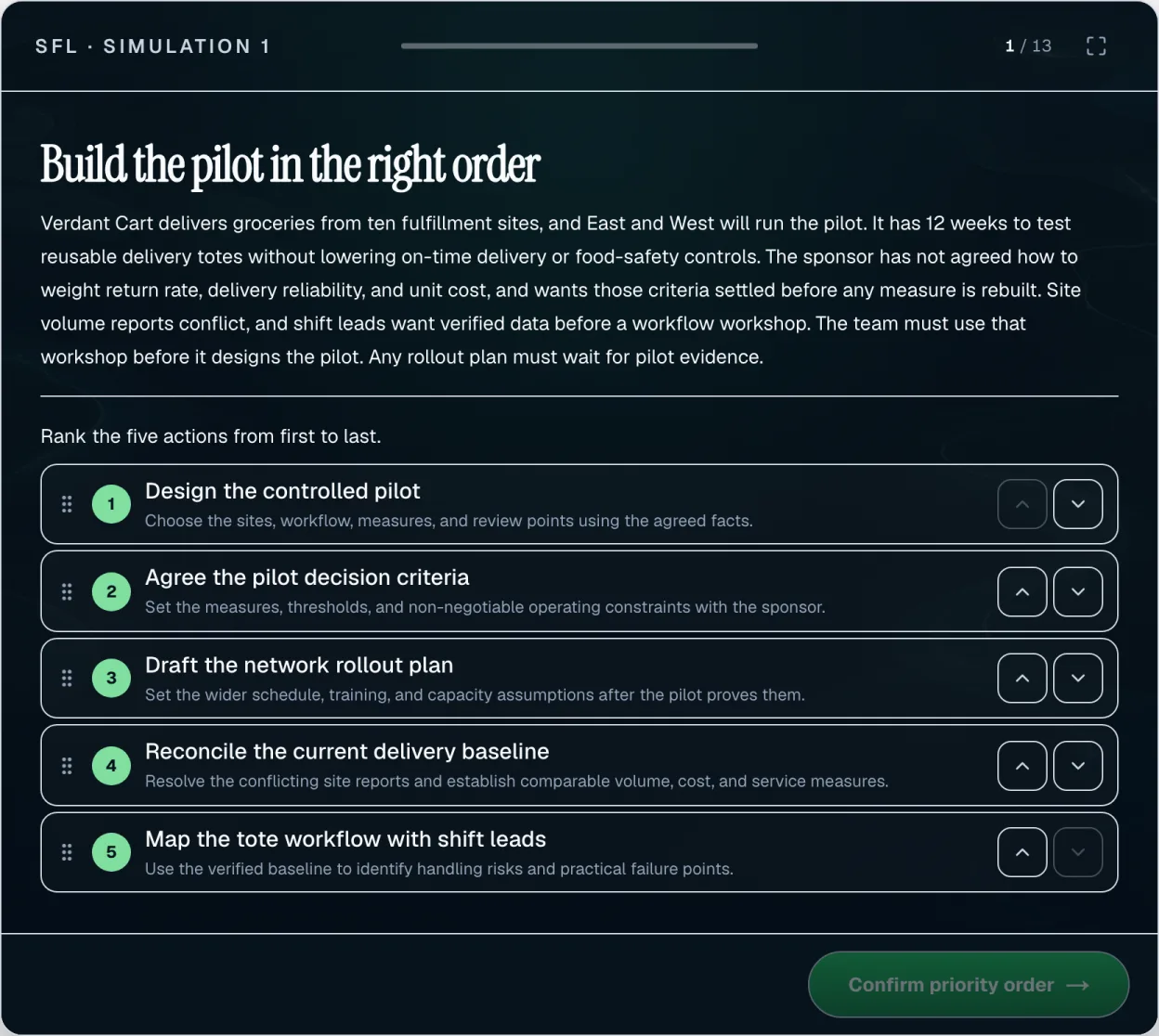
One full simulation: 13 linked decisions on one project that you design, repair and then scale, with every decision reviewed when you finish. The company, facts and options are original Road to Offer content.
| Free | One full Sustainable Futures Lab simulation (Verdant Cart: a reusable delivery-tote pilot). Your free run shows your score; the full worked review opens with a one-time unlock or a plan. Additional simulations are in paid packs. |
|---|---|
| Decisions | 13 linked decisions. The project unfolds through them in order, and you have to keep your reasoning consistent from the first to the last. |
| Decision types | Mostly single-choice judgment calls under stated criteria, plus ordering tasks such as ranking five pilot actions from first to last. |
| Clock | Learning mode is untimed, with feedback after each decision. Simulation mode runs start to finish with feedback at the end. |
| Skills scored | Each decision counts toward prioritization, problem solving, adaptability, collaboration or stakeholder judgment. |
| Your result | Where your points went by skill, then every decision with your answer, the evidence that mattered and the rule to reuse next time. A practice percentile appears once enough runs of the same simulation exist. |
| Library | Eleven SFL simulations, from a foundation scenario to integrated capstones where each run adds a harder chain of decisions. |
The quick version: Sustainable Futures Lab is the judgment and prioritization game candidates report as the third McKinsey Solve module: about 20 minutes in 85-minute invitations, and a newer, roughly 30-minute team-management version reported in 95-minute invitations since late August 2026. McKinsey has not published either format, so this simulation practices the underlying skills rather than replicating a live module.
Eleven simulations, $29 once. Simulation 1 is free.
Simulation 1 runs free, score only; the rest open with the game.
Rank the actions, then commit to one course of action each time.
Your answer beside the worked one, then three runs to fix it.
Finish 5 of 10 Sea Wolf and 5 of 10 Red Rock simulations first.
A sound choice can fail when the next fact changes the constraint. This simulation asks you to hold one business objective across a connected pilot, update your view when evidence changes, and separate a reversible test from a premature scale decision. Those habits transfer directly to case interviews: define the decision rule, use the evidence in front of you, and revise the plan without losing the objective.
Start free in Simulation mode, then enter the Verdant Cart reusable-tote pilot. Decision 1 is a five-option ranking. The next 12 decisions ask what you would do as costs, operations, partner constraints, results, and the final board message change. Paid Learning mode shows feedback after each decision and lets you retry a missed decision. The free first decision includes its result and explanation before signup. Later Simulation decisions have no step-by-step coaching; your score appears at the end, with the full worked review available through a debrief unlock or matching plan. If you start signed out, Decision 1 is saved before a signup checkpoint; after signup, the same attempt resumes at Decision 2. Your final server-scored result is saved in History. One complete simulation is free; additional simulations are available in paid packs.
These patterns teach the method without revealing any answer from the simulation.
Resolve the definition and source before making the decision. A fast recommendation built on incompatible baselines only hides the uncertainty.
Align the measurement rule first, then compare the evidence.
Find the source of the variation before treating the average as the whole story. A site-level failure can point to an operational fix or prove that the model does not travel.
Diagnose the outlier before you make the scale decision.
State what the current evidence supports, name the open assumption, and define the next check that can change the decision.
Give a bounded recommendation with a clear condition for revision.
Each mistake replaces the decision rule with a shortcut.
The Sustainable Futures Lab (SFL) is the judgment and prioritization game that candidates report as the third module of McKinsey Solve, after Red Rock and Sea Wolf. There is no calculator and no data exhibit: you rank actions, then make linked decisions about a sustainability project, its team and its stakeholders. In 2026 there are two reported versions. Candidates with an 85-minute invitation describe a 20-minute SFL of about 13 decisions. Since late August 2026, some candidates with a 95-minute invitation describe a new, roughly 30-minute SFL in which you lead a team of four researchers over three simulated days. McKinsey has published neither format, so everything below is labelled by how we know it, checked October 2, 2026.
Read the total time in your invitation email. McKinsey's Solve FAQ says the length of your assessment is in that email and that each task starts with an untimed tutorial. Candidate and prep-provider reports then map the length to the games like this:
Three facts matter more than the map itself.
If your email says 65 minutes, you will not sit SFL, so spend your time on Red Rock and Sea Wolf. If it says 85, practise the standard SFL below. If it says 95, read the new-version section and still practise the standard one: the judgment it trains is the same.
85- or 95-minute invite? Run one full SFL free
13 linked decisions on one project, starting with the ranking task, then a review of every decision.
The skills overlap more than the screens do. Both versions reward setting a clear objective first, spending scarce attention on the facts that change the decision, updating when new evidence lands, and keeping people on side without giving up the plan.
Most confident SFL content online blurs these categories. Keep them apart.
Prep-provider write-ups agree on the shape: a short project brief, then one ranking question, then about a dozen scenario questions that follow the same project from kickoff to recommendation. Each option is a full sentence describing a course of action, and later questions build on what happened earlier, so the run reads as one story rather than 13 quizzes.
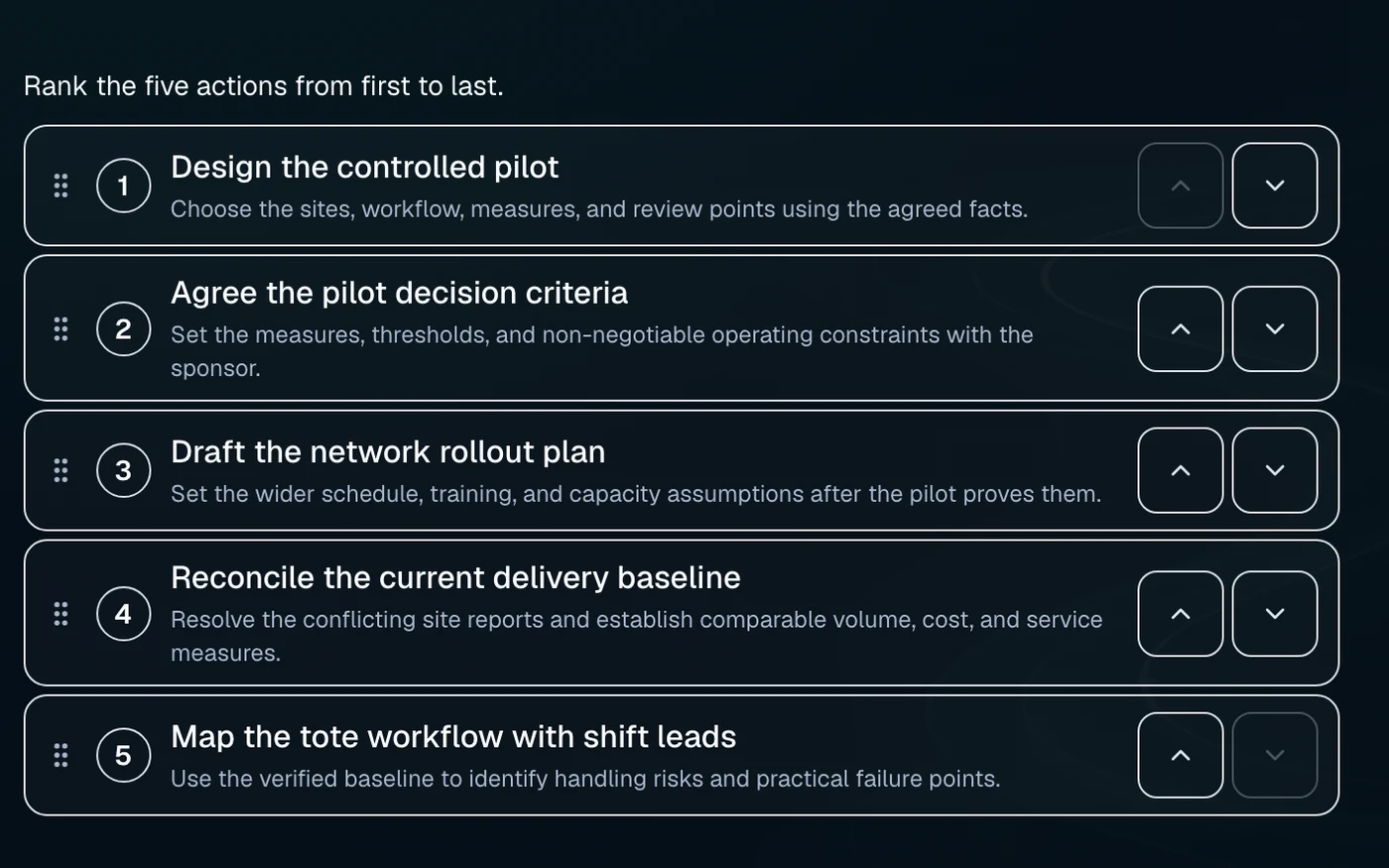
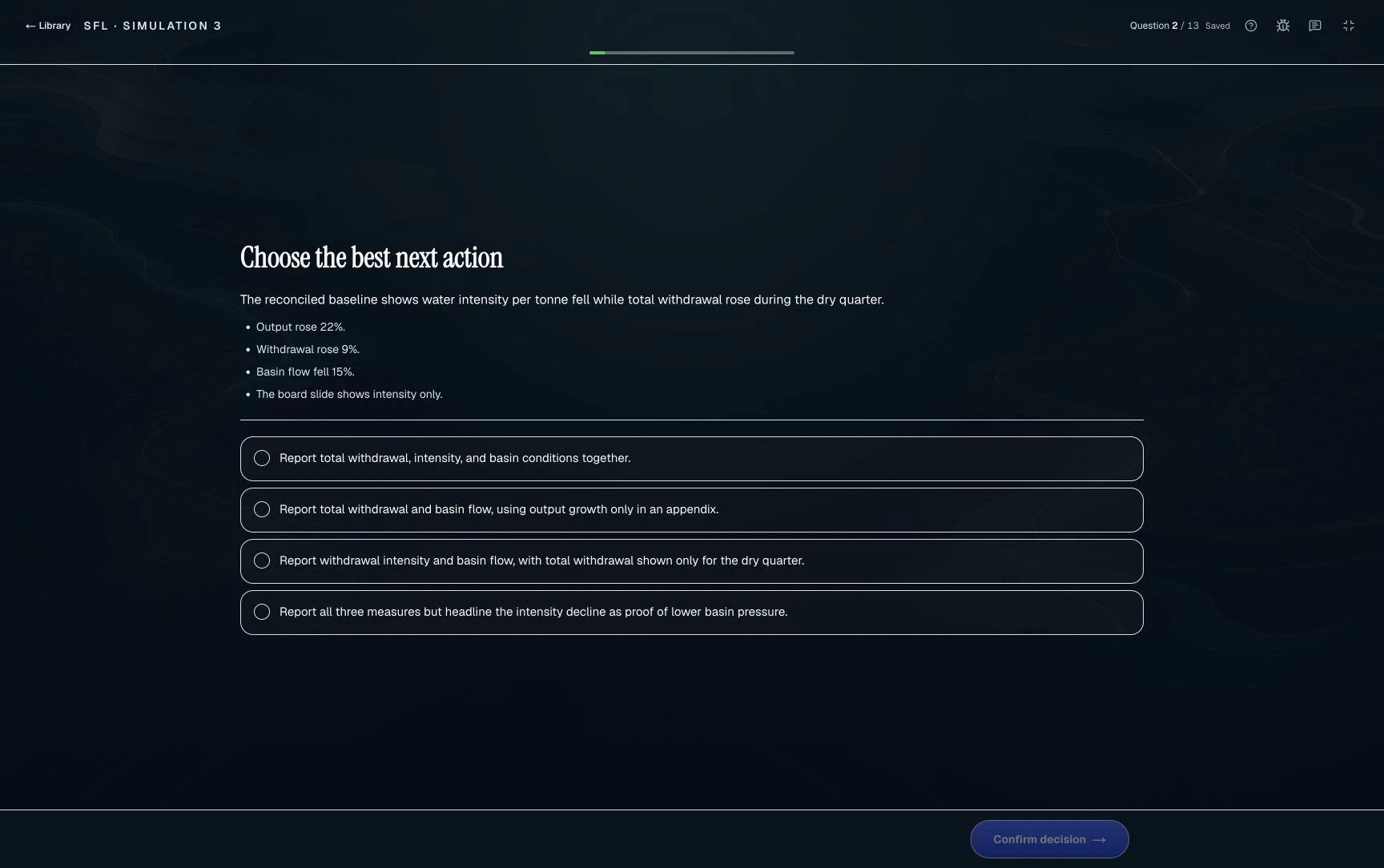
Road to Offer's free SFL simulation follows this standard format: 13 linked decisions on one project, starting with a ranking task, with every decision reviewed when you finish. It is original practice, not a copy of the live module.
This is the version candidates describe in 95-minute invitations. The step-by-step detail below comes from prep providers who reconstructed it from candidate reports (PrepMatter, which says it sat the redesigned assessment in September 2026, and Solve Games Guide); McKinsey has not confirmed any of it.
You lead a field research lab with four researchers who have different specialisms and four workstations that need staffing. After a tutorial and onboarding, the game runs three project days, and each day opens with a goal: reports describe Day 1 centred on the researchers' needs, Day 2 on the workstations' needs, and Day 3 on balancing both. Each day repeats four stages.
Reports agree the instructions are text only, with no calculator or exhibits, and that answers are recorded in a notes panel you can scroll back through. The scarce information requests are the main difference in feel: in the standard version every fact is on screen, while here you choose which facts to buy.
How Road to Offer covers it: a practice simulation for the 30-minute version is coming soon. Until then, the standard SFL simulation trains the habits both versions reward: set the objective first, spend attention on decision-changing facts, and handle people without abandoning the plan. If you have a 95-minute invitation, also rehearse the explore discipline on paper: before each day, write the one question per researcher that would change where you place them, and ask nothing else.
Strip away the sustainability framing and SFL is testing three things.
The first is whether you can apply a stated decision rule. A prioritization item hands you explicit criteria and then offers an option that feels important but scores poorly against them. Candidates who rank on instinct lose points to candidates who compute the criteria first.
The second is whether you treat constraints as constraints. When one initiative cannot begin until another is delivered, or a researcher cannot work a station without the right skill, that dependency is a hard rule, not a tie-breaker.
The third is whether you can handle disagreement without either capitulating or stalling. A stakeholder or researcher objects and offers no new data. Reordering to keep the peace makes the process arbitrary; going quiet lets the problem grow. The stronger move is to acknowledge the concern, show the evidence and create a concrete route forward. It is the same disposition McKinsey probes in the Personal Experience Interview.
Compute the criterion the prompt names, apply tie-breakers only to ties, then enforce dependencies.
Here is the method on an original example. A town ranks five flood initiatives by residents protected per $1M, and the volunteer alert network cannot run without the warning app.
Final order
The levee protects the most residents in total but ranks fourth: 18,000 residents for $3.6M is 5,000 per $1M.
Use three moves: acknowledge, evidence, action.
The weak extremes are capitulation and delay. In the new version the same rule applies to your researchers: a dilemma answered by doing whatever the researcher asks, or by ignoring them, both cost you. Answer the actual problem and keep the day's goal visible.
When reviewing a mistake, name the trap and rewrite the decision using the prompt's actual rule. That transfers better than memorizing which option was correct in one scenario.
Practise under the time your own invitation states, keep the decision rule visible, and follow the live tutorial over any guide, this one included.
In every reported invitation that includes SFL, you also sit Red Rock and Sea Wolf, and you switch methods between them. Sea Wolf is constraint satisfaction: filter microbes against disqualifying rules, then build a set whose averages meet every threshold. Red Rock is exhibit reading and calculation, where the traps are units, fixed costs and irrelevant-but-true facts. SFL has the least computation and the most instinct-versus-criteria conflict.
The Red Rock study guide goes phase by phase, and the umbrella McKinsey Solve guide covers how the assessment sits in McKinsey's process. All six firm assessment simulations Road to Offer publishes are on the assessment simulators page, and the McKinsey case interview guide covers the live rounds Solve is a gate for.
McKinsey and Solve are trademarks of McKinsey & Company. Road to Offer is independent and is not endorsed by McKinsey. Sources checked October 2, 2026: McKinsey's Solve FAQ (August 2025), PrepLounge thread 25242 (August 24 to September 11, 2026), and prep-provider reconstructions from Solve Games Guide, SolvePrep and PrepMatter, which we treat as reports rather than authority.

Turn your result into one focused practice rep: the decision you missed, worked through, and the next run that fixes it.