
BCG CCA Numerical Simulator
Free simulatorStart free, then continue the same 8-question numerical mock after signup.
 Free simulator
8-question CCA numerical mock
- 8 original numerical questions
- One shared 12-minute clock
- Forward-only, with a worked debrief
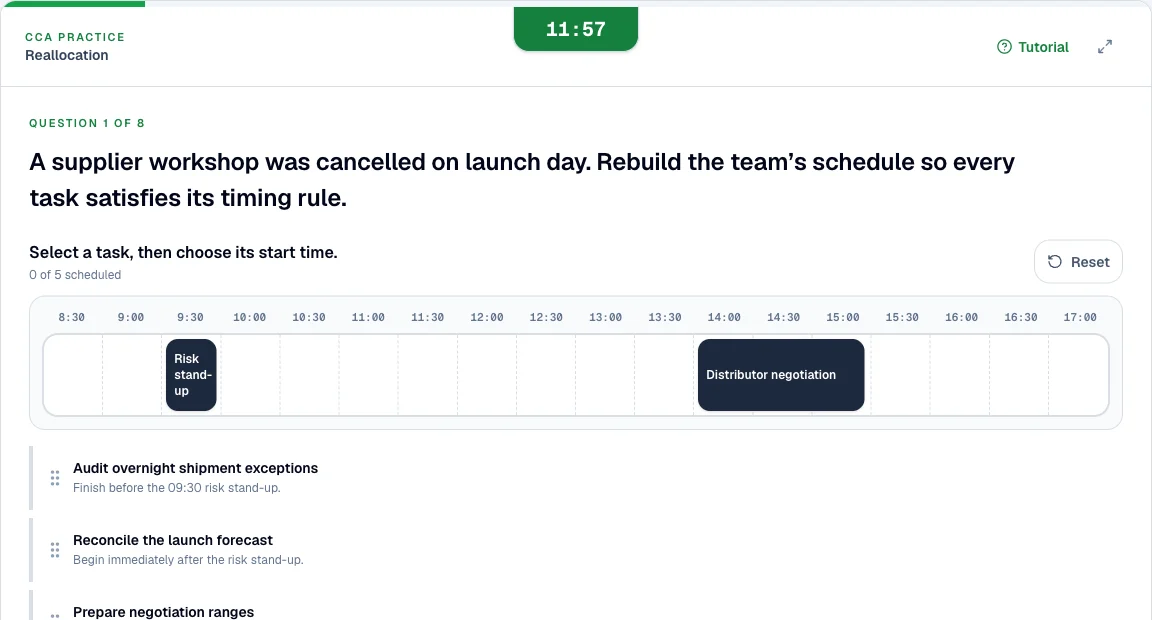
The quick version: BCG describes the CCA as a short, multidimensional assessment whose details can vary. Road to Offer's independent practice mock uses 8 original questions on one 12-minute clock with forward-only navigation.
Why numerical setup is worth practicing
BCG's public recruiting material describes the CCA as a short, multidimensional assessment. Public BCG pages do not publish one universal vendor, section blueprint, item count, or scoring model, and candidate experiences can vary by office and cohort. Your invitation is the source of truth.
Road to Offer's independent numerical mock trains four transferable reasoning families: scheduling constraints, time reallocation, percentages and ratios, and logical patterns. It uses 8 original questions on one shared 12-minute clock with forward-only navigation. The free result shows every outcome and one complete worked example; full CCA access adds the remaining walkthroughs, focused practice, and unscored work-style familiarization.
The full structure, scoring context, and a 4-week plan are in the BCG CCA guide.
How the simulator works
Try two verified CCA-style numerical questions on this page before signup. The signed-in path teaches four methods before Road to Offer's 8-question, 12-minute mock. Pro members and lifetime CCA Prep buyers also unlock a fresh second mock, focused family practice, detailed walkthroughs, progress history, and 51 original work-style familiarization items across both formats the assessment uses.
Use the numerical practice deliberately:
- One sitting, clock on. Treat the 8 questions as a single block. No pausing to review mid-run.
- Set up before you compute. State the equation (out loud or on paper), then plug numbers. Setup errors cost more than arithmetic errors.
- Use the tools in your invitation. Calculator and device rules can vary; follow the instructions for your assessment.
- Review after, not during. Use the result report to identify which shape (scheduling, reallocation, quant, or logical) cost you the most seconds.
View worked examples →
4 worked
4 CCA-style practice questions
Original practice examples built to mirror the reasoning shapes the CCA rewards. Set a 6-minute clock for the four of them.
- Example 1
Revenue rises 12% while costs rise 8% on a higher cost base. Did profit improve?
ApproachCompute the dollar change in revenue and costs separately, then compare. Comparing the percentages directly is the trap - 8% of a larger base can exceed 12% of a smaller one.
AnswerDepends on the bases: compare dollar deltas, not percentages.
- Example 2
A team of 4 finishes a task in 6 days. How long for 6 people at the same pace?
ApproachTotal work = 4 × 6 = 24 person-days. Divide by the new headcount: 24 / 6 = 4. Sanity-check the direction: more people, fewer days.
Answer4 days.
- Example 3
Three tasks take 3, 5, and 2 hours and share one resource. What is the minimum total time?
ApproachOne shared resource means the tasks run sequentially: identify the binding constraint, sequence to avoid idle time, then add the durations. 3 + 5 + 2 = 10.
Answer10 hours.
- Example 4
A chart shows quarterly sales by region. Which region drove the year's growth?
ApproachRead the title and axes first, isolate the largest absolute delta between the first and last quarter, then connect it back to the question asked - largest delta, not largest bar.
AnswerThe region with the largest absolute change, not the largest total.
View common mistakes →
4 pitfalls
4 common mistakes on the CCA numerical block
The block is short enough that one bad habit costs the whole section. These are the ones that show up most in timed reps.
- Practicing untimedLearn each question family's setup without a clock first. Once the method is stable, use the full shared countdown rather than forgiving per-question timers.
- Spending 3 minutes on one questionRoad to Offer's eight-question mock shares one budget. If a setup is not clear, make a structured decision and preserve time for the remaining original practice questions.
- Skipping scheduling and chart questions in prepPractice multiple transferable shapes. Use a stable read order: constraints first for scheduling; title, axes, period, and unit first for an exhibit.
- Treating it like a case interviewThis simulator trains numerical setup and forward decisions. Casey-style online cases and live interviews require additional structuring, interpretation, and communication practice.
Frequently asked questions
What is the BCG CCA numerical section?
BCG publicly describes the CCA as a short, multidimensional assessment but does not publish one universal numerical blueprint. Candidate reports mention numerical reasoning in some cohorts. This simulator provides original practice across four transferable families.
How does the timing work on the CCA?
Road to Offer's canonical mock uses one 12-minute countdown for eight original questions and forward-only navigation, so you rehearse the shared-budget pacing the CCA rewards before test day.
Is this a realistic BCG CCA simulator?
It is independent practice, not the official assessment: 8 original questions on one 12-minute clock with forward-only navigation. The free report shows every outcome and one complete worked example; full access adds every walkthrough.
Can I prepare for the work-style portion?
Yes. Road to Offer practises both formats the assessment uses, ranking three responses and choosing between two, so neither interface is new on test day. Choose a stable recent-work reference and pick the closest description of how you actually work.
Timed simulation
Learn the patterns, then run the full mock
Your first 8-question mock is free. Pro or lifetime standalone access adds a second mock and family practice.
Related resources
- BCG Consulting Career Assessment (CCA): 2026 GuideOfficial evidence, candidate-reported boundaries, and a 4-week prep plan.
- BCG Online Case (Casey) guidePrepare separately for chatbot-style online case reasoning.
- Case interview math practice: 30 free drillsBroader timed math reps beyond the CCA format.
- Aptitude tests in consultingWhere the CCA sits in the MBB and Big 4 assessment landscape.