
TMT Case Interview: Technology, Media & Telecom Frameworks, Metrics, and Worked Examples
Master TMT case interviews: sector-specific frameworks for telco pricing, streaming growth, digital ad revenue, 5G rollout, and media M&A with examples.
On this page
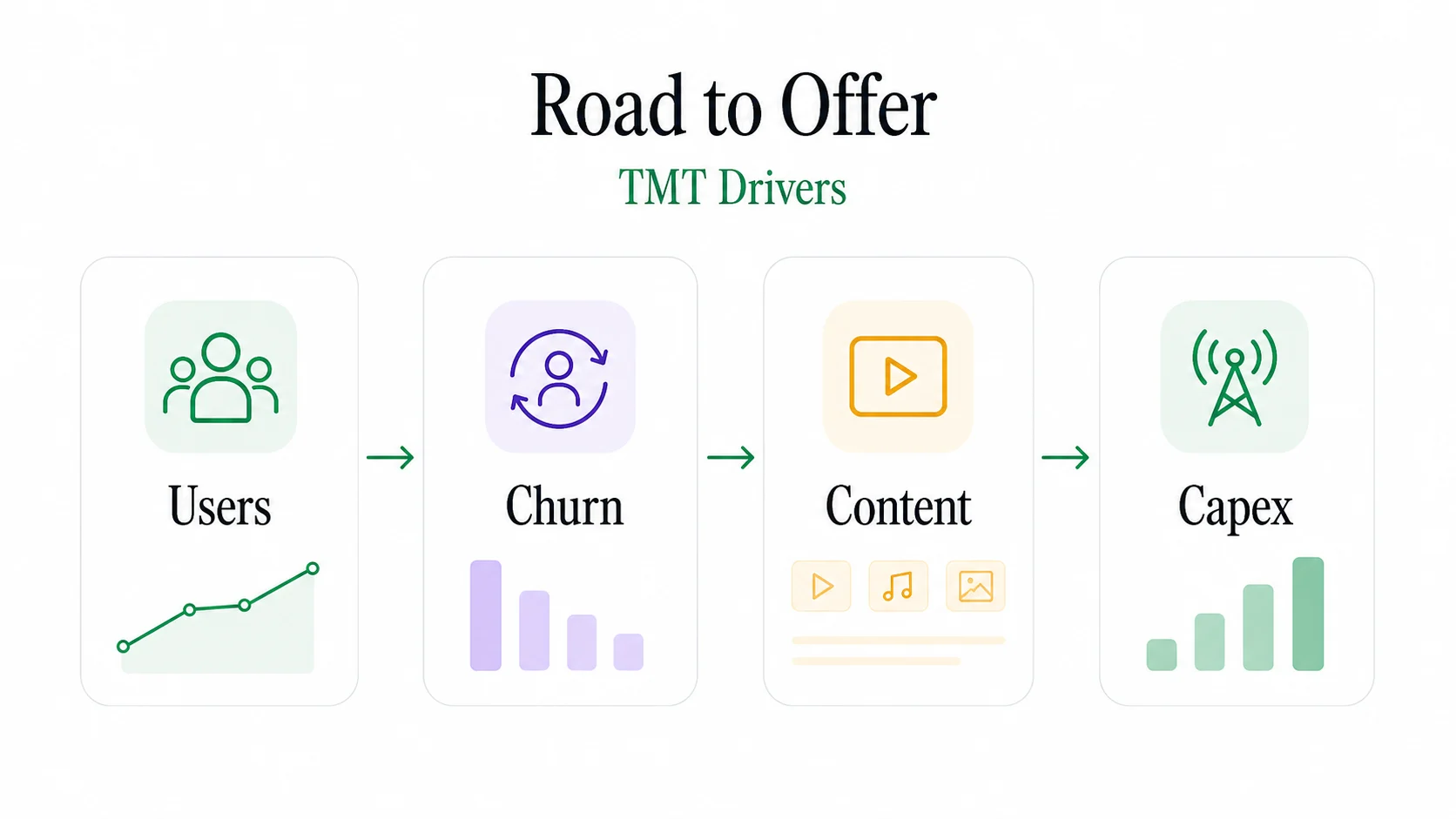
A TMT case interview asks you to solve strategy problems in Technology, Media, or Telecommunications, the three sub-sectors most TMT consulting practices are built around. These cases test whether you can apply standard consulting frameworks while accounting for sector-specific dynamics: network effects in tech, content economics in media, and infrastructure capex in telecom. Learn 6 key metrics (ARPU, churn, CAC, LTV, penetration rate, and content cost per subscriber), but take market sizes and benchmark values from dated primary sources or the case prompt.
Common TMT Case Types
TMT is not one case type. It is a sector overlay across several problem types. Each demands different frameworks and metrics. The most common mistake we see is candidates treating a telecom pricing case like a generic profitability case and missing the ARPU-churn tradeoff entirely.
Each type maps to a standard case interview framework but adds a TMT-specific lens. A telco pricing case is a profitability case with ARPU decomposition. A 5G rollout case is an investment case with infrastructure economics. A media M&A case follows the M&A framework but values content libraries and subscriber bases instead of factories and inventory.
TMT Metrics Worth Knowing
Interviewers may define some terms, but you will move faster if you know the common metrics. Ask for the case-specific values.
Illustrative sensitivity check: a 5% ARPU increase on 100M subscribers at $50 monthly ARPU equals a $3B annual revenue lift. If the case assumes churn falls by 0.1 percentage point each month on a stable 100M base, the simple annualized effect is about 1.2M fewer churn events before cohort and compounding adjustments.
Before reading the worked answers, calculate one clean TMT implication: if a streaming service has 4 million subscribers at $12 monthly ARPU and monthly churn rises from 2% to 2.5%, what extra monthly revenue is at risk before reacquisition? State the simplifying assumption about the subscriber base.
Calculate TMT subscriber economics from the Road to Offer drill engine. Answer a real prompt and get AI-scored feedback. Free accounts include 5 drills per day for the first 3 days after signup.
Framework: TMT Case Analysis
TMT Case Interview Framework
- 01
Step 1: Identify the TMT Sub-Sector. Tech (software, hardware, platforms), Media (streaming, advertising, content), or Telecom (wireless, broadband, infrastructure)? Each has different cost structures and competitive dynamics.
- 02
Step 2: Map the Revenue Model. Subscription (ARPU × subscribers), advertising (impressions × CPM × fill rate), transactional, or hybrid? This determines which metrics drive the case.
- 03
Step 3: Quantify Unit Economics. CAC, LTV, content cost/sub, capex/subscriber. TMT cases live and die on unit economics because marginal costs are often near zero.
- 04
Step 4: Assess Competitive Dynamics. Network effects, switching costs, bundling power, content exclusivity. TMT moats are structural, not just brand-based.
- 05
Step 5: Model the Decision. Build the financial case: NPV for investments, synergy value for M&A, revenue impact for pricing. Include a churn sensitivity when retention could change the answer.
Worked Example 1: Telco Pricing Optimization
This is the telecom consulting case study shape you are most likely to sit: a pricing prompt where ARPU and churn trade against each other.
Prompt: A US wireless carrier with 85 million postpaid subscribers and $47 average monthly ARPU is considering a $5/month price increase across all plans. Monthly churn is currently 0.9%. The CEO wants to know if this will increase annual revenue.
Step 1: Baseline revenue: 85M subscribers × $47 ARPU × 12 months = $47.94B annual revenue
Step 2: Revenue uplift from price increase (before churn impact): 85M × $5 × 12 = $5.10B gross uplift
Step 3: Estimate churn acceleration: For this worked example, assume the $5 increase raises monthly churn by 0.4 percentage point: 0.9% to 1.3%.
- Old annual churn: 0.9% × 12 ≈ 10.2% → 8.67M churned
- New annual churn: 1.3% × 12 ≈ 14.6% → 12.41M churned
- Incremental churn: 3.74M additional lost subscribers
Step 4: Net revenue impact: Lost revenue from incremental churn: 3.74M × $52 (new ARPU) × 6 months average = $1.17B lost. Net Year 1: $5.10B - $1.17B = +$3.93B before re-acquisition costs ($350 CAC × 3.74M = $1.31B).
Step 5: Recommendation: Net positive in Year 1, but 3.74M incremental churn events erode the base long-term. Test a tiered increase at $5 on premium plans, $3 mid-tier, and $0 on entry plans, then calculate the uplift from the case's segment mix and elasticity rather than assuming a universal capture rate. This is a classic case math problem where sensitivity analysis matters more than the point estimate.
Worked Example 2: Streaming Platform M&A
Prompt: A global media conglomerate (120M streaming subscribers, $14.99 average monthly price) is evaluating acquiring a mid-size streaming platform with 35M subscribers at $9.99/month. The target has an enterprise value of $28B. Should they proceed?
Step 1: Valuation sanity check: $28B ÷ 35M subscribers = $800 per subscriber. Treat that as this case's calculated transaction multiple; do not compare it with another platform without dated enterprise-value and subscriber data on the same basis.
Step 2: Subscriber overlap: 40% of the target's subs also subscribe to the acquirer. Net new: 35M × 60% = 21M. Adjusted price per net new sub: $28B ÷ 21M = $1,333/sub, significantly more expensive.
Step 3: Synergy analysis: Content cost consolidation ($800M, eliminating 15% duplicate licensing), tech platform merger ($350M), ad cross-sell ($200M), subscriber price migration ($500M). Total: $1.85B/year.
Step 4: Return calculation: Annual synergy yield is approximately 6.6% at $28B. To achieve at least 8% on synergies alone, negotiate to no more than approximately $23.1B, before integration costs and timing.
Both worked examples turn on fast, clean math under pressure. Then apply the same investment and utilization logic to the adjacent Cloud Computing Capacity Expansion case.

Growth · hard
Practice for TMT interviews in a real case
Matched to this TMT guide: a live technology growth case with an AI interviewer. Free, scored on every step.
5G, Digital Ads, and Media M&A: Sub-Sector Spotlights
5G investment cases center on the tension between infrastructure capex and uncertain revenue uplift. Segment consumer and enterprise demand, then request case-specific capex, site pricing, ARPU, adoption, and willingness-to-pay assumptions. The economics can differ materially, but no universal enterprise-to-consumer multiple should be imported into the case.
Digital advertising cases can use this revenue formula: Ad Revenue = DAU × Sessions/User × Ads/Session × CPM ÷ 1,000. Use interviewer-provided market size, platform share, and programmatic-adoption assumptions. In a digital transformation case with an ad component, test the tension between ad load and user experience.
Media M&A cases remain common because streaming portfolios, content libraries, and distribution rights are still consolidating. For M&A cases in media, EV/subscriber can be a useful valuation lens alongside EBITDA, cash flow, and strategic control. Subscriber overlap is a major synergy risk. If overlap is high, net subscriber additions may not justify the premium.
How to Prepare for TMT Cases
- Learn the 6 core metrics and practice calculating them under pressure with case math drills.
- Read one earnings call from each sub-sector: AT&T (telecom), Netflix (streaming), Google (digital ads). Note which KPIs management emphasizes.
- Practice TMT data interpretation: subscriber curves, ARPU trends, churn waterfalls. See the data interpretation guide.
- Check the current landscape: use dated primary sources for 5G, streaming consolidation, and advertising technology when the case requires outside facts.
- Pair TMT knowledge with core frameworks. A market entry framework still works for "should a telco enter streaming?"; add TMT metrics to each branch.
- Review adjacent industry cases. The technology case interview guide covers platform economics and SaaS models that overlap heavily with TMT. The fintech case interview covers digital payments and embedded finance that increasingly sit inside telecom billing stacks. For content and ad tech decisions, the new product launch case interview gives a go-to-market structure. The pricing strategy case interview is relevant for ARPU expansion and subscriber pricing strategy in streaming and 5G enterprise segments.
Turn sector metrics into an investment decision
Run the adjacent Cloud Capacity case to practice demand, utilization, economics, and recommendation under pressure.
Sources
- PwC: The State of 5G and Capex Trends, pwc.com/gx/en/industries/tmt/telecommunications/the-state-of-5G-capturing-more-value.html (checked June 17, 2026)
- eMarketer: Worldwide Ad Spending Forecast 2026, emarketer.com/content/worldwide-ad-spending-forecast-2026 (checked June 17, 2026)
- Deloitte: TMT Predictions 2026, deloitte.com/us/en/insights/industry/technology/technology-media-and-telecom-predictions.html (checked June 17, 2026)
- PwC: Media & Telecom M&A 2026 Outlook, pwc.com/us/en/industries/tmt/library/telecom-media-deals-outlook.html (checked June 17, 2026)
- McKinsey: TMT Practice Overview, mckinsey.com/industries/technology-media-and-telecommunications/how-we-help-clients (checked June 17, 2026)
- BCG: B2C Pricing in TMT, bcg.com/capabilities/pricing-revenue-management/b2c-pricing (checked June 17, 2026)
Frequently asked questions
Resources and related guides
- Practice for TMT interviews in a real casePractice
- Browse all free resourcesResource hub
- Digital Transformation Case Interview: Frameworks, Build vs Buy, and Worked ExamplesFrameworks · Mar 15, 2026
- Technology Case Interview: Frameworks, Worked Examples, and How to Solve Tech Cases (2026)Frameworks · Mar 29, 2026
- 3Cs Framework: Company, Customer, Competitor (Worked Example)Frameworks · Feb 6, 2026