Road to Offer
HomeBlogHubsDirectoryPricing
Log in
Start free
Road to Offer Logo
PrivacyTermsContactFAQPricing

© 2026 Road to Offer

Private Equity Case Interview Guide: LBO Basics, Deal Screening, Commercial Due Diligence, and Worked Examples (2026)

Published

Mar 15, 2026

Category

Frameworks

Tags

Private Equity Case Interview, Lbo Basics, Commercial Due Diligence, Deal Screening, Pe Interview Prep

Road to Offer Team

Road to Offer

We built Road to Offer to make deliberate case practice accessible to every candidate — not just those who can afford $200/hour coaching.

  • -Strategy consulting background
  • -200+ candidates coached

Published Mar 15, 2026

Blog›Private Equity Case Interview Guide: LBO Basics, Deal Screening, Commercial Due Diligence, and Worked Examples (2026)
A private equity analyst at a mahogany conference table in a New York City high-rise, reviewing a Confidential Information Memorandum alongside an LBO model printout with IRR and MOIC figures visible, a leather-bound notebook open with deal thesis bullet points, and the Manhattan skyline glowing at night through floor-to-ceiling windows — deep navy, gold, and charcoal tones

Private Equity Case Interview Guide: LBO Basics, Deal Screening, Commercial Due Diligence, and Worked Examples (2026)

Mar 15, 2026

Frameworks · Private Equity Case Interview, Lbo Basics, Commercial Due Diligence

Road to Offer Team

Road to Offer

We built Road to Offer to make deliberate case practice accessible to every candidate — not just those who can afford $200/hour coaching.

  • -Strategy consulting background
  • -200+ candidates coached

Published Mar 15, 2026

PostShare

Summary

Master private equity case interviews with a proven deal-screening framework, LBO basics, commercial due diligence approach, and two fully worked examples with real numbers.

A private equity case interview asks you to evaluate whether to acquire a target company, at what price, and whether the deal can deliver a 20%+ IRR — typically 2.5–3.0× MOIC over a 5–7 year hold. Unlike consulting case interviews that reward strategic breadth, PE cases demand a binary buy/don't-buy decision backed by LBO math, commercial due diligence, and a credible exit thesis. Private equity managed approximately $8.6 trillion in assets globally as of 2024, with firms like KKR, Blackstone, and Apollo hiring candidates who combine rigorous market analysis with financial modeling. The standard PE case structure covers 4 layers: market assessment, competitive position (commercial due diligence), financial profile and entry valuation, and exit strategy with return analysis.

A private equity case interview evaluates your ability to make investment decisions with financial precision. The core task is a deal screen: assess whether a target company's market position, financial profile, and valuation support a 2.5–3.0× return to LPs over a 5–7 year hold. This requires LBO mechanics (entry equity, debt structure at 50–80% of purchase price, EBITDA growth, exit multiple, debt paydown), commercial due diligence across 5 questions, and a clear buy or pass recommendation at a specific price.

PE Case Interview vs. Consulting Case Interview: The Core Difference

The framing matters more than you think. Most candidates who come from consulting backgrounds make the same mistake: they spend 80% of their time on qualitative analysis and forget to anchor their answer in a return target. Candidates from banking backgrounds make the opposite error — they get lost in the numbers and can't articulate why the business is worth buying.

According to eFinancialCareers, "consultants are often too focused on the qualitative elements and bankers are too focused on getting the numbers right." The PE interviewer wants both — in the right proportion.

Here's how the two case types differ structurally:

DimensionConsulting CasePE Case Interview
Central questionHow do we solve this business problem?Should we invest, at what price, and can we return 3x?
Financial depthRough profitability mathFull LBO mechanics, IRR/MOIC targets
Time horizonRecommendations for now5–7 year hold, exit strategy required
Recommendation styleStrategic options with tradeoffsSingle clear buy/don't-buy with price
Key artifactCase prompt (verbal)CIM (Confidential Information Memorandum)
Who evaluates youConsulting partnerPE partner + portfolio operations team

The deepest conceptual difference: "The difference between a good business and a good investment is the price." A great company at a 20x EBITDA multiple might be a terrible investment. A mediocre business at 5x EBITDA might be a home run if you can cut costs and exit at 8x. PE interviews test whether you can hold both ideas simultaneously.

PE firms don't need strategic fit — they're not market players in the traditional sense. They need an exit strategy. Your job is to convince an interviewer that the business can be bought at a price that allows debt service, operational improvement, and a 20%+ IRR on exit.

Practice deal screening with AI feedback

Road to Offer's AI gives you live PE-style investment cases with instant structured feedback — including on your financial logic.

Try a free case →

The 4-Layer Deal Screening Framework

When you receive a PE case prompt — whether live or as a take-home CIM — structure your analysis across four layers. These map directly to what a real investment team evaluates before an IC (Investment Committee) presentation.

PE Deal Screening Framework

11. Market Assessment

Is this a market we want to be in? Size, growth rate, cyclicality, regulatory risk, and defensibility of returns.

22. Company Competitive Position

Why does this business win? Pricing power, customer concentration, switching costs, brand moat, technology differentiation.

33. Financial Profile & Entry Valuation

What are revenue, EBITDA, and FCF trends? What entry multiple makes the math work? What's the leverage capacity?

44. Exit Strategy & Return Analysis

Who buys this in 5–7 years — strategic acquirer, secondary PE, or IPO? At what multiple? Can we hit 2.5–3.0x MOIC?

Layer 1: Market Assessment

Start here because a structurally bad market kills even great businesses. Ask:

  • Size: Is the addressable market large enough to justify a PE-scale investment? For most mid-market deals ($100M–$1B EV), you want a TAM of at least $5B.
  • Growth: Is market revenue growing, flat, or declining? CAGR of 5%+ provides a tailwind that helps you exit at a higher multiple than you entered.
  • Cyclicality: Healthcare and software are relatively non-cyclical. Industrial manufacturing and retail are highly cyclical — PE funds avoid full-cycle downturns eating into IRR.
  • Regulatory risk: Changes in regulation (e.g., healthcare reimbursement changes, environmental compliance) can destroy value unpredictably.

According to Baker Tilly's framework for market diligence, the three core pillars are: market conditions, competitive landscape, and customer preferences — a useful structure for your verbal answer.

Layer 2: Competitive Position

This is the commercial due diligence layer. We'll expand it in its own section below, but at a screening level ask: what's the moat?

Moat TypeSignalExample
Switching costsCustomer churn < 5%/yrB2B SaaS, specialty chemicals
Network effectsRevenue grows faster than usersMarketplace platforms
Regulatory moatLicensed, patented, or FDA-approvedMed devices, specialty pharma
Cost advantageEBITDA margin 10%+ above peersScaled logistics, commodity processing
BrandPremium pricing 15%+ above private labelConsumer brands

A company with no identifiable moat is dangerous for PE — without pricing power, you're dependent entirely on financial engineering to generate returns.

Layer 3: Financial Profile

Pull these numbers from the CIM data room (or the case prompt):

  • Revenue growth: 3-year CAGR. Distinguish organic from acquisition-driven growth.
  • EBITDA margin: And the trend direction. Expanding margins = operational leverage. Contracting margins = structural problem.
  • Free cash flow conversion: EBITDA × conversion rate (typically 60–80%). High capex businesses eat into FCF and limit debt paydown.
  • Working capital cycle: Negative working capital (collect before you pay) is a cash engine. Extended receivables are a warning sign.
  • Leverage capacity: Most lenders will provide 4–6× EBITDA in debt for quality businesses.

Layer 4: Exit Strategy

The exit is how LPs get paid. You need a credible exit path before committing capital:

  • Strategic buyer: Who in the industry would acquire this asset and pay a strategic premium (typically 1–2x additional multiple turns)?
  • Secondary PE: Another PE fund acquires after you — works if the business is still growing and there's more operational upside.
  • IPO: Viable only for large ($500M+ revenue), high-growth businesses with clean financials.

LBO Basics: The Math You Must Know

An LBO (leveraged buyout) is the defining transaction type in private equity. The mechanics are simpler than most candidates think.

Core concept: Acquire a company using mostly debt (50–80% of purchase price), improve the business over 5–7 years, pay down debt with free cash flow, then sell at a higher valuation. The equity holders — the PE fund — capture the difference between entry equity value and exit equity value.

According to Wall Street Prep's LBO primer, debt typically constitutes 50–80% of purchase price in a standard LBO, meaning post-acquisition debt/equity ratios often exceed 1.0x.

The LBO Return Drivers (Memorize These)

Returns in an LBO come from three sources — ranked by typical contribution:

  1. Debt paydown (~40%): Every dollar of debt paid off by FCF is a dollar of equity gain at exit. This is the "compounding" effect of leverage.
  2. EBITDA growth (~35%): Organic growth + operational improvements increase the exit EBITDA base.
  3. Multiple expansion (~25%): Buying at 7x and selling at 9x adds 2 turns of EBITDA to your exit equity. This is market-dependent and the riskiest assumption.

In a downside scenario for your PE case interview, strip out multiple expansion entirely. If your deal only works because multiples expand from 7x to 10x, it's a weak investment thesis. A robust deal generates 2.0–2.5x MOIC on debt paydown and EBITDA growth alone.

Paper LBO — The Mental Math Format

Many first-round PE interviews use a paper LBO: a 5–30 minute calculation on pen and paper. Corporate Finance Institute describes the format as a simplified version of the full LBO model used to test whether candidates can quickly assess deal returns without Excel.

Standard paper LBO setup:

  • Entry EBITDA: $50M
  • Entry multiple: 8×
  • Debt: 5× EBITDA ($250M debt, $150M equity)
  • Hold period: 5 years
  • EBITDA growth: $10M/year (reaches $100M at exit)
  • Exit multiple: 9×
  • Debt paydown: $100M over 5 years (assumes ~$20M FCF/year applied to debt)

Paper LBO calculation:

StepCalculationResult
Purchase price$50M × 8×$400M
Entry equity$400M – $250M debt$150M
Exit EV$100M × 9×$900M
Remaining debt$250M – $100M paid$150M
Exit equity$900M – $150M$750M
MOIC$750M / $150M5.0×
Approx. IRR5.0× over 5 years~38%

This is an exceptional deal — real-world targets are 2.5–3.0× MOIC (≈20–25% IRR). Use the MOIC-to-IRR approximation table in interviews:

MOIC (5-year hold)Approximate IRR
2.0×~15%
2.5×~20%
3.0×~25%
3.5×~28%

A 20%+ IRR is the industry standard threshold for most PE funds. If your deal can't clear that hurdle, it fails the basic investment test.

For mental math fluency with the calculations PE cases require, read our guide to mental math shortcuts for case interviews — the same number skills apply directly.

Build LBO math fluency with structured drills

Road to Offer's practice engine includes PE-style financial cases with built-in feedback on your deal math — not just your structure.

Practice PE cases now →

Commercial Due Diligence: The Consulting Layer of PE Cases

This is where consulting candidates have a natural edge — if they know how to deploy it correctly.

Consulting firms are frequently hired by PE firms to conduct commercial due diligence on acquisition targets. Investment banks handle financial DD; law firms handle legal DD; consultants assess the market opportunity and competitive position. CDD answers the fundamental question: is the business model defensible after acquisition?

CDD Framework: Five Commercial Questions

Commercial Due Diligence Framework

11. Market Size & Growth

How large is the addressable market? What is the 5-year growth CAGR, and what drives it — secular trend, pricing, or volume?

22. Competitive Position

What market share does the target hold? Is share growing, flat, or eroding? What are the top 3 competitors and what would it take to lose a major account?

33. Customer Quality

How concentrated is the customer base? What are churn rates? How long are contracts? Would customers leave if ownership changed?

44. Pricing Power

Has the company raised prices above inflation in the last 3 years? What happens if they try? Is pricing driven by cost-plus or value?

55. Management & Scalability

Does the company depend on 1–2 key people? Can revenue scale without proportional cost increases? Is there an operational improvement roadmap?

The Customer Concentration Warning Sign

One metric interviewers love to stress-test: customer concentration. If the top 3 customers represent 50%+ of revenue, there's existential risk in every contract renewal. When evaluating a PE target:

  • Healthy: Top 10 customers < 30% of revenue, churn < 5% annually
  • Acceptable: Top 10 customers 30–50% of revenue, multi-year contracts in place
  • Red flag: Single customer > 20% of revenue with no long-term contract

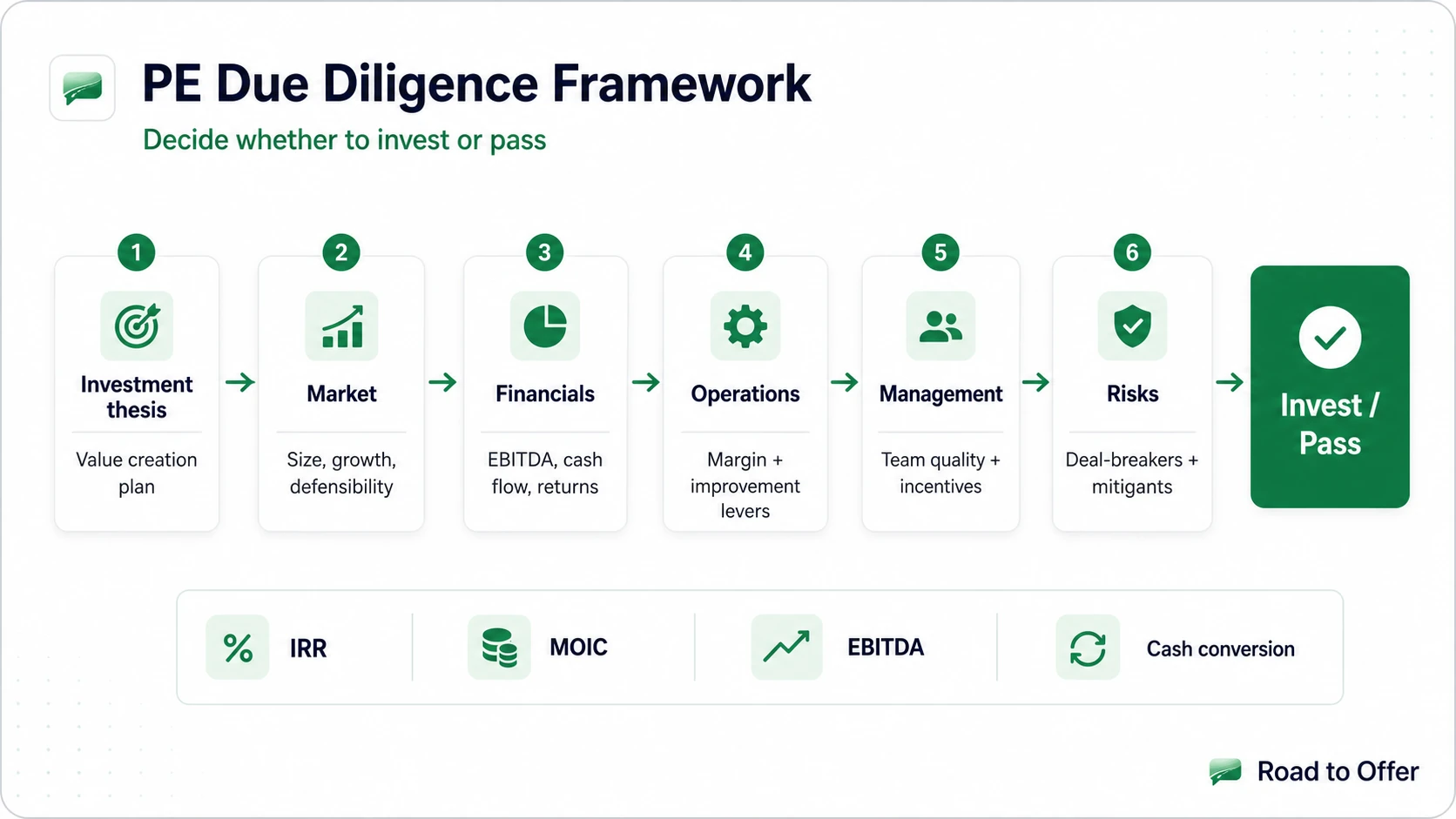
This connects directly to our PE due diligence framework — one of the most detailed standalone guides on structuring diligence analyses for deal interviews.

Worked Example: Full PE Case Walkthrough

Case prompt: Your PE firm is evaluating an acquisition of MedTrack, a software company that provides scheduling and compliance tools to outpatient physical therapy clinics. Current financials: $40M revenue, $12M EBITDA (30% margin), growing at 12% annually. Asking price: $96M (8× EBITDA). The seller wants a decision in 3 weeks.

Should you invest?

Step 1: Market Assessment

  • TAM: US outpatient PT market: ~35,000 clinics × ~$3,000/yr software spend = ~$105M addressable market. MedTrack has ~$40M revenue = ~38% market share — high, but the market is underpenetrated (many clinics still use paper).
  • Growth drivers: Rising demand for outpatient care vs. inpatient (cost pressure on hospital systems), aging population, ACA-driven coverage expansion for PT services. Market growing ~8–10%/year.
  • Cyclicality: Healthcare software is among the most recession-resistant verticals — clinics don't stop operating during downturns.
  • Assessment: Strong market backdrop. ✓

Step 2: Competitive Position

  • MedTrack has 38% market share in a fragmented space (next competitor at ~15%).
  • B2B SaaS for healthcare has high switching costs — migrating scheduling + compliance data is painful.
  • NPS is 72 (above industry average of 45 for healthcare software). Customer churn: 4%.
  • Assessment: Durable competitive position. ✓

Step 3: Financial Profile & Entry Valuation

MetricValueAssessment
Revenue$40MGrowing 12%/yr
EBITDA$12M30% margin — strong
FCF conversion~75%$9M/yr FCF
Revenue concentrationTop 10 = 22%Acceptable
Asking price$96M (8× EBITDA)Reasonable for SaaS

Entry structure:

  • Purchase price: $96M
  • Debt: 5× EBITDA = $60M
  • Equity: $36M

Step 4: Exit Analysis (5-Year Hold)

  • EBITDA at year 5: $12M growing at 12%/yr ≈ $21M (compounding: 12 × 1.12⁵)
  • Exit multiple assumption: 10× (SaaS businesses with high retention command premium multiples)
  • Exit EV: $21M × 10× = $210M
  • Debt paydown: $9M FCF/yr × 5 years = $45M repaid → remaining debt = $15M
  • Exit equity: $210M – $15M = $195M
  • MOIC: $195M / $36M = 5.4×
  • IRR (5-year): ≈ 40%+

Recommendation: Strong invest. Even with a conservative 8× exit multiple and slower 10% EBITDA growth, MOIC is ~3.5× (≈28% IRR) — well above the 2.5× hurdle. The key risk is customer concentration in larger clinic chains; mitigation is negotiating multi-year contracts as a closing condition.

Interviewer pushback: 'What if the exit multiple compresses to 7×?'

At 7× exit, EV = $21M × 7× = $147M. Exit equity = $147M – $15M = $132M. MOIC = $132M / $36M = 3.7×. Still above hurdle. The deal only breaks the 2.0× minimum at exit multiples below 4× — an extreme scenario given the company's growth profile. I'd still invest.

This type of rapid sensitivity analysis is what separates candidates who have genuinely internalized PE logic from those who've memorized frameworks. The same discipline applies in M&A case frameworks — knowing how to stress-test valuation assumptions in a live interview.

What PE Interviewers Are Actually Testing

Beyond the framework and the math, Mergers & Inquisitions notes that PE interviews test a specific set of skills that go beyond case interview basics:

1. Investment judgment: Can you distinguish a great company from a great investment? High-quality businesses at premium prices often return less than mediocre businesses bought at value prices.

2. Defensibility under pressure: Peak Frameworks emphasizes that "the worst thing you could do is not pick a side." You need a clear thesis and you need to defend it when challenged.

3. Return orientation: Every qualitative statement must connect back to value creation. "They have strong brand loyalty" → "which supports pricing power" → "which should sustain 30% EBITDA margins at exit" → "which gives us confidence in an 8–9× exit multiple."

4. Structured communication: Deal summary presentations follow a standard sequence: investment thesis → market and competitive analysis → financial profile → transaction structure → risk/mitigation → recommendation. Practice delivering this in under 3 minutes.

The most common PE interview failure: giving a hedge answer. "It depends on the exit environment." "There are both positives and negatives." PE interviewers hate this. They want a decision, a number, and a reason. Even if you're wrong, being directional and defending a thesis shows investment instinct. Waffling shows none.

How PE Cases Differ by Firm Type

Firm TypeCase FormatWhat They Emphasize
Megafund (KKR, Blackstone, Apollo)Excel LBO test + deal discussionModeling precision, Excel speed, financial detail
Upper-mid-market ($1–5B funds)Take-home CIM + 30-min presentationFull investment memo, market analysis, deal structure
Growth equity (General Catalyst, TA Associates)Live case + market sizingRevenue growth drivers, competitive moat, customer economics
Consulting PE practice (Bain PE group, McKinsey Private Equity)Consulting-style case + deal overlayCDD framework, market analysis, strategic fit

If you're targeting KKR's student programs or Blackstone's campus recruiting, expect a rigorous multi-round process with both behavioral and technical case components. Consulting PE practices lean more heavily on commercial analysis and are closer to the case interview format you may already know.

Preparation Plan

Execution checklist

  • Master paper LBO mechanics (5-year model in < 15 minutes)

    Almost every PE first round includes a paper LBO or verbal LBO walkthrough. Speed and accuracy are both tested.

  • Learn the CDD five-question framework cold

    Commercial due diligence is how consultants contribute to PE — this is the bridge between your consulting background and PE judgment.

  • Practice stating a buy/don't-buy recommendation out loud

    Most candidates hedge. Saying 'I would invest at 8× but not at 9×' with a clear reason instantly differentiates you.

  • Read 2–3 investment memos or deal summaries

    The format of a PE interview answer mirrors a real deal memo. Reading actual memos builds intuition for what matters.

  • Build MOIC-to-IRR conversion table from memory

    You will be asked to estimate IRR from MOIC in a live interview. The 4-row table (2.0× → 3.5×) takes 10 minutes to memorize.

  • Study one full PE case worked example per session

    PE cases are less common in prep books than consulting cases. Deliberate repetition builds the pattern recognition that makes you look experienced.

  • Review profitability and market-entry frameworks for CDD layer

    CDD uses the same frameworks as consulting cases — but applied to a deal context. You already know the tools; apply them to investment questions.

Related Frameworks and Articles

The PE case interview sits at the intersection of several skill areas. If you're systematically building this knowledge:

  • Our PE due diligence framework digs into the operational and financial diligence layers in depth — highly relevant for round 2 take-home cases.
  • The M&A case framework covers synergy analysis and deal structure questions that overlap significantly with PE investment cases.
  • Profitability framework cases build the margin analysis discipline you need for assessing EBITDA improvement potential.
  • Market entry frameworks translate directly to market assessment questions in deal screening.
  • For cases requiring rigorous market sizing (e.g., "estimate the TAM for this software vertical"), our market sizing guide walks through the structured approach.

Test Your Knowledge

Test yourself

Question 1 of 3

QuizA PE firm acquires a company at 7× EBITDA ($70M entry equity, $280M debt on $350M total EV). After 5 years, EBITDA has grown from $50M to $80M, exit multiple is 8×, and $120M of debt was repaid. What is the approximate MOIC?

Interactive Drills

See where you stand on PE and consulting case skills

Take Road to Offer's free assessment to benchmark your deal screening, LBO logic, and commercial due diligence skills — with a personalized improvement plan.

Take free assessment →

Sources and Further Reading (checked March 15, 2026)

  • Hacking the Case Interview — PE case guide: https://www.hackingthecaseinterview.com/pages/private-equity-case-interview
  • Mergers & Inquisitions — Private equity interviews: https://mergersandinquisitions.com/private-equity-interviews/
  • Wall Street Prep — LBO model basics: https://www.wallstreetprep.com/knowledge/basics-of-an-lbo-model/
  • Wall Street Prep — Paper LBO guide: https://www.wallstreetprep.com/knowledge/paper-lbo/
  • Corporate Finance Institute — Paper LBO tutorial: https://corporatefinanceinstitute.com/resources/career/paper-lbo/
  • Preqin — 2025 Global Private Equity report: https://www.preqin.com/insights/global-reports/2025-private-equity
  • McKinsey — Global Private Markets report: https://www.mckinsey.com/industries/private-capital/our-insights/global-private-markets-report
  • Bain & Company — Global PE Report 2025: https://www.bain.com/insights/outlook-is-a-recovery-starting-to-take-shape-global-private-equity-report-2025/
  • Baker Tilly — Three aspects of market diligence for PE: https://www.bakertilly.com/insights/three-aspects-of-market-diligence-private-equity-firms
  • Consultport — Commercial due diligence case study: https://consultport.com/resources-library/case-study-commercial-due-diligence-private-equity/
  • Peak Frameworks — Deal summary guide: https://www.peakframeworks.com/post/deal-summary
  • eFinancialCareers — PE case study interview: https://www.efinancialcareers.com/news/private-equity-case-study-interview
  • KKR student careers: https://www.kkr.com/careers/student-careers
  • Blackstone student recruiting: https://www.blackstone.com/careers/students/

Frequently asked questions

Continue your prep path

Next actions based on this article: one pillar hub, two related guides, and one conversion step.

Pillar hub

Case Interview Frameworks Hub

Related guide

Digital Transformation Case Interview: Framework, Build vs Buy, Platform Strategy, and Worked Examples (2026)

Related guide

Market Sizing Framework: Top-Down vs Bottom-Up, 5-Step Method, and 3 Worked Examples

Try a free voice case

Related articles

Digital Transformation Case Interview: Framework, Build vs Buy, Platform Strategy, and Worked Examples (2026)

Master digital transformation case interviews with a proven 5-layer framework, build vs buy decision guide, platform strategy, change management, and two full worked examples.

Frameworks
Mar 15, 2026

Market Sizing Framework: Top-Down vs Bottom-Up, 5-Step Method, and 3 Worked Examples

Master the market sizing framework with top-down vs bottom-up approaches, a repeatable 5-step method, three fully worked examples, and common patterns that appear at McKinsey, BCG, and Bain.

Frameworks
Mar 15, 2026

Supply Chain Case Interview: Framework, Worked Examples, and Expert Prep (2026)

Master supply chain case interviews with a proven 5-layer framework, two fully worked examples with numbers, and drills used by McKinsey and Kearney operations candidates.

Frameworks
Mar 15, 2026

On this page

  • PE Case Interview vs. Consulting Case Interview: The Core Difference
  • The 4-Layer Deal Screening Framework
  • Layer 1: Market Assessment
  • Layer 2: Competitive Position
  • Layer 3: Financial Profile
  • Layer 4: Exit Strategy
  • LBO Basics: The Math You Must Know
  • The LBO Return Drivers (Memorize These)
  • Paper LBO — The Mental Math Format
  • Commercial Due Diligence: The Consulting Layer of PE Cases
  • CDD Framework: Five Commercial Questions
  • The Customer Concentration Warning Sign
  • Worked Example: Full PE Case Walkthrough
  • Step 1: Market Assessment
  • Step 2: Competitive Position
  • Step 3: Financial Profile & Entry Valuation
  • Step 4: Exit Analysis (5-Year Hold)
  • What PE Interviewers Are Actually Testing
  • How PE Cases Differ by Firm Type
  • Preparation Plan
  • Related Frameworks and Articles
  • Test Your Knowledge
  • Interactive Drills
  • Sources and Further Reading (checked March 15, 2026)

Practice with AI

Get feedback on structure and delivery in real time.

Try a free voice case