
Big 3 vs Big 4 Consulting: How They Differ (2026)
Big 3 vs Big 4 consulting compared: services, salary, prestige, exit options, and which one to target as a candidate in 2026.
On this page
The Big 3 in consulting are McKinsey, BCG, and Bain, also called MBB. The Big 4 are Deloitte, PwC, EY, and KPMG. Big 3 are strategy-only firms hired by CEOs and boards; the Big 4 are audit-rooted networks where consulting is one division among several. The scale gap is the fastest way to see the difference: the Big 4 publish their numbers and are enormous (EY alone reported $53.2 billion in revenue and 406,209 people for FY2025, of which consulting was $16.4 billion), while the Big 3 are private partnerships that publish no revenue at all and employ well under 100,000 consultants between them. Big 3 hiring skews heavily toward MBA programs and target schools, while Big 4 hiring draws from a much wider mix of universities and backgrounds.
What is the Big 3 in consulting?
The Big 3 refers to McKinsey & Company, Boston Consulting Group (BCG), and Bain & Company, also called MBB. All three are private partnerships, all three focus on senior-leadership strategy advisory, and all three sit at the top of the consulting prestige hierarchy (Wikipedia, Big Three management consultancies).
The Big 3 are defined less by what they sell and more by who they sell to. Their typical buyer is a CEO, board, head of strategy, or private equity managing director. Engagements include corporate strategy, growth strategy, M&A diligence, transformation programs, and AI strategy. Bain stands out for its PE due diligence book; McKinsey carries the largest implementation footprint; BCG has been most aggressive on AI, and its BCG X unit now runs more than 3,000 people building AI products alongside client teams.
Headcount is small relative to the Big 4. Recent estimates put McKinsey at 38,000-40,000 consultants, BCG at 33,000-37,000, and Bain at 13,000-19,000 (The Finance Story, 2025). Combined that is under 100,000 people, versus over 1.5 million across the Big 4. For prep walkthroughs, see our McKinsey case interview guide, BCG case interview guide, and Bain case interview guide.
One thing does not change between the two groups: both screen with a business case, and both want a structure before they want an answer. Take one rep on that now, on a cold prompt, and see how your issue tree grades.
Structure a cold business problem from the Road to Offer drill engine. Answer a real prompt and get AI-scored feedback. Free accounts include 5 drills per day for the first 3 days after signup.
What is the Big 4 in consulting?
The Big 4 refers to Deloitte, PwC, EY, and KPMG, the four largest professional services networks in the world, originally built around audit and tax practices that grew massive consulting arms over the last two decades.
For a deep dive on each Big 4 firm, see our complete Big 4 firms guide. The short version: Deloitte led FY2025 with $70.5 billion in revenue and ~470,000 employees, then PwC at $56.9 billion (~364,000), EY at $53.2 billion (~406,000), and KPMG at $39.8 billion (~276,000) (PwC Global Annual Review 2025, EY Global FY2025 Announcement).
Each Big 4 firm runs a strategy boutique: Monitor Deloitte, PwC's Strategy& (formerly Booz & Co.), EY-Parthenon (now 25,000 people after the 2025 merger with Strategy & Transactions), and KPMG's Global Strategy Group. These boutiques compete most directly with the Big 3. The rest of each firm's consulting headcount focuses on technology implementation, risk and regulatory, deals advisory, ESG, and operations.
What are the key differences between Big 3 and Big 4?
The two groups are easy to mix up because both employ "consultants" with similar-sounding titles. The substance is very different.
Services. Big 3 firms decline most pure technology implementation, audit, and tax work. Big 4 firms run all of those at scale, plus a strategy boutique inside the network.
Prestige. MBB carries the highest brand premium in strategy consulting, and the gap is real for exits into private equity, corporate strategy, and venture capital (Poets&Quants, December 2025). Strategy& and EY-Parthenon are well-respected, but the Big 3 brand still moves the needle hardest in finance.
Selectivity. McKinsey reportedly screens roughly 200,000 applications a year for around 2,000 roles. Reported MBB acceptance rates sit under 1%, sometimes 3-4% counting all channels. Big 4 firms hire tens of thousands per year and convert a much higher share of interviewed candidates.
Salary. Pre-MBA analyst pay sits around $120,000-$135,000 base at MBB versus $85,000-$100,000 at Big 4 advisory. The MBA-hire gap is wider: $190,000-$192,000 at MBB versus $90,000-$115,000 at most Big 4 practices.
Exit options. Big 3 alumni dominate top PE, hedge fund, and CEO-track placements. Big 4 alumni are heavily represented in corporate strategy, F500 CFO/COO offices, technology firms, and government leadership.
Big 3 vs Big 4 salary: how do they compare?
The pay gap between Big 3 and Big 4 has been broadly stable over the last three years, through a stretch in which MBB ran layoffs, slower promotions, and tougher performance reviews. Our 2026 Consulting Salary Report breaks down base, bonus, and total comp across MBB and every Big 4 advisory practice.
Total comp tracks similarly. MBA hires at MBB now report total comp of $267,000-$285,000 (Management Consulted, 2025). For exact base ranges by firm and city, see our consulting salary guide, McKinsey salary, BCG salary, and Bain salary.
Two qualifiers: PwC Strategy& and EY-Parthenon pay at the top of the Big 4 range and approach MBB at senior levels, and sign-on bonuses plus MBA tuition reimbursement can move the gap 10-15%.
Should you target Big 3 or Big 4?
Most candidates can apply to both. The real question is which one to optimize for, because cycle timing and case prep depth force a choice. If you're early in prep, our complete consulting prep toolkit covers frameworks, math, and behavioral drills for both MBB and Big 4 finals.
If you are optimizing for MBB behavioral rounds specifically, comparing behavioral interview styles across top firms breaks down McKinsey PEI, BCG fit, and Bain teamwork signals side by side.
Target the Big 3 if:
- You want pure strategy work for CEOs, boards, and PE clients.
- Your target exits are PE, corp strategy, VC, or a C-suite track.
- You can clear a McKinsey-level case bar (getting there takes consistent practice over several weeks, not a couple of sessions; start banking reps with a free full case or focused structure drills).
- You are at a top-target undergrad or MBA program, or you have a strong non-traditional story.
- Salary is a top-3 driver.
Target the Big 4 if:
- You want technology, operations, deals, risk, regulatory, or ESG work in addition to strategy.
- You come from a non-target school or have a non-linear background.
- You value a more predictable lifestyle and steadier promotion timelines.
- You want deep regulated-industry expertise (financial services compliance, government, healthcare).
- You want optionality across many service lines without leaving the firm.
A practical move: if your case scores plateau below MBB threshold after weeks of steady practice, the highest-ROI play is usually Strategy& or EY-Parthenon, which offer the most strategy-shaped Big 4 work and the smallest pay gap to MBB. Stay on top of timing with our recruiting deadlines calendar. For broader context, see what is MBB consulting for the Big 3 tier, MBB vs boutique vs tier 2 for a three-way split, our management consulting firms ranking, consulting career path overview, and deeper Big 4 vs MBB consulting comparison.
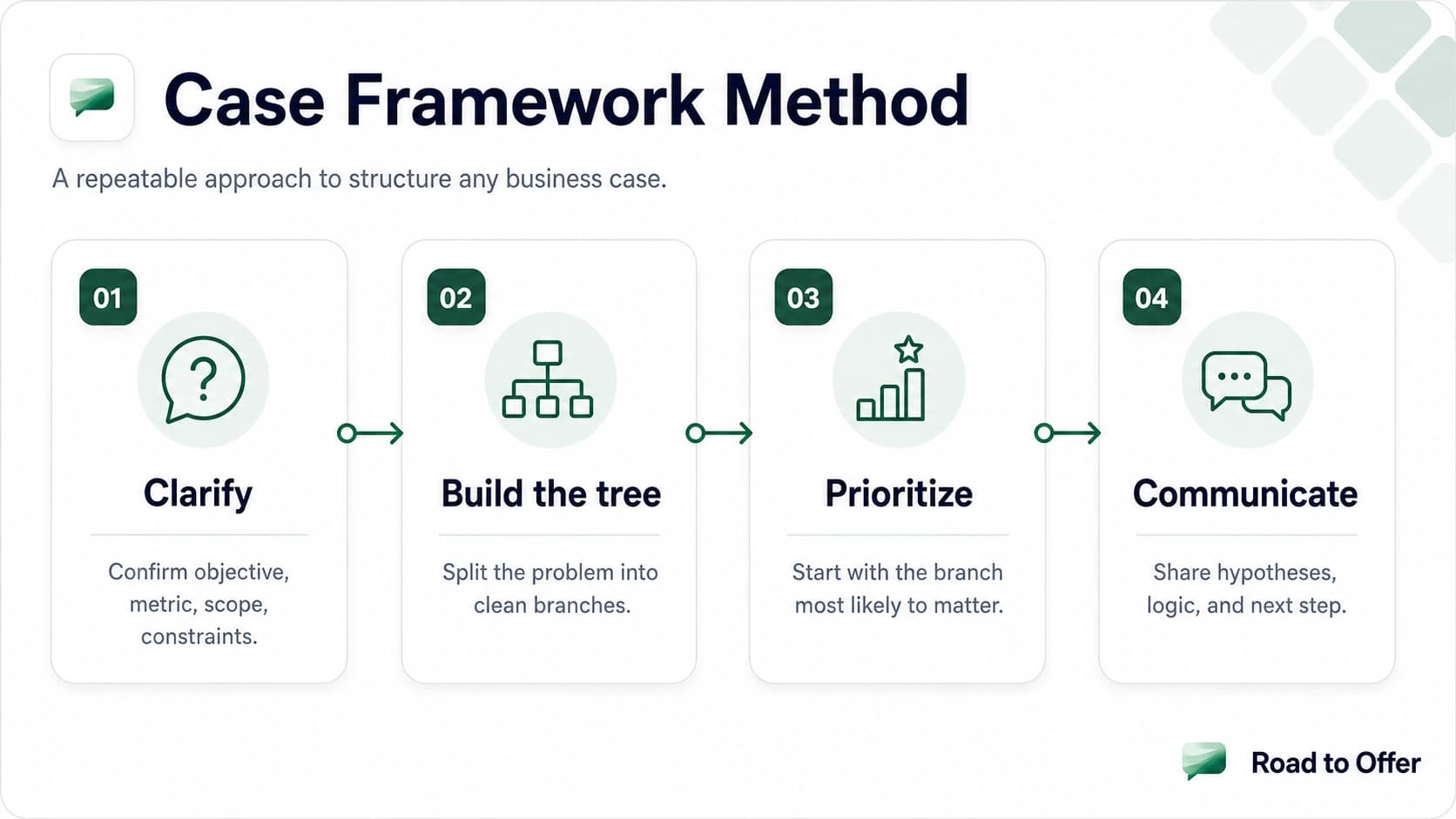
Learn the case method
One dense lesson, each step linked to the drill that trains it.
Sources (checked June 17, 2026)
- Wikipedia: Big Three (management consultancies)
- Hacking the Case Interview: MBB consulting firms
- Hacking the Case Interview: Big 3 Consulting Firms
- The Finance Story: BCG overtakes McKinsey in headcount, 2025
- CaseInterviewHub: McKinsey, BCG & Bain Layoffs, 2025
- Poets&Quants: Consulting Exit Ramps, December 2025
- Management Consulted: MBB salaries 2025
- Deloitte Global FY2025 Revenue Report
- PwC Global Annual Review 2025
- EY Global Revenue Announcement FY2025
Frequently asked questions
Resources and related guides
- 2026 consulting salary reportPractice
- Browse all free resourcesResource hub
- BCG vs Bain: 10 Real Differences (2026 Guide)Firm Specific · May 1, 2026
- Bain Capital vs Bain & Company: Are They the Same?Firm Specific · Apr 13, 2026
- What Is Bain & Company? Services, Careers & InterviewsFirm Specific · Apr 13, 2026
- Big 4 Consulting Firms: Deloitte, PwC, EY, KPMG Compared (2026)Firm Specific · Mar 30, 2026