
Ansoff Matrix Case Interview: The 2x2 Growth Framework Explained with Examples
The Ansoff Matrix is a 2x2 growth strategy framework used in consulting case interviews. Learn when to use it, how to apply each quadrant, and worked examples.
Most growth strategy cases come in looking like this: "Our client wants to grow revenue from $500M to $700M over three years. How should they do it?" That's not a market entry case. It's not a profitability case. It's a growth path selection problem—and the Ansoff Matrix is exactly the right tool.
Candidates who reach for their profitability framework or a generic 3Cs analysis on these cases lose time structuring the wrong problem. Here's how to use the Ansoff Matrix correctly.
What the Ansoff Matrix Is
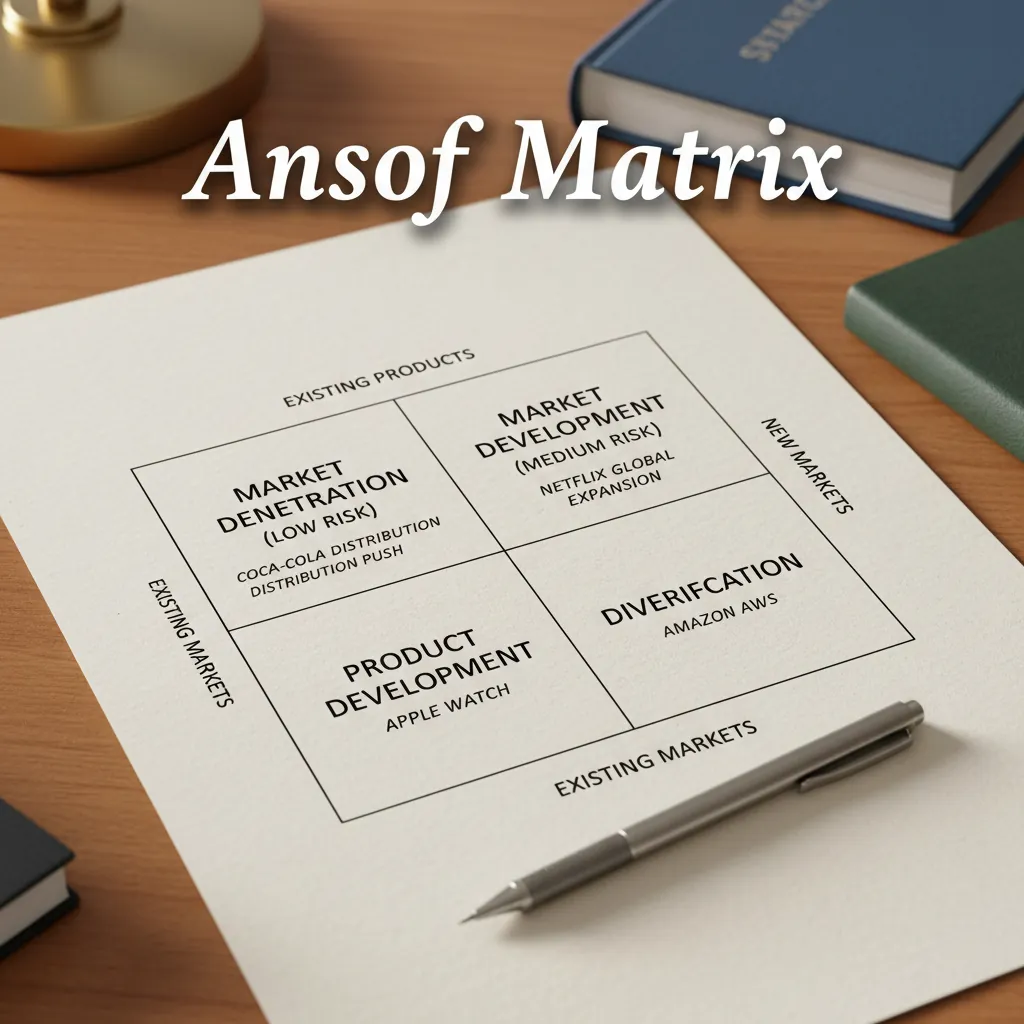
The matrix looks simple. Applying it well is not.
| Existing Markets | New Markets | |
|---|---|---|
| Existing Products | Market Penetration | Market Development |
| New Products | Product Development | Diversification |
Each quadrant represents a distinct growth strategy with different risk profiles, investment requirements, and execution timelines.
The Four Quadrants Explained
Framework
Ansoff Matrix — 4 Growth Strategies
- 01
Market Penetration
Sell more of your existing products to your existing customers. Increase market share, pricing, or purchase frequency. Lowest risk—leverage existing capabilities.
- 02
Market Development
Enter new markets with existing products. New geographies, new customer segments, or new distribution channels. Moderate risk—product is proven, market is unknown.
- 03
Product Development
Create new products for existing markets. New product lines, line extensions, or platform upgrades. Moderate risk—market is known, product requires R&D investment.
- 04
Diversification
Launch new products in new markets. Related (adjacent industry) or unrelated (conglomerate). Highest risk—no existing advantage in either dimension.
Market Penetration (Low Risk)
Tactics: price promotions, loyalty programs, increased advertising, expanded distribution, product bundling.
Real example: Coca-Cola's core strategy for decades—more distribution points, lower-priced multipacks, loyalty via vending placement—is classic market penetration. No new products, no new markets. Just more Coca-Cola in more places.
In a case interview: A client in market penetration mode should report good conversion metrics (high customer awareness and trial), but is likely facing a saturation ceiling. The growth ceiling is the key risk.
When to recommend market penetration: Client has untapped market share in existing segment, competitors are fragmented, or the client has under-invested in marketing relative to peers.
Market Development (Moderate Risk)
Tactics: geographic expansion, new customer segment targeting, new distribution channels, licensing.
Real example: Netflix pursued market development for a decade—same product (streaming video), but entering country after country. The content library adapted (local originals), but the core platform and technology required no reinvention.
In a case interview: Key questions for evaluating market development:
- Is the product fundamentally suitable for the new market, or does it require significant adaptation?
- What are the barriers to entry in the new market (regulatory, distribution, cultural)?
- What is the payback period for the market entry investment?
When to recommend market development: Client has a proven product with clear product-market fit in core market, and identified a target market with similar customer need and lower competitive intensity.
Product Development (Moderate Risk)
Tactics: new product lines, platform extensions, feature additions, adjacent categories.
Real example: Apple is the canonical product development example—same customer base (Apple loyalists), but constantly introducing new products: iPhone, iPad, Apple Watch, AirPods, Apple TV, Apple One subscription. High R&D investment; but very low market development risk because the customer base trusts Apple.
In a case interview: Key questions:
- What is the R&D investment and timeline to market?
- Does the client have the capabilities to develop this product, or does it require acquisition/partnership?
- Is there confirmed customer demand (validated by data) or is this assumption-driven?
When to recommend product development: Strong customer relationships with unmet needs in adjacent areas; existing R&D capabilities; client can maintain pricing power through proprietary product features.
Diversification (Highest Risk)
Two types:
- Related diversification: New product in a related industry (leverages some existing capabilities). Example: Amazon Web Services—Amazon's retail logistics capabilities partially translated to cloud infrastructure.
- Unrelated diversification: New product in an unrelated industry (conglomerate logic). Example: GE's financial services arm or Virgin Group's expansion across airlines, telecom, and health.
In a case interview: Diversification is almost never the right first recommendation. It's high risk, high investment, and the client rarely has any competitive advantage in the new space. When an interviewer gives you a diversification opportunity, your job is to pressure-test whether it actually makes strategic sense—often it doesn't.
Worked Example: Consumer Electronics Manufacturer
Case prompt: Your client is a mid-sized consumer electronics manufacturer with $800M in annual revenue, primarily from smart home devices (speakers, cameras, thermostats). Revenue growth has slowed to 2% annually. The CEO wants to hit 8% CAGR over the next 3 years. Walk through the strategic options.
Step 1: Use Ansoff to map the options
Existing products + existing markets = Market penetration
- Opportunity: competitor smart home brand just recalled a major product line; market share grab
- Tactic: aggressive pricing and retail promotion campaign for 6 months
- Potential: could capture 2–3% market share → ~$16–24M revenue
Existing products + new markets = Market development
- Opportunity: client sells primarily in North America; European smart home market is growing 15% YoY
- Tactic: distribution partnerships with European retailers + EU product certification
- Investment: ~$20M launch; potential $80M revenue in 3 years at 3% market share
New products + existing markets = Product development
- Opportunity: existing smart home customers (2M households) are asking for energy management features
- Tactic: add AI-powered energy optimization to existing product line; premium subscription
- Potential: 15% attach rate × 2M customers × $8/month = $28.8M ARR in Year 3
Step 2: Score the options
| Option | Revenue Potential (Y3) | Investment | Risk | Time to Revenue |
|---|---|---|---|---|
| Market penetration | $20M | $5M | Low | 6 months |
| Market development (EU) | $80M | $20M | Medium | 18–24 months |
| Product development (AI energy) | $29M ARR | $12M | Medium | 12–18 months |
| Diversification (appliances) | $50M | $60M | High | 36+ months |
Step 3: Recommend
A two-track strategy: short-term market penetration (capture competitor's lost customers now) + medium-term European expansion (highest revenue potential at moderate risk). Deprioritize diversification—it requires capital the client should deploy in proven markets first.
Where Candidates Go Wrong
Mistake 1: Using Ansoff as a checklist, not a diagnostic tool. Don't walk through all four quadrants mechanically. Prioritize and eliminate. If the client is a small startup with one product and one market, market penetration and product development are the only realistic options. Dismiss diversification early and justify why.
Mistake 2: Forgetting risk-return tradeoffs. Interviewers expect you to recommend based on risk profile, not just upside potential. A cash-constrained client should not pursue diversification even if the NPV looks attractive. Match the strategy to the client's financial position and risk tolerance.
Mistake 3: Skipping validation questions. Before recommending market development, ask: does the client's product work in the new market without modification? Before product development: what's the R&D timeline? These questions demonstrate business judgment, not just framework knowledge.
Connecting Ansoff to Other Frameworks
The Ansoff Matrix is a decision tree, not a complete framework. Once you've selected a quadrant, shift to the right execution framework:
- Market penetration selected? → Use profitability framework to find revenue levers and customer segmentation framework to identify highest-value customers
- Market development selected? → Use market entry framework to evaluate the target market
- Product development selected? → Use growth strategy cases approaches and innovation frameworks
- Diversification selected? → Use M&A case framework if it's an acquisition path
For a complete view of how growth strategy cases work, see case interview types.
Test Your Knowledge
Test yourself
1 / 3Question 1 of 3
A US athletic apparel company wants to grow by launching its existing product line in Southeast Asia. Which Ansoff quadrant does this represent?
Sources and Further Reading (checked March 25, 2026)
- Igor Ansoff, "Strategies for Diversification," Harvard Business Review, 1957: hbr.org
- Corporate Finance Institute — Ansoff Matrix: corporatefinanceinstitute.com/resources/management/ansoff-matrix
- PrepLounge — 2x2 Matrices and BCG Matrix: preplounge.com/en/case-interview-basics/2x2-matrices-bcg-matrix
- Hacking the Case Interview — Case Frameworks Guide: hackingthecaseinterview.com/pages/case-interview-frameworks
- Cascade — Ansoff Matrix with Examples: cascade.app/blog/the-ansoff-matrix-helps-organizations-grow
FAQ
Frequently asked questions
Keep reading
Related articles
BCG Growth-Share Matrix: Stars, Cash Cows, Dogs, and How to Use It in Case Interviews
The BCG Growth-Share Matrix classifies business units into Stars, Cash Cows, Question Marks, and Dogs. Learn how to apply it in case interviews with worked examples.
McKinsey 7S Framework: How to Use It in Case Interviews (2026)
Master the McKinsey 7S framework for case interviews. Learn all 7 elements, Hard vs Soft S distinction, when to apply it, and a worked retail example.
Energy Case Interview: Oil & Gas Framework, Worked Example, and Prep Guide (2026)
Energy case interviews require a different cost structure map than standard cases. Master the upstream/midstream/downstream value chain, key metrics, and the transition framework that McKinsey, BCG, and Deloitte actually use.