
Government and Public Sector Consulting Case Interview: Complete Guide (2026)
Public sector cases swap profit for public value. Learn the frameworks, a fully worked government case, social ROI math, and what Booz Allen, Deloitte, and McKinsey actually test.
On this page
Government consulting case interviews run on the same 30-to-45 minute format as private sector MBB cases, but the objective function, the success metrics, and the stakeholder landscape are fundamentally different. Firms such as Booz Allen Hamilton, Deloitte, McKinsey, and BCG run government cases around policy impact, service delivery efficiency, and social value creation rather than EBITDA and shareholder return. This guide covers the frameworks, the case types, a fully worked government case with real math, the social ROI calculation, and what each major firm actually tests.
Preparing for a government consulting interview?
Road to Offer lets you practice structured cases and get AI feedback on your framework, stakeholder mapping, and quantitative reasoning.
What Is Public Sector Consulting and Who Hires For It?
Public sector consulting covers work for government agencies, multilateral institutions (World Bank, IMF, UN), public utilities, and state-owned enterprises. The work spans strategy, operations, technology implementation, program evaluation, and policy design.
The market is large and durable, though its exact size depends on definition. Mordor Intelligence sizes global public sector consulting and advisory at roughly $31 billion in 2025, while Market Research Future, using a broader scope, puts it near $76 billion. Both agree on the shape: low-single-digit growth and steady, less-cyclical demand than commercial strategy.
The firms that hire heavily split into three groups:
- Pure-play government firms. Booz Allen Hamilton is the largest, reporting $11.98 billion in revenue for fiscal year 2025 across Defense ($5.9B), Civil ($4.2B), and Intelligence ($1.9B), with a record $37 billion backlog. Guidehouse and Accenture Federal Services also concentrate here.
- MBB public-sector groups. McKinsey, BCG, and Bain serve governments through dedicated groups alongside their commercial work, emphasizing transformational strategy.
- Big Four and broad-line firms. Deloitte Government and Public Services, EY, and KPMG run large public sector advisory teams focused on operations, technology, and compliance.
Engagements often run longer than commercial strategy projects, client relationships are more durable, and federal or defense roles can require security clearance eligibility, so mission alignment and stability tend to weigh more heavily.
How Government Cases Differ From Private Sector Cases
The format of a government case is identical to a private sector case: you receive a scenario, structure your approach, analyze data, and deliver a recommendation. The content is where the differences appear.
The most important shift is in how you define the right answer. In a private sector case, the recommendation with the highest NPV is directionally correct. In a public sector case, the highest-impact intervention may be politically unfeasible or constitutionally constrained. A strong answer addresses feasibility across three dimensions at once: effectiveness (will it work?), authorization (can it be approved?), and capability (can it be implemented?). That is the basis of Moore's Public Value Triangle, covered below.
How Do You Walk Through a Public Sector Case Live?
The mechanics mirror a standard case, with two public-sector adaptations. Use this sequence:
- Clarify the objective in public-value terms. Ask what success looks like for citizens, not just for the budget. "Are we optimizing for coverage, equity, or cost per person served?"
- Structure with your own issue tree first. Build a MECE tree for the specific problem. Do not open with a named framework. PESTEL and Moore's Triangle are lenses you apply onto the tree, not the tree itself.
- Run a 90-second PESTEL scan to flag which external factors are hard constraints versus background context.
- Drive the analysis, doing the quantitative work where the data points. Government cases contain real math (see the worked example below).
- Pressure-test against Moore's Triangle before you recommend: is it valuable, authorized, and executable?
- Synthesize with a named stakeholder. Lead with the recommendation, then name who must authorize it and how you would manage the most likely opponent.
If you want a deeper reference on the universal mechanics, see the case interview prep guide and the case interview frameworks complete guide.
The PESTEL Framework for Government Cases
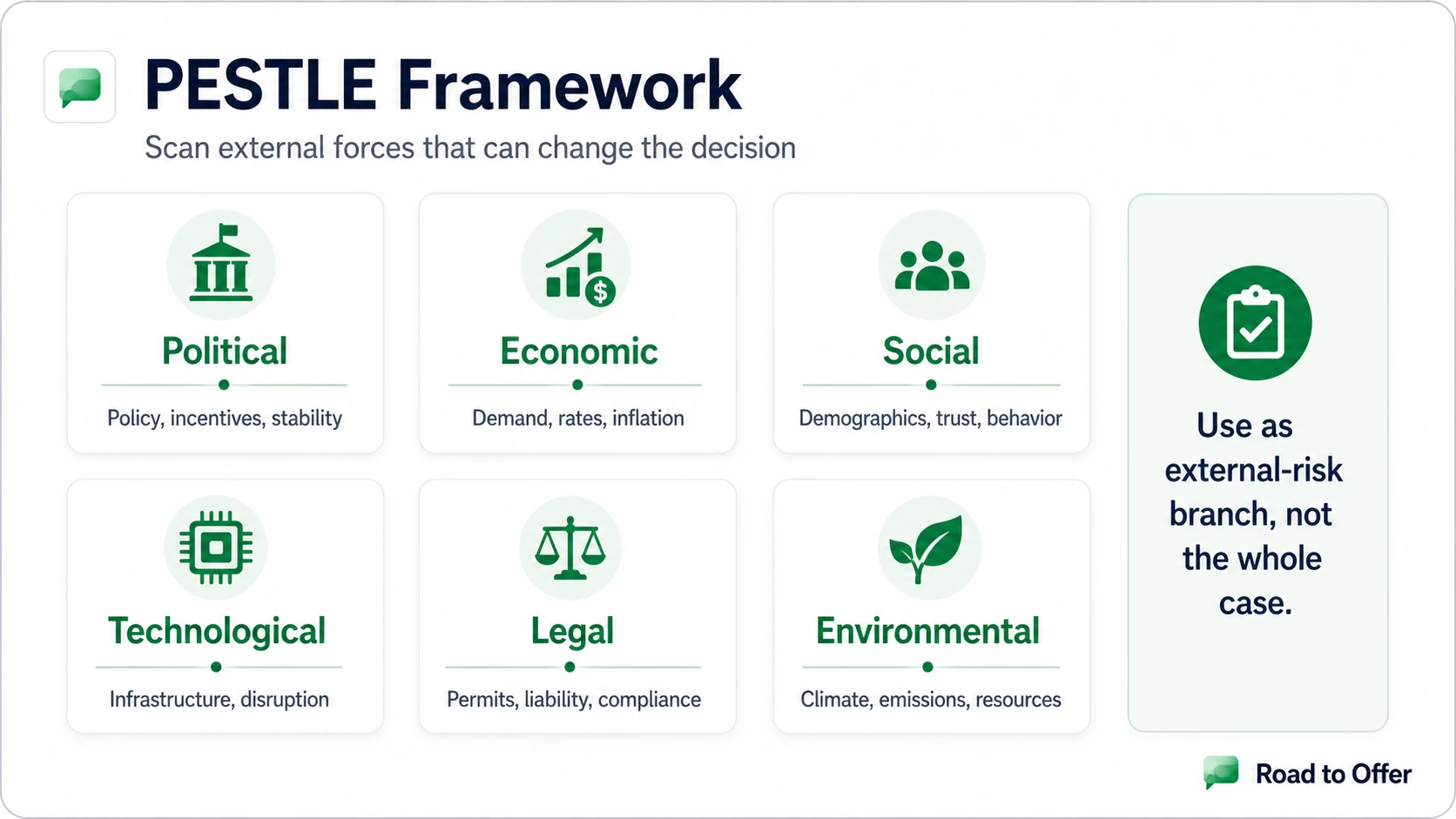
The profitability framework and market entry framework are starting points for private sector analysis. For government cases, PESTEL (Political, Economic, Social, Technological, Environmental, Legal) is the primary environmental scan.
PESTEL is not a replacement for an issue tree. It is a structured read of the external environment that precedes your analytical framework. In government cases, political and legal factors are first-order constraints, not afterthoughts.
PESTEL Framework for Government Cases
- 01
Political. Political will, election cycles, ministerial priorities, coalition dynamics, opposition risks
- 02
Economic. Budget constraints, fiscal position, macroeconomic context, funding sources (domestic vs. donor)
- 03
Social. Demographics, public opinion, cultural context, equity and inclusion considerations
- 04
Technological. Digital infrastructure, data availability, implementation readiness, cybersecurity
- 05
Environmental. Climate targets, resource constraints, environmental regulations, sustainability mandates
- 06
Legal. Constitutional constraints, procurement law, data privacy regulations, international obligations
How to use PESTEL in a case: after your initial structure, run a quick scan to identify which factors are active constraints versus background context. Political and legal factors tend to be hard constraints you cannot design around. Economic and social factors tend to be design inputs that shape what will work. Technological and environmental factors are often opportunity spaces where your recommendation can create leverage. You do not need to address all six. Identify the two or three most relevant, acknowledge the rest briefly, and focus your analysis on the binding constraints.
Moore's Public Value Triangle: The Three-Part Test Every Policy Must Pass
Mark Moore's Public Value Strategic Triangle (Harvard Kennedy School, 1995, updated 2013) is the foundational test for whether a government initiative is viable. It checks three dimensions at once:
- Public Value (societal benefit). Does the initiative deliver outcomes citizens and society genuinely value? Not what politicians say citizens want, but what evidence and direct engagement show citizens need.
- Authorization (political and legal legitimacy). Has the initiative secured enough political support and legal authority to proceed? Can it survive a change of government? Is it constitutionally permitted?
- Operational Capacity (implementation feasibility). Does the agency have the people, budget, technology, and organizational capability to execute? A brilliant strategy with 20% implementation capacity is not a viable recommendation.
All three must hold. High public value without authorization will not be approved. Political support without operational capacity will fail in execution. Strong recommendations address all three vertices explicitly.
A Fully Worked Government Case: Underperforming Public Schools
Government cases still contain hard arithmetic. The example below is adapted from a real McKinsey public sector case so you can see structure and math working together.
Prompt. A public school system serves 130,000 students across 13 grades (kindergarten through 12th). Statewide exam scores underperform the national average by roughly 20%. The state wants to know what is driving low performance and what to do about it.
Structure. A clean MECE tree splits the student journey into three branches:
- Admission and access: are the right students enrolled, and can they physically reach school?
- Learning: teacher quality, materials, study environment, and student motivation.
- Exams: consistency, conditions, and fairness of the assessment itself.
The quantitative leg. Inside the learning branch, the interviewer drills into materials. Junior high spans 2 of the 13 grades, each student needs 2 math books, and only 75% arrive on time. Of the delayed books, 75% are stuck in warehousing and 25% in online ordering. A proposed fix improves warehouse efficiency by 50% and online efficiency by 80%. How many more books arrive on time?
On-time delivery rises from 30,000 of 40,000 (75%) to 35,750 of 40,000, roughly 89%. That is a concrete, defensible operational win you can put in the synthesis.
Synthesis. Lead with the recommendation, attach the number, and close with the public-value frame: "Fixing logistics raises on-time materials delivery from 75% to 89%, a fast operational win. But materials alone will not close a 20-point gap, so I would pair it with teacher development and improved exam conditions, sequenced so the Department of Education can show measurable progress within one budget cycle." For more on delivering this final step, see case interview synthesis, and for the underlying arithmetic technique see case interview math practice.
Structure a McKinsey public sector operations case. Fifty escaped hippos in Colombia could reach 250 and threaten people and crops. Answer this McKinsey operations case step in the article, then continue the full case. Continue the full case on Road to Offer
Six Common Government Case Types
Government cases cluster around six recurring problem types. Each is a slight adaptation of a private sector equivalent.
For most of these, the analytical skeleton mirrors a private sector case. The difference is in the inputs (social outcomes instead of financial returns) and the constraints (political and legal rather than competitive). A digital transformation case inside a federal agency, for instance, uses the same current-state-to-roadmap structure but adds procurement law and legacy-system risk as binding constraints.
Social ROI: Quantifying Impact Without a P&L
The Social Return on Investment (SROI) methodology quantifies social outcomes in financial terms. It is the public sector counterpart to NPV analysis and pairs naturally with cost-benefit analysis when you are asked to value a government program.
Social ROI = (Total Social Value Created) ÷ (Total Investment)
A ratio of 4.2 means every $1 invested generates $4.20 in social value.
How to calculate it in a case: identify two or three measurable outcomes (graduates, readmissions prevented, citizens lifted above the poverty line), quantify the units, monetize each with government cost data or productivity estimates, sum the social value over the relevant horizon, total the investment (operating plus capital plus opportunity cost of public funds), and divide.
Worked example: early childhood education. A state is evaluating a $200M early-childhood expansion (10,000 additional children per year, 5-year program).
- Outcome 1, graduation. Early childhood education raises high school graduation by roughly 8 percentage points. 10,000 × 8% = 800 extra graduates per cohort. At $180,000 in incremental lifetime earnings each, that is 800 × $180,000 = $144M per cohort.
- Outcome 2, special education savings. Early intervention cuts special-education placement by about 15%. At $25,000 per child per year for 5 years: 10,000 × 15% × $25,000 × 5 = $187.5M.
- Outcome 3, justice savings. A 2% reduction in juvenile justice contact at $50,000 per case: 10,000 × 2% × $50,000 = $10M.
- Total social value (one cohort): $144M + $187.5M + $10M = $341.5M.
- Total investment (5 years): $200M.
- Social ROI: $341.5M ÷ $200M = 1.7x on a single cohort. Across multiple annual cohorts the cumulative ratio rises well above that.
The program clears the value test. The recommendation is to proceed, subject to authorization and operational capacity, which closes the loop back to Moore's Triangle.
McKinsey, Deloitte, and Booz Allen: What Each Firm Tests
The three leading government employers have distinct orientations that shape their interviews.
McKinsey (government practice). Cases mirror McKinsey's commercial format: hypothesis-led and interviewer-guided. The content leans toward transformational strategy such as digital governance, national education reform, and economic development. McKinsey rewards candidates who apply private sector rigor to public problems and who can reason about trade-offs between efficiency and equity and about sustaining reforms across political cycles. See the McKinsey case interview guide for the full format.
Deloitte (Government and Public Services). Cases are typically candidate-led and more operationally focused than McKinsey's. Common themes are IT modernization, program implementation, and regulatory compliance. Deloitte values strong project-management thinking, so your recommendation should include a credible implementation plan with milestones, a governance structure, and risk mitigation. See the Deloitte case interview guide.
Booz Allen Hamilton. Here the conventional wisdom is wrong. Booz Allen is behavioral-heavy and many candidates complete the process without a single formal case. The standard path is a recruiter screen followed by interviews weighted toward fit and the firm's core values, assessed with STAR-structured stories. When a case does appear it is usually candidate-led and set in a real government context such as federal IT modernization, defense logistics, public health, or cybersecurity, rather than a commercial profitability problem. Prepare both: tight STAR stories and a structured case approach for government scenarios. See the Booz Allen case interview guide.
Stakeholder Mapping: Navigating Political Complexity
Private sector cases have stakeholders (employees, customers, suppliers, shareholders). Government cases have political actors, and the dynamics differ in kind. A technically optimal but politically toxic recommendation will not be implemented.
Address four groups:
- Authorizers. Who must approve this (ministry, legislature, cabinet, oversight body)? What are their priorities and constraints?
- Implementers. Who must execute it (agency staff, local governments, contractors)? Do they have the capability and the incentive?
- Beneficiaries. Who is the program meant to serve? How do they access it, and what are their barriers?
- Opponents. Whose interests conflict (competing agencies, regulated industries, opposition politicians)? What power do they have to block or delay?
In a synthesis, name at least one actor per category when relevant: "The Ministry of Finance is the key authorizer and will resist on fiscal grounds, so I would phase the investment over three years to ease the appropriations hit." That signals the political maturity purely analytical candidates miss.
Execution checklist
Learn PESTEL with government-specific examples before your first mock. Candidates who use it fluently signal immediate familiarity with public sector context.
Memorize Moore's Public Value Triangle and practice applying all three vertices. It separates candidates who understand public sector logic from those relabeling private sector outputs.
Practice at least 3 social ROI calculations end to end. Quantifying social impact is the public sector equivalent of NPV. Fluency here signals analytical credibility.
Work the underperforming-schools example until the logistics math is automatic. Government cases hide real arithmetic inside a public-value wrapper. Drill it.
Research your target firm's practice areas before the interview. Deloitte runs IT and compliance, Booz Allen runs defense and behavioral fit, McKinsey runs transformational strategy. Tailor your framing.
Prepare STAR behavioral stories, especially for Booz Allen. Booz Allen often weights fit over case performance and may not give a case at all.
Related Guides
- Nonprofit Case Interview: mission-first logic and impact metrics that mirror government public-value cases.
- Social impact consulting firms: Bridgespan, FSG, Dalberg, MBB social impact practices, and capacity-building boutiques compared.
- ESG Sustainability Case Interview: carbon policy and climate infrastructure cases that often sit inside government mandates.
- Real Estate Case Interview: public housing, infrastructure siting, and government property portfolios.
- Supply Chain Case Interview: government procurement, military logistics, and public-sector resilience.
- Case Interview Prep for Career Changers: moving into consulting from a policy, government, or non-business background.
- Case Interview Types: how public sector cases fit alongside profitability, market entry, and other case archetypes.
Sources and Further Reading (checked June 18, 2026)
- Mordor Intelligence, public sector consulting and advisory services market: mordorintelligence.com/industry-reports/global-public-sector-consulting-and-advisory-services-market
- Market Research Future, public sector consulting and advisory service market: marketresearchfuture.com/reports/public-sector-consulting-advisory-service-market-36290
- Booz Allen Hamilton FY2025 results (SEC Form 8-K, exhibit 99.1): sec.gov/Archives/edgar/data/0001443646/000144364625000075/bahexhibit991q4fy25_fina.htm
- McKinsey Center for Government, how we help clients: mckinsey.com/industries/public-sector/how-we-help-clients
- Moore, M.H. (2013). Recognizing Public Value. Harvard University Press: hup.harvard.edu/catalog.php?isbn=9780674066755
- Social Value UK, SROI methodology guide: socialvalueuk.org/what-is-sroi
- McKinsey, Diconsa rural financial inclusion case study: mckinsey.com/industries/public-sector/our-insights/diconsa
- The Thinksters, real McKinsey public sector case example (schools logistics): thethinksters.com/real-mckinsey-interview-example-public-sector-case
Frequently asked questions
Resources and related guides
- Try a free live public sector case interviewPractice
- Browse all free resourcesResource hub
- 3Cs Framework: Company, Customer, Competitor (Worked Example)Frameworks · Feb 6, 2026
- 4C Framework Case Interview: The 4 Cs, a Worked Example & How to Use It (2026)Frameworks · Jun 28, 2026
- 4Ps Framework Case Interview: Product, Price, Place, PromotionFrameworks · Feb 6, 2026