
MECE Meaning: What It Stands For and Why Consultants Use It
MECE meaning explained: stands for Mutually Exclusive, Collectively Exhaustive. Coined by Barbara Minto at McKinsey, used in 80%+ of MBB cases.
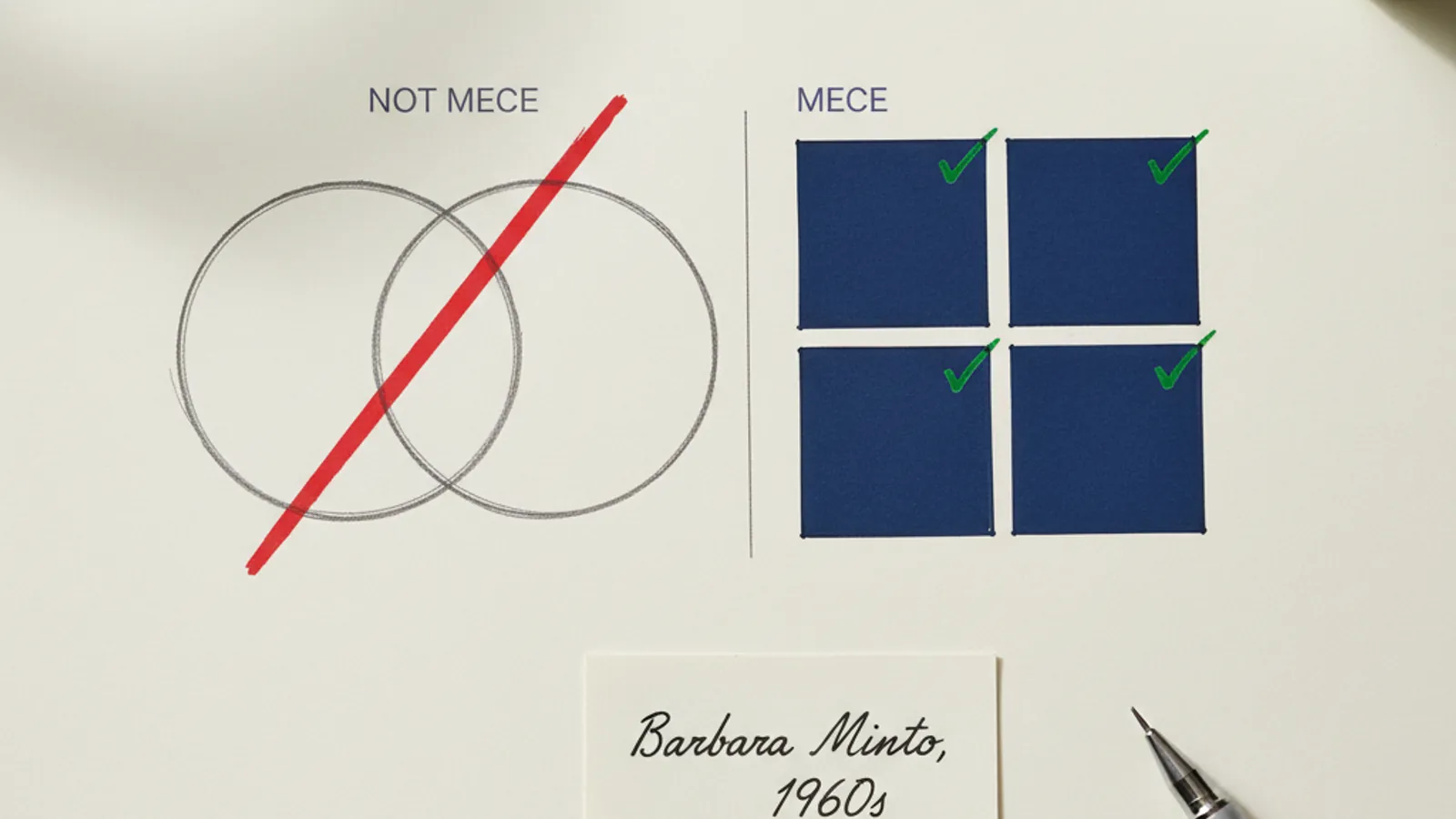
MECE means Mutually Exclusive, Collectively Exhaustive. It's the structuring quality test Barbara Minto invented at McKinsey in the 1960s and used today in roughly 80% of MBB case interviews. "Mutually exclusive" means each item fits one bucket only (no overlap); "collectively exhaustive" means the buckets together cover the whole problem (no gaps). MECE is not a framework, it's a test you apply to any framework. On Road to Offer's platform, the most-searched framework concept among candidates is "MECE." This page gives the clean 5-minute answer: what it stands for, who coined it, and why consultants still use it sixty years later.
TL;DR: What you need to know
- MECE stands for Mutually Exclusive, Collectively Exhaustive. No item fits two buckets; the buckets together cover 100% of the problem.
- Coined by Barbara Minto at McKinsey between 1963-1973 and formalized in The Pyramid Principle (Pearson, 1987). Minto was McKinsey's first female MBA hire.
- It's a quality test, not a framework. You apply it to issue trees, the 3Cs, profitability trees, customer segmentations: any structure can be checked for MECE.
- The 2-question test: "Can any single item fit in two buckets?" (mutual exclusivity) and "Is anything relevant missing?" (collective exhaustiveness).
- Used in 80%+ of MBB case interviews and weighted at roughly 30-35% of the overall structure score at McKinsey, BCG, and Bain.
What does MECE stand for?
MECE stands for Mutually Exclusive, Collectively Exhaustive. Pronounced "mee-see" (or "meece" if you ask Barbara Minto). The acronym describes two properties a structure must have at the same time: buckets don't overlap, and buckets together cover the whole problem. Pass both checks, your structure is MECE. Fail either, a McKinsey-style interviewer will spot it inside 30 seconds.
Each word does work. "Mutually exclusive" is a logical constraint: no item belongs in two categories at once. "Collectively exhaustive" is a completeness constraint: every relevant item belongs to at least one category. Together they describe a clean partition of the problem space (Source: Wikipedia, MECE principle, https://en.wikipedia.org/wiki/MECE_principle).
What does MECE mean in practice?
In practice, MECE means running two quick tests on any structure and knowing immediately whether it holds. This is the silent check every consultant runs while a candidate presents.
The mutual exclusivity test
Ask: "Could a single real example fit in two of my buckets?" If yes, the structure overlaps. Classic failure: "marketing, pricing, product, competition" as four drivers of revenue, where pricing is part of competition and marketing affects product perception. Fix by redefining boundaries or picking a single dimension (Source: PrepLounge, https://www.preplounge.com/en/case-interview-basics/mece-principle).
The collective exhaustiveness test
Ask: "If the answer to the case lived in one of my buckets, would I find it?" If no, you're missing a bucket. Classic failure: splitting costs into "salaries and rent" while ignoring equipment, taxes, marketing. Fix by anchoring on a math identity that's exhaustive by construction (Cost = Fixed + Variable).
A structure has to pass both tests to be MECE. Passing only one isn't enough. For the deeper rule and a worked 5-step build, see the MECE principle explained.
Who coined MECE?
Barbara Minto coined MECE at McKinsey between 1963 and 1973, where she was the firm's first female MBA professional hire. She developed it as part of a larger system for structured business communication, formalized in The Pyramid Principle: Logic in Writing and Thinking (Pearson, 1987). The book is still the canonical reference on consulting-style structured thinking and required reading at top MBA consulting clubs.
In her own words from a McKinsey alumni interview: "MECE: I invented it, so I get to say how to pronounce it." She prefers "meece" (rhyming with "fleece"); most consultants today say "mee-see." Both are accepted in an interview.
Minto traces the underlying logic back to Aristotle, who described the requirement that a logical partition include everything and exclude nothing. What Minto did was turn that classical principle into an operating standard at McKinsey, then export it through her book to BCG, Bain, the Big 4, and beyond (Source: Wikipedia, https://en.wikipedia.org/wiki/MECE_principle).
Why do consultants use MECE?
Three reasons that all compound into the same outcome: faster, clearer recommendations under time pressure.
Quality control on structure
MECE is a checklist that catches overlap and gaps before analysis starts. Without it, a consultant might spend two weeks investigating four "drivers" only to find two were the same driver counted twice. With it, the mistake is caught in 60 seconds.
Reduced cognitive load for the audience
A MECE structure is easier for a partner, client CEO, or case interviewer to follow because they don't have to mentally check whether a finding belongs in branch A or branch B (it can only be in one). According to IGotAnOffer, clean structure means the partner reads the deck in 15 minutes instead of an hour.
Faster synthesis
When buckets don't overlap, the recommendation writes itself. When they do, synthesis becomes a fight over what counts where. In case interviews, structure carries roughly 30-35% of the overall score at McKinsey, BCG, and Bain (Source: Management Consulted, https://managementconsulted.com/mece-framework-case-interview-example/).
"MECE is the operating standard for consulting structure: every issue tree, every segmentation, every cost breakdown is built MECE and tested against the 2 questions before it leaves the consultant's desk."
What are 3 quick examples of MECE?
Three short examples: one case interview, one daily life, one wrong-vs-right comparison.
Example 1: Case interview (revenue decline)
MECE: Revenue = Price × Volume. Every dollar of revenue change comes from a price effect, a volume effect, or both. Exhaustive (covers every dollar), non-overlapping (a price change is not a volume change).
Non-MECE: "Revenue depends on marketing, pricing, product, and competition." Marketing affects volume; pricing is part of competition; product affects both. The branches overlap and there's no completeness test.
Example 2: Daily life (sorting laundry)
MECE: Whites, lights, darks. Every garment falls into one pile by color; the three piles cover the full load.
Non-MECE: "Cottons, work clothes, towels, things that go in the dryer." A cotton work shirt fits three piles, and "things that go in the dryer" cuts on heat tolerance instead of fabric or function. Mixing dimensions is the most common MECE failure.
Example 3: Wrong vs. right cut (customer segmentation)
Wrong: Small businesses, online customers, enterprise clients, repeat buyers. A small online repeat-buyer business fits three buckets. Three dimensions (size, channel, behavior) collapsed onto one level.
Right: B2C consumers, B2B businesses, government/public sector. One dimension (buyer type), every customer fits exactly one bucket.
For live application in case interviews, see how to apply MECE in cases.
What's the difference between MECE, the MECE Principle, and the MECE Framework?
These three terms get used interchangeably online, which causes confusion. They're related but distinct.
| Term | What it is | Use it when |
|---|---|---|
| MECE (concept / meaning) | The acronym and definition: Mutually Exclusive, Collectively Exhaustive. The thing you're checking for. | You need the definition, the etymology, or the 2-question test. (This page.) |
| MECE Principle | The rule itself, with the 2-question test, common failure modes, and historical origin. | You need to understand the principle deeply: when it applies, when it fails, why it matters. See the MECE principle. |
| MECE Framework | The applied how-to: how to build MECE structures in case interviews, with drills and live-case examples. | You're prepping for an interview and need to practice building MECE structures. See the MECE framework guide. |
Short version: this page tells you what MECE is. The principle page tells you why and when it works. The framework page shows you how to use it under pressure.
Is MECE used outside consulting?
Yes. MECE shows up wherever analysts decompose a problem cleanly: law (claims must not overlap, defenses must cover all elements), product management (one user need shouldn't map to two epics), investment research (revenue models must be MECE or they double-count cash flows), and academic writing.
Consulting "owns" MECE because McKinsey systematized it and Minto's Pyramid Principle became canonical. The underlying logic predates Minto by two thousand years and is taught in introductory logic as the requirement for a well-formed classification.
Free resource:
Want the full case-interview prep stack (frameworks, math, fit, drills, mock cases) in one place? Grab the free consulting toolkit bundle, which includes a MECE structure cheat sheet alongside the rest of the Road to Offer prep library.
Frequently Asked Questions
What does MECE stand for?
MECE stands for Mutually Exclusive, Collectively Exhaustive. Mutually exclusive means each item in your structure fits exactly one bucket (no overlap). Collectively exhaustive means the buckets together cover the entire problem (no gaps).
What is the MECE principle?
The MECE principle is the rule that any well-structured analysis should be both mutually exclusive (no overlap) and collectively exhaustive (no gaps). It's a quality test, not a framework. See the MECE principle explained.
Who invented MECE?
Barbara Minto invented MECE at McKinsey between 1963 and 1973 (the firm's first female MBA professional hire) and formalized it in The Pyramid Principle (Pearson, 1987).
Is MECE only for consulting?
No. MECE is used in law, product management, investment research, and academic writing whenever an analyst needs to decompose a problem cleanly. It's most associated with consulting because McKinsey formalized it.
How is MECE different from a framework?
A framework (3Cs, Porter's Five Forces, profitability tree) is a specific structure. MECE is the quality test you apply to any framework. The 3Cs framework, for example, is MECE if you scope each C correctly and non-MECE if you let the buckets blur.
What is the MECE full form?
The full form of MECE is Mutually Exclusive, Collectively Exhaustive. Pronounced "mee-see" by most consultants. Barbara Minto, who coined it, prefers "meece." Either is acceptable.
Related reading and next steps
- MECE Principle Explained – the rule, the 2-question test, common failures
- MECE Framework: How to Apply It – live case application and drills
- Issue Tree Case Interview – build MECE issue trees from scratch
- 3Cs Framework – a framework you test with MECE
- Case Interview Frameworks: Complete Guide – the full toolkit
- Ready to practice? Run timed structure drills or take a mock case with AI feedback on the Road to Offer dashboard.
Sources and further reading (checked May 15, 2026)
- Minto, Barbara. The Pyramid Principle: Logic in Writing and Thinking. Pearson, 1987.
- McKinsey Alumni: Barbara Minto, "MECE: I invented it, so I get to say how to pronounce it".
- Wikipedia: MECE principle.
- PrepLounge: MECE Principle guide with applied examples.
- IGotAnOffer: MECE Framework (Meaning, Examples, McKinsey).
- Management Consulted: MECE Framework: Case Interview Example.
FAQ
Frequently asked questions
Keep reading
Related articles
MECE Framework: How to Apply It in Case Interviews (With Examples)
Apply the MECE framework in 5 steps. 3 worked case examples (profitability, market sizing, M&A), a decision tree, and the pitfalls that fail 30% of structures.
BCG Matrix: Growth-Share Framework for Cases
The BCG matrix compares growth and share to guide portfolio investment, divestment, and prioritization decisions.
Case Structure vs Case Framework
Why case structure and case frameworks are not the same thing, and how to use frameworks as a starting point instead of a memorized script.