
Marketing Case Interview: The 5C-STP-4P Framework, Examples, and Drills (2026)
Marketing case interviews use the 5C-STP-4P framework. Learn when to apply it with a worked product launch example, key metrics, and practice drills.
On this page
A marketing case interview asks how a company should sell a product more effectively. One useful Road to Offer framework is 5C-STP-4P: use the 5Cs to diagnose, STP to define the target and positioning, and the 4Ps to build the go-to-market plan. No representative dataset establishes one universal interview prevalence by firm.
Practice marketing cases with AI feedback
Road to Offer gives you structured practice on commercial cases with instant feedback on your framework, analysis, and recommendation logic.
When You Get a Marketing Case
Recognizing a marketing case is the first diagnostic step. Interviewers rarely announce "this is a marketing case." Instead, they embed it in a prompt. Common signals:
- Declining revenue despite a stable cost base: if costs are fine but revenue is dropping, the problem is commercial, not operational.
- New product launch: "our client wants to introduce a new line" almost always requires a 5C-STP-4P structure.
- Brand repositioning: "customers no longer see us as premium" is a marketing and positioning problem.
- Pricing misalignment: "our price is in line with competitors but conversion is low" points to a value-communication failure.
- Market expansion: "we want to target a new customer segment" requires STP before you get to the 4Ps.
The critical distinction: marketing cases are about how to sell, not whether to enter. If the prompt includes phrases like "should we expand into Germany?" or "is this a good market to enter?" you are in market entry framework territory. If the prompt assumes you are already competing and asks how to improve commercial performance, it is a marketing case.
Many marketing cases start as profitability declines: a revenue drop caused by losing market share or declining pricing power. In those situations, use the profitability framework to isolate the root cause first, then transition to 5C-STP-4P once you have confirmed the problem is commercial in nature. For a broader overview of when to use which framework, see our case interview frameworks complete guide.
The 5C-STP-4P Framework: Step by Step
The 5C-STP-4P framework runs in three sequential stages. Stage one (5Cs) builds your situational diagnosis. Stage two (STP) locks in your strategic targeting and positioning. Stage three (4Ps) translates strategy into a tactical go-to-market plan. Skipping ahead to the 4Ps without completing the 5Cs and STP is one of the most common mistakes candidates make. It produces recommendations that are tactically detailed but strategically groundless.
5C-STP-4P Marketing Case Framework
- 01
5Cs: Situational Diagnosis. Company, Collaborators, Customers, Competitors, Context: understand the full picture before recommending anything
- 02
STP: Strategic Targeting. Segmentation (who exists), Targeting (who to focus on), Positioning (what value proposition wins that segment)
- 03
4Ps: Go-to-Market Plan. Product, Price, Place, Promotion: tactical execution derived from your STP choices, not invented in isolation
- 04
Key Metrics. Quantify: CAC, LTV, market share by segment, brand awareness, conversion rate, NPS, payback period
- 05
Recommendation. Prioritized action with an estimated revenue or market share impact and a clear rationale
Stage 1: The 5Cs
Company. Start with an honest assessment of your client's assets and constraints. What is the current revenue, growth rate, and margin profile? What are the core capabilities (brand reputation, distribution reach, manufacturing capacity, innovation pipeline)? What are the weaknesses that could limit the go-to-market plan? Candidates often skip this step, but it is essential: a premium brand cannot pursue a low-price strategy without eroding equity it took years to build.
Collaborators. Who are the key partners in the value chain? Distributors, retail partners, co-manufacturers, marketing agencies, and licensing partners all shape what is commercially possible. If your recommended strategy requires channels your client does not currently have access to, that is a material execution risk. Partnership savings depend on the channel, contract, and operating model, so calculate them from explicit case assumptions.
Customers. This is the most important C. Who currently buys, how often, how much, and why? Who is not buying but could? What is the NPS, and what drives satisfaction or dissatisfaction? Use a jobs-to-be-done lens: what problem is the customer trying to solve, and how well does this product solve it? Behavioral data matters more than stated preferences: what customers do outweighs what they say.
Competitors. What is the competitive set, and how does your client compare on price, product, brand equity, and distribution? Where is share being won or lost? A brand losing share to a lower-priced competitor has a different diagnosis than one losing share to a premium entrant. The Ehrenberg-Bass Institute's research on brand growth confirms that mental availability (being top of mind in a buying situation) is the primary driver of market share, not product superiority alone (Byron Sharp, How Brands Grow, Oxford University Press, 2010).
Context. Macro forces that affect the category: economic conditions, regulatory changes, cultural shifts, and category-wide trends. Are consumers trading up or trading down? Is the category growing or contracting? Is there a regulatory threat (e.g., sugar taxes for beverages, labeling requirements for packaged foods)? Context sets the outer boundary for what strategies are feasible.
Stage 2: STP
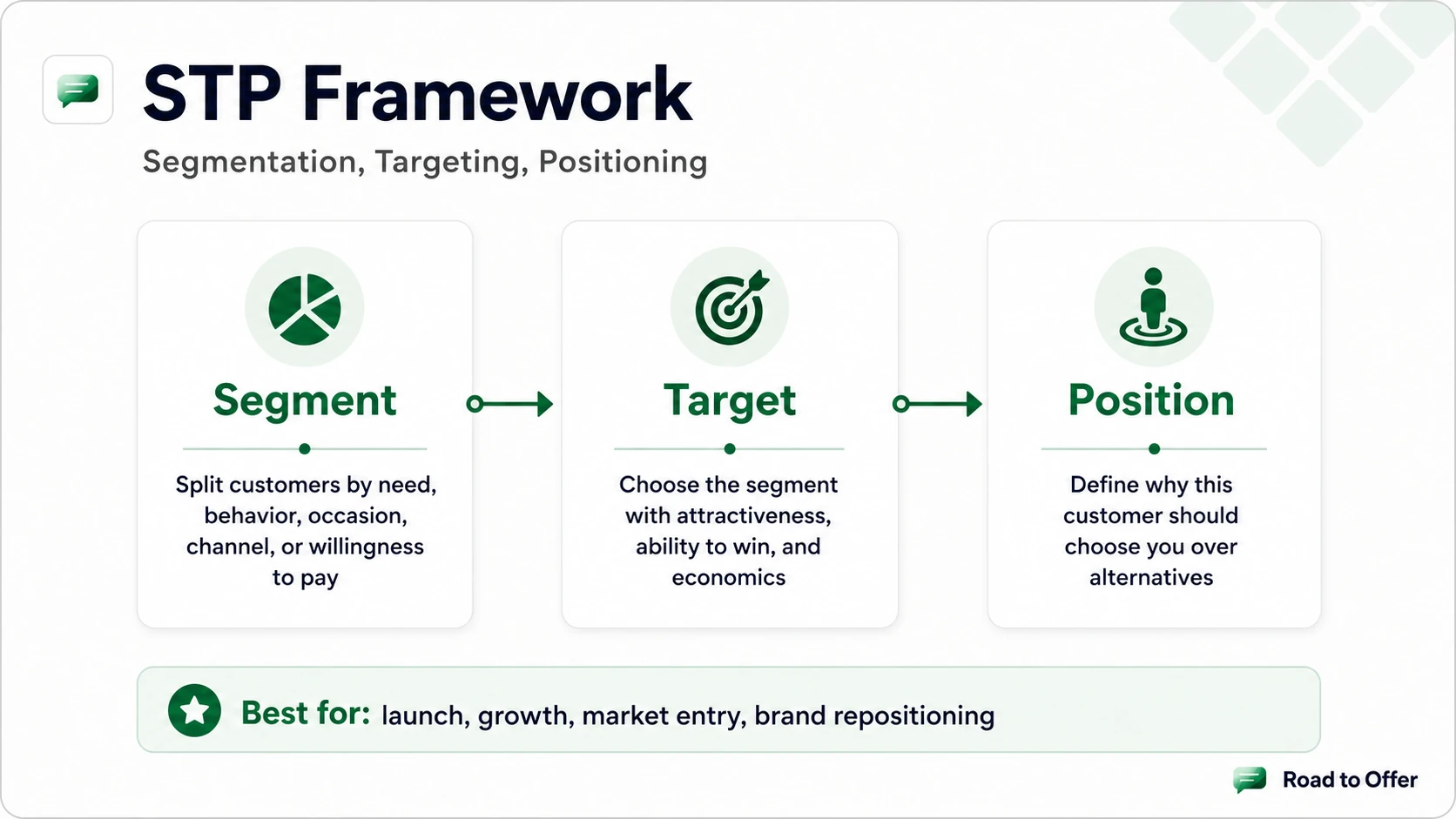
Segmentation. Divide the total addressable market into meaningful customer groups based on needs, behaviors, or demographics. Good segmentation is actionable: segments should be large enough to matter, distinct enough to serve differently, and measurable enough to track. Common segmentation bases in marketing cases include: heavy vs. light users, premium vs. value seekers, occasion-based (everyday vs. special occasion), and channel preference (online vs. offline). For a full treatment, see our customer segmentation framework guide.
Targeting. Choose which segment(s) to prioritize. This is a resource allocation decision. Evaluate each segment on two dimensions: attractiveness (segment size, growth rate, current penetration) and ability to win (brand fit, competitive position, cost to serve). The best target segment is not always the largest. It is the one where the intersection of attractiveness and competitive advantage is strongest.
Positioning. Define the value proposition for the target segment. A strong positioning statement answers: for [target customer], [brand] is the [category frame of reference] that [key benefit] because [reason to believe]. Positioning is not a tagline. It is a strategic choice about what the brand will and will not stand for. Do not assume positioning creates a universal price premium; test willingness to pay and conversion in the case.
Stage 3: The 4Ps
With your STP locked, the 4Ps become execution levers derived from your positioning, not an independent checklist. For a deep dive into the 4Ps mechanics, see our 4Ps framework case interview guide.
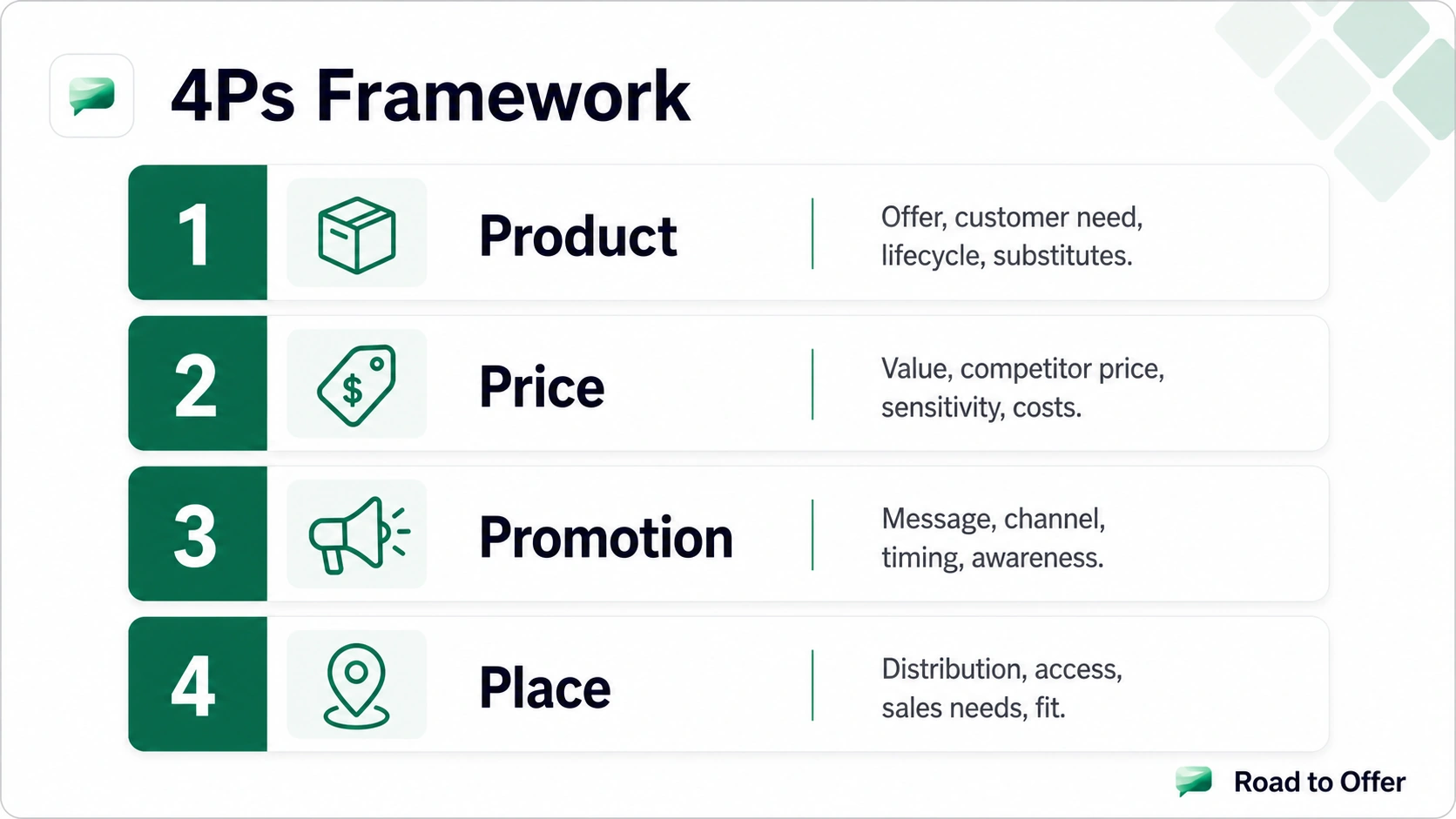
Product. Does the current product deliver on the positioning for the target segment? If the positioning is "premium convenience," does the product design, packaging, and quality signal premium? Identify which features drive the most value for the target segment and ensure those are excellent. Everything else is a nice-to-have.
Price. Set the price at the intersection of value delivered, competitive reference, and brand positioning. A premium positioning requires a premium price. Discounting undermines brand equity faster than almost any other action. Use the three pricing lenses: cost-plus sets the floor, competitive pricing sets the reference range, and value-based pricing sets the ceiling based on willingness to pay.
Place. Where does the target segment shop, and does your distribution reach them there? Channel choice is a brand decision as much as a logistics decision. A premium brand in dollar stores sends the wrong signal. Map the margin stack by channel: the channel that captures the most absolute margin per unit is not always the right choice if it conflicts with positioning. For channel strategy details, see our pricing strategy cases guide which covers channel margin economics.
Promotion. How do you build awareness, drive consideration, and convert the target segment? Structure your promotion analysis around the funnel: top (awareness), middle (consideration and evaluation), and bottom (conversion and retention). Quantify where you are and where you need to be: if brand awareness among the target segment is 25% and the category average is 60%, the primary investment should be in reach and awareness, not conversion optimization.
Worked Example: AquaFlow Sparkling Water Relaunch
Prompt: A US beverage brand wants to relaunch its sparkling water line after 2 years of declining sales. Revenue dropped from $180M to $140M. The category is growing at 8% annually. How would you approach the relaunch?
5Cs Diagnosis
Company. AquaFlow is a mid-market sparkling water brand with 20 years of history, strong grocery distribution (85% ACV nationally), and manufacturing capacity of 500M units annually. Current utilization is at 60% due to volume declines. Brand health tracking shows brand awareness has dropped from 52% to 38% among 18–35-year-olds, the fastest-growing demographic in the category. Gross margin is 38%, below the category leader (LaCroix) at 44%.
Collaborators. AquaFlow distributes through three major grocery chains, two national distributors, and a network of regional convenience stores. Retail partners have reduced shelf space allocation from 8 facings to 5 due to declining velocity. The brand has no direct-to-consumer capability.
Customers. Exit research and NPS data (NPS: +12, down from +34 two years ago) show the core loyalty base is 35–55-year-olds who value no-calorie hydration. The 18–35 segment, which drove category growth, perceives AquaFlow as "old" and "flat." Trial rates among 18–35 have dropped 40% in two years. The primary competitor gaining share is Liquid Death (premium, irreverent positioning) and store-brand sparkling water (value positioning).
Competitors. The market has bifurcated: premium brands (LaCroix, Liquid Death, Spindrift) own the upper end with strong brand identities; private label captures the value end. AquaFlow is caught in the middle: priced above private label but without the brand identity to justify a premium. This "stuck in the middle" trap is a classic Porter positioning failure (Michael Porter, Competitive Strategy, Free Press, 1980, hbsp.harvard.edu/product/competitive-strategy).
Context. The sparkling water category grew 12% last year and is projected at 8–10% CAGR through 2030, driven by health-conscious consumers trading out of sugary soft drinks. Regulatory tailwinds are positive (no sugar taxes apply to plain sparkling water). However, shelf competition is intensifying: grocery chains have reduced total sparkling water SKUs by 15% while adding private label, putting pressure on mid-tier brands.
Diagnosis: AquaFlow's revenue decline is not a category problem; the category is growing. It is a brand relevance and positioning problem concentrated in the 18–35 segment. The brand is perceived as outdated, is losing shelf space due to declining velocity, and is priced in a "no-man's-land" between premium and value.
STP
Segmentation. Four segments exist in sparkling water:
- Health-conscious millennials (25–38, urban/suburban, income $60K+): fastest growing, willing to pay $1.50–2.00/can
- Hydration pragmatists (35–55): existing AquaFlow core, buy for value and habit, price-sensitive
- Fitness/active consumers (20–40): want functional positioning (electrolytes, natural flavors)
- Value seekers: buying on price, primarily served by private label
Targeting. Primary target: health-conscious millennials. This is the highest-growth, highest-willingness-to-pay segment, and it is where AquaFlow has the largest gap. Secondary: retain hydration pragmatists (current loyalty base) without cannibalizing them. Abandoning the secondary segment entirely risks a further revenue step-down while the primary target is being rebuilt.
Positioning. For health-conscious millennials, AquaFlow will relaunch as "effortlessly pure": crisp, clean sparkling water made with no additives, no sweeteners, no gimmicks. The positioning deliberately contrasts with Liquid Death's aggressive irreverence (appealing to a different millennial sub-segment) and Spindrift's real-fruit positioning (a different benefit). Illustrative case assumption: AquaFlow has 16mg sodium per 12oz versus the assumed LaCroix benchmark of 35mg. That is a credible product truth that supports the "pure" positioning.
4Ps Go-to-Market Plan
Product. Reformulate packaging: slim-can format (replaces round can to match category visual language), new minimalist label design reflecting "effortlessly pure" positioning, and an updated flavor portfolio dropping the four lowest-velocity SKUs and adding two new natural flavors (yuzu and cucumber-mint) that index strongly with the target segment. Core product formula remains unchanged. The mineral source is the brand's credible differentiator.
Price. Increase list price from $1.19/can to $1.49/can (25% increase). This moves AquaFlow off the shelf-space floor and into the premium-adjacent price band occupied by LaCroix. The margin impact: at $1.49 vs. $1.19, with stable COGS of $0.73/can, gross margin per can moves from $0.46 (39%) to $0.76 (51%). Volume will decline from the price increase, but the margin accretion is material. Price elasticity estimate: at 25% price increase, model a 10–15% volume decline. The modeled revenue change is approximately +6–13%. Break-even: if volume declines no more than 20%, revenue is flat or slightly positive and margin expands significantly.
Place. Prioritize shelf positioning in natural/health food sections of major grocery (Whole Foods, Sprouts, Kroger Natural) rather than the main beverage aisle, which is dominated by private label. This is a positioning signal as much as a distribution strategy. Negotiate for 6+ facings in the health section in exchange for promotional support. Add convenience and gym retail (SoulCycle retail, Equinox, REI snack bars) as premium touchpoints consistent with the target segment lifestyle. Deprioritize dollar store distribution entirely, as it contradicts the new positioning.
Promotion. $18M total launch budget allocated across:
- Digital/social ($7M): Instagram and TikTok content campaign featuring the "effortlessly pure" positioning; creator partnerships with health/wellness accounts (target: 150M impressions in 12 months)
- Retail activation ($5M): in-store displays, end caps, and sampling at target grocery partners
- PR and events ($3M): sponsorship of three major US 10K/half-marathon events where the target segment concentrates
- Sampling/trial ($3M): targeted sampling at gyms, yoga studios, and farmers markets in top 10 metro markets
Projected impact: If the relaunch achieves brand awareness recovery to 45% among 18–35 (from current 38%), trial rate recovery to 22% (from depressed 13%), and average purchase frequency of 2.8 cases/year, the model projects:
- Year 1 revenue: ~$148M (still below the $180M peak but reversing the decline trajectory)
- Year 2 revenue (with distribution growth): ~$162M
- Year 3 target: return to $180M with 41% gross margin vs. 38% today
Recommendation
Reposition AquaFlow as "effortlessly pure" targeting health-conscious millennials with a 25% price increase, full packaging refresh, channel realignment away from value retail toward health/natural and premium convenience, and an $18M 12-month launch campaign. The single most important metric to track in the first 90 days is brand awareness recovery among 18–35-year-olds. If awareness does not move, the distribution and pricing changes cannot do their job.
Practice a Bain growth strategy case in beauty retail. Growth has stalled at a Korean beauty marketplace that leads its US category. Answer this Bain growth strategy case step in the article, then continue the full case. Continue the full case on Road to Offer
Key Marketing Metrics Every Candidate Must Know
Retention can materially affect LTV, but quantify the effect from the case's cohort retention, contribution margin, and repeat-purchase data rather than importing a universal profit-uplift range.
Common Mistakes in Marketing Case Interviews
A common structural error is failing to link the 5Cs diagnosis to the STP choices and the STP choices to the 4Ps recommendations. The three stages should form a logical chain: because the diagnosis shows X (5Cs), the right target is Y and the positioning is Z (STP), therefore the product needs A, the price should be B, the channels should be C, and the promotion plan should do D (4Ps). If any link in that chain is missing, the recommendation lacks analytical rigor.
For more on structuring consulting recommendations, see our growth strategy cases guide.
Get scored feedback on your marketing case framework
Road to Offer's Guided Mode walks you through commercial cases step by step, scoring your structure, metrics use, and recommendation logic, the same dimensions real interviewers evaluate.
Related Frameworks and When to Bridge
Marketing cases rarely exist in isolation. Knowing when to bring in adjacent frameworks is a sign of analytical maturity.
- Profitability first, marketing second. When revenue is declining, always rule out cost-side issues before assuming a marketing problem. See the profitability framework guide for the diagnostic structure.
- Customer segmentation is the foundation of STP. The customer segmentation framework guide covers advanced segmentation approaches used in CPG and B2B marketing cases.
- Market entry vs. marketing cases. If the prompt is ambiguous, see the market entry framework guide for the full go/no-go decision structure.
- Pricing strategy depth. When price is the primary lever, the pricing strategy cases guide covers value-based pricing, elasticity analysis, and price architecture in depth.
- 4Ps tactics. For a full breakdown of each P with worked examples, see the 4Ps framework case interview guide.
Interactive Drills: Marketing Problem Diagnosis
Interactive drill set. Write an answer before revealing the worked solution, then continue into Road to Offer for scored practice and AI feedback.
Ready to practice marketing cases with real-time AI feedback?
Road to Offer scores your 5C-STP-4P structure, metrics use, quantitative analysis, and final recommendation. Practice commercial cases with AI feedback that adapts to your level.
Related Guides
- Retail Case Interview: marketing cases for consumer brands frequently overlay with retail channel strategy and private label decisions
- New Product Launch Case Interview: go-to-market execution and launch marketing planning connect directly to the 4Ps stage of marketing cases
- Revenue Growth Case Interview: marketing-led revenue growth cases (volume expansion, new customer acquisition) build on the same STP logic
- Digital Transformation Case Interview: digital marketing platforms, martech stack consolidation, and performance marketing attribution cases
- Growth Strategy Cases
- 4Ps Framework for Case Interviews
Sources (checked June 17, 2026)
- McKinsey & Company, "Winning the battle for growth in consumer goods": mckinsey.com/industries/consumer-packaged-goods/our-insights/winning-the-battle-for-growth-in-consumer-goods
- Bain & Company, "Prescription for Cutting Costs" (customer retention economics): bain.com/insights/prescription-for-cutting-costs
- Byron Sharp, How Brands Grow (Ehrenberg-Bass Institute, mental availability and market share): Oxford University Press, 2010
- Harvard Business Review, "Branding in the Age of Social Media" (brand positioning and price premium): hbr.org/2016/03/branding-in-the-age-of-social-media
- Michael Porter, Competitive Strategy (stuck-in-the-middle positioning failure): Free Press, 1980; Harvard Business School Press edition: hbsp.harvard.edu/product/competitive-strategy
- HubSpot, "STP Marketing Model Explained": blog.hubspot.com/marketing/stp-marketing
- Corporate Finance Institute, "5C Analysis": corporatefinanceinstitute.com/resources/management/5c-analysis
Frequently asked questions
Resources and related guides
- Practice marketing in a real case interviewPractice
- Browse all free resourcesResource hub
- STP Framework: Segmentation, Targeting, Positioning (Case Guide)Frameworks · Jun 2, 2026
- Airline Case Interview: Profitability Framework, Revenue Drivers, and Worked Examples (2026)Frameworks · Mar 29, 2026
- Ansoff Matrix Case Interview: The 2x2 Growth Framework Explained with ExamplesFrameworks · Mar 25, 2026
- Real Estate Case Interview: Framework, Metrics, and Worked Example (2026)Frameworks · Mar 31, 2026