
Willis Towers Watson Interview: Process, Cases & Prep Strategy (2026)
WTW interviews can combine HireVue assessments, behavioral rounds, and case studies. Full breakdown with worked examples and prep plan.
On this page
WTW interview processes vary by role, team, and location. The firm's careers guidance describes a recruiter conversation, optional HireVue or role-based assessment, hiring-manager interviews, and final conversations with relevant team members or stakeholders. For consulting and advisory roles, candidate reports commonly include behavioral questions plus case studies in employee benefits, retirement, insurance risk, workforce, or broader advisory scenarios.
Why WTW Interviews Are Different From MBB
WTW is not a management consulting firm in the McKinsey/BCG/Bain sense. It is an advisory firm specializing in human capital, risk management, and insurance broking. Where MBB cases test general business problem-solving, WTW cases anchor in industry-specific scenarios: designing a benefits package, pricing cyber insurance, or modeling a pension plan freeze. You do not need to be an actuary, but candidates who reason through insurance and benefits mechanics will outperform those who treat it as generic strategy consulting.
The other major difference is that some WTW processes include HireVue or a role-based assessment before later interviews. Your invitation should define the exact step, timing, and format.
Practice case interviews with instant AI feedback
WTW cases test structured thinking across HR, risk, and benefits scenarios. Road to Offer gives you AI-scored feedback on structure, math, and synthesis after every practice case.
The WTW Interview Process: Round by Round
Step 1: Online Application and Resume Screen
WTW's early careers portal accepts applications on a rolling basis for most geographies. The resume screen filters for academic credentials (strong GPA, quantitative coursework), relevant internships, and demonstrated analytical skills. This is the highest-volume elimination point; the majority of applicants never reach the HireVue stage.
Step 2: HireVue Video Assessment
Some candidates receive a HireVue invitation after application review. Your invitation controls the exact timing and format, but candidate reports commonly describe:
The most common mistake we see from candidates on Road to Offer is treating HireVue like a casual video call. A structured video screen rewards concise, organized answers. Use the STAR method (Situation, Task, Action, Result) for every response, and practice recording yourself at least 3 times before the real assessment. See our behavioral interview consulting guide for story frameworks that translate directly to HireVue.
Step 3: First-Round Interviews (2 Consultants)
Candidates who clear the early screen are invited to first-round interviews, often conducted via video with consultants or hiring-team members. A common consulting-interview format includes:
- Behavioral questions (15–20 minutes): Why WTW? Tell me about a time you influenced a team decision. Describe an analytical problem you solved.
- Case study (25–35 minutes): A business problem related to WTW's practice areas, often in benefits design, workforce restructuring, or risk management.
The behavioral component is heavier than at MBB firms. WTW interviewers weight cultural fit and motivation alongside analytical capability. Prepare specific answers for "Why WTW and not a Big 4 firm?" and "Why advisory consulting versus pure strategy?" Generic answers about wanting to "solve business problems" will not differentiate you.
Step 4: Final Round or Assessment Day
For some consulting and early-career processes, candidate reports describe a final round or assessment day with multiple interviewers. The format may include:
- Individual case interviews: Same format as Round 1 but with more complex, multi-part scenarios
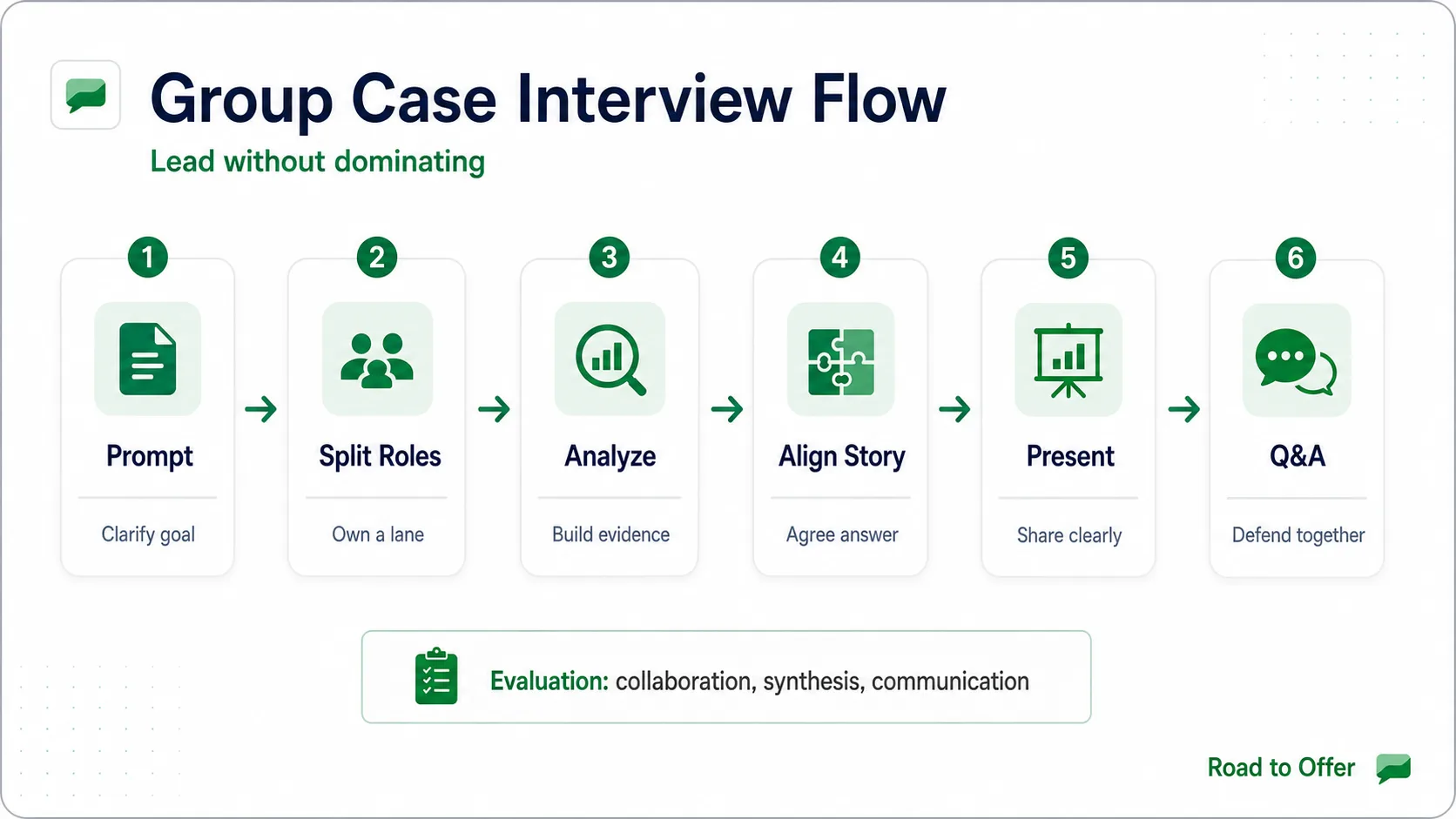
- Group case exercise: If assigned, you collaborate with other candidates on a case problem and present findings to a panel
- Behavioral deep-dive: Expect follow-up questions probing your motivational fit, career aspirations, and understanding of WTW's business model
If your process includes a group case, WTW can evaluate collaboration style, how you contribute to team problem-solving, and whether you can synthesize a group's analysis into a coherent recommendation. For preparation strategies, see our group case interview guide: the dynamics apply directly.
WTW Case Interview: What to Expect
WTW case interviews are best described as semi-structured: the interviewer presents a business scenario and you drive the analysis, but the interviewer will redirect you if you go off track. This is closer to BCG's candidate-led style than McKinsey's interviewer-led approach.
Common Case Types at WTW
Based on candidate reports from Glassdoor, Wall Street Oasis, and Management Consulted, the most frequently reported case themes at WTW are:
For case frameworks that apply across all of these, see the case interview frameworks complete guide. For profitability-specific structure, the profitability framework is your go-to.
Worked Example: Employee Benefits Redesign
Prompt: A Fortune 500 technology company with 30,000 employees spends $450M annually on employee health benefits. Costs have grown 8% year-over-year for three consecutive years, significantly outpacing revenue growth of 4%. The CHRO has engaged WTW to recommend a benefits strategy that reduces cost growth to under 5% annually without reducing employee satisfaction scores below 80% (currently at 85%).
Clarifying questions to ask:
- What is the breakdown between employer-paid premiums, employee contributions, and self-insured claims?
- Which benefit categories are driving the 8% cost growth (medical, dental, pharmacy, or behavioral health)?
- Has the company benchmarked its benefits against peer tech employers?
- Are there regional variations in cost or utilization across the workforce?
Structure (3 buckets):
Bucket 1: Cost drivers (where is the money going?)
- Premium vs. claims breakdown: Self-insured firms have more levers than fully insured.
- Category analysis: Medical is 65–70% of spend; pharmacy is the fastest-growing (12–15% annual growth).
- Utilization concentration: Typically 5% of members generate 50%+ of claims.
Bucket 2: Plan design levers (what can change?)
- HDHP migration: Shifting 40% of employees to a high-deductible plan reduces employer cost 10–15%.
- Pharmacy formulary tightening: Stricter formulary or preferred network saves 5–8%.
- Centers of excellence: Steering complex procedures to lower-cost facilities saves 15–20% per procedure.
- Telemedicine expansion: Replacing 20% of non-emergency visits with virtual care saves $50–80 per visit.
Bucket 3: Employee experience (protecting satisfaction)
- HSA employer contributions ($1,000–1,500/year) offset HDHP sticker shock.
- Strong change-management communication prevents satisfaction drops from plan redesigns.
Quantitative analysis:
Current spend: $450M. At $50M–77M savings, annual growth rate drops from 8% to approximately 2–4%, meeting the CHRO's target. Satisfaction risk is manageable if the employer funds HSA contributions ($15M–20M investment) and runs a strong change-management communication campaign.
Calculate savings in a WTW case from the Road to Offer drill engine. Answer a real prompt and get AI-scored feedback. Free accounts include 5 drills per day for the first 3 days after signup.
Recommendation: Implement a three-part strategy: (1) introduce an HDHP option with $1,500 employer HSA seed as the default plan for new hires, migrating existing employees over 2 years; (2) renegotiate the pharmacy formulary with the PBM to capture $15M+ in savings; (3) launch a centers-of-excellence network for the top 5 highest-cost procedure categories. Expected net savings: $35M–55M annually after HSA seed funding, bringing cost growth below the 5% target while maintaining satisfaction above 80%.

Profitability · medium
Practice a WTW-style cost and margin recovery case
Consumer Packaged Goods / Beverages
How should you align your Willis Towers Watson resume and cover letter before this interview?
Write for the selected advisory, risk, insurance, people, or other role instead of one broad WTW profile. Show quantitative judgment and stakeholder communication that the posting and your record support.
- Before: Supported an advisory project.
- After: Compared two risk scenarios, tested the key assumption, and summarized the decision implication for the project sponsor.
Check the target business and current assessment process before naming either. Recruiters read the documents together: the resume proves the evidence, while the letter explains why the selected WTW role. Rehearse the revised line against the guide's advisory-case framework and current invitation.
Make the risk judgment easier to follow
Upload the resume for an independent graded report, not a WTW competency score.
Revise one advisory line, rehearse its tradeoff, and bring the implication into the next case rep.
WTW vs. Peer Firms: Interview Comparison
For deeper comparisons with specific Big 4 firms, see the Deloitte case interview guide and PwC case interview guide. For the bigger picture, see how WTW's advisory model ranks against the main consulting firm types, from MBB strategy to specialist risk and benefits firms.
The Fit Interview: What WTW Looks For
WTW's behavioral interview is embedded in every round; there is no standalone "fit round" separate from cases. Expect three categories:
- Motivational: Why WTW specifically? Why Health, Wealth & Career, or why Risk & Broking?
- Behavioral: "Tell me about a time you worked in a team where members disagreed." "Describe a project where you analyzed complex data to make a recommendation."
- Situational: "A client pushes back on your recommendation because it increases short-term cost. How do you respond?"
For structuring these answers, our case interview fit questions guide covers STAR format and consulting fit themes. The consulting career path guide helps you articulate long-term trajectory in a way that resonates with WTW interviewers.
Common WTW Interview Mistakes
1. Treating WTW like a generalist strategy firm. WTW's cases are domain-specific. Showing up with only profitability and market-sizing frameworks, without any understanding of insurance mechanics or benefits economics, signals you have not researched the firm.
2. Underestimating HireVue. The recorded HireVue round is a common elimination point for WTW applicants, yet many candidates barely rehearse it. Record yourself practicing at least 5 answers before the real assessment.
3. Weak "Why WTW?" answers. "I want to do consulting and WTW seems interesting" is a non-answer. Reference specific practice areas (Health & Benefits, Retirement, Risk & Broking), recent WTW thought leadership, or the firm's unique position between pure consulting and insurance broking.
4. Ignoring the group case dynamics. In the final-round group exercise, some candidates try to dominate the conversation. WTW interviewers are watching for collaborative problem-solving. Contribute specific analytical insights, build on others' points, and volunteer to synthesize. That is the leadership signal they look for.
5. Poor quantitative estimation in cases. WTW cases may involve insurance-specific math (loss ratios, combined ratios, claims reserves). You do not need actuarial-level precision, but you should be comfortable with percentage-of-revenue calculations and basic financial ratios. Our case interview math practice guide covers the mental math foundations. Candidates also interviewing at adjacent firms should review the Accenture case interview guide and the KPMG case interview guide for comparable HR and benefits consulting case formats.
4-Week WTW Prep Plan
Execution checklist
Week 1: Foundations + HireVue. Master the profitability and market entry frameworks. Record 8–10 HireVue practice answers using STAR format. Watch your recordings and eliminate filler words, rambling, and vague outcomes. Aim for 90-second answers that hit all four STAR beats.
Week 1: WTW Research. Read WTW's Annual Report overview and understand the two segments (Health, Wealth & Career vs. Risk & Broking). Review 3–5 WTW thought leadership pieces on their website. Prepare your 'Why WTW?' answer with segment-specific detail.
Week 2: Case Practice (General). Complete 8–10 practice cases covering profitability, market entry, and M&A. Focus on structured frameworks and clean quantitative analysis. Use Road to Offer drills plus the profitability framework and case interview frameworks guide as references.
Week 2: Domain Knowledge. Learn basic insurance and benefits terminology: combined ratio, loss ratio, HDHP vs. PPO, self-insured vs. fully insured, PBM, formulary. You do not need to be an expert, but you need enough vocabulary to structure a WTW-specific case without freezing.
Week 3: WTW-Specific Cases. Practice 4–6 cases modeled on WTW scenarios: benefits redesign, insurance market entry, pension plan optimization, workforce restructuring. Ask a practice partner to play the role of a WTW interviewer who probes domain knowledge.
Week 3: Group Case Practice. Run 2–3 group case simulations with 3–5 participants. Practice contributing analytically, building on others' points, and synthesizing the group's findings. Time each session to 45 minutes.
Week 4: Full Mock Interviews. Conduct 4 full mock interviews: 15 minutes behavioral + 30 minutes case. Get feedback on structure clarity, domain credibility, and recommendation quality. Simulate back-to-back interviews to build stamina for the half-day final round.
Framework for WTW-Style Advisory Cases
WTW Advisory Case Framework
- 01
1. Clarify the Advisory Mandate. What decision is the client trying to make? Is this a cost problem, a design problem, a risk problem, or a competitive positioning problem? WTW cases often have a dual objective (e.g., reduce cost AND maintain satisfaction).
- 02
2. Segment the Problem by Stakeholder. WTW's advisory work affects multiple stakeholders: employer, employees, insurers, and regulators. Map who is affected and what each stakeholder needs. This is different from pure-strategy cases where there is usually one decision-maker.
- 03
3. Quantify the Current State. Size the baseline: total spend, cost growth rate, utilization metrics, benchmark comparisons. WTW interviewers expect you to anchor analysis in numbers, not just conceptual frameworks.
- 04
4. Identify Levers and Trade-offs. For each problem area, list 2–3 specific levers. Crucially, identify the trade-offs. WTW's business is built on balancing competing objectives (cost vs. coverage, risk vs. premium, retention vs. budget).
- 05
5. Recommend with Implementation Detail. Lead with the recommendation. Include a phased timeline, estimated financial impact, and the top risk to manage. WTW consultants deliver advice that clients can act on next quarter, not theoretical strategies.
Ready to practice WTW-style cases?
Road to Offer's AI case coach runs live simulations scored on structure, quantitative analysis, and recommendation quality so you can rehearse WTW-style trade-offs before the real interview.
Sources and Further Reading (checked June 17, 2026)
- WTW official, Early Careers Application Process & FAQ: https://careers.wtwco.com/early-careers-application-process-faqs
- WTW official, Candidate journey: https://careers.wtwco.com/blogs/life-at-wtw/Your-candidate-journey-at-WTW
- WTW official, About Us Overview: https://www.wtwco.com/en-us/about-us/overview
- Glassdoor, WTW Interview Questions (2026): https://www.glassdoor.com/Interview/WTW-Interview-Questions-E1122768.htm
- Wall Street Oasis, Willis Towers Watson Interviews (2026)
- Management Consulted, WTW Interviews and Culture
- Hacking the Case Interview, WTW Case Study Interview Guide
Frequently asked questions
Resources and related guides
- Run a real case interviewPractice
- Browse all free resourcesResource hub
- McKinsey vs BCG: 10 Real Differences (2026 Guide)Firm Specific · May 1, 2026
- Accenture Case Interview: Strategy vs Consulting, Group Format, and Prep Plan (2026)Firm Specific · Mar 15, 2026
- AlixPartners Careers 2026: Turnaround Salary and Interview GuideFirm Specific · Sep 11, 2026