
McKinsey 7S Framework: How to Use It in Case Interviews (2026)
Master the McKinsey 7S framework for case interviews. Learn all 7 elements, Hard vs Soft S distinction, when to apply it, and a worked retail example.
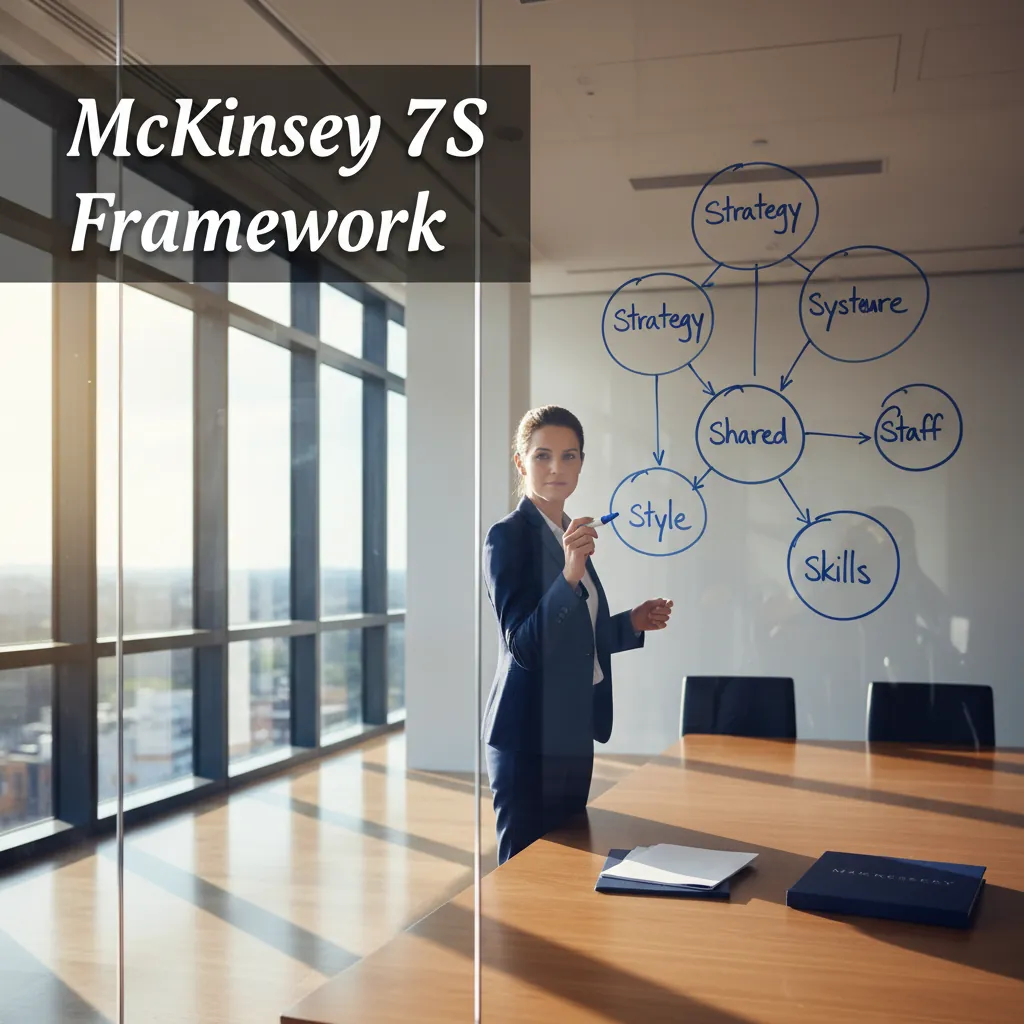
The McKinsey 7S framework diagnoses organizational underperformance by examining seven interdependent elements — Strategy, Structure, Systems, Shared Values, Style, Staff, and Skills — and identifying where they fall out of alignment. When a client's financials are deteriorating despite a sound strategy, the root cause almost always lives in one of these seven dimensions and the friction between them.
In case interviews, the 7S framework signals to interviewers that you can think beyond financials and operations to the organizational root causes of business problems. Most candidates reach for the profitability tree or market entry framework by reflex. Knowing when — and how — to apply 7S instead is a genuine differentiator.
The 7 Elements Explained
The 7S model separates its elements into Hard S (tangible, document-driven) and Soft S (intangible, culture-driven). Hard S elements are easier to identify and adjust quickly; Soft S elements take longer to shift but have greater long-term impact on performance.
Hard S Elements
Strategy defines where the organization chooses to play and how it plans to win — which markets, customer segments, and value propositions it pursues and which it deliberately ignores. In case interviews, probe strategy by asking: Is the stated strategy coherent? Is it differentiated from competitors? Is the organization actually executing against it?
Structure is how work, authority, and accountability are organized — business units, functions, reporting lines, spans of control, and governance mechanisms. Common structure problems in cases include over-centralization that slows decisions, matrix structures that create accountability gaps, and misaligned incentives between divisions.
Systems encompass the processes, technologies, and routines that run the business day-to-day — planning, budgeting, performance management, risk and compliance, IT platforms, and core operating processes. Systems misalignment often shows up as data silos, inconsistent metrics, or manual workarounds that consume significant labor.
Soft S Elements
Shared Values are the organization's core beliefs and non-negotiables — the principles that inform decisions when the rules don't specify. They sit at the center of the 7S diagram because they shape all other elements. A company that espouses "customer first" but compensates salespeople purely on volume has a Shared Values conflict that undermines strategy.
Style refers to how top leadership manages and interacts — the behavioral signals they send about what is rewarded, tolerated, and punished. A risk-averse leadership style in a company pursuing aggressive market expansion creates a predictable execution gap.
Staff covers how the organization recruits, develops, motivates, and rewards its people — not just headcount, but the talent pipeline and employee value proposition. Staff misalignment often appears when a firm acquires new capabilities it cannot retain: the talent leaves within 18 months of the deal.
Skills are the enterprise's distinctive capabilities — what it is actually good at, organizationally. Skills differ from Staff: you can have talented people (Staff) who lack the specific capability (Skills) the strategy requires. A hospital system pivoting to value-based care needs analytical and care coordination skills that a fee-for-service model never developed.
| Element | Category | Key Diagnostic Question |
|---|---|---|
| Strategy | Hard S | Does the strategy reflect deliberate choices about where NOT to compete? |
| Structure | Hard S | Do reporting lines and governance support or impede the strategy? |
| Systems | Hard S | Do processes and technology create consistency or friction? |
| Shared Values | Soft S | Do stated values drive actual decisions under pressure? |
| Style | Soft S | Does leadership behavior reinforce or contradict the strategy? |
| Staff | Soft S | Does the talent model attract and retain what the strategy requires? |
| Skills | Soft S | Does the organization have the distinctive capabilities the strategy demands? |
When to Use 7S in a Case Interview
The 7S framework is the right tool when the case prompt involves one of three scenarios:
Organizational effectiveness — A client's financial results are declining despite a stable market. Competitors aren't obviously outperforming. The problem is internal. This is the clearest signal to use 7S because operational and financial frameworks will surface symptoms without identifying root causes.
Post-merger integration — Two organizations have been legally combined but performance hasn't improved — or has degraded. M&A value destruction is almost always a people and culture problem, not a financial one. 7S helps map where the legacy organizations conflict across each dimension.
Change management — A client is launching a major strategic shift (digital transformation, new market entry, restructuring) and needs to understand what organizational elements need to change, in what sequence, to make the strategy stick.
Do NOT reach for 7S in a standard profitability decline with an identifiable external cause, a market sizing question, or a market entry case with no organizational complexity. Using a complex framework where a simple one works signals poor judgment — not sophistication.
Step-by-Step Application in a Case
Step 1: Clarify the Organizational Scope
Before structuring your analysis, confirm what the case is actually asking. "Performance has declined" could mean revenue, margins, employee retention, or customer satisfaction. The performance dimension shapes which 7S elements to prioritize.
Step 2: Map the Current State of Each Element
Work through all seven elements systematically, but spend your time on the most stressed dimensions. In an initial communication to your interviewer, you might say: "I'd like to use the McKinsey 7S framework to examine the organization's internal alignment. I'll start with the Hard S elements — Strategy, Structure, and Systems — to establish the structural picture, then move to Soft S to understand the cultural and people dimensions."
Step 3: Identify Key Misalignments
The diagnostic power of 7S comes from spotting contradictions between elements, not from cataloguing each element independently. The most common misalignments in case prompts are:
- Strategy vs. Structure (aggressive growth strategy with a slow, centralized structure)
- Strategy vs. Skills (entering a new vertical without the required capabilities)
- Shared Values vs. Systems (stated customer-centricity but performance management focused on internal metrics)
Step 4: Prioritize and Quantify Impact
Narrow your misalignments to the 2-3 highest-impact ones. Where possible, assign rough impact numbers: "If the approval process misalignment is adding 3 weeks to each product launch, and the company launches 20 products per year, that's a 60-week cumulative delay annually — likely costing $X in foregone revenue."
Step 5: Recommend with Sequence in Mind
When you change one element, you change the system. Your recommendations should acknowledge this. "Addressing the Skills gap first, before restructuring the operating model, ensures that the new structure doesn't create capability vacuums."
Worked Example: Retail Chain Performance Decline
Case prompt: A national retail chain with 450 stores has seen same-store sales decline 8% over the past two years. The CEO believes the strategy is sound — they pivoted to an "experience-first" positioning 18 months ago — but execution is lagging. Diagnose the problem.
Step 1 — Strategy check: The experience-first strategy is directionally coherent given e-commerce pressure, but 18 months is too short to fully evaluate. Note it and move on.
Step 2 — Structure: The chain uses a regional management structure where store managers report to district managers who report to regional VPs. Decisions about in-store experience (fixtures, events, staffing models) require VP approval — a 6-to-8-week cycle. This is a Strategy vs. Structure misalignment: an experience-first strategy requires local responsiveness, but the structure enforces central control.
Step 3 — Systems: The company's inventory and performance management systems were built for a transaction-volume model. Stores are still measured on units per square foot and average transaction value, not on experience metrics like Net Promoter Score or dwell time. Strategy vs. Systems misalignment.
Step 4 — Skills: Store managers were hired and promoted for operational efficiency under the previous model. Experience design, event programming, and community engagement are distinct skills that most current managers lack and the training budget hasn't yet addressed. Strategy vs. Skills misalignment.
Step 5 — Shared Values & Style: If the CEO communicates "experience-first" in town halls but regional VPs still hold stores accountable for comparable transaction metrics, the Shared Values signal is mixed. Leadership behavior (Style) is reinforcing the old model.
Quantified impact: If the structural approval delay is causing 60% of planned in-store experience initiatives to miss their launch window, and experience initiatives correlate with a 3-4% same-store sales lift in the pilot stores, the structure problem alone could account for approximately 2-2.5 percentage points of the 8% decline.
Recommendations — in sequence:
- Immediately delegate experience-design authority to store managers (Structure fix, fastest to implement)
- Add NPS and dwell-time metrics to district and regional scorecards (Systems fix)
- Launch 90-day manager capability-building program focused on experience design (Skills fix)
- Have regional VPs publicly drop units-per-square-foot from their quarterly reviews to signal the values shift (Style and Shared Values fix)
How to Present 7S Insights in a Case
Structure your synthesis around misalignments, not elements. Never walk an interviewer through all seven elements sequentially — it reads as a checklist, not an analysis. Instead:
- State the primary diagnosis: "The core problem is that the experience-first strategy lacks the structural and measurement alignment to execute."
- Name the 2-3 critical misalignments with supporting evidence
- Give sequenced recommendations with ownership (who does what) and timeline
- Acknowledge what you'd want to validate before committing to the full plan
A strong 7S synthesis takes 60-90 seconds. Interviewers at firms like McKinsey, BCG, and Bain assess synthesis as a distinct skill — see the case interview synthesis guide for detailed technique. For the opening of your case, the case interview opening statement guide covers how to frame your framework choice cleanly.
Common Mistakes to Avoid
Forcing 7S onto every organizational case. Not every org problem needs seven dimensions. If the case is clearly a cost structure problem in a specific division, a simpler decomposition is faster and more credible.
Treating elements as independent. The diagnostic value of 7S is in the interconnections. If you analyze each element in isolation and never identify a misalignment, you've used the framework as a checklist, which adds no value.
Spending equal time on all seven elements. In a 40-minute case, you have time to go deep on 3-4 elements. Identify which dimensions are most stressed and allocate time accordingly.
Ignoring the Soft S elements. Most candidates default to analyzing Strategy, Structure, and Systems because they feel more concrete. But in organizational effectiveness and change management cases, the Soft S elements — particularly Shared Values and Style — are where the root causes live. A 2025 PMC study on healthcare organizations found that McKinsey 7S soft elements were the primary differentiators between high and low performing organizations.1
Recommending changes without acknowledging interdependence. Changing structure without addressing skills creates new dysfunction. Your recommendations must be presented as a sequenced system, not a to-do list.
For a broader view of when to deploy different frameworks, the case interview frameworks complete guide provides a decision framework for choosing between tools. If your case has a hypothesis-driven element, see case interview hypothesis-driven approach. For post-merger cases, market entry framework and profitability framework often complement 7S analysis.
QuizSet
Test yourself
1 / 3Question 1 of 3
A regional bank just acquired a fintech startup. Six months post-deal, retention of fintech talent is at 40% and product velocity has dropped 60%. Which 7S elements should you prioritize first?
Checklist
Execution checklist
Memorize all 7 elements with one-sentence definitions
You must be able to define each element instantly without hesitation — interviewers test fluency
Practice distinguishing Hard S from Soft S out loud
Knowing the distinction signals framework depth; most candidates know the elements but not the categories
Prepare 3 case types where you would deploy 7S
Being able to say 'I'd use 7S here because...' demonstrates judgment, not just knowledge
Practice identifying 2 misalignments in a 90-second drill
The diagnostic skill — not the element list — is what gets evaluated in interviews
Practice presenting a 7S synthesis in under 90 seconds
Synthesis is a graded dimension; time yourself to build fluency before your interview
Review post-merger integration and change management case examples
These are the two most common 7S case types; specific familiarity increases confidence
Sources (checked April 1, 2026)
- PrepLounge — The 7S-Framework of McKinsey: https://www.preplounge.com/en/case-interview-basics/7s-framework-of-mckinsey
- Strategic Management Insight — McKinsey 7S Model Explained: https://strategicmanagementinsight.com/tools/mckinsey-7s-model-framework/
- Corporate Finance Institute — McKinsey 7S Model Overview: https://corporatefinanceinstitute.com/resources/management/mckinsey-7s-model/
- Management Consulted — McKinsey 7S Organizational Design Assessment: https://managementconsulted.com/mckinsey-7s/
- Wikipedia — McKinsey 7S Framework: https://en.wikipedia.org/wiki/McKinsey_7S_Framework
- Mindtools — The McKinsey 7-S Framework: https://www.mindtools.com/aicks4s/the-mckinsey-7-s-framework/
Footnotes
-
PMC — Evaluating organisational performance in healthcare using McKinsey 7S: https://pmc.ncbi.nlm.nih.gov/articles/PMC12083357/ ↩
FAQ
Frequently asked questions
Keep reading
Related articles
Energy Case Interview: Oil & Gas Framework, Worked Example, and Prep Guide (2026)
Energy case interviews require a different cost structure map than standard cases. Master the upstream/midstream/downstream value chain, key metrics, and the transition framework that McKinsey, BCG, and Deloitte actually use.
ESG Case Interview: Dual-Metric Framework, Scope Emissions, and Worked Example (2026)
Master ESG case interviews with the dual-metric recommendation framework, Scope 1/2/3 emissions structure, five common case types, and a fully worked supply chain decarbonization example.
Nonprofit Case Interview: IFOS Framework, Bridgespan Process, and Prep Plan (2026)
Nonprofit case interviews invert the private-sector logic — impact first, financial sustainability second. Full breakdown of the IFOS framework, Bridgespan's process, and a 4-week prep plan.