
FTI Consulting Case Interview: Format, Practice Areas, and Prep Guide (2026)
FTI Consulting case interviews are candidate-led: restructuring cases focus on liquidity and cash flow, economic consulting cases are data-driven. Prep guide.
On this page
FTI Consulting is one of the world's largest business advisory firms, but it is not a strategy consultancy. FTI specializes in high-stakes, time-sensitive situations: corporate bankruptcies, financial distress, economic damages litigation, regulatory investigations, and major transactions. Its case interviews reflect that. Rather than market entry or growth strategy cases, you should expect restructuring scenarios, cash flow analysis, and investigative logic. If you prepare for FTI using a standard MBB framework guide, you will walk into the wrong interview.
Practice FTI-style restructuring and financial cases
Road to Offer simulates candidate-led cases with real-time feedback on your structure, cash flow logic, and synthesis quality.
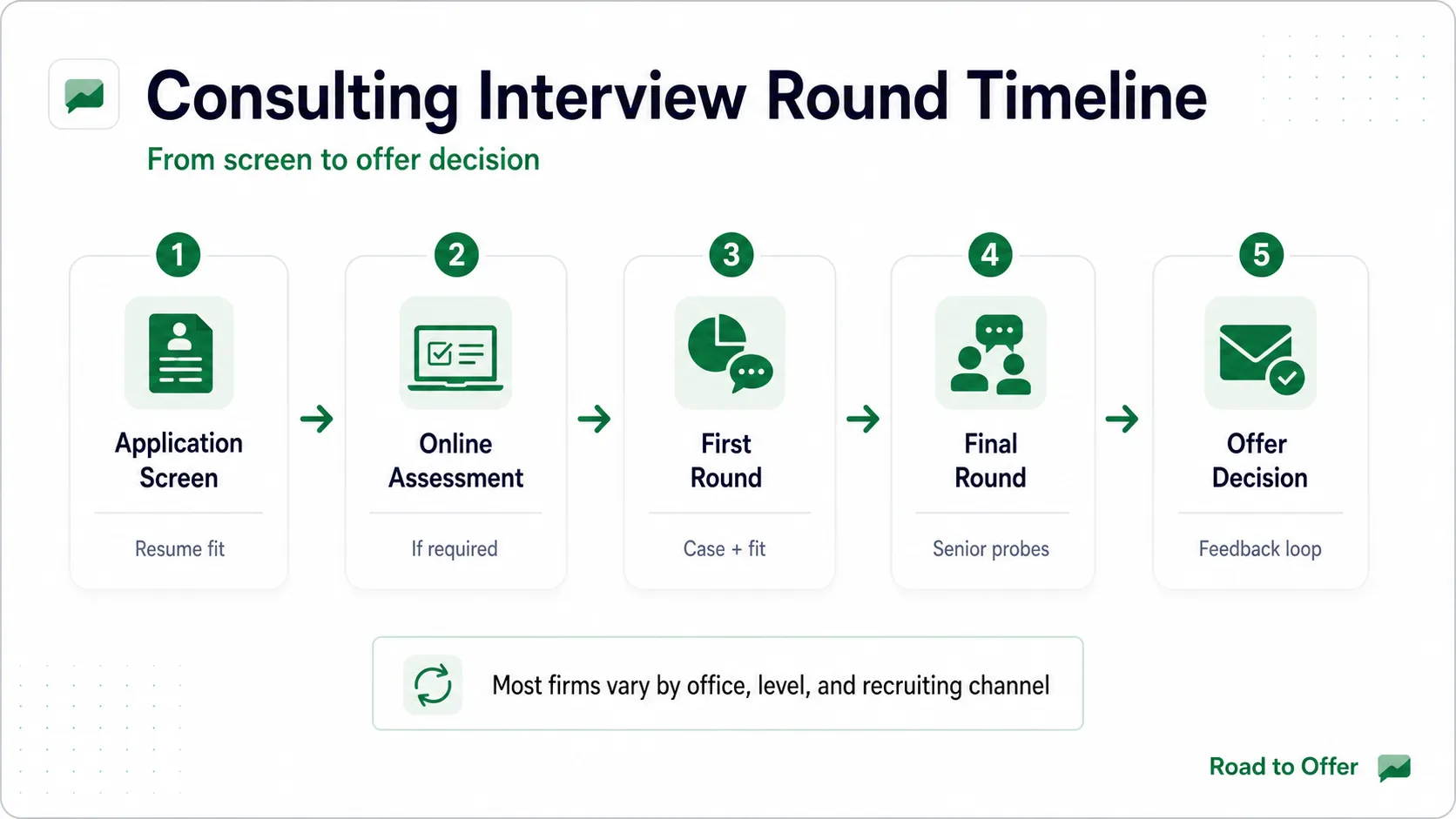
The FTI Consulting Interview Process
FTI's hiring process varies by practice area, office, role, and seniority level. The pattern below is a practical prep map, not a guarantee for every posting.
Round 1: Behavioral and Fit
The first round is primarily behavioral. Expect classic fit questions alongside FTI-specific probes:
- Why FTI over a strategy firm like McKinsey or Bain?
- Walk me through a situation where you had to make a decision with incomplete financial data.
- Tell me about a time you worked on a project with a tight, non-negotiable deadline.
- What do you know about FTI's restructuring work in [relevant sector]?
FTI interviewers probe whether you genuinely understand what advisory work looks like in distress situations. Vague answers about "wanting to help companies grow" miss the mark. FTI's work is more often about helping companies survive.
Later Rounds: Cases + Behavioral Interviews
Later rounds are the core evaluation. Candidate reports often describe multiple interviews with consultants, managers, and directors. The exact count, timing, and case mix vary by role, but you should be ready for both case work and behavioral deep dives.
Case interview details:
- Format: Often candidate-led or hybrid (you drive the structure, ask for data, and synthesize)
- Duration: Commonly a meaningful portion of a standard interview slot
- Case type: Strongly shaped by the practice area you are interviewing for
If a networking lunch, coffee chat, or dinner is included, treat it as part of the evaluation environment: interviewers may notice how you communicate across seniority levels and whether you demonstrate genuine curiosity about the firm's work.
FTI vs. MBB: What Makes FTI Cases Different
FTI cases share the candidate-led structure common across consulting, but the content and knowledge requirements diverge significantly from MBB.
The single biggest mistake candidates make is treating FTI like a second-tier MBB interview. It is not. The financial depth required (particularly for Corporate Finance & Restructuring roles) is closer to investment banking or restructuring advisory prep than to standard case interview prep.
How should you align your FTI Consulting resume and cover letter before this interview?
Write for the selected FTI practice and office, whether the role concerns restructuring, transactions, investigations, or another current area. Use only evidence that matches the posting and your record.
- Before: Assisted on a turnaround.
- After: Built the weekly cash view, isolated the delayed collection issue, and prepared the options used in the stakeholder review.
Check that confidential detail uses a safe proxy and that the line does not imply experience you did not have. Recruiters read the documents together: the resume proves the work, while the letter explains fit for the selected practice. Rehearse the evidence against the matching FTI case context.
Tighten the practice evidence before submission
Drop the resume here for an independent graded report on whether the restructuring evidence holds up. Road to Offer's score, not a firm hiring decision.
By uploading, you agree to resume analysis and report storage until you delete it. See the privacy policy.
Revise one practice line, rehearse its tradeoff, and bring that evidence into the next case rep.
Practice Area Deep Dive: Corporate Finance & Restructuring
Corporate Finance & Restructuring (CF&R) is one of FTI's signature practices and a common destination for finance-oriented consulting hires. It is also where some of the most technically demanding cases appear.
What CF&R Does
FTI's CF&R team advises companies in financial distress, creditors in bankruptcy proceedings, boards navigating M&A transactions, and executives managing complex capital structure decisions. High-profile engagements have included major airline restructurings, retail Chapter 11 filings, and multi-billion-dollar creditor advisory mandates.
Case Types You Will See in CF&R Interviews
1. Liquidity and cash flow stabilization A recurring CF&R case type. You are given a distressed company with negative cash flow and asked to design an immediate stabilization plan. The framework is the 13-week cash flow: a rolling cash forecast that maps every cash inflow and outflow over the next 13 weeks to determine how long the company can survive and what actions buy the most time.
Key questions to structure your answer:
- What is the current cash balance and weekly burn rate?
- What is the minimum operating cash level below which operations fail?
- Which cash outflows are fixed vs. deferrable?
- Where can collections (receivables) be accelerated?
- Which supplier payments can be extended without triggering supply disruption?
2. Profitability and cost structure Similar to a standard profitability framework case, but with higher urgency and a balance sheet dimension. You must identify which business units or product lines are cash drains vs. contributors, and sequence cost actions by impact and implementability.
3. Capital structure analysis You may be given a company's debt schedule and asked to assess whether the capital structure is sustainable. This involves calculating debt-to-EBITDA leverage ratios, interest coverage (EBITDA / Interest Expense), and free cash flow after debt service. You will need to know what a distressed capital structure looks like: leverage above 5–6x EBITDA, interest coverage below 1.5x, and approaching debt maturities with no refinancing path.
These leverage and coverage ratios are exactly the kind of fast, accurate quant FTI tests. Drill the underlying calculations so you can move from a debt schedule to a verdict without fumbling the arithmetic.
Practice restructuring case calculations from the Road to Offer drill engine. Answer a real prompt and get AI-scored feedback. Free accounts include 5 drills per day for the first 3 days after signup.
4. M&A and transaction advisory Less common at the interview stage, but FTI also advises on distressed M&A, where a buyer acquires a distressed target at a discount or a seller is forced to divest assets to raise liquidity. If you see a transaction case, apply the M&A case framework with a focus on asset value recovery and liability assumption.
For a deeper foundation on restructuring case mechanics, see our restructuring case interview guide.
Worked Example: FTI-Style Restructuring Case
Case prompt: "Your client is a mid-market specialty retail chain with $500M in revenue. Over the past 12 months, the business has burned through $80M in cash (approximately $6.7M per month). Cash on hand is now $35M. Revenue has declined 18% year-over-year. The CEO has asked FTI to develop a 13-week cash flow stabilization plan. Where do you start, and what are your recommendations?"
Before reading the worked solution, try a full candidate-led turnaround case where you have to diagnose a struggling operation and sequence stabilization actions by impact.

Operations · medium
Practice for FTI Consulting in a real case interview
Matched to this FTI Consulting guide: a live retail supply chain operations case with an AI interviewer. Free, scored on every step.
Step 1: Establish cash runway.
Cash on hand: $35M. Monthly burn: $6.7M. Runway: $35M ÷ $6.7M ≈ 5.2 months.
This is a critical finding. With just over 5 months of cash remaining, the company cannot survive without intervention. The plan must generate positive cash flow before month 5 or secure external liquidity.
Step 2: Diagnose the $80M burn.
Ask the interviewer to decompose the $80M cash burn:
Revenue declined 18% ($90M loss on $500M base) while the fixed cost base held steady. This is a classic contribution margin squeeze. With 70% fixed costs, a $90M revenue decline translates to approximately $63M in EBITDA deterioration.
Step 3: Build the stabilization plan (13-week horizon).
The 13-week cash flow plan targets actions that generate cash within 90 days. Prioritize by speed and certainty.
After stabilization: Adjusted cash position = $35M + $50.5M = $85.5M. Adjusted burn (post-actions) ≈ $3.5M/month. New runway: ~24 months. Stabilization achieved.
Step 4: Synthesize.
"The company has roughly 5 months of cash at current burn, insufficient to execute any strategic plan. The 13-week stabilization priorities are: immediately freeze capex and non-critical IT ($10.5M), accelerate receivables and extend payables in weeks 2-4 ($27M), and begin closing the 15 worst-performing stores in weeks 6-10 ($8M plus SG&A savings). Combined, these actions improve cash by approximately $50M over 13 weeks, extending runway to roughly 24 months and creating space for a broader operational restructuring. The primary risks are supplier relationships during the payables extension and employee morale during store closures. Both require direct CEO communication."
Economic Consulting at FTI
FTI's Economic Consulting segment (FTI Economic Consulting, or FTI EC) advises on antitrust, damages estimation, regulatory economics, and transfer pricing. It competes directly with Analysis Group, NERA, and Charles River Associates; for the broader category, see the economic consulting overview.
What EC Cases Look Like
Economic Consulting interviews at FTI differ substantially from CF&R:
- Less cash flow, more data interpretation: Cases may involve reviewing regression output, interpreting statistical significance, or designing a damages study methodology.
- Litigation-focused framing: Cases often begin "our client is a defendant in an antitrust case" or "we need to quantify damages caused by a patent infringement." Your job is to construct or challenge an economic argument.
- Microeconomics knowledge required: Supply and demand, price elasticity, market definition, HHI concentration analysis, and basic regression concepts (R², coefficients, standard errors).
Sample EC case prompt: "A pharmaceutical company is accused of anticompetitive pricing on a branded drug. Damages are claimed at $200M. Walk me through how you would assess whether the $200M figure is defensible and how you would build a counter-damages analysis."
Strong answer structure:
- Define the but-for world: What would prices have been absent the alleged conduct?
- Assess the damages methodology: What benchmark market was used? Is the regression model controlling for the right variables?
- Identify the key assumptions: How sensitive is the $200M figure to the choice of benchmark period and comparison market?
- Build the counter-analysis: Propose an alternative benchmark that yields a lower damages figure, with economic justification.
For candidates coming from an economics background, see the PE due diligence framework for financial analysis overlap.
Forensic & Litigation Consulting at FTI
FTI's Forensic & Litigation Consulting (FLC) practice focuses on financial fraud investigation, asset tracing, expert witness services, and regulatory compliance. Interview cases here test investigative logic and financial statement literacy.
Case types in FLC interviews:
- Financial statement analysis: Given a company's financials, identify red flags suggesting earnings manipulation (revenue recognition irregularities, unusual accruals, off-balance-sheet items).
- Investigative logic: "A company's CFO is suspected of diverting funds. You have access to the general ledger and bank statements. Walk through your investigation approach."
- Damages tracing: Quantify financial harm from a specific alleged act, similar to EC but with forensic document review as a component.
FLC interviews are the least standardized of the three. Emphasize structured thinking, financial literacy, and your ability to work backward from evidence to conclusions.
Common Mistakes in FTI Interviews
Additional mistakes to avoid:
- Over-structuring: FTI cases are candidate-led, but interviewers expect dialogue. Don't read a framework off the page. Think out loud.
- Avoiding financial precision: MBB cases reward logical structure over financial accuracy. FTI rewards both. Know how to read a cash flow statement.
- Weak "why FTI" narrative: Saying "I want to do restructuring" is not enough. Name a specific FTI engagement, practice group, or geographic office and connect it to your background.
- Missing the urgency signal: If a case mentions a 60-day deadline, a covenant breach, or an upcoming debt maturity, that is a time-constraint signal. Acknowledge it explicitly.
30-Day Prep Plan for FTI Consulting
Execution checklist
Days 1–5: Master the restructuring case framework (4-phase: diagnose, stabilize, restructure, reposition). CF&R cases often follow this arc; without it, you cannot structure your answer
Days 1–5: Study the 13-week cash flow model to understand inflows, outflows, and minimum cash floor. FTI interviewers may hand you a simplified cash model; you need to interpret and build from it fluently
Days 6–10: Practice 5 candidate-led restructuring cases with a timer (20-35 min each). Candidate-led format requires you to drive the structure. Passive prep will not build that muscle.
Days 6–10: Review financial statement fundamentals (income statement, balance sheet, cash flow statement). FTI expects you to navigate three-statement logic; gaps here are disqualifying for CF&R roles
Days 11–15: Prepare 5 behavioral stories using STAR format, each tied to FTI-relevant themes (high-stakes decisions, analytical rigor, managing ambiguity). Behavioral depth matters; weak stories can hurt even when cases go well
Days 16–20: Research FTI's recent engagements (FTI press releases, case studies, legal database mentions). Interviewers may probe 'why FTI'; naming a specific engagement demonstrates genuine interest
Days 21–25: For EC roles, review microeconomics (elasticity, HHI, regression basics, damages methodology). Economic Consulting cases require vocabulary and analytical tools beyond business frameworks
Days 26–30: Full mock interview x2, one case plus behavioral in sequence. Stamina matters when interviews are clustered; you need to stay sharp across multiple conversations

Profitability · medium
Practice a real consumer packaged goods profitability case
Matched to this FTI Consulting guide: a live consumer packaged goods profitability case with an AI interviewer. Free, scored on every step.
Connecting to Broader Prep
FTI cases build on foundational skills you should develop across your entire consulting prep. The case interview frameworks complete guide covers the structural thinking that underpins every case type. The profitability framework is the core diagnostic tool for identifying margin and cost problems, always relevant in a restructuring scenario.
For the behavioral component, the behavioral interview consulting guide provides STAR-format structures with consulting-specific story examples. Since FTI later rounds can cluster several interviews close together, the consulting interview prep timeline can help you organize your preparation across 4–8 weeks.
For candidates exploring financial advisory more broadly, the PE due diligence framework and M&A case framework provide adjacent frameworks that frequently appear in transaction-related FTI engagements.
Ready to prepare for FTI Consulting interviews?
Road to Offer provides candidate-led case simulations built for restructuring, economic consulting, and forensic advisory roles, with AI feedback on every dimension FTI evaluates.
Sources (checked June 17, 2026)
- FTI Consulting, Corporate Finance & Restructuring practice overview: fticonsulting.com/services/corporate-finance-restructuring
- FTI Consulting, Economic Consulting practice overview: fticonsulting.com/services/economic-consulting
- FTI Consulting, Careers and interview process (official): fticonsulting.com/careers
- Management Consulted, FTI Consulting interview guide: managementconsulted.com/fti-consulting-interview
- Hacking the Case Interview, FTI Consulting case interview guide: hackingthecaseinterview.com/pages/fti-consulting-case-interview
- Wall Street Oasis, FTI Consulting interview reports: wallstreetoasis.com/company/fti-consulting/interview
- Glassdoor, FTI Consulting interview reviews: glassdoor.com/Interview/FTI-Consulting-Interview-Questions-E8473.htm
Frequently asked questions
Resources and related guides
- Practice for FTI Consulting in a real case interviewPractice
- Browse all free resourcesResource hub
- AlixPartners Case Interview: Process, Test & Turnaround CaseFirm Specific · Jun 29, 2026
- Analysis Group Case Interview: Process, Question Types, and How to Prepare (2026)Firm Specific · Mar 25, 2026
- Charles River Associates Case Interview: Rounds, Economic Cases, and Prep Guide (2026)Firm Specific · Mar 25, 2026