
NERA Economic Consulting Case Interview: Format, Economics Focus, and Prep (2026)
NERA Economic Consulting case interviews differ from standard consulting: they emphasize economic reasoning, regulatory knowledge, and quantitative modeling.
On this page
NERA Economic Consulting is not a management consulting firm in the traditional sense. If you prepare for NERA interviews like you'd prepare for McKinsey, you'll fail. NERA is an economic consulting firm: it applies rigorous economic analysis to litigation, regulatory proceedings, and corporate strategy. The interview tests economics, not business frameworks.
The candidate who wins at NERA is the one who can explain what a regression analysis shows, discuss why a particular market structure might be anti-competitive, and calculate damages using economic theory. The one who can only draw the best MECE issue tree will not win.
NERA vs. Management Consulting: The Core Difference
Understanding this distinction determines how you prep.
The economic consulting industry (NERA, Analysis Group, CRA, Cornerstone Research) serves a specialized market that most case interview prep resources ignore. If this is your target, standard case prep is necessary but not sufficient.
The NERA Interview Process
NERA's process varies by office but typically follows this structure:
Per Wall Street Oasis candidate reports and Glassdoor, NERA's process is less standardized than MBB. The specific case format depends on which practice group you're interviewing for (antitrust vs. securities vs. energy, etc.).
Build quantitative reasoning skills before your NERA interview
Road to Offer's AI practice cases include data interpretation and quantitative reasoning exercises applicable to economic consulting.
What NERA Cases Actually Look Like
A NERA case is not "a client is losing profitability, how do you fix it?" It's more likely to involve:
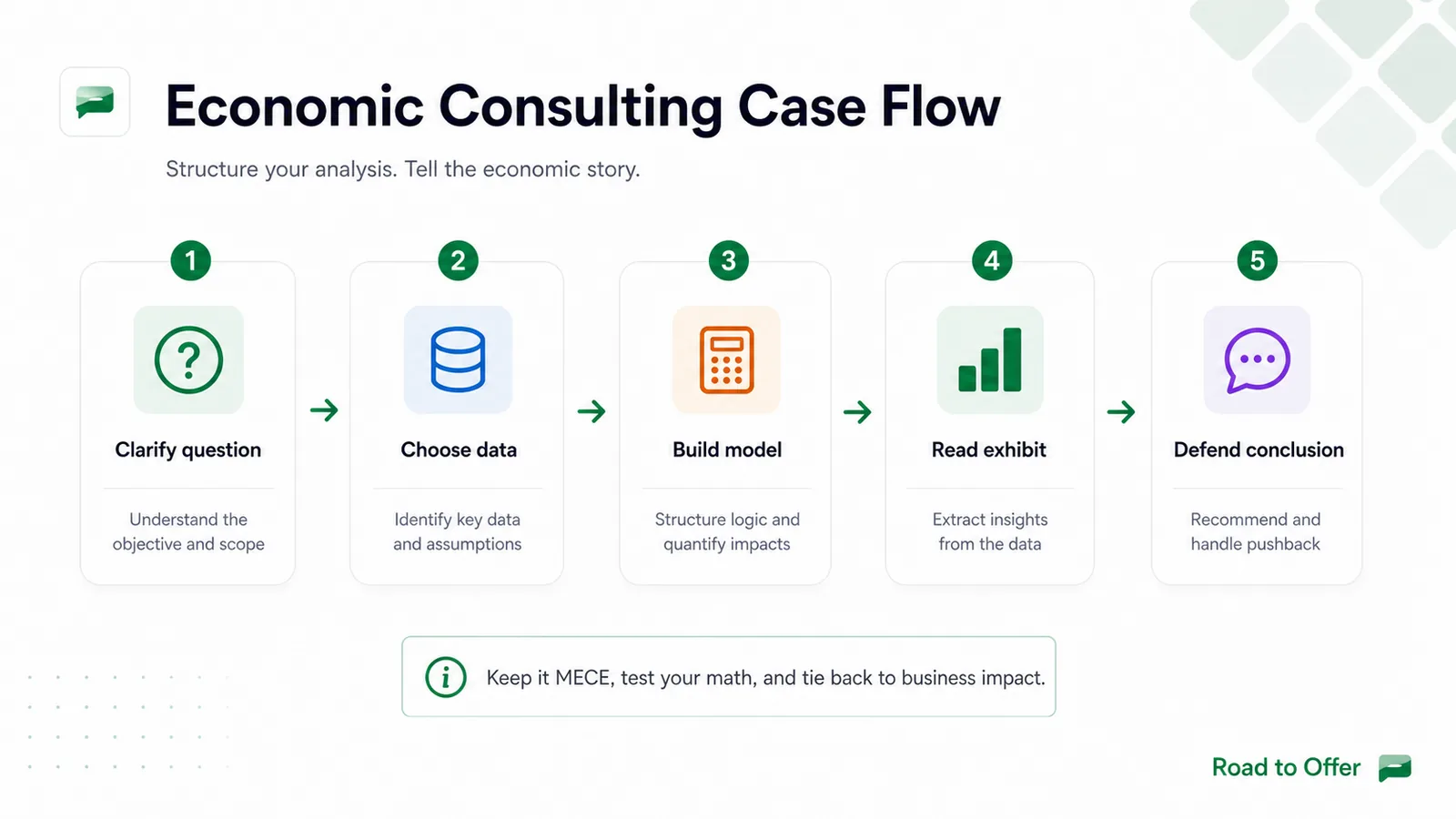
Antitrust case example: "Two competing widget manufacturers want to merge. The DOJ is reviewing whether this merger violates antitrust law. What economic analysis would you conduct to assess whether this merger creates anti-competitive harm?"
Strong answer framework:
- Market definition: Define the relevant product and geographic market using the hypothetical monopolist test (SSNIP test)
- Market concentration: Calculate HHI before and after the merger; flag if it exceeds DOJ thresholds (1800 HHI post-merger with delta > 100)
- Competitive effects: Assess unilateral effects (would the merged entity raise prices?) and coordinated effects (does the merger facilitate collusion?)
- Entry analysis: Could new entrants discipline a post-merger price increase?
- Efficiencies: Do cost savings outweigh anti-competitive harm?
This is economic analysis, not a strategy framework. The case interview frameworks complete guide is less relevant here than core microeconomics.
Securities damages example: "Shareholders in a class action allege that a company misled investors about its financial condition, causing the stock price to decline when the truth emerged. How would you calculate damages?"
Strong answer: Apply the event study methodology. Isolate the stock price movement attributable to the disclosure (vs. market-wide movement), apply a regression to separate the firm-specific effect, and multiply by shares outstanding. Discuss the "but-for" price concept: what would the price have been absent the fraud?
Key Economic Concepts for NERA Interviews
You should be able to discuss these fluently:
You don't need to be a PhD to discuss these. You need to be able to explain what they measure and why they're relevant in a particular context.
Practice this next: Pair economics review with graph drills for data interpretation and math drills for clean calculations under time pressure.
Behavioral Interview at NERA
NERA's behavioral questions are closer to academia than to consulting. Common themes:
The "why economic consulting vs. PhD or management consulting" question is important. Strong answers for economic consulting typically involve: interest in applied economics and real-world impact; preference for varied, project-based work over academic research; interest in the litigation and regulatory context that management consulting doesn't touch.
For broader behavioral prep, see our behavioral interview consulting guide: the STAR framework applies even if the content is more economics-focused.
Related Economic Consulting Firms
If you're targeting NERA, also look at:
- Analysis Group, similar positioning; slightly more PhD-dominant; strong in healthcare economics: see our Analysis Group case interview guide
- Charles River Associates (CRA), strong in antitrust and intellectual property damages, very similar to NERA: see our Charles River Associates case interview guide
- Cornerstone Research, securities litigation specialist, more focused than NERA: see our Cornerstone Research case interview guide
- Compass Lexecon, antitrust specialist, founded by key antitrust economists: see our Compass Lexecon case interview guide
- Bates White, boutique economic consulting with a similar litigation-support focus: see our Bates White case interview guide
All use similar interview formats emphasizing economic reasoning.
Practice quantitative case communication
Run a Road to Offer practice case, then use the feedback to tighten how you explain assumptions, calculations, and data-backed conclusions.
Sources and Further Reading (checked June 17, 2026)
- Hacking the Case Interview, NERA guide: hackingthecaseinterview.com/pages/nera-case-interview
- Wall Street Oasis NERA interview reports: wallstreetoasis.com/company/nera-economic-consulting/interview
- NERA open roles: nera.com/open-roles.html
- Management Consulted NERA guide: managementconsulted.com/nera-economic-consulting-interview
- Glassdoor NERA interview experience: glassdoor.com/Interview/NERA-Interview-Questions-E38370.htm
Frequently asked questions
Resources and related guides
- Practice for NERA in a real case interviewPractice
- Browse all free resourcesResource hub
- Analysis Group Case Interview: Process, Question Types, and How to Prepare (2026)Firm Specific · Mar 25, 2026
- AlixPartners Careers 2026: Turnaround Salary and Interview GuideFirm Specific · Sep 11, 2026
- Alvarez and Marsal Careers 2026: Restructuring Salary and Interview GuideFirm Specific · Sep 11, 2026
- Compass Lexecon Case Interview Guide 2026: Process, Cases & PrepFirm Specific · Apr 8, 2026