
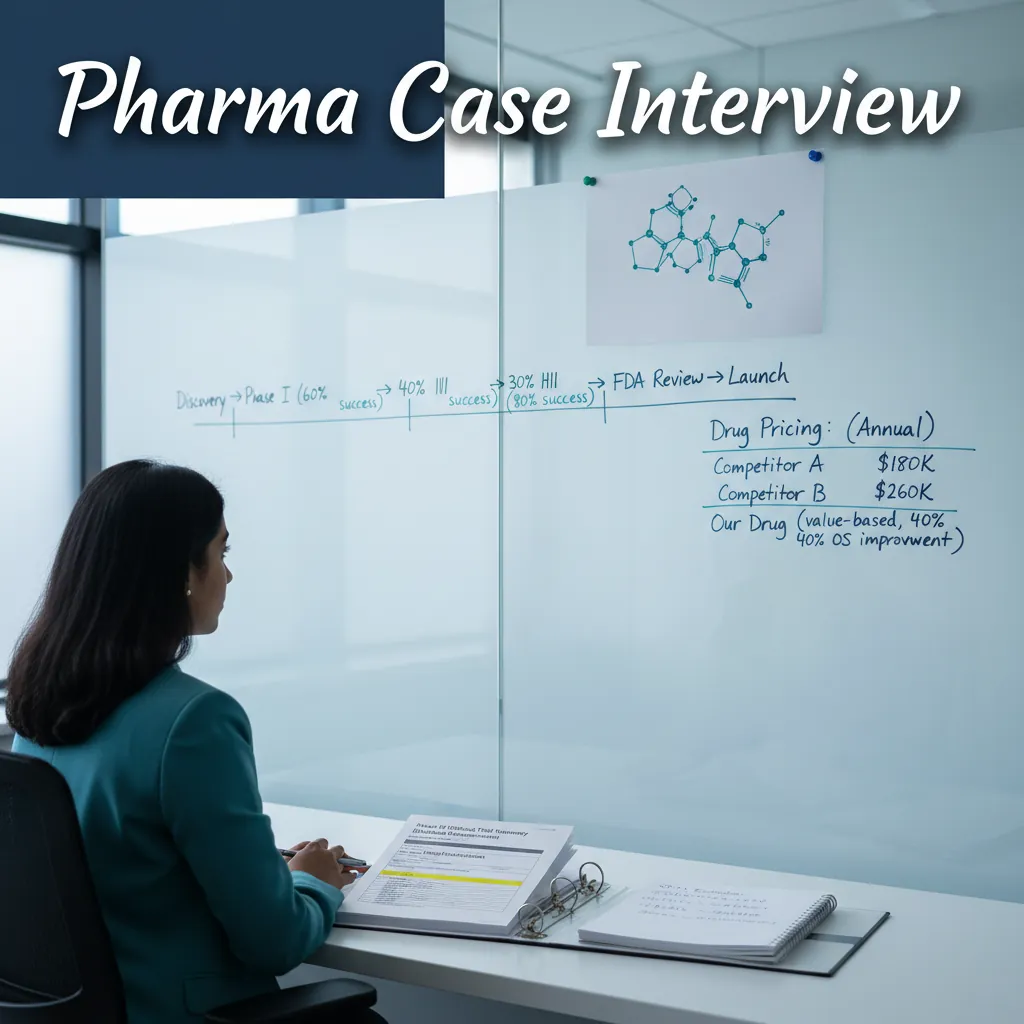
Pharma Case Interview: Drug Launch, Pipeline Valuation, and Pricing Strategy (2026)
Pharmaceutical case interviews cover drug launch strategy, pipeline valuation, pricing, and market access. Learn the pharma-specific framework and worked examples for MBB and life sciences firms.
The drug pricing case is one of the hardest problem types in consulting interviews—not because the math is complicated, but because the business model is unlike anything in other industries. A pharma company can spend $2 billion and 12 years developing a drug that fails in Phase III. If it succeeds, it has 10–15 years of patent exclusivity before generics destroy 90% of revenue overnight.
That context shapes every strategic decision. Here's how to navigate pharma cases.
The Pharma Business Model in 90 Seconds
If your target firms are L.E.K., ZS, Huron, IQVIA, or a dedicated biopharma practice, pair this guide with the broader life sciences consulting case interview guide. It connects drug launch, payer strategy, rNPV, and firm-specific expectations in one prep plan.
The pharma P&L is radically different from standard businesses:
| Stage | Time | Cost | Risk |
|---|---|---|---|
| Drug discovery | 2–4 years | $100–$500M | 90%+ failure rate |
| Phase I (safety) | 1–2 years | $20–$50M | ~40% failure |
| Phase II (efficacy) | 2–4 years | $100–$200M | ~50% failure |
| Phase III (large trial) | 3–5 years | $300M–$1B | ~30% failure |
| FDA review + launch | 1–2 years | $50–$200M | — |
| Total approved drug cost | 12–15 years | ~$2.6B (average, DiMasi 2016) | — |
The average approved drug costs approximately $2.6 billion to bring to market, according to a 2016 Tufts CSDD study. Once approved, it competes in a window of patent-protected exclusivity—typically 10–12 years from market launch before generic competition.
This explains why pharma drugs are expensive: the revenue from successful drugs must recoup the cost of the 9 out of 10 candidates that failed.
The Pharma Case Framework (5 Dimensions)
Framework
Pharma Case Framework
- 01
1. Clinical Profile
What does the drug do? What condition does it treat? How does it compare to standard of care on efficacy and safety? What are the clinical data (Phase II/III results)?
- 02
2. Patient Population & Market Size
How many patients have this condition globally / in the target market? What % are diagnosed and treated? What is the peak sales opportunity?
- 03
3. Payer & Reimbursement Landscape
Which payers cover this condition? What are the formulary dynamics? Will payers reimburse at the proposed price? What is the access strategy?
- 04
4. Competitive Positioning & Pricing
What existing treatments exist? What is the clinical differentiation? What pricing approach applies (value-based, competitor-based)? What is the price range?
- 05
5. Launch Execution
What does the sales force look like? How do we reach key prescribers (KOLs)? What is the launch sequence (markets, timing)? What are the main launch risks?
Drug Launch Strategy Case
The most common pharma case type. The question: "Our client has received FDA approval for a new drug. What should the launch strategy look like?"
Worked Example: Oncology Drug Launch
Case prompt: Your client is a large pharma company that has just received FDA approval for a first-in-class cancer immunotherapy for non-small cell lung cancer (NSCLC). The drug shows a 40% improvement in overall survival versus the current standard of care. The client wants to know: what price should it charge, and how should it launch?
Step 1: Clinical profile and differentiation
- Indication: NSCLC (2nd largest cancer type; ~250,000 new US diagnoses/year)
- Clinical differentiation: 40% OS improvement vs. current standard (pembrolizumab/Keytruda)
- This is significant—Keytruda is a $20B+/year drug; a 40% survival improvement is a major clinical advance
Step 2: Market sizing
- US NSCLC new cases: ~250,000/year
- % appropriate for immunotherapy (advanced/metastatic): ~40% = 100,000 patients
- Market penetration in Year 1 (new drug typically captures 5–15% in first year): ~8,000–15,000 patients
Step 3: Competitive pricing
| Competitor Drug | Annual Price | OS Improvement vs. Chemo |
|---|---|---|
| Keytruda (pembrolizumab) | ~$180,000/year | ~25% |
| Our drug | ? | ~35% (40% better than Keytruda) |
Value-based pricing logic: our drug delivers meaningfully better survival than Keytruda. Using a QALY-based approach: 40% OS improvement on 12-month median survival = ~5 additional months of life at cancer-adjusted quality. At $150,000/QALY, this supports a price premium of $75,000–$90,000 over Keytruda.
Recommended price: $240,000–$260,000/year, a 35–45% premium to Keytruda, anchored on the demonstrated clinical superiority.
Step 4: Revenue potential
Year 3 peak penetration estimate (15% market share): 15,000 patients × $250,000 = $3.75B peak annual revenue
Step 5: Launch execution priorities
- Payer access: Negotiate Tier 2 formulary placement with commercial insurers and obtain Medicare Part D coverage. Patient assistance program to reduce co-pays for uninsured/underinsured
- KOL engagement: Target top 200 oncology thought leaders with Phase III data; fund medical education and conference presentations
- Sales force: Deploy 300-person specialty oncology sales team focused on academic medical centers and cancer centers
- Launch market sequence: US launch first (largest and fastest reimbursement); Europe in Year 2 (market access negotiations take 12–18 months per country)
Pipeline Valuation Case
The second most common pharma case type: should a pharma company acquire a biotech company with a promising drug in development?
The core framework: Risk-Adjusted NPV (rNPV)
Pipeline drugs are valued by adjusting their peak sales potential for:
- Probability of approval (success rate at each development stage)
- Time to peak sales (discounted cash flows)
- Development cost remaining
Simplified formula: rNPV = (Peak annual sales × Margin × Patent exclusivity years × Probability of approval) − Remaining development cost − Acquisition premium
Example calculation:
A biotech has a Phase II oncology drug:
- Peak annual sales potential if approved: $2B
- Probability of Phase III success and approval: ~20% (industry average for oncology)
- Patent exclusivity remaining at launch: 10 years
- Remaining development cost: $600M
- Estimated operating margin: 50%
rNPV ≈ (20% × $2B × 50% × 10 years) = $2B Minus remaining development cost ($600M) = $1.4B base value Minus typical acquisition premium (30%) = maximum offer ~$1.8B
Market Access and Reimbursement
The "market access" question comes up in launch cases: how do we get payers to cover this drug?
The formulary tier system (US):
| Tier | Out-of-Pocket for Patient | Payer Priority |
|---|---|---|
| Tier 1 | Lowest ($5–$15 co-pay) | Generic preferred |
| Tier 2 | Moderate ($30–$60) | Preferred brand |
| Tier 3 | High ($60–$150) | Non-preferred brand |
| Specialty | Very high (20–30% coinsurance) | Specialty drugs |
Oncology and rare disease drugs are typically on specialty tier, meaning patients pay 20–30% coinsurance. A $250,000 drug means ~$50,000–$75,000 out-of-pocket annually. That's why patient assistance programs (co-pay cards, foundation grants) are essential launch components.
Key Pharma Terms for Interviews
| Term | Definition |
|---|---|
| NDA / BLA | New Drug Application / Biologics License Application (FDA submissions) |
| KOL | Key Opinion Leader—prominent physicians who influence prescribing behavior |
| QALY | Quality-Adjusted Life Year—unit for health economic value |
| Peak sales | Maximum annual revenue projected at market maturity |
| Patent cliff | Expiration of patent exclusivity → generic competition enters |
| Orphan drug | Drug for rare diseases (<200,000 US patients); gets faster FDA review and 7-year exclusivity |
| Co-pay assistance | Pharma-funded programs that reduce patient out-of-pocket costs |
| PBM | Pharmacy Benefit Manager—intermediaries who negotiate formulary placement |
Connecting to Firm-Specific Prep
Different firms weight pharma cases differently:
- ZS Associates: Heavy pharma/commercial analytics focus; expect quantitative pharma cases
- Simon-Kucher: Deep pricing strategy focus; pharma pricing cases are common
- L.E.K.: Pharma M&A and commercial due diligence; pipeline valuation cases
For the broader healthcare context, see healthcare case interview for coverage of hospitals, payers, and digital health cases.
Test Your Knowledge
Test yourself
1 / 3Question 1 of 3
A pharma company is pricing a new drug using value-based pricing. The drug delivers 0.8 incremental QALYs over the standard of care. The US payer threshold is $150,000/QALY. What maximum price does this analysis support?
Sources and Further Reading (checked March 25, 2026)
- Management Consulted — Pharma Case Interview Example: managementconsulted.com/pharma-case-interview-example
- Tufts CSDD Drug Development Cost Study: csdd.tufts.edu/news/drug-development-cost-study
- McKinsey — GlobaPharm Practice Case: mckinsey.com/careers/interviewing/globapharm
- PrepLounge — McKinsey Pharma Pipeline Case: preplounge.com/en/management-consulting-cases/mckinsey-pharma-pipeline-291
- ZS Associates Practice Case: zs.com/careers/hiring-process/case-interview-practice/practice-case-two
FAQ
Frequently asked questions
Keep reading
Related articles
Healthcare Case Interview: Framework, Key Questions, and Worked Examples (2026)
Healthcare case interviews require industry-specific thinking beyond standard frameworks. Learn the 5-part healthcare framework, key stakeholders, and worked examples.
McKinsey 7S Framework: How to Use It in Case Interviews (2026)
Master the McKinsey 7S framework for case interviews. Learn all 7 elements, Hard vs Soft S distinction, when to apply it, and a worked retail example.
Energy Case Interview: Oil & Gas Framework, Worked Example, and Prep Guide (2026)
Energy case interviews require a different cost structure map than standard cases. Master the upstream/midstream/downstream value chain, key metrics, and the transition framework that McKinsey, BCG, and Deloitte actually use.