
Brain Teaser Questions: consulting interview examples with worked solutions
Practice brain teaser questions with consulting-style examples, spoken solution patterns, answer rubrics, and targeted Road to Offer drills.
On this page
Brain teaser questions are useful for consulting prep only when you treat them as thinking drills, not riddles to memorize. The goal is to show calm structure under ambiguity: clarify the task, state assumptions, break the problem into parts, reason aloud, sanity-check the answer, and summarize the insight. The best practice prompts are not random trivia. They train the same muscles that show up in case interview problem solving: market sizing, mental math, creative brainstorming, prioritization, and synthesis. Use brain teaser questions to diagnose how you think under pressure, then route the miss into a targeted drill. If your answer collapses because you cannot frame the problem, drill structure. If the arithmetic gets messy, drill math. If you reach a reasonable answer but cannot explain the takeaway, drill synthesis.
For a consulting-specific view of puzzle-style prep, see consulting brain teasers.
Are brain teaser questions still useful for consulting interviews?
Classic interview puzzles are not the center of modern consulting preparation. Official firm pages tend to emphasize problem solving, case interviews, assessments, and structured interview conversations, not memorized riddles. McKinsey describes its process around personal experience, problem-solving interviews, assessments for many consulting roles, and sample business cases on its interviewing page. Bain similarly frames consultant interviews around working through a problem as part of the case interview process.
That does not make brain teaser questions useless. It means their value is diagnostic. A good prompt reveals whether you can slow down, define the task, organize messy information, and communicate a path forward. A weak answer usually reveals the opposite: guessing, silent calculation, fake precision, or a clever final answer with no visible reasoning.
The key caveat is simple: do not assume any named consulting firm currently asks a specific puzzle unless the claim comes from an official current source. Use puzzle practice as training for consulting reasoning, then graduate into full case interview questions.
Brain teaser questions by skill category
Use categories, not random lists. Each category below trains a different consulting skill.
Worked example: how to solve a brain teaser out loud
Prompt: A small service team is missing deadlines. You can change staffing, task routing, or customer intake, but you cannot change the product. How would you figure out the most likely bottleneck?
A strong spoken answer might sound like this:
I would first clarify what deadline means here: response time, completion time, or customer handoff. Assuming the problem is completion time, I would split the workflow into intake, assignment, execution, review, and delivery. Then I would look for where work piles up. If intake volume is stable but the queue grows after assignment, the issue is probably execution capacity or task complexity. If work waits before assignment, routing is likely the bottleneck. If completed work waits for review, staffing may not be the first fix.
I would test routing before adding people because a poor routing rule can make a staffed team look under-resourced. If specialists are overloaded while generalists are idle, I would redesign triage. If every role is overloaded, staffing becomes more plausible. My recommendation would be to measure queue buildup by workflow step, fix the step with the largest delay, and only add capacity if the delay remains after routing is corrected.
The answer works because it does not jump to a fix. It clarifies the metric, decomposes the system, tests alternatives, and ends with a decision rule. The final answer matters, but the visible process matters more. Silent calculation and answer-first behavior make even a correct conclusion sound fragile.
Answer rubric: how interviewers judge puzzle responses
Strong interview evaluation is usually based on consistent criteria, not vibes. The U.S. Office of Personnel Management explains that structured interviews use consistent questions and rating standards, which is a useful model for how to judge any problem-solving response. You should not assume every consulting firm uses the same rubric, but you can use a practical version for practice.
Common mistakes that make brain teaser answers sound weak
The most common mistake is treating the prompt like trivia. If you search your memory for the trick, you stop interviewing like a consultant. The fix is to say what you are trying to prove, then build a path.
Another mistake is guessing without structure. If the prompt asks why demand changed, do not list every possible reason. Bucket the answer into customer demand, pricing, channel, product availability, and competitor response. Then prioritize.
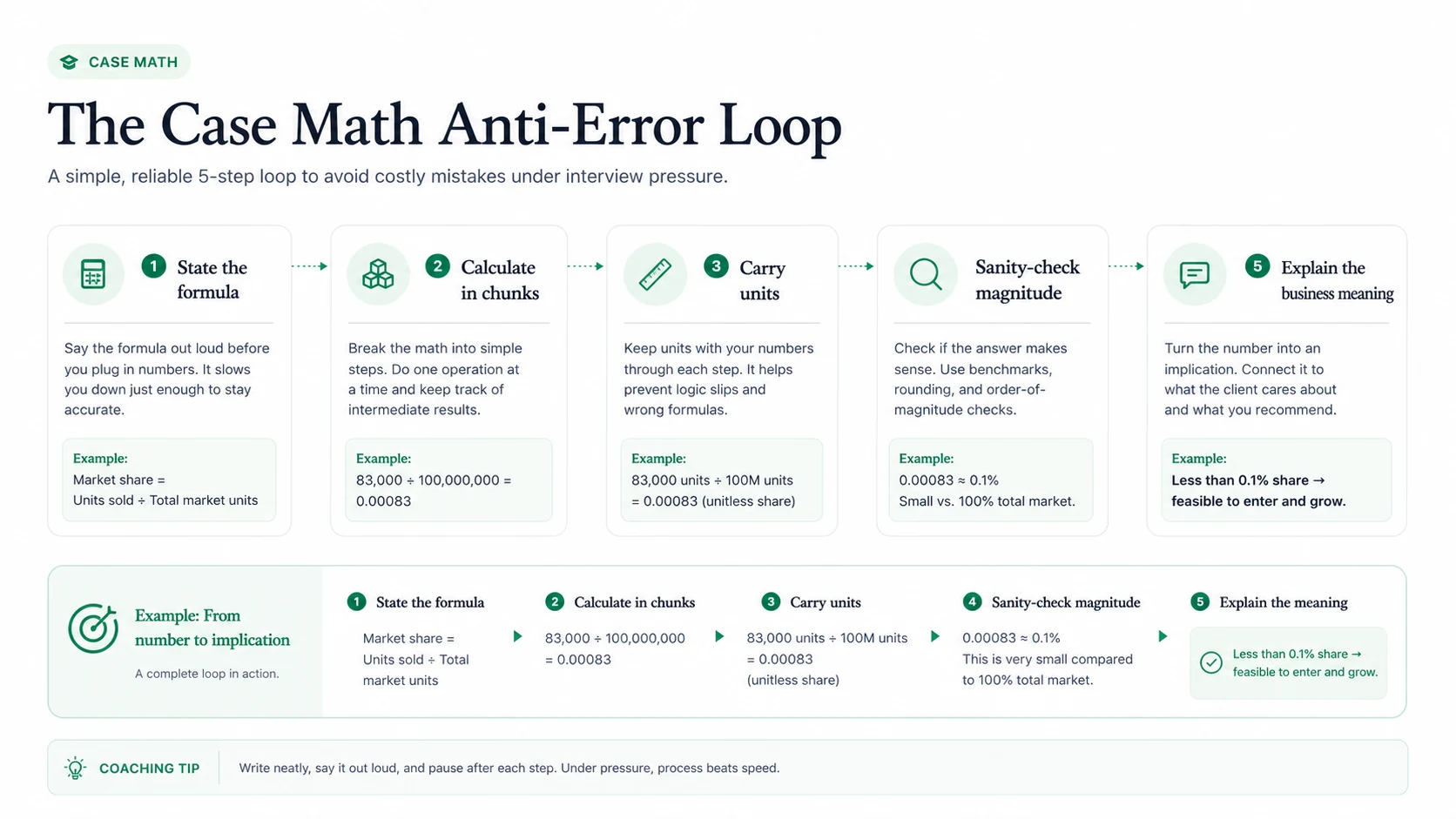
Fake precision is especially risky in estimation prompts. A brain teaser that behaves like market sizing does not reward invented exactness. It rewards clear assumptions, reasonable rounding, and a sanity check. If your setup breaks, recover directly: I think this path is getting too detailed, so I will step back and use a simpler driver-based estimate.
A final weak pattern is ending without synthesis. The interviewer should not have to infer your point. Close the loop: the constraint appears to be routing, not total staffing, so I would test triage rules before adding people.
If a miss exposes structure, use a structure drill. If it exposes arithmetic, use a math drill. If your ideas are thin, use a brainstorming drill. If the ending trails off, use a synthesis drill before collecting more puzzles.
Practice drill plan for brain teaser questions
A practice drill should turn each attempt into a specific improvement. Pick a category, answer aloud, score yourself with the rubric, then choose the Road to Offer drill that matches the miss pattern.
Use logic prompts when you need cleaner decomposition. Use estimation prompts when you need stronger assumptions and market sizing habits. Use mental arithmetic prompts when your calculation setup slows you down. Use creative prompts when your brainstorming is either too narrow or too messy. Use synthesis prompts when you can solve but cannot land the answer.
Keep the loop focused: prompt, spoken answer, self-score, targeted drill, repeat. When isolated puzzle skills start holding together, move into full case practice through the broader case interview prep guide. Brain teasers are useful, but the real test is whether structure, math, creativity, and synthesis work together inside a complete case.
Brain teaser question examples to practice next
Use these prompts as practice, not as memorization material.
Logic and constraints:
- A restaurant has slow service only during weekday lunch. How would you isolate whether the issue is kitchen capacity, ordering flow, or staffing mix?
- A delivery team misses deadlines even though total capacity seems sufficient. What constraints would you test first?
- A software onboarding process loses users after setup. How would you map the failure points?
Guidance: speak in steps. Define the goal, list constraints, isolate the bottleneck, then name the next test.
Estimation and market sizing:
- Estimate demand for a new commuter coffee subscription in a city.
- Estimate how many charging stations a university campus might need.
- Estimate whether a small gym should add more lockers or more equipment.
Guidance: build from drivers, not memory. Use simple assumptions, round cleanly, and sanity-check the result.
Creative brainstorming:
- A meal delivery company wants more repeat orders without discounting. What levers would you test?
- A museum wants to increase weekday attendance. What ideas would you prioritize?
- A B2B software firm wants faster trial conversion. What could change in onboarding?
Guidance: bucket ideas before listing them. Prioritize the few that are easiest to test and most tied to the objective.
Synthesis:
- Your analysis shows demand is healthy but capacity is constrained. What is the recommendation?
- Your estimate suggests the market is attractive but customer acquisition is uncertain. What would you do next?
- Your constraint analysis shows the issue is handoff quality, not total workload. What should the team change?
Guidance: finish with the answer, the reason, and the next action. The goal is not to know every puzzle. The goal is to sound structured when the prompt is unfamiliar.
Sources and Further Reading (checked 2026-05-22)
- McKinsey & Company - Interviewing at McKinsey
- Bain & Company - Our Hiring Process
- Boston Consulting Group - Consulting Case Study Interview Preparation
- Boston Consulting Group - Consulting Interview Process
- U.S. Office of Personnel Management - Structured Interviews
- Google re:Work - Hiring & Onboarding
FAQ
Frequently asked questions
Keep reading
- Case Interview Formulas: Cheat Sheet for Profitability and Math (2026)Math And Quant · May 1, 2026
- Case Interview Math Practice: 30 Drills, Questions, and SolutionsMath And Quant · Feb 6, 2026
- Case Interview Math Tips: A Calm, Repeatable ProcessMath And Quant · May 1, 2026
- ROI, NPV & Payback Period for Case Interviews (2026)Math And Quant · Mar 20, 2026