
How to Use Claude for Case Interview Prep (2026)
Claude beats ChatGPT for long sensitivity chains, full-case context, and reliable math. Six copy-paste prompts plus when to use Claude over ChatGPT.
On this page
Claude can be especially useful for three specific case prep tasks: long sensitivity calculation chains, pasting full case prompts and drilling the math inside, and consistent reasoning across multi-step problems. ChatGPT is often more convenient for high-volume practice, Voice Mode, and rapid prompt iteration. The full stack: Claude for hard sensitivity, ChatGPT for daily volume, and Road to Offer's free tier for the weekly graded case. Six copy-paste Claude prompts plus when to use which tool.
When Claude Beats ChatGPT for Case Prep
Both Claude and ChatGPT can run case interviews with the right prompts. The reason to add Claude isn't "better than ChatGPT in general." It is about specific moments where Claude's design wins.
The three Claude advantages that matter for case prep: long-context handling, multi-step math support (sensitivity, decomposition, chained calculations), and reasoning that can hold intermediate values across many steps. Any AI can still drop digits or swap units in long math chains, so treat the output as a practice scaffold and verify the numbers.
Which Claude Model Should You Use for Case Prep?
Start with the model your plan includes, then move up only when a task needs deeper reasoning. Model descriptions come from Anthropic's models overview and model selection guide; plan access comes from Claude pricing, which names model families without version numbers.
Claude models as of September 2026
Six Copy-Paste Claude Prompts That Beat Generic Practice
Prompt 1: Long Sensitivity Math Chain
Here is a profitability scenario. Revenue $1.2 billion, cost base $940 million, three cost drivers (labor 45 percent, materials 30 percent, overhead 25 percent). Drill me on what happens to operating margin if: labor rises 7 percent, materials rise 12 percent, overhead falls 4 percent. Walk me through one chained calculation at a time. After each, ask me to state my arithmetic and the business meaning. Grade strictly. Penalize digit drops, unit swaps, or skipped sanity checks.
This is the kind of multi-step math where AI tools can lose accuracy. Claude is useful here because it can keep more context in view, but you should still check every intermediate value.
Prompt 2: Paste Full Case Prompt and Drill the Math
I am pasting a full case prompt below. Read the entire case. Identify every place a candidate would do math (revenue calculations, profitability decomposition, breakeven, market sizing, sensitivity). Drill me on each math moment one at a time. After each, grade my equation, units, and business interpretation. Be strict. [Then paste a 1-page case prompt from a casebook here.]
This uses Claude's long-context window. ChatGPT can do this on shorter prompts but loses fidelity on longer pastes.
Prompt 3: McKinsey PEI Story Refinement
Act as a McKinsey partner running the Personal Experience Interview. I am pasting my full personal impact story below. Grade it against three criteria: clarity of my specific role, evidence of impact under resistance, concrete measurable outcome. After grading, ask one probing follow-up question a real McKinsey partner would ask. Tell me which criterion was weakest and why. [Paste 300 to 500 word story.]
Claude's larger context handles long stories without summarizing or losing detail.
Prompt 4: Multi-Driver Profitability Decomposition
Run a profitability case for a regional airline. The decline is 12 percent year over year. Decompose the problem MECE across revenue and cost branches with at least 3 sub-drivers each. After I propose a structure, push back on any branch that overlaps another. Then walk me through the math one driver at a time. Grade hypothesis-first ordering at the end.
Prompt 5: Market Entry with Long Industry Context
Here is a 2-page industry primer on the U.S. electric vehicle market. Read it fully. Then run a market entry case for a European luxury car brand considering this market. Use facts from the primer in your follow-up questions. Drive the structure. Grade my hypothesis quality and risk acknowledgement. [Paste primer content.]
Claude's context window lets you ground the case in real industry data instead of generic prompts.
Prompt 6: Synthesis Pressure Test
Here is the case prompt and my final recommendation [paste both]. Act as the McKinsey Director judging this synthesis. Tell me three weaknesses in my recommendation: did I lead with the answer, are my supports load-bearing, did I acknowledge a real risk, is the next step actionable. Be strict. Then rewrite the synthesis as a top McKinsey candidate would deliver it.
Practice with AI feedback
Run one scored case rep, then use Claude for targeted fixes instead of generic prompt loops.
Claude vs ChatGPT: Pick the Right Tool for Each Task
Use Claude for the hard, long, multi-step tasks. Use ChatGPT for the fast, repetitive, voice-driven daily volume. See the ChatGPT prompt guide for daily-volume prompts.
Where Claude Falls Short
Claude is excellent for long-context, multi-step problems. It isn't perfect.
The three Claude weak spots: no Voice Mode (delivery feedback requires ChatGPT or Road to Offer's Voice Mode), free tier message limits (heavy users hit caps quickly), and slower rapid iteration (Claude takes a moment longer to respond than ChatGPT, which matters during timed drills).
The fix is a multi-tool stack: ChatGPT for voice and volume, Claude for hard problems and long context, Road to Offer's free tier for the weekly graded case. See the MBB.AI alternatives guide for purpose-built platforms and best AI drill platform for MBB prep for the drill stack.
A Working Claude Routine for Hard Cases
The routine for candidates already comfortable with daily ChatGPT drills who want Claude for the harder problems:
Claude Weekly Hard-Case Routine
- 01
Monday. Prompt 1: Long sensitivity math chain (15 minutes)
- 02
Wednesday. Prompt 2: Paste a full case prompt and drill embedded math (20 minutes)
- 03
Friday. Prompt 4: Multi-driver profitability decomposition (15 minutes)
- 04
Weekend PEI. Prompt 3: PEI story refinement against McKinsey criteria (10 minutes per story)
- 05
Weekly graded case. One full case on Road to Offer's free tier for AI-graded feedback
That stack covers the high-leverage Claude moments without burning daily message limits. ChatGPT or Road to Offer's math drills handles the daily drill volume separately.
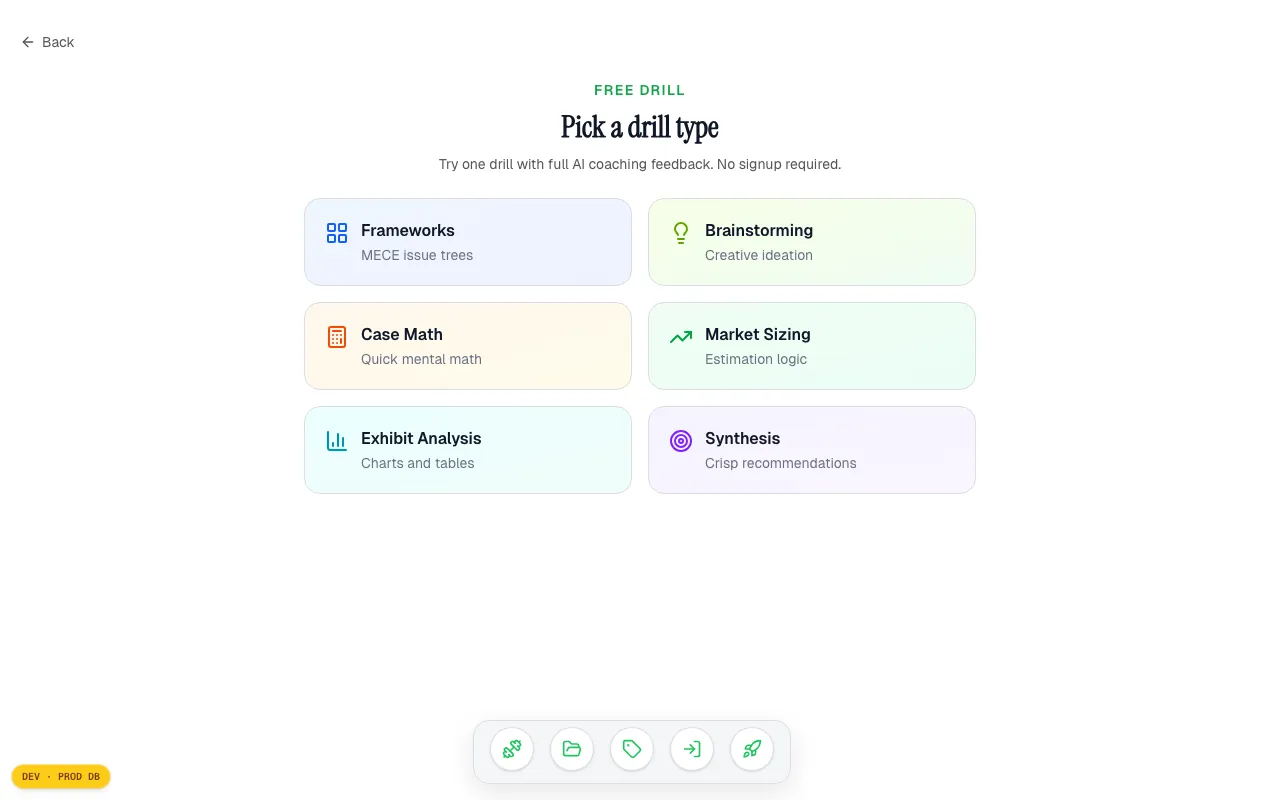
Run a timed case math rep right now from the Road to Offer drill engine. Answer a real prompt and get AI-scored feedback. Free accounts include 5 drills per day for the first 3 days after signup.
A New Trend: AI Collaboration as an Interview Skill
The Guardian reported in January 2026 that McKinsey is testing AI-assisted interview components using its internal AI tool Lilli, with candidates partly evaluated on how they collaborate with AI during problem solving. That changes Claude prep priorities.
The skill firms now test is judgment when working with AI: spotting weak suggestions, synthesizing them into a coherent answer, using AI as a thinking partner without losing structure. To build that skill with Claude, deliberately ask for a weak framework, critique it out loud, and explain which parts to keep. The meta-skill (filtering AI output under pressure) transfers directly to AI-assisted interview formats.
Verdict
Claude is useful for long sensitivity chains, full-case context, multi-driver profitability decomposition, and PEI story refinement. ChatGPT is often better for high-volume drill practice, Voice Mode, and rapid iteration. Most candidates should use both: Claude for hard problems three times a week, ChatGPT daily for volume, and a purpose-built tool weekly for graded full cases.
Picking one AI and ignoring the other leaves drill volume or sensitivity reliability on the table. Use both. Cheaper than two paid subscriptions and complementary by design.
Sources and Further Reading (checked June 17, 2026)
- Claude homepage: claude.ai
- ChatGPT homepage: chatgpt.com
- Road to Offer (purpose-built case prep): roadtooffer.com
- Road to Offer math drills: start a math drill
- The Guardian on McKinsey testing AI-assisted interviews with Lilli: theguardian.com/business/2026/jan/14/mckinsey-graduates-ai-chatbot-recruitment-consultancy
- Anthropic models overview (checked September 15, 2026): platform.claude.com/docs/en/about-claude/models/overview
- Anthropic, choosing a model (checked September 15, 2026): platform.claude.com/docs/en/about-claude/models/choosing-a-model
- Claude plans and model access (checked September 15, 2026): claude.com/pricing
Run the weekly graded case Claude can't deliver
Road to Offer's free tier includes 1 graded case plus free daily drills.
Related Guides
Frequently asked questions
Resources and related guides
- Run a real case interviewPractice
- Browse all free resourcesResource hub
- How to Use ChatGPT for Case Interview Prep (2026)Getting Started · May 8, 2026
- Which Free AI Tools Are Best for Case Interview Prep in 2026?Getting Started · May 8, 2026
- Case in Point Book Review (2026): 12th Edition, PDF & AlternativesGetting Started · Apr 1, 2026