
What Is Consulting? A Plain-English Definition (2026)
Consulting means getting paid to solve business problems you didn't cause. Here's what consultants actually do, who hires them, and what it pays.
On this page
The meaning of consulting in 2026: being paid to analyze and solve a business problem that isn't your own. A company brings in an outside expert because its internal team lacks the specialized knowledge, analytical frameworks, or objectivity to solve it themselves. Consultants are grouped into strategy firms like McKinsey, BCG, and Bain (who advise on the highest-stakes CEO and board decisions), management consultancies handling organizational and operational change, and IT consultancies implementing new technology and systems, the last of which, according to IBISWorld, generated over $600 billion in US revenue in 2022 alone, making it the largest consulting category by revenue. First-year MBB analysts earn $110,000 to $150,000 in total compensation, and most leave after two to three years for private equity, corporate strategy, or an MBA. That's the definition. Everything else (the prestige, the hours, the jargon) is downstream of that simple fact.
What Consultants Actually Do Day-to-Day
The Hollywood version of consulting is a partner walking into a boardroom, drawing on a whiteboard, and declaring the answer. The reality is more spreadsheet than cinematic.
After reviewing 200+ consulting job descriptions and accounts from analysts across McKinsey, BCG, Bain, and Deloitte, the day-to-day breaks down into roughly four buckets.
Data gathering and analysis. Junior consultants spend a significant portion of their time building Excel models, running market sizing analyses, mining client databases, and doing primary research, which means calling industry experts, surveying customers, or interviewing frontline employees. The data doesn't arrive pre-structured. Part of the job is deciding what questions to ask and what data actually matters.
Slide-building. PowerPoint and Excel are the two primary deliverable formats in consulting. A junior analyst may spend three to five hours a day building and revising slides. Not because consultants love decks, but because the client's CFO and board need a format they can act on. A good consulting slide makes a single point clearly, supported by one chart and a headline that states the insight: not just "Revenue Trends" but "Revenue declined 12% in Q3, driven entirely by SMB segment churn."
Team and client meetings. Most consulting projects run a daily stand-up to track workstreams, and one to two structured client check-ins per week. Senior consultants spend more time in these meetings; analysts spend more time doing the work that feeds them. When a project reaches a key milestone (usually at 30%, 60%, and 90% completion) the team presents interim findings to the client and adjusts based on feedback.
Hypothesis testing. This is the intellectual core of consulting that separates it from research. Consultants don't just gather data and summarize it. They start with a hypothesis ("the client's gross margin problem is a pricing issue, not a cost issue") and deliberately try to disprove it. If the data holds up, the hypothesis becomes the recommendation. If it doesn't, they revise and test again. This structured approach to problem-solving is what the case interview is designed to screen for.
A typical project lasts six to twelve weeks and ends with a final presentation and implementation roadmap. Whether the client actually follows through on the recommendations is, famously, not the consultant's problem. That tension between advice and execution is one of consulting's defining paradoxes.
The Main Types of Consulting
Consulting is not one industry; it's several, loosely grouped under the same label. The work, culture, and career trajectory differ substantially across types. Strategy consulting is only one branch; what is strategy consulting explains that work, its firms, and its pay before you compare firm categories.
Consulting firms cluster into five recognized tiers, each with different clients, work, and career implications:
For more detail on each type, see our guide on types of consulting firms.
Strategy Consulting
This is the category most people mean when they say "consulting." Strategy consultants advise C-suites and boards on the highest-stakes decisions: Should we enter the Brazilian market? Should we acquire this competitor or build the capability internally? Why has our core business been losing share for three years?
The defining characteristic is that the work operates at the level of decisions that change the company's direction. Projects are typically shorter (six to twelve weeks), the pace is intense, and the deliverable is a recommendation, not a built product or an implemented system.
The flagship firms are McKinsey & Company, Boston Consulting Group (BCG), and Bain & Company, collectively called MBB. Roland Berger, Oliver Wyman, and Strategy& (PwC) operate in the same tier. These firms recruit almost exclusively from top universities and MBA programs, and the case interview is their primary screening mechanism.
Management Consulting
Management consulting is broader. It covers organizational design, talent management, change management, and operational improvement: everything from restructuring a leadership team to redesigning a procurement function. The Big 4 firms (Deloitte, PwC, EY, KPMG) and Accenture dominate this space, along with Kearney, Alvarez & Marsal, and dozens of boutiques. For more on how these firms compare, see our management consulting firms ranking.
IT and Technology Consulting
IT consulting is, by revenue, the largest consulting category in the United States. According to IBISWorld data, the US IT consulting industry generated over $600 billion in revenue in 2022, roughly three times the size of the strategy and management consulting market combined.
Work includes selecting and implementing enterprise software (SAP, Salesforce, Oracle), managing cloud migrations to AWS or Azure, building cybersecurity programs, and advising on AI adoption. Accenture, IBM, Capgemini, and Infosys are the dominant players. Day-to-day work is more implementation-heavy and less hypothesis-driven than strategy consulting.
Operations Consulting
Operations consultants focus on making things run more efficiently: supply chains, manufacturing processes, procurement, logistics (see how a supply chain case interview tests exactly this, with a worked resilience example). A manufacturing client experiencing rising production costs might hire an operations consulting team to identify waste, renegotiate supplier contracts, and redesign factory floor workflows. Firms like McKinsey Operations, Oliver Wyman's operations practice, and specialized boutiques like Proxima (procurement) operate here.
Illustrative example: a logistics company working with an operations consultancy meaningfully cut delivery times after consultants introduced real-time tracking systems and automated inventory management, roughly the order of gains consultancies commonly cite for this kind of intervention. The internal team had been working toward that result for two years without success.
Financial Advisory Consulting
This covers M&A due diligence, restructuring, valuations, and post-merger integration. Deloitte Financial Advisory, AlixPartners, FTI Consulting, and the Big 4's deal advisory arms are central players. The work is quantitatively intensive and often tied to live transactions with hard deadlines. It's distinct from investment banking: financial advisors advise on decisions; bankers execute them.
Who Hires Consultants and Why
Companies hire consultants for three core reasons, and all three involve a gap between what they need and what they have internally.
Capability gaps. A fast-growing fintech startup scaling toward a Series D doesn't have an in-house team that's restructured a financial reporting function before. A mid-sized manufacturer evaluating an acquisition hasn't built the M&A due diligence muscle. Consultants fill these capability gaps faster than hiring a full-time expert, and without the long-term cost.
Objectivity. Internal teams are embedded in politics, history, and relationships. A VP of Operations can't easily tell the CEO that a flagship initiative is destroying value, but an outside team can. This is why McKinsey's "findings" sometimes match what internal leaders already believed but couldn't say publicly. The consultant's role is sometimes to give political cover to a decision that's already been made.
Scale and speed. Whether a project requires six analysts for six months or 100 consultants for one month (common in post-merger integration work), consulting firms can staff up quickly. Hiring permanent employees for temporary work is economically irrational; consulting is the alternative.
The companies that hire consultants span the full economy. Fortune 500 corporations hire MBB for strategy reviews. Governments hire Deloitte and KPMG for regulatory and operations work. Private equity firms hire consultants during due diligence and after acquiring a portfolio company. Mid-market companies hire boutiques for specific functional problems. According to Runn's 2026 industry analysis, there are over 700,000 management consulting firms worldwide, which tells you the demand is distributed, not concentrated.
One pattern stands out: companies hire consultants most aggressively during transitions, such as mergers, leadership changes, market entry, and strategic pivots. Stable, well-run organizations with capable internal teams use consultants less. The consulting engagement model implicitly assumes the client is at an inflection point.
How Much Do Consultants Earn
Consulting compensation is a function of firm tier, level, and geography. The numbers below reflect 2025-2026 US compensation.
McKinsey data specifically: Business Analysts earn a base of approximately $112,000 with performance bonuses bringing total first-year compensation to $150,000–$170,000. Associates (post-MBA) earn a base of approximately $192,000, with total compensation reaching $260,000–$270,000 including bonuses.
For complete salary data by firm, level, and geography (including European figures and bonus breakdowns) see the full consulting salary guide.
One important context: consulting salaries include compensation for hours. Consulting analysts regularly work 55–75 hours per week. On an hourly basis, that $110,000 analyst salary at MBB may be comparable to a $75,000 salary at a company where a 40-hour week is standard.
How to Get Into Consulting
The path into consulting is narrow and well-defined, which makes it both competitive and learnable.
At top-tier firms, recruiting flows through two primary channels: undergraduate recruiting at target schools (think Ivy League, Oxbridge, IIT, and a small list of other universities each firm targets by name) and MBA recruiting from a similarly short list of programs. Off-cycle and experienced-hire recruiting exists but is far less predictable.
The interview process has two components. The behavioral interview tests fit, communication, and your ability to tell a coherent story about why you want this career. The case interview tests structured problem-solving under pressure: your ability to break down an ambiguous business problem, identify what matters, and reason through to a defensible recommendation.
Most candidates underestimate how much the case interview can be learned. It has a structure. There are patterns. Firms use similar problem archetypes across cases. Deliberate practice (not just reading frameworks, but practicing live cases with feedback) is what moves candidates from the reject pile to the offer pile. The consulting career path article covers the full trajectory from undergrad recruiting through partnership. For a step-by-step breakdown of the application and prep process, see how to get into consulting.
Is Consulting Right for You?
Consulting is genuinely excellent for some people and genuinely bad for others. The honest version skips the recruiting pitch.
The case for consulting is real. You get accelerated learning. Two to three years in consulting exposes you to more business models, executive decision-making, and structured analysis than most people see in a decade of corporate work. The alumni network is dense and valuable. The exit opportunities (into private equity, corporate strategy, startups, and operating roles) are consistently strong. Consulting exit opportunities average better than most comparable early-career paths.
The case against is also real. The hours are long. 50 to 80 hours per week is industry standard, and project crunches push beyond that. Travel is substantial at most firms, often meaning Monday-Thursday on the road. The work can be repetitive: building similar financial models and slide structures across engagements, regardless of how interesting the underlying business problem is. The promotion model at most firms is up-or-out, meaning you advance or you leave, with limited room for lateral movement.
There's also a version of consulting that doesn't suit a certain type of person: the implementer. If you find it frustrating to give a recommendation and then hand it to the client without seeing it through, consulting will wear you down. The consultant's engagement ends at the slide deck. Someone else does the messy work of making the change happen.
A few diagnostic questions worth asking honestly:
- Do you find it energizing to work on a different industry or business every few months, or do you want deep domain expertise?
- Can you do excellent work at 70 hours per week, sustainably, for two to three years?
- Are you comfortable with ambiguity: being handed a question that doesn't have an obvious answer and expected to produce a structured recommendation in six weeks?
- Do you want to build something, or do you want to figure things out?
If the first three answers are yes and the fourth answer leans toward "figure things out," consulting is likely a good fit. If you want to build, look at startups or product roles after a consulting stint.
For candidates weighing Big 4 consulting versus MBB, the differences in work type, culture, and exit trajectory are meaningful, and the recruiting process is substantially different.
Before choosing a path, compare the firm models: strategy, implementation, technology, operations, and specialist firms each interview differently.
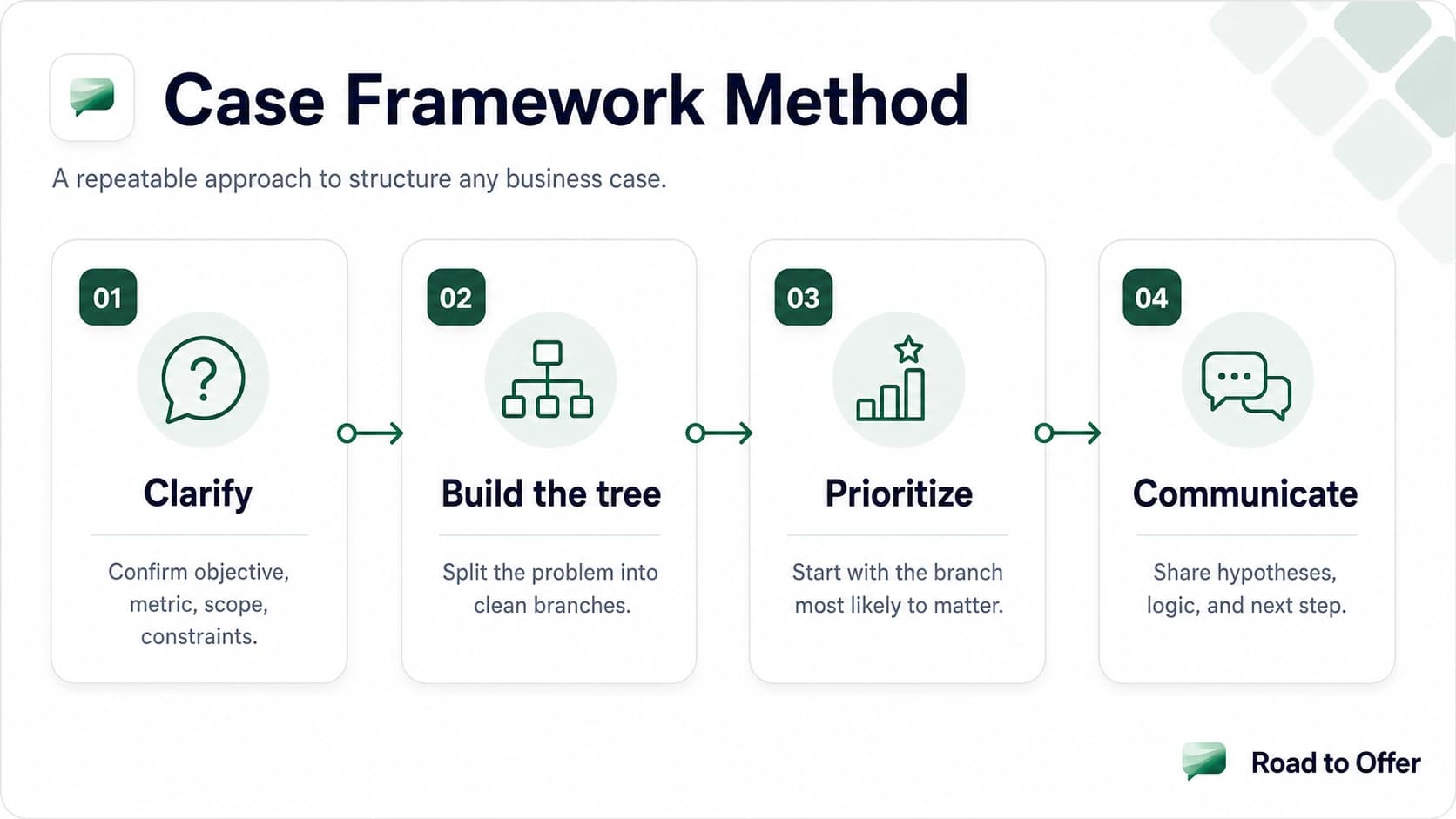
Learn the case method
One dense lesson, each step linked to the drill that trains it.
Frequently asked questions
Resources and related guides
- Practice a real case interviewPractice
- Browse all free resourcesResource hub
- Consulting Exit Opportunities: Top Career Paths After McKinsey, BCG, and Bain (2026)Getting Started · Mar 20, 2026
- Consulting Salary by City 2026: NYC, SF, London + 5 MoreGetting Started · Apr 8, 2026
- Consulting vs Investment Banking: Salary, Hours, Exit Opps, and How to Choose (2026)Getting Started · Mar 20, 2026
- Day in the Life of a Management Consultant: Schedule & HoursGetting Started · Mar 15, 2026